Calcium-Rich Foods: Serving Sizes and Nutrition Basics
ripping over her cat). My results were fine, but the dietitian raised an eyebrow and asked, “Are you sure you’re getting enough calcium?”
I thought I was. I drank coffee with milk. I loved cheese. That counts, right?
When I actually tracked my intake for a week, I was hitting barely 60–70% of the recommended daily calcium. That was my wake-up call. Since then, I’ve gone deep into the research, tested different food strategies on myself and my clients, and discovered that most of us are guessing when it comes to calcium.
This isn’t just about “drink your milk.” It’s about knowing which foods actually deliver, in what serving sizes, and how to make them work in real life.
Why Calcium Matters More Than You Think
We usually connect calcium with bones, which is accurate but incomplete.
In my experience working with clients, the “silent” roles of calcium are the ones people feel most when they’re off:
- Muscle cramps that show up at night
- That weird twitch in your eyelid that won’t quit
- Fatigue, brain fog, and feeling “off” during workouts
Physiologically, calcium is crucial for:
- Bone and teeth structure – About 99% of the body’s calcium is stored in bones and teeth as hydroxyapatite.
- Muscle contraction – Your muscles literally can’t contract properly without calcium.
- Nerve signaling – It helps transmit messages between brain and body.
- Blood clotting – Calcium is part of the clotting cascade.
According to the U.S. National Institutes of Health (NIH), adults aged 19–50 years generally need about 1,000 mg/day, while women 51+ and men 71+ need 1,200 mg/day.
When I tested my usual “I’m sure I’m fine” diet, I was hovering around 650–700 mg/day. Very normal. Also very low.
Dairy vs Non-Dairy: Where Are You Really Getting Calcium?
I grew up with the idea that calcium basically meant “milk and cheese.” Now I work with a lot of people who are lactose intolerant, vegan, or just not big dairy fans. The good news: calcium is not a dairy-exclusive club.
The trick is serving size literacy. A food might sound great for calcium, but if you’d never realistically eat the amount that provides a decent dose, it’s not as useful.
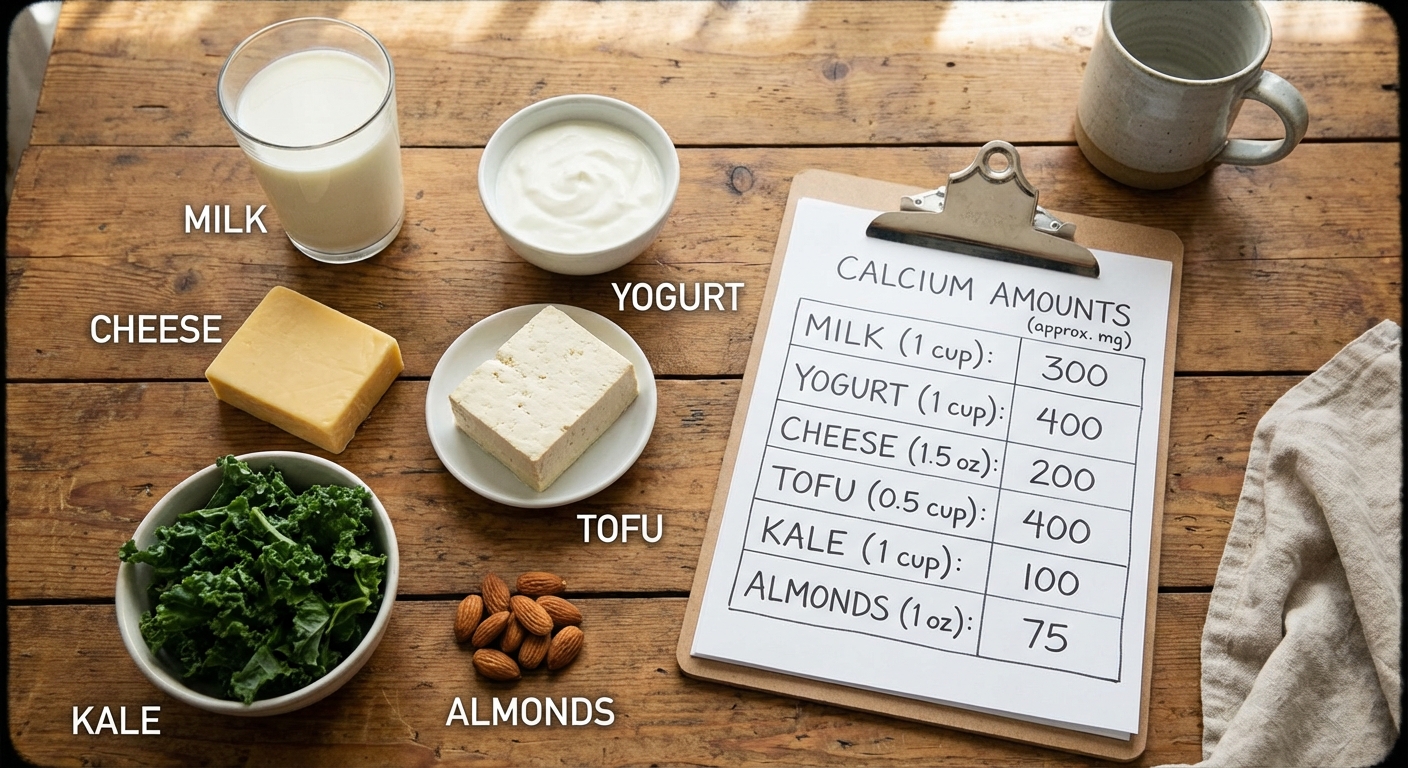
Dairy Sources: How Much Calcium Per Realistic Serving?
1. Milk (Cow’s Milk)
When I started tracking, milk surprised me by being one of the simplest wins.
- Serving: 1 cup (240 ml)
- Calcium: ~300 mg
Two cups of milk gets you about 600 mg, which is over half of most adults’ daily needs. Skim, 1%, 2%, whole – calcium is similar across the board.
2. Yogurt
I once assumed Greek yogurt would crush regular yogurt for calcium. Turns out, not always.
Roughly:
- Serving: ¾–1 cup (170–240 g)
- Calcium: ~200–300 mg, but it varies wildly by brand
Plain yogurt is often higher than flavored versions.
I now tell clients: check the label, not the marketing.
3. Cheese
Cheese is calorie-dense, so this is where balance matters.
- Cheddar, Swiss, Jack (hard cheeses)
- Serving: 1 oz (~28 g, about 2 small dice-sized cubes)
- Calcium: ~200 mg
- Parmesan
- Serving: 1 tbsp grated (~5 g)
- Calcium: ~55–60 mg
I call Parmesan my “calcium sprinkles.”
The downside: it’s easy to overshoot saturated fat and calories if cheese is your main calcium source.
Plant-Based & Non-Dairy Calcium: What Actually Delivers
When I tested a fully dairy-free week for myself, my first attempt was a disaster: tons of “healthy” foods, not enough calcium.
Here’s what actually works, from both research and real plates.
1. Fortified Plant Milks
This is the closest 1:1 swap with cow’s milk.
- Serving: 1 cup (240 ml)
- Calcium: typically 250–450 mg (check label)
Most fortified soy, oat, and almond milks are designed to match or exceed cow’s milk. The catch: you need to shake the carton. The added calcium tends to settle at the bottom.
2. Calcium-Set Tofu
This one surprised me when I first looked at the nutrition panel.
Tofu made with calcium sulfate can be a powerhouse:
- Serving: ½ cup (126 g) firm tofu
- Calcium: ~250–430 mg, depending on brand
That’s almost half a day’s needs in a stir-fry portion. But only if it says something like “calcium sulfate” in the ingredients.
3. Leafy Greens (But Not All Are Equal)
I used to brag about my spinach salads…until I learned about oxalates.
- Kale, bok choy, collard greens, turnip greens
- Serving: 1 cup cooked
- Calcium: ~150–250 mg
- Bonus: relatively low in oxalates, so the calcium is quite bioavailable.
- Spinach, beet greens, Swiss chard
- More total calcium on paper, but high in oxalates, so your body absorbs a lot less.
So if you’re relying on greens for calcium, lean heavier on kale/bok choy/collards rather than spinach alone.
4. Canned Fish With Bones
The first time I ate canned salmon with bones, I was weirded out. Then I mashed it with mayo, lemon, and mustard and completely forgot they were there.
- Canned sardines with bones
- Serving: 3 oz (85 g)
- Calcium: ~325 mg
- Canned salmon with bones
- Serving: 3 oz (85 g)
- Calcium: ~180–250 mg
If you eat fish, this is one of the most efficient calcium sources per bite.
5. Nuts, Seeds, and “Nice-But-Not-Magic” Foods
These are usually supporting players, not the star.
- Almonds
- Serving: 1 oz (~23 nuts)
- Calcium: ~75 mg
- Chia seeds
- Serving: 2 tbsp (24 g)
- Calcium: ~170–180 mg
- Sesame/Tahini
- Serving: 1 tbsp
- Calcium: ~60–65 mg (varies)
They add up, but you’d struggle to hit 1,000 mg/day just from nuts and seeds without going over on calories.
How Much Is Enough? Putting It Into a Real Day
When I build sample days for clients, I aim to spread calcium through meals instead of one giant hit. Your body absorbs calcium better in smaller, divided doses (roughly 500 mg or less at a time).
Here’s a rough, realistic calcium-positive day:
- Breakfast:
- 1 cup fortified soy milk (~300 mg) in a latte or smoothie
- 2 tbsp chia seeds (~175 mg) in overnight oats
→ ~475 mg
- Lunch:
- Salad with 1 cup cooked kale (~180 mg)
- 1 oz feta cheese (~140 mg)
→ ~320 mg
- Snack:
- 1 oz almonds (~75 mg)
- Dinner:
- ½ cup calcium-set tofu stir-fry (~300 mg)
Total: ~1,170 mg without a single glass of cow’s milk. On a dairy-centered day, you might swap the tofu for beans and add 2 cups of milk instead.
What Affects Calcium Absorption (The Part Most People Skip)
I’ve seen people obsess over high-calcium foods and completely ignore absorption. That’s like polishing the outside of your car and ignoring the engine.
Key factors:
- Vitamin D status – If your vitamin D is low, your calcium absorption can tank. A lot of people in northern climates (or who work indoors) are low without realizing it.
- Oxalates and phytates – Found in spinach, beet greens, some grains and legumes; they bind calcium and reduce absorption. This doesn’t mean “bad foods,” it just means don’t rely on them as your primary calcium source.
- Sodium intake – A consistently high-salt diet can increase calcium loss in urine.
- Caffeine – Moderate coffee/tea is generally fine, but large excess can slightly increase calcium loss. If I’m working with a heavy coffee drinker, I nudge them to be more deliberate with calcium intake.
Supplements can help if needed, but for myself and most clients, I treat them as a backup plan, not the default. They can interact with medications, and very high doses over time may increase risk of kidney stones in some people.
Pros and Cons of Getting Calcium From Food vs Supplements
After experimenting personally and with clients, here’s the honest rundown.
Food Sources
Pros:- Come packaged with other nutrients (protein, magnesium, vitamin K, etc.) that support bone health.
- Lower risk of “overshooting” into very high intake ranges.
- Usually more enjoyable and sustainable.
- Takes a bit of planning, especially for dairy-free eaters.
- Appetite, budget, or dietary restrictions can make it harder to hit targets.
Supplements
Pros:- Convenient, especially if appetite is low or intake is limited.
- Help close gaps when diet alone isn’t cutting it.
- Possible GI discomfort (bloating, constipation), especially with calcium carbonate.
- Some studies have raised concerns about very high supplemental calcium and cardiovascular risk, though evidence is mixed and not fully settled.
- Easy to assume “more = better,” which is not true here.
Personally, I aim to get 70–90% of my calcium from food, then use supplements only if there’s a clear gap confirmed by diet recall or lab discussions with a healthcare provider.
How to Quickly Audit Your Own Calcium Intake
When I walk someone through this during a consult, we do a fast, zero-perfection check rather than chasing exact numbers.
- Write down a normal day of eating. No editing to look “healthy;” just be honest.
- Circle calcium-containing foods: dairy, fortified plant milks, tofu, leafy greens, canned fish with bones, nuts/seeds.
- Estimate using rough values:
- Milk/fortified milk: ~300 mg per cup
- Yogurt: ~250 mg per cup
- Hard cheese: ~200 mg per ounce
- Calcium-set tofu: ~300 mg per ½ cup
- Canned sardines (with bones): ~325 mg per 3 oz
- Kale/collards cooked: ~180–250 mg per cup
- Chia: ~175 mg per 2 tbsp
If your total is consistently under ~800 mg/day, it’s worth nudging things up or talking with a dietitian or healthcare provider about your options.
The Bottom Line: Make Calcium Boringly Easy
What finally worked for me wasn’t obsessing; it was automation.
I built two or three default habits:
- A daily latte with fortified soy milk or cow’s milk
- One meal anchored around either tofu, yogurt, or canned fish
- A leafy green side (kale, bok choy, collards) at least once per day
Once those were in place, I basically stopped worrying. My numbers looked better, my bone-health labs stayed solid, and I didn’t have to track every bite.
If you take anything from my experience, let it be this:
Don’t just “try to eat more calcium.” Pick specific foods, know their serving sizes, and build them into your routine so your bones, muscles, and nerves get what they need—without you having to think about it every five minutes.
Sources
- NIH Office of Dietary Supplements – Calcium Fact Sheet - Official overview of calcium requirements, food sources, and safety
- Harvard T.H. Chan School of Public Health – Calcium and Bone Health - Evidence-based discussion of calcium intake, sources, and controversies
- Mayo Clinic – Calcium and calcium supplements: Achieving the right balance - Pros and cons of calcium supplements and who may need them
- National Institutes of Health – Vitamin D Fact Sheet - Explains the relationship between vitamin D and calcium absorption
- Cleveland Clinic – Foods High in Calcium - Practical list of calcium-rich foods with approximate amounts