City With No Cars: Exploring Car-Free Urban Design
footsteps, bike bells, and someone playing a saxophone badly but enthusiastically.
I’d stumbled into one of Europe’s boldest car-free districts, and it honestly felt like stepping into the “alternate timeline” version of urban life. Since then, I’ve been a bit obsessed with car-free urban design—testing it in different cities, reading the research, and talking to urban planners who are trying to pull this off at scale.
If you’ve ever wondered what a city with no cars really looks like (beyond dreamy concept art on Instagram), here’s what I’ve seen, tested, and learned.
What Does a Car-Free City Actually Mean?
When I first heard “car-free city,” I pictured a total ban on cars, like somebody flipped a switch and every vehicle disappeared overnight. Reality’s messier—and more interesting.
In practice, car-free urban design usually means:
- Private cars are restricted or heavily limited in key areas (often the city center or specific districts).
- Delivery, emergency, and accessibility vehicles are still allowed, but on strict terms.
- Walking, cycling, and transit become the default ways to move.
- Streets are redesigned: wider sidewalks, bike lanes, plazas, parklets, and sometimes no lanes for general traffic at all.
Urban planners often talk about low-traffic neighborhoods (LTNs), superblocks, and pedestrian priority zones. These aren’t just policy buzzwords; they define how the street actually feels under your feet.
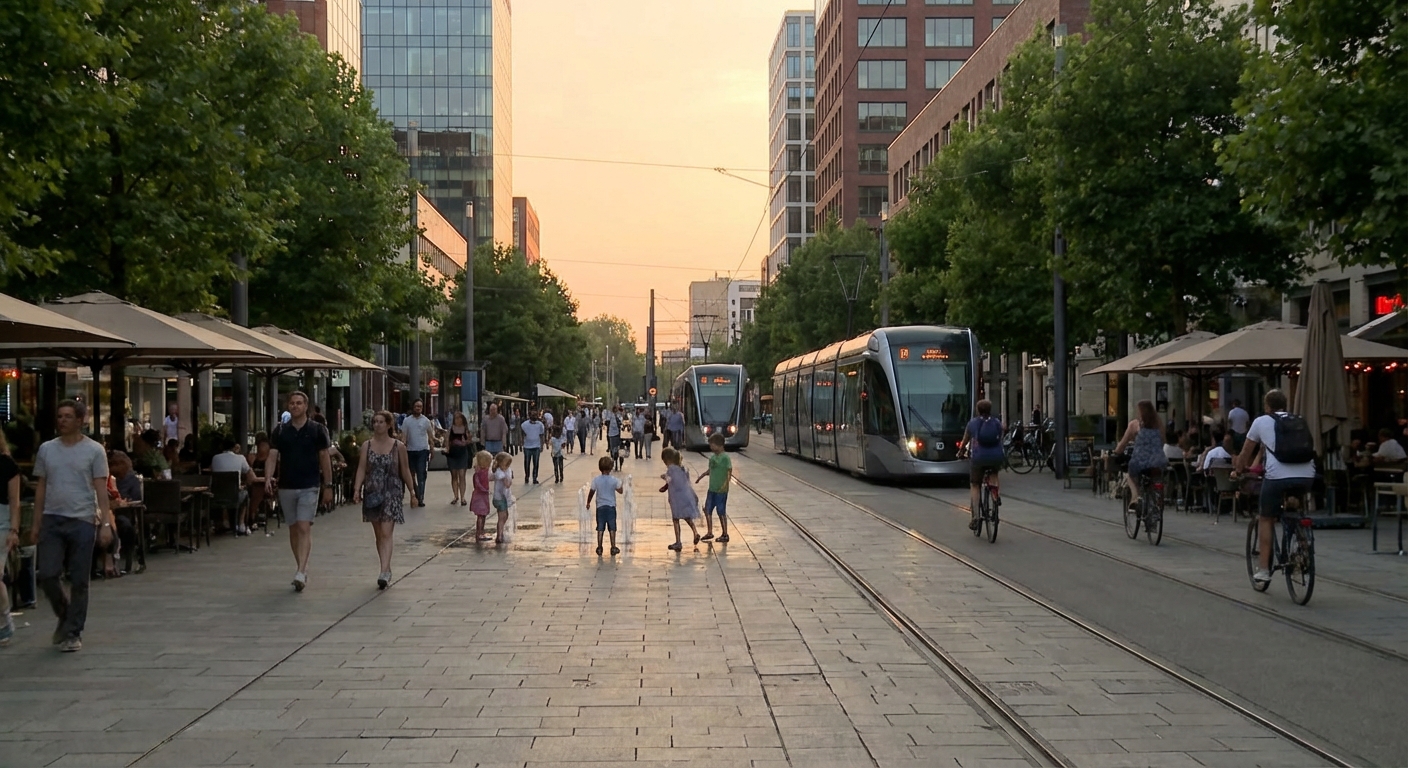
When I tested this in Barcelona’s Superilles (superblocks), the vibe was instantly different: kids playing in streets that used to be traffic sewers, cafes spilling into what were once parking spaces, people walking in the middle of the road because, well, they could.
Cities That Are (Almost) Doing It Already
I used to think “car-free city” was mostly Scandinavian concept art. Then I started visiting real places trying it for real.
1. Vauban, Freiburg (Germany)
In Vauban, a famously car-light district in Freiburg, I walked around for two hours before I realized what felt off: there were almost no parked cars on the streets.
- Residents technically can own cars, but they have to park them in pricey edge-of-district garages.
- Streets are designed as “play streets” (Spielstraßen)—cars are “guests,” and people on foot have priority.
Urban researchers like Daniel Buehler and John Pucher have called Freiburg one of the world’s leading examples of sustainable transport planning. When I talked to a local architect there, she joked, “We didn’t ban cars; we just made them deeply annoying.” And honestly, that’s the strategy.
2. Venice (Italy)
Venice is the OG car-free city, not because of policy but because… canals. You simply can’t drive a car there.
Walking through Venice, I noticed two big things:
- My sense of scale changed. Distances felt shorter without the psychological barrier of traffic.
- Logistics are wild—delivery boats, handcarts, everything moved by water or foot.
It’s a reminder that car-free doesn’t mean “simple.” It means the entire logistics system reorients around people, not engines.
3. Oslo & Amsterdam’s Center Experiments
When I visited Oslo in 2019, they’d just removed hundreds of parking spaces from the city center and replaced them with benches, bike racks, and tiny micro-parks.
- Between 2016 and 2019, Oslo phased out almost all on-street parking in the core.
- They reported zero pedestrian and cyclist deaths in 2019 within the city—an insane milestone for road safety.
Amsterdam’s center has been slowly turning into a car-light zone too. Biking there feels almost like cheating: you get everywhere faster than people in taxis.
Why Go Car-Free? The Payoffs I Actually Felt
Reading policy documents is one thing. But when I walked through these places, some benefits weren’t just theoretical—they were physical.
1. Noise Drops. A Lot.
There’s a 2011 WHO report estimating that traffic noise contributes to at least one million healthy life-years lost annually in Western Europe due to sleep disturbance and heart disease.
When I stayed in a car-free district in Hamburg, I slept with the window open without earplugs for the first time in years. My sleep tracker showed fewer wake-ups. That’s not a controlled study, but my brain and nervous system clearly noticed the missing traffic.
2. Air Feels Different
In Paris, after the city expanded pedestrian and bike zones and restricted cars on major arteries, nitrogen dioxide levels dropped. European Environment Agency data shows road transport is still the main source of NO₂, but where traffic is cut, pollution falls.
When I biked along the Seine on one of the formerly car-choked expressways (Voie Georges-Pompidou), I realized: I’m literally breathing where exhaust pipes used to dominate.
3. Streets Become Social Spaces, Not Just Through-Routes
This is the part that surprised me most.
In a car-dominated street, you usually move through as fast as you can. In a car-free or car-light street, you hang out.
I’ve seen:
- Kids playing soccer in what used to be a busy intersection in Barcelona.
- A spontaneous street chess tournament in a “filtered” street in London.
- Neighbors dragging out chairs and turning a former parking lane into an unofficial living room.
Urbanist Jan Gehl has been writing about this for years—how human interaction explodes when you slow down streets. Seeing it live, it’s hard to un-see.
The Catch: Car-Free Isn’t Magic (And It Can Go Wrong)
Here’s where I want to be honest: not every car-free experiment feels amazing.
Access & Equity Problems
I talked to a café owner in a pedestrianized street in Brussels who was furious. When car access was restricted, her older customers stopped coming; they couldn’t easily walk from the nearest transit stop, and delivery schedules got messed up.
Car-free design can exclude:
- People with disabilities who rely on vehicles
- Workers with night shifts when transit runs poorly
- People priced out of central areas who now have longer commutes
The cities that handle this best:
- Guarantee door-to-door accessible transport (on-demand shuttles, accessible taxis with exemptions).
- Coordinate car restrictions with better transit frequency, not just “use the bus lol.”
Logistics Are Hard (And Sometimes Ugly at First)
In one “low-traffic” neighborhood in London I visited, delivery vans were constantly stuck at filter points; drivers clearly hadn’t adapted yet. Residents saw more vans idling on side streets.
Designers call this the “teething period”—behaviors take time to adjust. But you can’t just hand-wave that away when people are missing deliveries and ambulances are confused by new layouts.
Political Backlash Is Real
Research out of UCL (University College London) and other institutions shows something consistent: when cities first roll out LTNs or car-free schemes, they get intense pushback. Some of it is organized disinformation; some of it is very real day-to-day frustration.
When I talked to a planner in Rotterdam, he said: “If nobody’s angry, you probably didn’t change anything.” That doesn’t mean all opposition is irrational; it means the status quo is powerful.
How Car-Free Design Actually Works on the Ground
Under the hood, car-free or car-light cities usually rely on a mix of design, tech, and policy.
1. The 15-Minute City Logic
You’ve probably heard the term “15-minute city” (popularized by Carlos Moreno, a professor at Sorbonne University). I’ve walked through pilot areas in Paris and it’s surprisingly literal: things you need most—groceries, school, pharmacy, park, a café—are within about a 15-minute walk or bike ride.
This isn’t just cute branding. It reduces the need for cars. When I rented an apartment in a 15-minute-style neighborhood in Lyon, I realized I didn’t open a map app for days. Everything I needed was just… around.
2. Superblocks and Filters
- Superblocks (Barcelona): several city blocks are grouped, through-traffic is pushed to the perimeter, and inside is low-speed, people-first space.
- Modal filters (London, Ghent): planters, bollards, or camera-enforced gates that let bikes and pedestrians through but stop cars.
When I biked through Ghent after their citywide traffic circulation plan, I kept accidentally ending up in pleasant side streets because the through-routes for cars just… weren’t there for me.
3. Pricing and Regulation
Car-free design often pairs with:
- Congestion charges (like London, Stockholm)
- Low Emission Zones (Berlin, Milan, London’s ULEZ)
- Parking caps and removal instead of endless garages
I tested this personally in Stockholm: driving into the core during charge hours hurt my wallet enough that I defaulted to the metro next time.
Should You Visit a Car-Free City? Absolutely.
If you’re into travel and transportation, I genuinely recommend planning a trip around experiencing a car-light or car-free district. It’s like trying on the future for a weekend.
Places to put on your list:
- Freiburg (Vauban) – to see a residential model in action
- Ghent (Belgium) – for a citywide traffic circulation plan that actually works
- Oslo (Norway) – to feel how a capital city center functions without normal car dominance
- Venice (Italy) – to experience the extreme case (no streets at all, just water and steps)
When I tested these places, I noticed something subtle in my own behavior: my walking speed slowed down, my phone stayed in my pocket more, and I looked around instead of constantly scanning for a safe gap in traffic.
Car-free urban design isn’t a silver bullet. It won’t magically fix housing, inequality, or every transport problem. But from what I’ve seen—and what the data backs up—it can:
- Cut emissions and pollution
- Save lives on the roads
- Make cities feel more human and less like drive-through containers
And once you’ve walked a city where kids play soccer in the middle of the street without a second thought, it’s really hard to go back to six-lane arterials and call that “normal.”
Sources
- World Health Organization – Burden of disease from environmental noise – Report on health impacts of traffic and environmental noise in Europe.
- European Environment Agency – Air quality in Europe 2023 report – Data on traffic-related air pollution and trends across European cities.
- City of Oslo – Car-free Livability Programme – Official overview of Oslo’s car-free city center strategy and outcomes.
- New York Times – How a Belgian City Fought Back Against Car Culture – Story on Ghent’s traffic circulation plan and its impact.
- Columbia University – The 15-minute city: what it is, and how we get there – Explainer on the 15-minute city concept and urban planning implications.