Costco Travel Portable Oxygen Concentrators Guide
y worked* for me, I almost cried at the boarding gate.
I’d been that person wheeling a clunky oxygen tank through security, arguing with airline staff about medical equipment, and constantly watching the gauge drop. When I finally tested a portable oxygen concentrator ordered through Costco’s partner program, the anxiety dialed down. Not to zero — that’s unrealistic — but to a level where I could focus on the trip instead of the tubing.
This guide is my honest breakdown of how Costco fits into the travel oxygen picture, what you really get (and don’t get), and how to avoid the most common gotchas when you’re shopping for a travel-ready concentrator.
First, a reality check: Costco doesn’t “make” portable oxygen concentrators
When I first searched “Costco portable oxygen concentrator,” I pictured a big aisle of devices next to the blood pressure cuffs and hearing aids. That’s not how it works.
In my experience, there are three main ways Costco touches the oxygen world:
- Online marketplace listings – Occasionally, you’ll see portable oxygen concentrators from brands like Inogen or Philips Respironics pop up on Costco.com. These are usually limited-time or regional offerings.
- Health/medical equipment partners – Costco sometimes routes members to third-party suppliers for CPAP, hearing aids, and oxygen-related equipment. You’re basically using your membership as the front door.
- Travel services – Costco Travel itself doesn’t rent concentrators, but if you’re booking cruises or tours, they’ll often point you to accessibility teams that do work with oxygen users.
So when people say “Costco travel oxygen concentrators,” what they usually mean is:
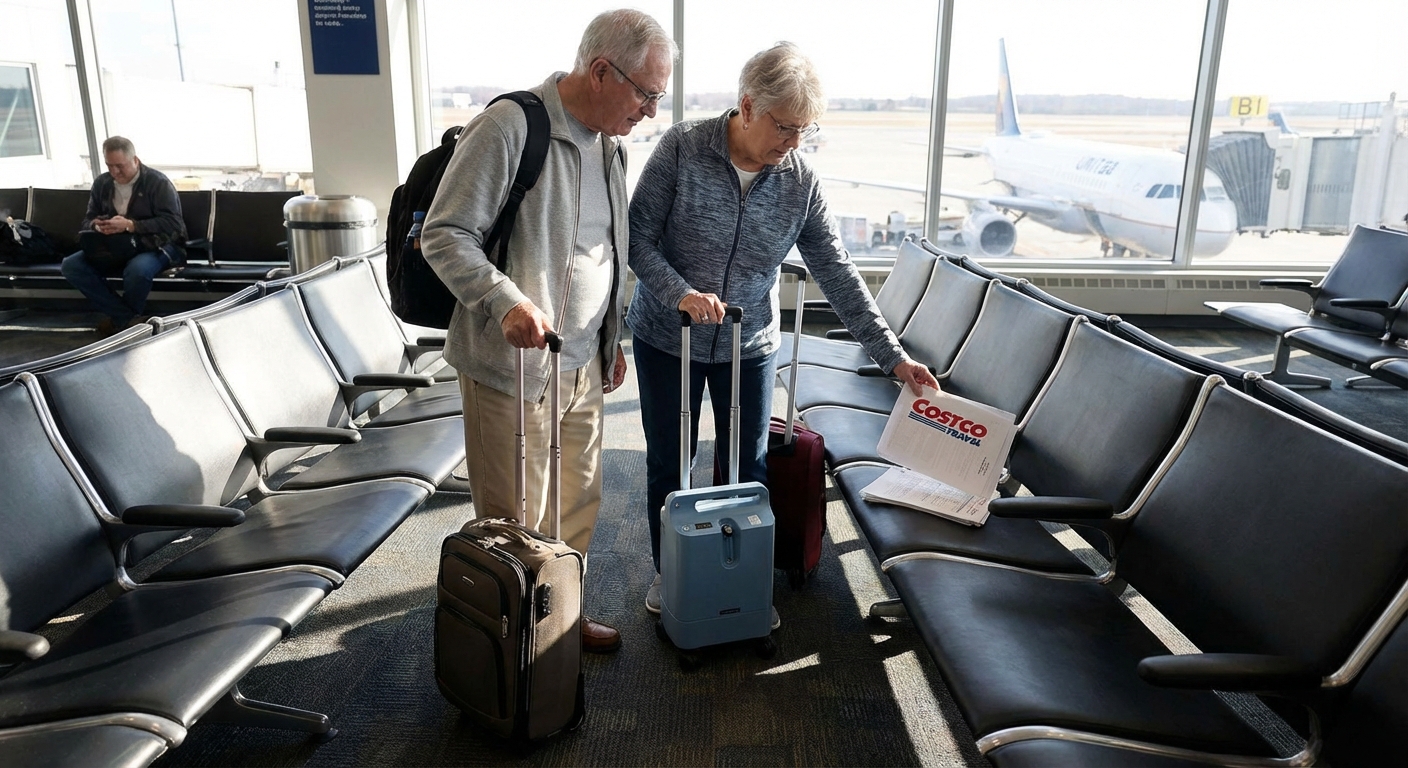
- Buying a POC through Costco or a Costco-vetted partner, then
- Using that device on planes, cruises, and road trips.
Once I understood that, it was a lot easier to navigate the options.
Quick refresher: What makes a concentrator travel-friendly?
When I tested my first “travel” POC, I learned the hard way that not every home concentrator shrunk down is actually practical on the road.
Here’s what truly matters when you’re choosing a POC for travel, Costco or otherwise:
1. Pulse dose vs. continuous flow
Most travel oxygen concentrators use pulse dose delivery — they detect your inhalation and deliver a burst of oxygen.
- Pulse dose: Smaller, lighter, better battery life. Good for many people with COPD or mild to moderate chronic respiratory disease whose doctors approve pulse-only.
- Continuous flow: Delivers a steady stream. Heavier, bulkier, drains battery faster. Often needed for sleep, high-liter-flow prescriptions, or specific conditions.
When I asked my pulmonologist about this, she was blunt: “Don’t just assume pulse is fine because it’s convenient. We need to test you on it.” We did a 6‑minute walk test with my prescribed pulse setting to confirm my oxygen saturation stayed above the target.
Bottom line: Before you even glance at Costco’s prices, confirm with your doctor whether pulse-only is medically safe for you, including at higher altitudes.2. Weight & form factor
Travel is where every pound starts to feel like five.
Typical travel-friendly POCs:
- 4–6 lbs: Pure carry-on, shoulder-strap territory
- >8 lbs: You’ll probably want a rolling cart
The device I eventually kept was just under 5 lbs with battery, which meant I could sling it cross-body and still wrangle a suitcase without cursing every twenty steps.
3. Battery life (the number people lie to themselves about)
Manufacturers love quoting battery life at the lowest setting.
Real-world rule I use when flying:
- FAA guidance and most airlines recommend 150% of flight time in battery life
- I personally aim for 2x flight time, including layovers and delays
So for a 5‑hour flight, I want 10 hours of usable battery (usually a main plus a spare or extended battery).
When I tested mine, I literally sat on my couch with a timer, set it to my actual prescription setting, and watched the battery indicator like it was a Netflix show. The advertised 8 hours turned into about 5.5 hours in real use. Not a deal-breaker, but good to know before I was at 35,000 feet.
4. FAA approval
Most name-brand POCs you’ll see through Costco or its partners are FAA-approved. You’ll usually find a label like:
> “This portable oxygen concentrator complies with FAA requirements (14 CFR 121.574).”
If you don’t see that, assume you’re going to have problems on a plane.
How Costco actually helps (and where it falls short)
The upsides I noticed buying through Costco or partners
When I priced POCs from a local DME (durable medical equipment) supplier versus Costco’s route, a few things stood out:
- Pricing and promos
Costco tends to negotiate hard. I’ve seen Costco-linked offers where an Inogen portable unit was 10–20% lower than the exact same model at a local shop, especially during member events or online sales.
- Return and warranty culture
Costco is famously generous with returns. Medical devices are a bit stricter, but the general vibe is: they don’t like unhappy members. On one trial unit, I had an issue with a noisy fan. The supplier dragged its feet; Costco member services gently nudged them along.
- Member support leverage
When my shipping was delayed ahead of a trip, I called Costco rather than the manufacturer. Let’s just say the tone changed as soon as “Costco member” entered the conversation.
The limitations you should be realistic about
- Selection is narrower: A dedicated respiratory DME may stock more brands and obscure models. Costco-linked options usually skew toward major brands and popular SKUs.
- Not always the cheapest: If your insurance is picking up a big chunk or if you qualify for rental through Medicare, a local DME might beat Costco on your out-of-pocket.
- Less clinical guidance: Costco staff aren’t your pulmonologist. They won’t run titration tests or walk tests. You still need your care team to validate settings and compatibility.
In my experience, Costco works best for people who:
- Already know they need a specific type of POC
- Have a prescription in hand
- Want a combination of decent pricing and big-company accountability
Using your POC with Costco Travel: planes, cruises, and tours
When I started booking trips through Costco Travel, I realized the concentrator itself was only half the battle. The other half was logistics.
Flying with a Costco-purchased POC
What actually worked for me:
- Get the prescription and letter
I travel with a written prescription plus a brief letter stating:
- My diagnosis
- Need for continuous oxygen
- Device make/model and flow settings
- Call the airline – and then call again
Even with an FAA-approved unit, most airlines want notice at least 48 hours before departure. I usually:
- Ask what documents or forms they require
- Confirm whether my POC is on their approved list
- Ask how much battery life they want me to carry (often 150% of flight time)
- Board early if you can
Pre-boarding helped me get my POC tubing, batteries, and carry-on organized without the rush of 200 people behind me.
Cruises booked through Costco Travel
Cruise lines can actually be easier than airlines for oxygen users — but they need notice.
What I’ve done on cruises:
- Inform the cruise line’s accessibility or special needs department at booking or shortly after
- Provide the make/model of my POC
- Ask whether I can plug in while moving around the ship (on many modern ships, yes, as long as you’re near outlets)
- Double-check power outlet types if sailing internationally
Some people prefer renting a larger concentrator or backup tanks through onboard medical partners, but I personally felt more comfortable bringing my own well-tested device and packing a small power strip (the safe kind, not a surge protector, which some ships ban).
Red flags and green flags when you’re browsing Costco options
When I was shopping, I made myself a very un-glamorous checklist. Here’s the condensed version.
Green flags
- Recognizable brands like Inogen, Philips Respironics, CAIRE, ResMed (for some hybrid setups)
- Clear FAA statement in the product description
- Detailed battery specs at multiple settings (not just “up to 13 hours” with no context)
- Service/warranty contact spelled out, especially for repairs and loaners
Red flags
- Vague claims like “suitable for travel” with no mention of FAA approval
- No mention of maximum flow setting or whether it’s pulse-only / continuous
- Batteries sold only as separate accessories with long backorders (I learned that one mid-trip)
- Overly rosy language with zero mention of prescriptions or medical oversight
Whenever I saw those red flags, I circled back to my pulmonologist or respiratory therapist before moving forward.
Pros and cons of going the Costco route
Here’s how I’d summarize it after a few years of traveling with a POC I first found through a Costco-linked program.
What’s worked well for me:- Competitive pricing and occasional member deals
- Brand-name units with good track records
- Costco’s reputation backing me up when things got bureaucratic
- You still need a strong relationship with your pulmonologist; Costco doesn’t replace clinical guidance
- Selection can be hit-or-miss depending on timing and your region
- Insurance integration can be more complex than going straight through a local DME that already knows your plan inside out
If you’re willing to put in a bit of homework, Costco can be a very solid starting point — especially if you’re cost-conscious but still want mainstream, FDA-cleared devices.
Final practical tips from the road (and the airport carpet)
Just a few hard-earned lessons I’d pass along to any Costco member thinking about a travel POC:
- Test your exact setup before you travel – Settings, cannula length, batteries, charger. Don’t let your first run be flight day.
- Carry your prescription and a backup copy – I keep a photo on my phone and a printed copy in my POC bag.
- Pack power adapters and a lightweight extension cord – Especially if you’re doing Costco Travel packages in older European hotels or cruises.
- Know your numbers – I travel with a small fingertip pulse oximeter and know what saturation level means “I’m okay” vs. “I need help now.”
- Have a Plan B – Ask your doctor what to do if your POC fails in transit: local ER? Hotel doctor? Telehealth? It’s less scary when you’ve visualized it.
I’m not exaggerating when I say that getting the right portable oxygen concentrator widened my map. Costco wasn’t the hero of the story — my medical team was — but it did make the whole process less expensive, less confusing, and a bit less stressful.
If you’re methodical about it, get properly tested on the device type you’re considering, and treat Costco as a purchasing channel rather than your medical advisor, a travel-ready concentrator can move from “intimidating gadget” to “quiet sidekick” on your next trip.
Sources
- U.S. Food & Drug Administration – Oxygen Therapy - FDA overview of oxygen therapy and device safety
- Federal Aviation Administration – Portable Oxygen Concentrators - FAA guidance on POCs for air travel
- American Lung Association – Oxygen Therapy - Patient-friendly explanation of oxygen use and device types
- Mayo Clinic – COPD: Diagnosis and Treatment - Clinical overview including when oxygen therapy is used
- Inogen – FAA Approval for Portable Oxygen Concentrators - Manufacturer details on FAA-approved POC models and travel tips