Guide to Care Options for Bone-on-Bone Knee Pain
showed me: that lovely dark space where cartilage should be? Gone. It felt like someone had sandpapered the inside of my knee.
If you’re reading this, there’s a good chance you’ve heard the same phrase—or you’re trying to avoid it. So I’m going to walk you through what I’ve tried, what actually helped, what flopped for me, and what the research says about care options for bone-on-bone knee pain.
I’m not your doctor, obviously, but I have sat in way too many exam rooms, read way too many PubMed abstracts, and tested more “miracle” knee fixes than I’d like to admit.
What “Bone-on-Bone” Knee Pain Really Means
When my radiology report came back with the phrase “severe medial compartment joint space narrowing”, my doctor translated it in plain English: the cartilage between my femur and tibia in one part of the knee was basically worn down.
In osteoarthritis (OA) of the knee, you usually see:
- Cartilage loss – the smooth, protective tissue is thinning or gone.
- Osteophytes – bone spurs forming at the joint margins.
- Synovitis – irritation of the joint lining, leading to inflammation.
- Subchondral bone changes – the bone under the cartilage becomes denser and can develop tiny cracks.
When that cushioning cartilage disappears, bone rubs on bone. That’s when pain, grinding, stiffness, and the famous “I can predict the weather with my knee” feeling really kick in.
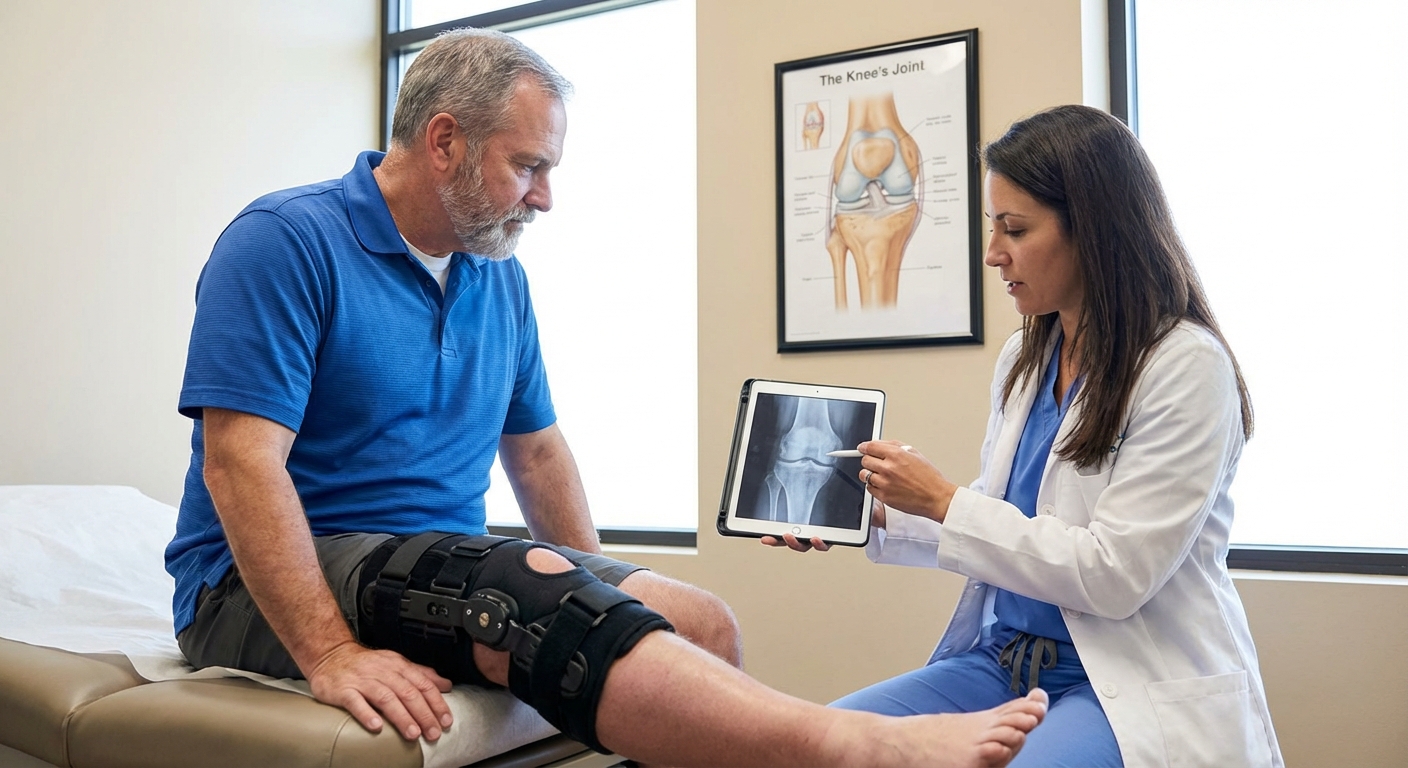
My first wake‑up call was when going down stairs felt like dropping a bowling ball onto my kneecap with every step.
Step One: Get a Real Diagnosis (Not Just Dr. Google)
I tried to self-diagnose for months. Big mistake.
What actually helped:
- X‑rays – They show joint space narrowing and bone spurs.
- Physical exam – My ortho checked alignment, range of motion, and ligament stability.
- MRI (later) – This showed the full horror story: cartilage loss, some meniscal fraying, and bone marrow edema.
In my experience, seeing the images changed my mindset. It wasn’t “I’m weak and out of shape,” it was “Okay, there is real structural damage—and also real options.”
Non-Surgical Options I Tried (and What Actually Helped)
1. Physical Therapy: The Unsexy Option That Matters Most
When I tested a targeted PT program for 12 weeks—2 sessions a week plus home exercises—my pain scores dropped more than with any brace or supplement.
We focused on:
- Quadriceps and hip strengthening – especially the glute medius and VMO (vastus medialis obliquus)
- Hamstring and calf stretching
- Neuromuscular training – practicing balance and alignment to reduce knee load
There’s solid evidence backing this. A 2021 guideline in Arthritis Care & Research recommended exercise and weight management as first-line treatments for knee OA.
Pros:- Builds long-term stability
- No systemic side effects
- You gain confidence using your knee, not babying it
- Progress can be slow
- It hurts at first (in a “my muscles are furious” way)
- Requires consistency, which is… not always fun
But out of everything I’ve done, PT is still the thing I’d fight to keep if you took every other treatment away.
2. Weight Management & Activity Tweaks
This part stung my ego. I wasn’t “obese,” but I was carrying an extra 20–25 pounds.
Multiple studies show each extra pound of body weight can add around 4 pounds of force across the knee joint during activity. The famous Framingham Study found that losing as little as 5 kg (~11 lbs) reduced the risk of developing knee OA in women by 50%.
What helped me:
- Swapping high-impact runs for cycling and swimming
- Using walking poles on long walks to unload my knees
- Shorter, more frequent walks instead of heroic weekend hikes
My knee didn’t magically regenerate cartilage (I wish), but my daily pain level went from “constant background noise” to “only loud when I push it.”
3. Braces, Sleeves, and Taping
I went through a little “knee accessory” phase.
- Compression sleeve: Gave me a surprising sense of stability and warmth. It didn’t fix the joint but made longer walks tolerable.
- Unloader brace: Designed to shift weight away from the damaged side of the knee. When I tested one, it did reduce pain going down stairs, but it was bulky and annoying under clothes.
- KT taping: Mild benefit for me—more proprioception (awareness of joint position) than pain relief.
Research is mixed but suggests valgus unloading braces can help some people with medial compartment OA. They’re not magic, but they can turn “I can’t walk to the store” into “Okay, that was doable.”
4. Medications: The Reluctant Relationship
I had three main tools here:
- Acetaminophen (paracetamol): Mild help, but not enough when pain flared.
- NSAIDs (ibuprofen, naproxen, diclofenac): More effective for me, especially during big flares.
- Topical NSAIDs: Diclofenac gel became my pre-walk ritual.
The American College of Rheumatology (ACR) 2019 guideline strongly recommends topical NSAIDs for knee OA because they provide local relief with fewer systemic side effects.
Pros:- Can make daily life functional
- Topicals are useful if your stomach hates oral NSAIDs
- Oral NSAIDs can irritate the stomach, increase blood pressure, and affect kidney function
- Don’t fix the underlying problem
I treat them now as a “supporting actor,” not the star of the show.
Injection Options: My Experience Getting Needles in the Knee
I swore I’d never get a knee injection… then I saw my MRI and changed my mind fast.
Corticosteroid Injections
The first injection I tried was corticosteroid.
My experience:- The injection itself was uncomfortable but quick.
- Pain relief kicked in within 48 hours.
- I felt noticeably better for about 6–8 weeks… then it faded.
Research supports this pattern: good short-term relief (up to ~6 weeks), limited long-term effect. Some studies suggest repeated frequent steroid injections may accelerate cartilage loss, so most surgeons I spoke with limit them to a few a year.
Hyaluronic Acid (Gel) Injections
People call these “rooster comb shots” (some older versions were literally derived from rooster combs).
When I tested a series of hyaluronic acid (HA) injections:
- I didn’t feel much for the first couple of weeks.
- Around week 3–4, my knee felt smoother, less “grindy.”
- The benefit lasted maybe 4–5 months for me.
The evidence is mixed—some meta-analyses show modest benefit, others call it marginal. The American Academy of Orthopaedic Surgeons (AAOS) actually doesn’t strongly recommend HA due to variable results, but some patients (and doctors) swear by it.
Platelet-Rich Plasma (PRP)
PRP was the “cool new thing” on my radar. It’s your own blood, spun down to concentrate platelets and growth factors, then injected into the joint.
My ortho was honest: “It might help with symptoms, it won’t regrow your lost cartilage, and you’ll pay out-of-pocket.”
I haven’t personally done PRP (yet) because of cost, but:
- Some randomized trials show better pain relief than HA or placebo, especially in younger patients with mild-to-moderate OA.
- It seems less impressive in severe, bone-on-bone cases.
If you’re considering it, I’d frame it as a potential pain-modulating tool, not a miracle regenerator.
Supplements & “Natural” Approaches: What Was Worth It
I’ve burned money on more bottles than I’d like to admit. Quick rundown:
- Glucosamine & chondroitin: I took them daily for 6 months. Zero noticeable difference. Large trials like the GAIT study found no significant benefit for most patients, though a subset with moderate-to-severe pain did a bit better.
- Turmeric/curcumin: Mild improvement in daily aches for me, especially when paired with black pepper (piperine) for absorption. Some small studies show anti-inflammatory effects comparable to low-dose NSAIDs.
- Omega‑3s: Good for general inflammation and heart health. My knee didn’t magically rejoice, but my joints overall seemed less stiff.
I now think of supplements as supportive background players, not main treatment.
When “Bone-on-Bone” Means It’s Time to Talk Surgery
There’s a point where you’re not just managing pain—you’re rearranging your entire life around it.
My own checklist moment came when:
- I was avoiding social events if they involved stairs or standing.
- Sleep was regularly interrupted by knee pain.
- I was turning down activities I loved (like hiking) out of fear.
That’s when my surgeon brought up total knee replacement (TKA) as a realistic option—not a failure, but a tool.
What Surgery Can Offer
Total knee replacement basically resurfaces the damaged bone and replaces it with metal and plastic components. For many people with severe OA, it’s life-changing.
Data from the American Academy of Orthopaedic Surgeons shows:
- Over 90% of knee replacements are still functioning well at 15+ years.
- Most patients report major improvements in pain and function.
There are also partial knee replacements (unicompartmental) if only one part of the knee is affected.
The Flip Side: It’s Not a “Quick Fix”
From talking to patients and reading outcomes data:
- Recovery is real work—PT, swelling, stiffness, and a few “what did I do” moments.
- Some people still have residual pain or limitations.
- Implants can wear out, especially in very active or younger patients.
In my experience talking with surgeons, they’re happiest with outcomes when:
- The patient has true bone-on-bone arthritis with clear X‑ray findings.
- Non-surgical options have been tried consistently.
- The patient is mentally ready to commit to rehab.
Putting It All Together: A Practical Roadmap
When I stopped chasing a single magic fix and started layering strategies, things got better.
If I had to map out a realistic approach to bone-on-bone knee pain, based on both my experience and the evidence, it would look like this:
- Confirm the diagnosis with a good orthopedist or sports med doctor.
- Start physical therapy and stick with it for at least 8–12 weeks.
- Adjust activities: swap impact for low-impact, manage weight if needed.
- Use medications and topicals wisely, not constantly.
- Experiment (cautiously) with bracing and possibly injections if PT and meds aren’t enough.
- Evaluate surgery when pain is limiting your life despite consistent conservative care.
And one thing I wish someone had told me earlier: you’re allowed to take your pain seriously before you’re completely disabled. “Bone-on-bone” isn’t just a dramatic phrase — it’s a signal to build a smart, personalized plan instead of hoping it’ll just “calm down” someday.
Sources
- American College of Rheumatology Guideline for the Management of Osteoarthritis of the Hand, Hip, and Knee (2019) - Evidence-based recommendations for knee OA treatments
- National Institute of Arthritis and Musculoskeletal and Skin Diseases – Osteoarthritis Overview - Government overview of OA causes, symptoms, and treatments
- Johns Hopkins Medicine – Knee Osteoarthritis - Clinical explanation of knee OA and treatment options
- New England Journal of Medicine – A Randomized Trial of Glucosamine and Chondroitin for Knee Osteoarthritis (GAIT Study) - Major trial evaluating common joint supplements
- Mayo Clinic – Knee Replacement - Detailed description of knee replacement surgery, risks, and outcomes