Guide to Eczema Care for Healthier Skin
y heard the word: eczema.
If you’re reading this, you probably know that mix of itching, burning, stinging, and “why is my skin doing this again?” So I’m going to walk you through what’s actually helped me and the people I work with manage eczema — not as a miracle cure, but as a realistic, science-backed game plan.
What Eczema Really Is (And Why Moisturizer Alone Isn’t Enough)
In my experience, the biggest mindset shift was realizing eczema (especially atopic dermatitis) isn’t just “dry skin.” It’s a chronic inflammatory skin condition with two big problems going on at once:
- Barrier dysfunction – The outer layer of your skin (stratum corneum) is basically a busted brick wall.
- The “bricks” (skin cells) don’t hold together as tightly.
- The “mortar” (lipids like ceramides, cholesterol, fatty acids) is depleted.
- Result: more water escapes (transepidermal water loss) and irritants sneak in.
- Immune overreaction – Your immune system is dramatic.
- It overreacts to triggers (like dust mites, fragrances, sometimes foods) and drives inflammation.
- This inflammation shows up as redness, swelling, and that itch that ruins your focus at 2 a.m.
The American Academy of Dermatology estimates over 16.5 million adults in the U.S. have atopic dermatitis, with many starting in childhood.¹ That’s a lot of people trying not to scratch in public.
So when I tested just “more moisturizer” years ago, I got some relief… but flares kept coming. Once I started targeting both the barrier and the inflammation, my skin calmed down in a way that felt sustainable instead of lucky.
Step 1: Build a Skin-Restoring Routine (Not a Pretty One)
When I finally accepted that my eczema routine was allowed to be boring — even ugly — my skin got better.
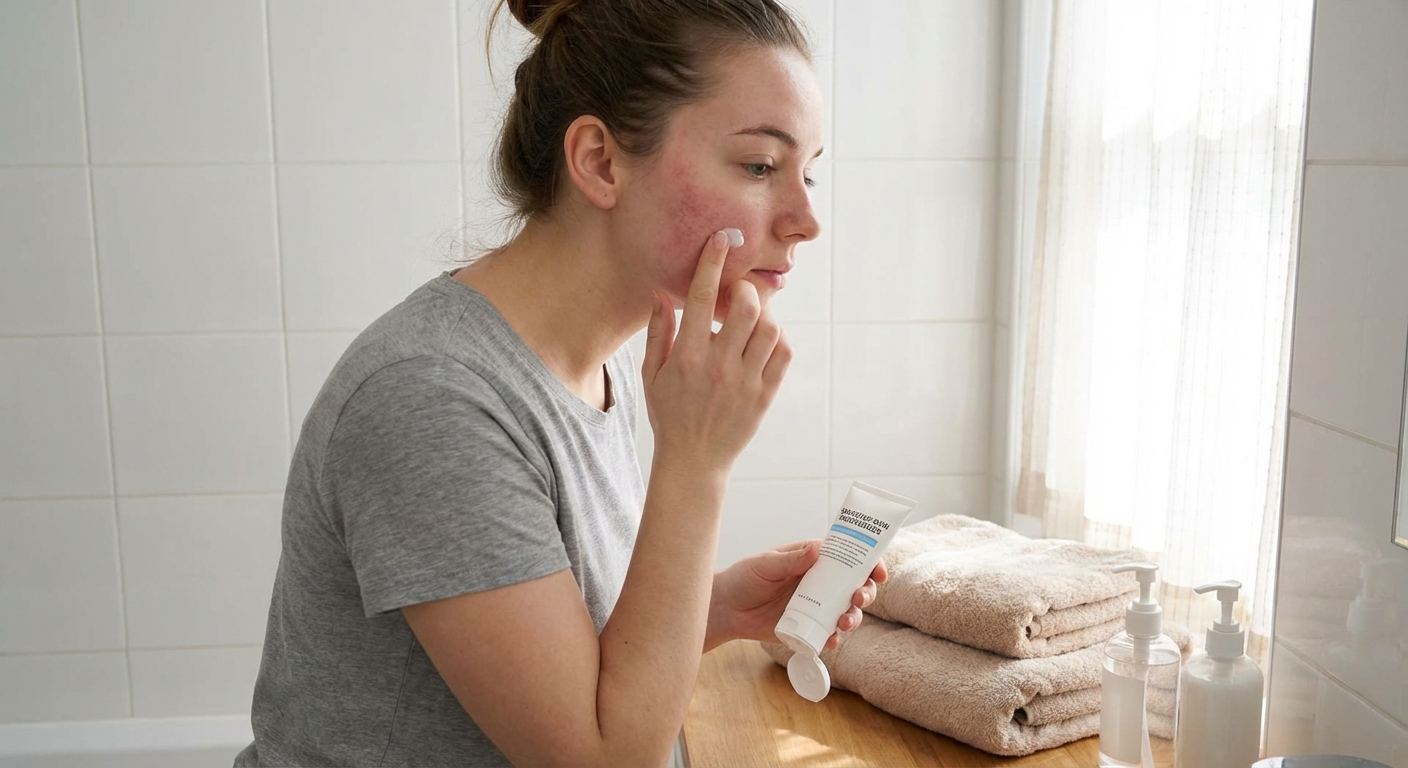
1. Keep cleansing gentle and short
I used to love foaming, squeaky-clean body washes. Big mistake.
Now, my dermatologist-approved rules are:
- Short, lukewarm showers – 5–10 minutes. Hot water strips lipids.
- Fragrance-free, low-foaming cleansers – I personally do best with creamy, non-soap cleansers labeled for “sensitive” or “eczema-prone” skin.
- Pat, don’t rub – When I tested this tiny change (just patting dry with a soft towel), those micro-abrasions and post-shower itch dropped dramatically.
2. Moisturize like it’s a medical treatment
I used to dab on lotion when my skin “felt dry.” Now I treat moisturizer like a prescription.
What’s consistently helped:
- Frequency: At least 2x/day, and within 3 minutes after showering. This is called the “soak and seal” method: hydrate with water, then trap it in.
- Texture:
- Ointments (like petrolatum-based products) are the gold standard for severe dryness.
- Thick creams are a good compromise if ointments feel too greasy.
- Ingredients I actually look for:
- Ceramides – help rebuild the skin barrier.
- Glycerin and hyaluronic acid – attract water into the skin.
- Colloidal oatmeal – FDA-recognized for soothing eczema-prone skin.
There was one winter where I did a “moisturizer challenge”: I moisturized twice a day, every day, no excuses, for four weeks. No new products, no hero serums, just consistency. The difference in the frequency and intensity of my flares was… annoyingly obvious. Consistency beat every “miracle” cream I’d impulse-bought before.
3. Patch test everything (yes, even ‘gentle’ products)
When I tested a very popular “clean” natural body oil, my arms lit up in angry red patches. Turned out it was packed with essential oils — which are common irritants.
My personal rule now:
- Test every new product on a small area for 48–72 hours.
- If it tingles, burns, or looks even slightly more irritated, it’s a no.
Step 2: Taming the Itch–Scratch Cycle
Eczema’s most evil feature isn’t the dryness. It’s the itch–scratch cycle:
- Skin gets dry or inflamed → you itch.
- You scratch → barrier gets more damaged.
- More inflammation → more itching.
Breaking that loop is half the battle.
What’s helped me (and what didn’t)
Helped:- Cold therapy – I keep gel packs in the fridge. When I want to claw my skin off, I wrap one in a cloth and hold it on the area for a few minutes. This numbs the nerve signals a bit.
- Thick night-time occlusion – On very rough patches, I’ll use a dermatologist-recommended steroid or non-steroid cream (more on that below), then seal with petrolatum and cotton clothing. Not pretty, very effective.
- Antihistamines (when prescribed) – For me, non-drowsy daytime ones didn’t do much, but sedating ones at night (under medical guidance) helped me sleep through the itch on bad flare days.
- Scratching “gently.” There is no gentle way. I just damage my skin slower.
- Natural DIY scrubs. Sugar and salt scrubs on compromised barrier? I basically sandpapered myself.
A 2019 review in Allergy, Asthma & Immunology Research highlighted that behavioral approaches (like habit-reversal techniques) can also help reduce scratching, especially in kids.² That might sound over the top, but honestly, eczema is that disruptive.
Step 3: Medications, Creams, and When to See a Dermatologist
I used to feel guilty “resorting” to steroid creams. Then I actually read the research and had a long talk with a dermatologist.
Topical steroids: helpful, but not a lifestyle
Topical corticosteroids are still the frontline treatment for many eczema flares.
- They reduce inflammation fast.
- Strength is matched to location (weaker for face/skin folds, stronger for thick skin like hands/feet).
The real issue is how they’re used:
- Long-term, continuous use of strong steroids can thin the skin and cause other side effects.
- But short, targeted courses under medical guidance are considered safe and effective by groups like the American Academy of Dermatology.³
In my case, short bursts of a mild-to-moderate steroid on bad flares, combined with heavy moisturization, worked far better than ignoring things until they were severe.
Non-steroid prescription options
When I tested non-steroid treatments, I was honestly nervous — new meds always sound intense. But for many people, they’re game-changers.
Some you might hear about:
- Topical calcineurin inhibitors (tacrolimus, pimecrolimus) – Often used for sensitive areas like the face or folds, especially for long-term management.
- Topical PDE4 inhibitors (crisaborole) – Anti-inflammatory, but not a steroid.
- Biologics like dupilumab (Dupixent) – An injection targeting specific immune pathways. Studies in the New England Journal of Medicine have shown significant improvement in moderate-to-severe atopic dermatitis.⁴
These aren’t casual “try this over the weekend” options. They’re for moderate to severe disease and absolutely require a dermatologist. But it’s worth knowing they exist — especially if you feel like you’ve “tried everything.” You probably haven’t.
Step 4: Triggers — How I Actually Found Mine (And Didn’t Lose My Mind)
I used to blame everything: gluten, the weather, stress, laundry detergent, that one almond I ate in 2013. The reality is more nuanced.
Common triggers many people report
- Dry air / cold weather
- Sweat and heat
- Fragrances (in skincare, detergents, candles)
- Rough fabrics (wool is my personal nemesis)
- Dust mites and pet dander
- Stress (yes, your skin absolutely listens to your anxiety)
What actually worked for me
- Two-week detective periods – I changed one thing at a time:
- Switched to fragrance-free detergent → waited 2 weeks.
- Then swapped fabric softener → waited 2 weeks.
Slow and boring, but I finally noticed patterns, like how my skin hated heavily fragranced fabric softeners.
- Eczema diary – Not fancy. Just notes:
- “Flare on hands. Weather: cold, dry. Stress: high. New product: yes (hand soap at office).”
Over time, the same culprits kept showing up: office soap, space heaters, skipped moisturizer days.
- Professional allergy testing – My allergist ran skin prick and blood tests. Some results were expected (dust mites), others surprised me. It didn’t solve everything, but it gave me data instead of vibes.
Balanced take: not every eczema case has obvious triggers, and sometimes the condition flares for no clear reason. That doesn’t mean you’re doing it wrong — it just means this disease is complex.
Lifestyle Tweaks That Quietly Add Up
I used to roll my eyes at “holistic” tips, but a few changes genuinely made flares less frequent or severe.
- Clothing: I switched to mostly cotton, bamboo, or TENCEL fabrics. Anything scratchy stays in the store. This one change made daily comfort way higher.
- Nails: I keep them short and filed. It doesn’t stop me from scratching, but it reduces damage.
- Humidifier: When I tested running a cool-mist humidifier at night in winter (40–50% humidity), my morning tightness and itching dropped.
- Stress management: I’m not going to pretend meditation cured my eczema. But on weeks where I move my body, sleep more than 6 hours, and do something relaxing, my flares are less vicious. The mind–skin connection is real.
A 2020 paper in Frontiers in Psychiatry discussed how chronic skin conditions like eczema are strongly linked with anxiety and depression, and that managing mental health can improve outcomes.⁵ I felt that personally: once I stopped viewing my skin as “broken” and started treating it like an organ under stress, I made kinder (and better) choices.
What Actually Worked for Me (TL;DR You Can Screenshot)
If I had to compress years of trial and error into one realistic routine, it’d be this:
- Short, lukewarm showers with fragrance-free, gentle cleansers.
- Moisturize twice daily with a thick cream or ointment, no skipping.
- Use prescription anti-inflammatory creams/ointments early in a flare, as directed, not as a last resort.
- Avoid known triggers (for me: fragrance detergents, hot showers, wool, aggressively foaming soaps).
- Use cold packs and occlusion at night to fight the itch–scratch cycle.
- Work with a dermatologist for moderate-to-severe eczema or if over-the-counter approaches aren’t cutting it.
Pros: My flares are less frequent, shorter, and more predictable. I can wear short sleeves without constantly scanning for people staring.
Cons: It takes discipline, boring consistency, money for better products and appointments, and accepting that eczema is usually managed, not magically erased.
But my skin no longer runs my entire life, and that’s a win I wish I’d given myself sooner.
If you’re dealing with eczema, you’re not “too sensitive.” You’re living with a chronic inflammatory condition that deserves real care, real information, and real compassion — especially from you.
Sources
- American Academy of Dermatology – Atopic dermatitis: overview - Clear medical overview of eczema, symptoms, and treatment options.
- Mayo Clinic – Atopic dermatitis (eczema) - Detailed explanation of causes, triggers, and management strategies.
- National Eczema Association – Treatment options - Up-to-date review of topical treatments, biologics, and lifestyle care.
- NEJM – Dupilumab in inadequately controlled atopic dermatitis - Clinical trial data on biologic therapy for moderate-to-severe eczema.
- NIH / NCBI – Psychological stress and skin disease - Review of the link between stress, mental health, and chronic skin conditions like eczema.