Guide to Mobility Scooters for Daily Senior Use
surgery, and wow—there’s a whole universe behind those handlebars.
Over the past few years, I’ve test-driven models in parking lots, argued with insurance reps, measured a frankly ridiculous number of doorways, and watched my dad go from avoiding outings to insisting on doing his own coffee runs again. So this isn’t theory—I’ve watched how a scooter can quietly shift somebody’s day-to-day life from “I can’t” back to “I might.”
Let’s walk (or roll) through what I’ve learned.
What a Mobility Scooter Really Does for Daily Life
When I first suggested a scooter to my dad, he rolled his eyes. “I’m not that old.” Sound familiar? What changed his mind wasn’t the tech specs—it was one particularly bad day at the supermarket where he had to abandon his cart halfway through because his legs just wouldn’t cooperate.
In my experience, the real value of a mobility scooter for daily senior use isn’t distance—it’s confidence. Being able to say:
- “Yes, I can go with you to the park.”
- “Yes, I can handle my own errands.”
- “Yes, we can stay longer at the family gathering.”
A 2021 review in Disability and Rehabilitation: Assistive Technology found that powered mobility devices (including scooters) are strongly associated with greater social participation and improved quality of life for older adults. That matches exactly what I’ve seen: it’s not just mobility, it’s mood.
Types of Mobility Scooters (The Real-World Versions)
When I tested different scooters with my dad, the sales rep threw a lot of jargon at us. Here’s the plain-English breakdown of the main types, plus what I actually noticed using them.
1. Travel / Portable Scooters
These are the smaller, lighter models that usually disassemble into 3–5 pieces.
Best for:- Seniors who go in cars a lot
- Apartment living with tight storage
- Mostly indoor + short outdoor trips
- Easy to get into a trunk (if you have someone with decent upper-body strength)
- Shorter battery range, often 8–12 miles
- Smaller wheels mean rough sidewalks, gravel, or grass can be a bit of an adventure (not always the fun kind)
2. Mid-Size / Everyday Scooters
This is what my dad ended up with.
Best for:- Daily use around the neighborhood
- Indoor/outdoor mix
- People who want comfort without a huge “road warrior” machine
- More comfortable seat, better suspension
- 10–20 mile range on a charge
- Stable over small curbs and cracks
- Still fits in many elevators and through standard doorways (after careful measuring)
3. Heavy-Duty / All-Terrain Scooters
These look like the SUVs of scooters.
Best for:- Bigger/taller users
- Rural or suburban areas with rougher terrain
- Seniors who want to go on longer outdoor rides
- Extremely stable, even on uneven sidewalks
- Wide turning radius—not great in tight spaces
- Often too big for some indoor doorways or narrow hallways
Key Features That Actually Matter Day to Day
When we first started researching, I got lost in endless spec sheets. After a lot of trial and error, these are the features that made a real difference.
1. Turning Radius
When I tested a couple of scooters in a pharmacy aisle, this became very clear: tight turning radius = less frustration. For daily senior use, especially indoors, aim for a turning radius under about 45 inches if possible.
Three-wheel models usually turn tighter than four-wheel ones, but four-wheel scooters feel more stable outdoors. We compromised with a mid-size four-wheel model with a reasonably tight turn.
2. Seat Comfort & Adjustability
My dad’s deal-breaker was the seat. On one model, he said, “I feel like I’m sitting on a cafeteria chair with an engine.”
Things that helped:
- A padded, swiveling seat (swivel matters for getting on/off when balance isn’t amazing)
- Adjustable armrests
- Backrest that actually supports the mid-back, not just the lower spine
If you can, sit in the scooter for at least 10–15 minutes before you decide. A 2-minute test is not long enough to know if your hips and back will hate you.
3. Battery Range & Charging
Manufacturers love optimistic numbers. When a brochure says “up to 18 miles,” I mentally mark it down to 60–70% of that for real-world use (hills, stop-start, heavier users, cold weather).
For daily senior use, I generally recommend:
- A real-world range of at least 8–10 miles
- Easy-to-see battery indicator
- A charger you can plug in without bending like a yoga instructor
My dad charges his every night, like a phone. That habit has saved him from mid-trip battery panic more than once.
4. Portability vs Stability
This is the eternal trade-off. Lighter scooters are easier to transport but can feel “twitchy” on rough surfaces. Heavier scooters ride like a tank (in a good way) but are harder to lift and may not fit in every car.
We tested a very light travel scooter that felt fine indoors but borderline scary on a sloped driveway. That was our wake-up call that daily outdoor use demanded more stability.
Safety: The Stuff People Don’t Talk About Enough
When my dad first got his scooter, his biggest risk wasn’t speed—it was his own overconfidence. Within a week, he tried to take a steep curb cut at an angle and almost tipped.
Here’s what’s actually made a difference in keeping him safe:
- Training rides: We did a “practice day” in an empty parking lot and then a slow trip around the neighborhood. Learning how it handles slopes and tight spaces is huge.
- Respecting slopes: Most manufacturers specify a maximum safe incline (often 6–10 degrees). If it looks steep, we treat it like it’s off-limits.
- Visibility: When I tested his scooter in evening light, I was shocked how invisible it felt to cars. We added a reflective vest draped over the seat back and a bright rear light.
- Foot placement: Feet fully on the platform, not dangling. A small bump can jerk the leg and throw off balance.
The U.S. Consumer Product Safety Commission has highlighted powered mobility device accidents—especially falls and tip-overs—as a real issue among older adults. It’s not about fear; it’s about respecting the machine.
Insurance, Medicare & Cost: The Honest Version
This part felt like the boss level of a video game.
In the U.S., Medicare may cover some or all of the cost of a mobility scooter, but there are strings attached. For Part B coverage, your doctor has to document that you need a powered mobility device to move around inside your home—not just for outdoor errands.
When we went through this with my dad:
- The first request was denied because the note focused on difficulty walking “to the store.”
- After the physician clarified his difficulty navigating inside the home (including getting to the bathroom safely), Medicare approved a portion of the cost for a basic model.
- Entry-level scooters: often $800–$1,300
- Mid-range daily models: roughly $1,500–$3,000
- Heavy-duty/all-terrain: $3,000 and up
Insurance coverage varies wildly. My best tip: call the scooter company and ask which models they’ve actually seen approved lately.
Who a Mobility Scooter Helps Most (and When It Backfires)
In my experience, scooters are game-changing for seniors who:
- Can transfer on and off fairly safely
- Have arm strength and coordination to steer and use controls
- Fatigue easily when walking moderate distances
- Are starting to skip social activities because “it’s just too much walking”
But there are downsides and situations where I don’t recommend jumping in right away:
- Deconditioning: If someone can still walk safely short distances, I like to see a plan to maintain that walking ability, not replace it completely. My dad uses his scooter for longer trips but still walks around the house.
- Cognitive issues: For seniors with significant dementia, operating a scooter can be risky—judging speed, distance, and hazards takes attention.
- Space constraints: Tiny, cluttered apartments with narrow hallways can make daily scooter use more frustrating than freeing.
A 2019 study in Journal of Transport & Health pointed out that while mobility scooters increase independence, they can also decrease physical activity levels if they replace all walking. The sweet spot I’ve seen is using the scooter strategically, not constantly.
How to Test-Drive a Scooter Like a Pro
When I tested scooters with my dad, our first attempt was basically: sit, circle once, nod politely. Completely useless.
The second time, we came in with a plan:
- Simulate a real day. We rode down a sidewalk, up a small ramp, through a doorway, and around aisles.
- Check comfort over time. He stayed seated for 15–20 minutes. Only then did he notice that one model made his lower back ache.
- Test controls. Could he operate the throttle with either hand? Could he adjust speed easily while turning?
- Try transfers. Getting on and off safely was just as important as how it drove.
I also secretly took a video (with his permission) of him maneuvering. Watching it later helped us see where he looked unstable or hesitant.
Final Thoughts from the Sidewalk
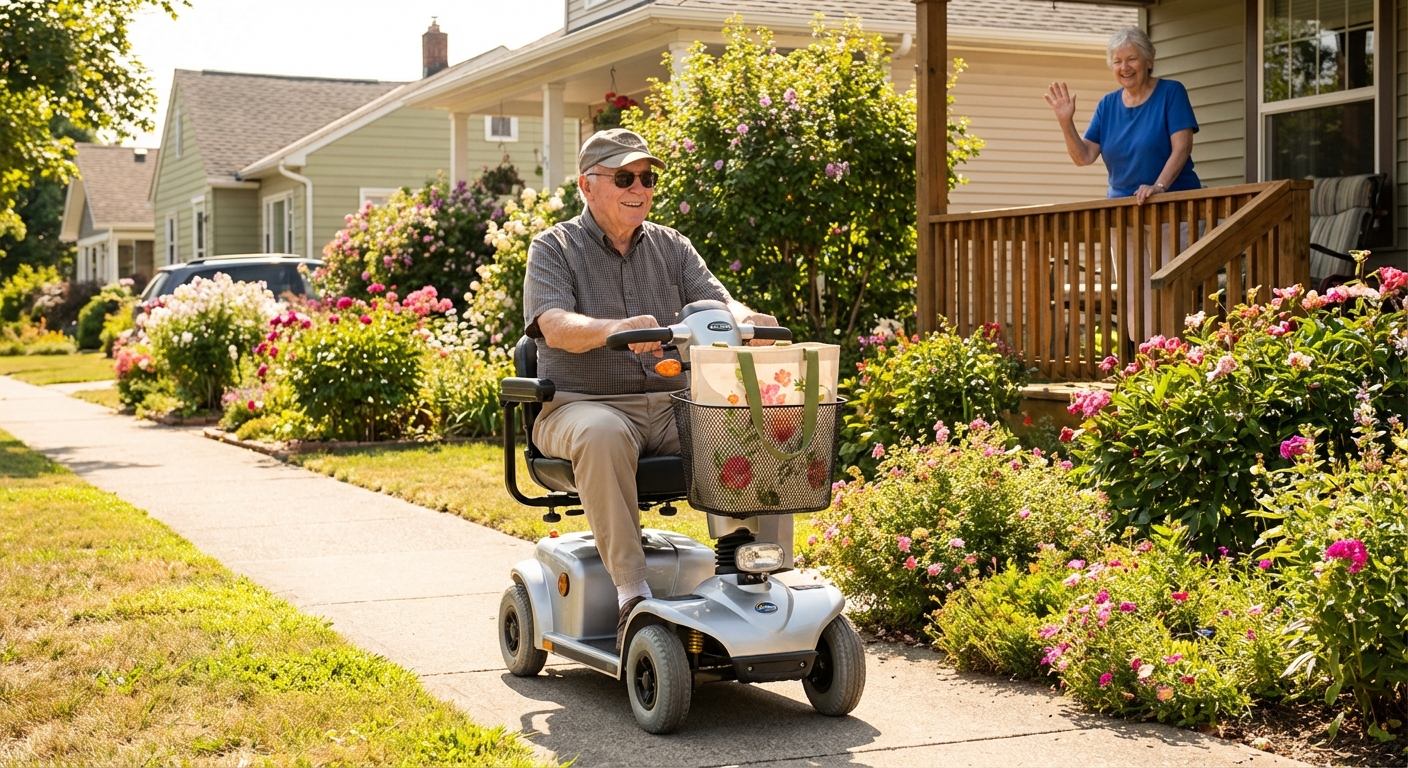
When I think about my dad’s scooter now, I don’t think about the brand name or the battery specs. I think about the first time he rolled up to his favorite café, parked outside like he owned the sidewalk, and said, “You know what, I could get used to this.”
Mobility scooters aren’t about giving up walking; they’re about not giving up living just because your legs can’t keep up with your plans.
If you’re considering one for yourself or a parent, my best advice is this: treat it like choosing a car and a pair of shoes. It has to fit your life, your body, and your daily routes—not just look good on a brochure.
And absolutely, if you can, test it in the wild, not just in a showroom.
Sources
- Medicare: Power Wheelchairs & Scooters Coverage - Official U.S. Medicare guidelines on powered mobility devices and coverage criteria.
- Mayo Clinic: Mobility Aids - Overview of different mobility aids, including powered options, with clinical context.
- U.S. Consumer Product Safety Commission – Mobility Scooter Safety - Information and safety considerations related to mobility scooters.
- NHS (UK): Mobility Scooters and Powered Wheelchairs - Guidance on choosing and using mobility scooters and powered wheelchairs.
- Journal of Transport & Health – The impact of mobility scooters on their users - Research on how mobility scooters affect activity levels and independence.