Guide to New Colon Cancer Treatment Approaches
as. But that day shoved colon cancer out of the abstract and straight into my kitchen conversations, Google searches, and late-night panic spirals.
Since then, I’ve become that person who reads clinical trial abstracts over coffee.
This guide is my attempt to translate what I’ve learned — from doctors, researchers, and my own slightly obsessive deep dives — into something human, hopeful, and actually understandable.
I’m not your doctor (please keep yours), but I’ve spent a ridiculous amount of time asking them questions and cross-checking the science. Let’s walk through the new colon cancer treatment approaches that are changing the game right now.
The Big Shift: From “One-Size-Fits-All” to Precision Treatment
When my dad was first diagnosed, the default plan sounded very linear: surgery, then chemo, then “we’ll see.”
What I quickly discovered is that colon cancer care has been moving away from that rigid sequence. Instead of treating all tumors like identical villains, oncologists now try to understand the tumor’s molecular profile — its unique set of genetic mutations and biomarkers.
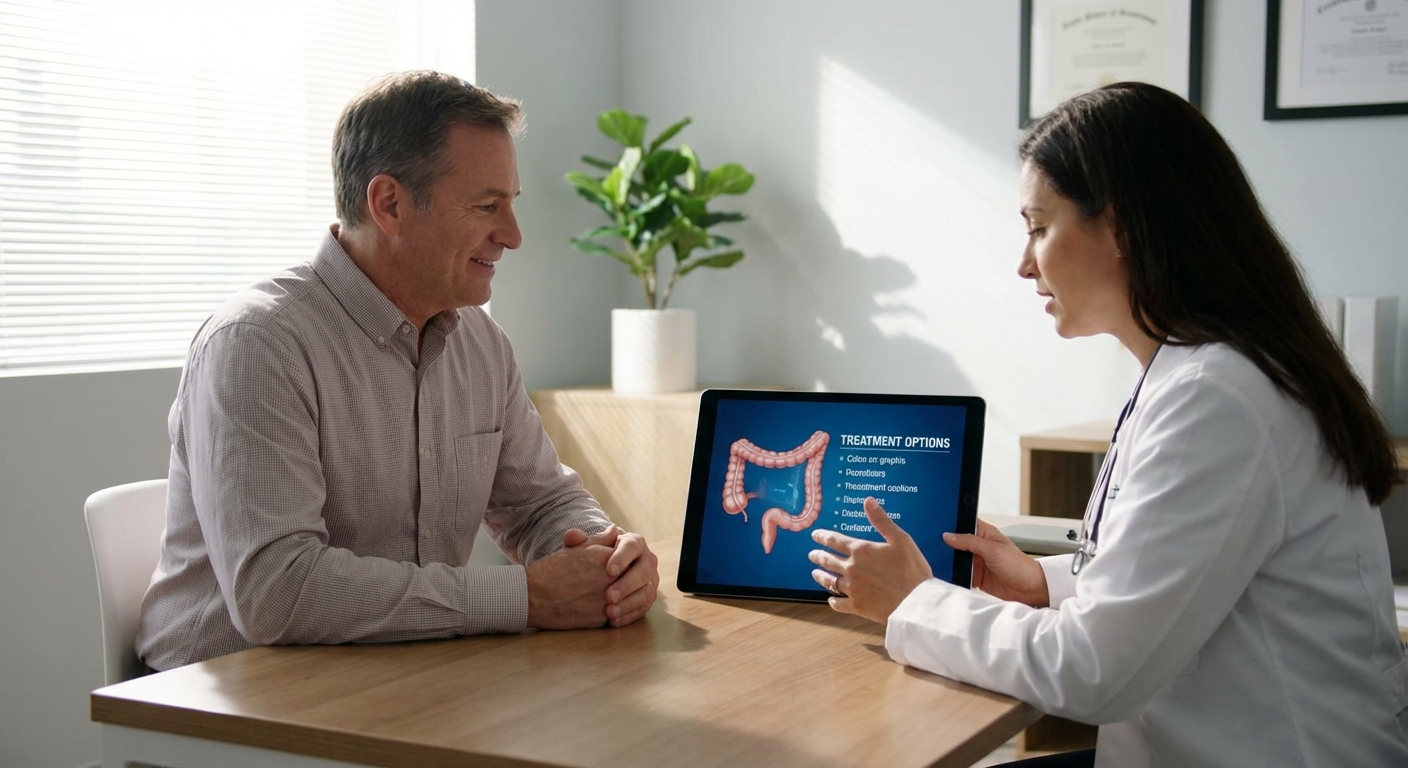
In practice, that looks like this:
- The tumor is tested for MSI status (microsatellite instability) and MMR status (mismatch repair).
- They check for mutations like KRAS, NRAS, BRAF, and sometimes HER2 amplification.
When I saw my dad’s report, it looked like alphabet soup, but those letters matter a lot. They help determine who might benefit from immunotherapy, targeted drugs, or clinical trials instead of “just chemo.”
This is the backbone of most of the new approaches: precision oncology.
Immunotherapy: When Your Immune System Joins the Fight
I remember the first time my dad’s oncologist said, “If this were MSI-high, we’d be having a very different conversation.” That comment sent me straight to PubMed.
Who benefits from immunotherapy?
About 10–15% of colon cancers are MSI-high (MSI-H) or dMMR (deficient mismatch repair). These tumors accumulate tons of mutations, which ironically makes them easier for the immune system to recognize.
For these patients, drugs called checkpoint inhibitors can be game-changing:
- Pembrolizumab (Keytruda) – an anti–PD-1 therapy
- Nivolumab (Opdivo), sometimes combined with ipilimumab (Yervoy)
The pivotal KEYNOTE-177 trial (published in 2020 in the New England Journal of Medicine) found that pembrolizumab doubled progression-free survival compared with standard chemo as first-line therapy for MSI-H metastatic colorectal cancer.
When I read that, my first thought was: why isn’t every patient being tested for MSI/MMR status on day one? (They should be. If you or your loved one hasn’t been, ask.)
Pros and cons from what I’ve seen
Pros:- For the right patients, responses can be dramatic and long-lasting.
- Less hair loss, less nausea compared with traditional chemo — quality of life can be significantly better.
- If your tumor is microsatellite stable (MSS) — which most are — these drugs usually don’t work.
- Side effects can be weird and serious: the immune system can attack healthy organs (thyroid, lungs, colon, skin).
When I talked to one patient (through a support group) who’d been on pembrolizumab, she described it as “the first time I felt like my body was helping, not just being poisoned.” But she also developed thyroid issues that now require lifelong medication. It’s a trade-off — sometimes a worthwhile one.
Targeted Therapies: Hitting Specific Weak Spots
One phrase I kept hearing in oncology clinics: “We’re trying to drug the driver, not the passenger.”
Targeted therapies go after specific genetic changes that drive cancer growth. In colon cancer, the big ones you’ll hear about are:
Anti-EGFR therapy (for RAS wild-type tumors)
If the tumor is RAS wild-type (no KRAS/NRAS mutation), drugs like:
- Cetuximab (Erbitux)
- Panitumumab (Vectibix)
can be added to chemo in metastatic disease.
These block the EGFR pathway, which some tumors use like a gas pedal. When I tested my understanding with an oncologist friend, she laughed and said, “Yeah, basically we’re slamming our foot on that pedal and then cutting the fuel line.”
Downside: acne-like skin rashes, nail changes, and sometimes significant diarrhea. One patient joked that “my skin hated me more than my tumor did,” but his scans looked better.BRAF-targeted combinations
For patients with BRAF V600E mutations (around 8–10% of colorectal cancers), standard chemo alone does poorly.
Recent regimens like:
- Encorafenib + cetuximab
have improved outcomes, as shown in the BEACON CRC trial. It’s not a cure-all, but it’s a meaningful step forward for a group that historically had very grim statistics.
HER2-targeted therapy
If you’ve heard of HER2 in breast cancer, yep, it matters in colon cancer too — but in a smaller subset.
For HER2-positive metastatic colorectal cancer (especially RAS wild-type), combinations like:
- Trastuzumab + tucatinib
- Trastuzumab + pertuzumab
are showing real promise in trials.
In my experience, this is where getting a comprehensive genomic panel (like those offered by major labs) can be crucial. You don’t want to miss a potential target because only a basic panel was ordered.
New-Age Chemotherapy: Smarter, Not Just Stronger
I used to think chemo was just “chemo” — a big toxic bucket. Then I watched how precisely oncologists sequence and tweak it.
Common regimens you might hear:
- FOLFOX – 5-FU, leucovorin, and oxaliplatin
- FOLFIRI – 5-FU, leucovorin, and irinotecan
- CAPEOX / XELOX – capecitabine + oxaliplatin
What’s evolved isn’t just which drugs, but how long and in what combinations.
Shorter adjuvant chemo for some patients
The IDEA collaboration (a huge pooled analysis) suggested that for certain stage III colon cancer patients, 3 months of FOLFOX or CAPEOX may be nearly as effective as 6 months — with less nerve damage from oxaliplatin.
When I read those results, I actually felt angry on behalf of older patients who endured 6 months of neuropathy-inducing chemo for years. Now, at least, there’s data to support shorter courses in the right cases.
Oral chemo: capecitabine
Capecitabine is an oral prodrug of 5-FU. Some patients love the convenience; others find the hand-foot syndrome (red, painful palms and soles) brutal.
Here’s the nuance:
- Oral sounds easier, but it still carries significant toxicity.
- Dosing adjustments are common; “standard dose” isn’t always your dose.
If you’re on it, moisturizing and aggressively reporting side effects early can literally save your skin — I’ve seen dose tweaks turn a miserable regimen into a manageable one.
Integrating Surgery, Radiation, and Ablation Techniques
We tend to think of metastatic colon cancer as “incurable,” but that’s not always the whole story anymore.
Liver and lung metastases
Colon cancer loves to spread to the liver and lungs. In certain cases, cutting those out — or zapping them — can extend survival or even lead to long remissions.
Options include:
- Surgical resection of liver or lung mets
- Radiofrequency ablation (RFA) or microwave ablation for small lesions
- Stereotactic body radiation therapy (SBRT) for precise, high-dose targeting
I remember one surgeon explaining it like this: “If the disease is limited and the biology is favorable, sometimes we can turn stage IV into something we can actually control long-term.”
The catch: this requires a multidisciplinary team — medical oncologist, surgeon, radiation oncologist — all talking to each other. When I sat in on a tumor board as an observer (perk of being a slightly intrusive writer), the level of debate over just one patient’s liver lesions was intense. That’s what you want.
Clinical Trials: Where Tomorrow’s Standard Starts
One of my biggest regrets is that I didn’t ask about clinical trials earlier for my dad. By the time I started digging, his options were narrower.
Clinical trials sound scary, but many are simply:
- Standard treatment plus a new drug
- Or comparing two reasonable options to see which is better
There are trials now exploring:
- Immunotherapy combinations for MSS (microsatellite stable) tumors
- Vaccines targeting specific tumor antigens
- Circulating tumor DNA (ctDNA) to detect microscopic disease after surgery and tailor who actually needs chemo
That last one — ctDNA — really grabbed me. Early studies suggest it might predict recurrence more accurately than scans alone. It’s not fully mainstream yet, but it’s one of the most promising “near future” tools I’ve seen.
If I could rewind time, I’d do this on day one:
- Ask the oncologist: “Can we test the tumor comprehensively (MSI, RAS, BRAF, HER2, NTRK, etc.)?”
- Once results are in, search clinicaltrials.gov by those biomarkers.
- Get a second opinion at a major cancer center, even virtually.
Lifestyle, Diet, and Reality Checks
Everyone asks about food. I did too. I aggressively Googled “anti-cancer diets” and nearly banned my dad from ever seeing bread again.
Here’s where I landed after talking to dietitians and reading way too many meta-analyses:
- No diet cures colon cancer.
- Certain patterns (high fiber, low processed meat, moderate exercise) may help reduce recurrence risk and improve overall health.
- Vitamin D deficiency is common in colon cancer patients; some studies suggest low vitamin D is associated with worse outcomes. Supplementation under medical supervision is reasonable.
I watched my dad’s energy improve the most not from some exotic superfood, but from boring fundamentals: small frequent meals, enough protein, walking on days he could, sleeping when his body begged for it.
There’s a lot of misinformation online, including people urging patients to skip chemo in favor of “natural” cures. Every oncologist I’ve asked about this has the same pained expression. If something sounds like it’s promising a guaranteed cure with zero side effects, I’d treat it as a red flag.
How to Make Sense of All This (Without Losing Your Mind)
If you’re feeling overwhelmed, that’s normal. I was, constantly.
A few practical things that helped me:
- Bring a notebook or use a notes app to every appointment. Write down drug names, acronyms, and “homework questions.”
- Ask explicitly: “What’s the goal of this treatment — cure, long-term control, or symptom relief?” The answer changes how the risks feel.
- Don’t be shy about second opinions. The best oncologists I’ve met encourage them.
- Remember that no treatment is one-size-fits-all. What worked for the woman in a Facebook group might be totally wrong for you.
The new colon cancer treatment approaches — immunotherapy, targeted drugs, smarter chemo, ctDNA, aggressive surgery for select cases — have genuinely shifted the landscape. Survival rates for certain groups are better now than they were even a decade ago.
But it’s still a tough disease. There are wins and gut-punches, often in the same week. The most honest thing I can say, from the family-member side of the glass, is this: being informed doesn’t remove the fear, but it does give you more agency.
If you’re in this fight — as a patient or a caregiver — you deserve that.
Sources
- National Cancer Institute – Colon and Rectal Cancer Treatment (PDQ®) - Comprehensive, regularly updated clinical overview of colorectal cancer treatment
- NEJM – Pembrolizumab in Microsatellite-Instability–High Advanced Colorectal Cancer (KEYNOTE-177) - Landmark trial showing benefits of immunotherapy in MSI-H metastatic CRC
- American Cancer Society – Targeted Therapy for Colorectal Cancer - Plain-language breakdown of targeted drugs and who they’re for
- NCCN Guidelines for Patients: Colon Cancer - Patient-friendly version of expert guidelines on colon cancer care
- ClinicalTrials.gov – Colorectal Cancer - Searchable database of ongoing and completed clinical trials in colorectal cancer