Guide to Orthopedic Shoes That Support Proper Posture
ck and knees teamed up to stage a full-blown protest.
I spend a lot of time sitting and then suddenly walking long distances when I travel. After one particularly brutal week of airport sprints and standing desks, my lower back felt like it had aged 20 years. That’s when a physical therapist looked at my shoes, raised an eyebrow, and said, “Your posture doesn’t stand a chance in those.”
That sent me down the orthopedic-shoe rabbit hole, and when I tested a few pairs over several months, my posture, pain levels, and even how quickly I got tired on walks all changed more than I expected.
Here’s everything I’ve learned — not theory from a catalog, but what actually matters when you’re choosing orthopedic shoes that really support proper posture.
How Your Shoes Quietly Wreck (or Rescue) Your Posture
When I first heard “your shoes affect your posture,” I thought it was a bit dramatic. Then I saw video gait analysis of myself walking barefoot vs. in my old floppy sneakers. The difference in my spine alignment was wild.
Your posture is basically a chain reaction:
- Your feet hit the ground →
- That affects how your ankles roll →
- Which changes your knee alignment →
- Which tilts your hips →
- Which either stacks or strains your spine
If the foundation (your feet) is unstable, everything above compensates. The American Podiatric Medical Association notes that abnormal foot mechanics like overpronation (feet rolling inward) can contribute to knee, hip, and lower back pain.
Orthopedic shoes are designed to address that foundation: they support the natural alignment of your feet so the rest of your body doesn’t have to twist and tilt to keep you moving.
What Actually Makes a Shoe “Orthopedic”?
When I started shopping, I saw “orthopedic” slapped on all sorts of shoes. Some were genuinely supportive; some were… just expensive.
From my experience and what I’ve learned from podiatrists and physical therapists, true orthopedic shoes usually have these features:
1. Proper Arch Support
Whether you have flat feet, high arches, or something in between, the shoe should support your medial longitudinal arch (the main arch) so it doesn’t collapse every time you take a step.
When I tested shoes with real arch support, the first thing I noticed was less fatigue in my calves and lower back by the end of the day. It doesn’t feel cushy; it feels held.
Tip: If you can fold the shoe in half like a taco, the arch support is probably more marketing than function.2. Firm Heel Counter
The heel counter is the stiff part around your heel at the back of the shoe. A good orthopedic shoe has a firm, structured heel counter that:
- Keeps your heel from wobbling
- Reduces overpronation or supination
- Helps line up your ankle with your leg
When I switched to shoes with a strong heel counter, my ankles stopped doing that lazy inward roll I never noticed before.
3. Stable, Not Squishy, Midsole
I used to think the spongiest, most cushioned shoe was automatically the best. Then I learned: too much squish = unstable platform.
Supportive orthopedic shoes use materials like EVA foam or polyurethane that compress a bit but don’t collapse. They absorb shock without turning your foot into a wobble board.
4. Rocker Sole (Sometimes)
Some orthopedic shoes have a rocker bottom, where the sole is slightly curved. When I tested a pair of rocker-sole walking shoes, I noticed two big things:
- I rolled through each step more smoothly
- My forefoot and toes didn’t have to push off as hard
Research published in Footwear Science has shown rocker soles can reduce pressure on the forefoot and help people with conditions like hallux rigidus (stiff big toe) or forefoot pain.
It’s not for everyone, but if you’re dealing with forefoot issues or want to reduce impact, it can be a game-changer.
5. Roomy Toe Box
This was the most surprising one for me. I didn’t realize how much I was cramming my toes until I put on shoes with a wider, deeper toe box.
A proper toe box lets your toes spread naturally. That:
- Improves balance
- Reduces bunion pressure
- Lets your foot function as a stable base
If your toes are pressed together like a subway at rush hour, posture support is already compromised.
How Orthopedic Shoes Help Your Posture (For Real)
When I wore basic fashion sneakers, here’s what an orthopedic specialist pointed out in my posture:
- Slight forward lean from the hips
- Shoulders creeping forward
- Knees slightly knocked inward
After a few weeks in properly fitted orthopedic shoes, my follow-up posture check was noticeably better — not military-straight, but more aligned and less strained.
Here’s what’s going on biomechanically:
- Neutral foot alignment reduces overpronation, which helps keep knees tracking over the toes instead of caving inward.
- Stable heel and arch support the pelvis, so it doesn’t tip forward excessively (which usually causes an exaggerated lower back curve).
- Even weight distribution through the foot prevents certain muscles from overworking to keep you upright.
The result? You don’t have to “force” a straight posture as much. Your body is better stacked, so standing tall feels more natural instead of like a workout.
I’m not claiming orthopedic shoes magically fixed everything — I still had to strengthen my glutes and core — but walking and standing no longer actively worked against my posture.
How to Choose Orthopedic Shoes That Don’t Ruin Your Outfit
I’ll be honest: the first pair I bought were so clunky I basically looked like I was cosplaying as my own grandfather. They felt amazing… and stayed in my closet.
Here’s how I eventually found pairs I actually wear outside the house.
1. Get Your Feet Properly Measured
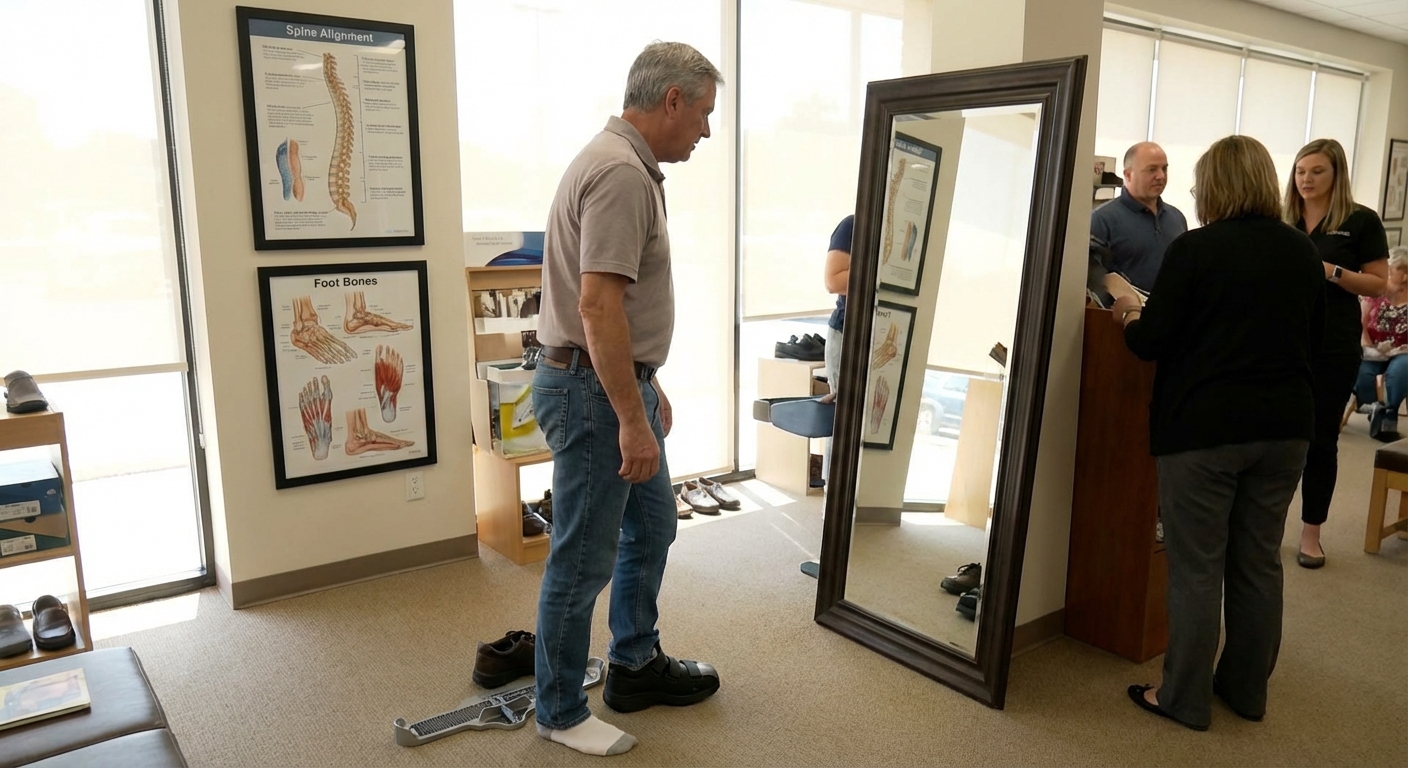
When I finally let a specialist measure my feet (length, width, arch type), I learned:
- I’d been buying half a size too small
- My left foot is slightly wider than my right
A proper fitting changed everything. If you can, get evaluated by a podiatrist or at a reputable specialty shoe store with trained staff.
2. Match the Shoe to Your Activity
In my experience, trying to find “one shoe to do everything” is asking for disappointment.
- Walking/standing all day: Look for supportive walking shoes or lifestyle sneakers with strong heel counters and arch support.
- Workplace: Many brands now make orthopedic dress shoes, loafers, and even decent-looking flats.
- Running or training: Look for stability or motion-control running shoes, especially if you overpronate.
3. Test Three Things in Store
When I test shoes, I now always do this:
- The bend test: The shoe should bend at the ball of the foot, not in the middle.
- The twist test: Try twisting the shoe. It should resist twisting, not behave like a dishcloth.
- The heel squeeze: The heel counter should be firm; if you can crush it easily, skip it.
Then I walk around for at least 5–10 minutes. If something feels off in the store, it won’t magically improve at home.
4. Don’t Ignore Aesthetics (You Won’t Wear Them)
When I chose shoes purely on function, they lived in my closet. When I finally found supportive sneakers and boots that actually matched my clothes, I wore them constantly — and that’s when my posture and pain really started to improve.
Function first, look second… but the look still matters.
Pros and Cons: Are Orthopedic Shoes Worth It?
After wearing orthopedic shoes for several months, here’s my honest, non-sponsored take.
What’s Great
- Noticeable reduction in pain: My lower back and knee discomfort dropped significantly on days I wore them.
- Less fatigue: I can stand and walk longer without feeling like my whole body is overworking.
- More natural posture: I don’t have to constantly “correct” myself; my alignment just feels more stable.
- Better long-term investment: They often last longer than cheap, squishy sneakers.
What’s Not So Great
- Cost: Good orthopedic shoes can be pricey. Sometimes you’re paying for actual tech and design, sometimes for branding — sorting that out takes work.
- Break-in period: Supportive shoes can feel weird or even slightly uncomfortable at first as your feet and muscles adapt.
- Not a magic fix: If your posture issues come from weak core, prolonged sitting, or structural issues in your spine, shoes alone won’t fix everything.
- Style limitations: The selection is better now, but you’ll still compromise a bit on super-minimalist or very sleek fashion styles.
When to See a Professional (Not Just Google and Guess)
There’s a point where DIY shoe shopping hits its limit. In my experience, it’s worth seeing a podiatrist, physical therapist, or orthopedic specialist if:
- You’ve had foot, knee, or back pain for more than a few weeks
- One leg or foot clearly feels or looks different in alignment
- Off-the-shelf “supportive” shoes haven’t helped much
A study in the Annals of Internal Medicine (2014) found that exercise and education can reduce the risk of low back pain episodes. Shoes are just one piece; a pro can help you combine them with posture work, strengthening, and maybe custom orthotics if needed.
When I finally got a proper evaluation instead of just guessing my arch type from a wet footprint on the bathroom floor, the advice I got completely changed how I shopped.
My Bottom Line After Testing Orthopedic Shoes
If I strip away all the marketing, here’s how I’d sum it up based on my own experience:
- Orthopedic shoes can absolutely support better posture by stabilizing your feet and aligning the chain up to your spine.
- They’re not miracle workers, but they’re one of the lowest-effort upgrades you can make if you stand, walk, or commute a lot.
- The real win happens when you combine them with simple habits: moving more, doing some basic strength work, and not living in flimsy, flat shoes.
If your body’s been sending you little warning shots — sore lower back at the end of the day, achy knees after walks, feet that feel like bricks by 6 p.m. — it might be less about “getting old” and more about what’s on your feet.
I was skeptical until I tested them myself. Now, my future self (and my spine) are honestly a lot less mad at me.
Sources
- American Podiatric Medical Association – Foot Health Information – General background on foot mechanics and related pain
- Harvard Health Publishing – Choosing the right shoes – Overview of supportive footwear and posture
- National Institutes of Health (NIH) – Rocker-Soled Shoes and Plantar Pressures – Research on rocker soles and pressure distribution
- Annals of Internal Medicine – Prevention of Low Back Pain – Study on reducing low back pain episodes
- Mayo Clinic – Foot Pain Causes and Treatments – Clinical context on foot pain and contributing factors