Guide to Spotting Early Skin Cancer Signs
thout sunscreen. Then a tiny, boring-looking spot on my arm scared me straight.
It didn’t look dramatic. No dramatic color, no pain, no itching. Just a slightly darker mole that (in retrospect) was changing faster than I wanted to admit.
When my dermatologist biopsied it and said, “Good call coming in, this could’ve turned into something serious,” I realized how sneaky early skin cancer can be — and how much damage we avoid by catching it early.
This guide is exactly what I wish I’d read a few years earlier.
Why Early Detection Matters More Than You Think
Here’s the part that made my jaw drop when I started researching:
- Melanoma, the deadliest form of skin cancer, has a 99% 5‑year survival rate when it’s caught early and localized.
- Once it spreads to distant organs, that survival rate can drop below 35%.
Those numbers come straight from the American Cancer Society, not from some sketchy wellness blog. That gap — 99% vs under 35% — is the difference between, “We can just remove this in the office” and “We’re talking scans, systemic treatment, and real fear.”
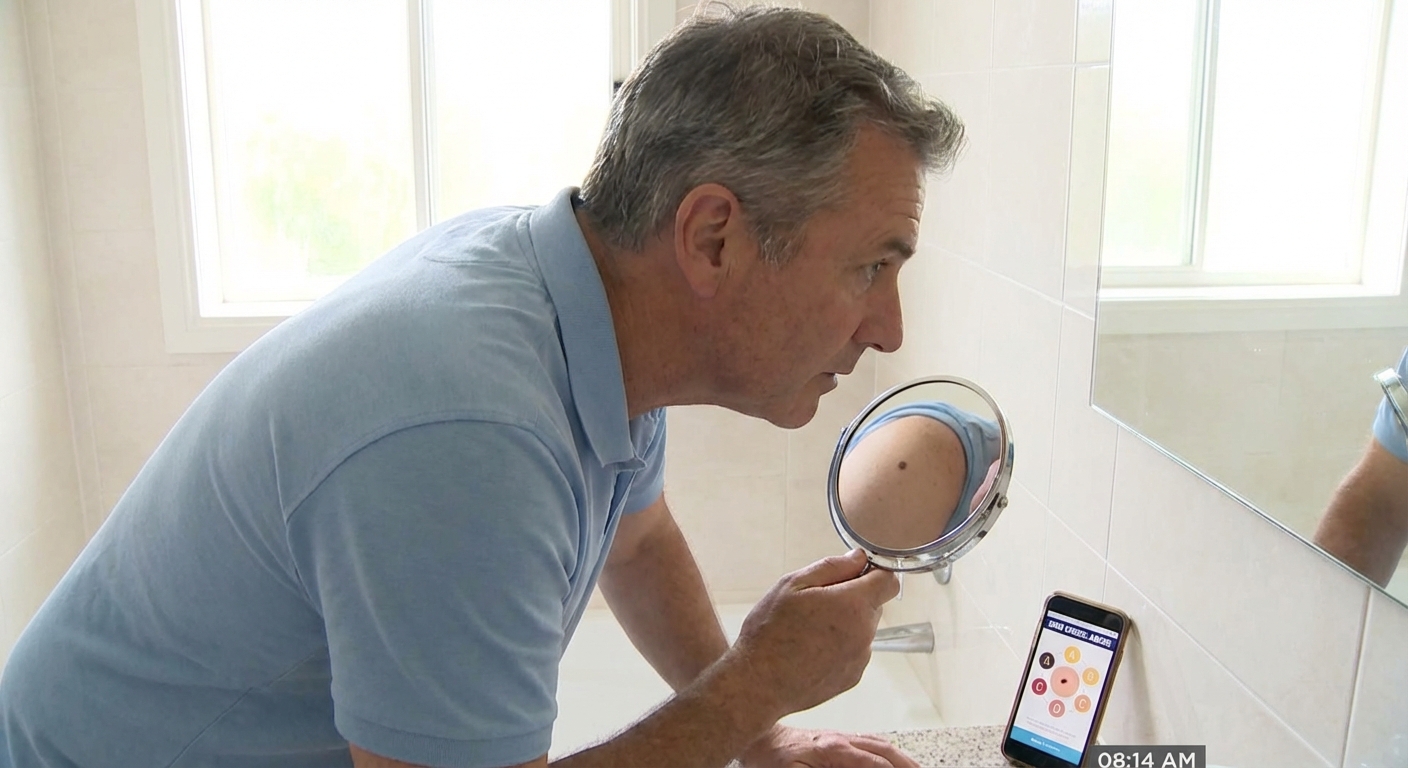
After my biopsy scare, I promised myself I’d never again depend on “I’ll just keep an eye on it” as a medical strategy. The trick is knowing what to look for and when not to wait.
The Big Three: Basal, Squamous, and Melanoma (Quick and Clear)
When I first heard these names, they blurred together like boring textbook jargon. Once my doctor walked me through them in normal language, it clicked.
Basal Cell Carcinoma (BCC)
This is the most common skin cancer — and usually the least aggressive.
Typical early signs I’ve seen (and that derms point out all the time):
- A pearly or shiny bump that looks like a pimple that never really heals
- A small, pinkish patch that’s slightly scaly
- A waxy bump with visible tiny blood vessels
My dermatologist joked, “Basal cells are like that clingy ex — they often don’t leave your skin alone, but they rarely try to kill you.” They can, however, grow deep and cause serious damage if you ignore them.
Squamous Cell Carcinoma (SCC)
This one tends to look meaner, faster.
Early signs often include:
- A rough, scaly patch that feels like sandpaper
- A crusted sore that bleeds or cracks and keeps coming back
- A wart-like growth that gets bigger over time
These are more likely than basal cells to spread if you just let them hang out. Sun-exposed areas (ears, scalp, nose, backs of hands) are common hotspots.
Melanoma (The One You Really Don’t Want to Ignore)
This is the one dermatologists get serious about really fast. Melanoma starts in pigment-producing cells (melanocytes), which is why it’s usually about moles or dark spots — but not always.
The gold-standard method my own derm drilled into my brain is the ABCDE rule.
The ABCDE Rule: How I Actually Check My Moles Now
When I tested this on myself the first time, I felt ridiculous standing half-naked in front of a mirror talking to my own freckles. But it works.
Here’s how I remember it (and how my doc explained it):
A – AsymmetryDraw an imaginary line through the middle of the mole. If one half doesn’t match the other — like a lopsided blob instead of a circle — that’s a red flag.
B – BorderBenign moles are usually smooth and clearly defined. Worrisome ones can have irregular, blurry, jagged, or notched edges.
C – ColorMultiple colors in one spot = get it checked. Look for:
- Different shades of brown or black
- Spots of red, white, blue, or gray inside the mole
The classic rule is bigger than 6 mm (about the size of a pencil eraser). But my dermatologist was blunt: “I don’t care if it’s smaller — if it’s weird or changing, I want to see it.”
E – EvolvingThis is the big one. Any mole or spot that’s changing in size, shape, color, or sensation (itchy, painful, bleeding) deserves attention.
The mole that sent me to the doctor? It failed the E test. It went from “meh” to “hm, that’s new…” over a few months.
The “Ugly Duckling” Rule (The Trick That Finally Made Sense to Me)
This is my favorite mental shortcut, and it came straight from a derm who sees suspicious moles all day.
Your body tends to make moles that look somewhat similar — like a matching set. The “ugly duckling” is the one that doesn’t fit the pattern.
In my case, most of my moles are light brown and flat. The one that got biopsied was darker, slightly raised, and just… wrong. Not dramatically monstrous. Just different.
So when you scan your skin, ask:
> Does anything look like it doesn’t belong in the family photo?
That spot? That’s the one to show your doctor.
Non-Mole Warning Signs You Really Shouldn’t Ignore
One thing I recently discovered that surprised me: not all skin cancers show up as classic moles. Some early signs are easy to blow off as “just dry skin” or “I must’ve scratched myself.”
Watch for:
- A sore that doesn’t heal within 3–4 weeks
- A spot that repeatedly bleeds with minimal trauma (like towel drying)
- A new streak of dark color under a nail (especially if it’s not from an obvious injury)
- A patch that’s red, itchy, or painful and doesn’t go away
- A firm, dome-shaped bump that’s growing
Melanoma can also show up in places you’d never think about: under nails, on the soles of feet, in the genital area, even in the eye. That’s why dermatologists love doing full-body exams — not just checking your shoulders and back while you’re making awkward small talk.
Who’s Actually at Higher Risk? (It’s Not Just Pale Redheads)
I grew up thinking, “I tan easily, so I’m fine.” That’s… not how this works.
Things that can increase your risk:
- History of blistering sunburns, especially as a kid or teen
- Indoor tanning bed use (the WHO classifies them as a Group 1 carcinogen — same risk category as tobacco for cancer-causing potential)
- Fair skin, light eyes, red or blond hair
- Lots of moles (especially more than 50)
- Family history of melanoma or atypical moles
- Weakened immune system (from medications, certain illnesses, transplants)
But here’s the part I didn’t fully appreciate until I read about it: darker skin tones are not protected from skin cancer. In fact, melanoma in Black and Brown individuals is often found later, sometimes on palms, soles, or nails, and can have worse outcomes simply because it wasn’t expected or spotted early.
So no, having melanin doesn’t mean you get to skip skin checks.
How I Actually Do a Self Skin-Check (Without Overthinking It)
When I tried to copy the full, official dermatology checklist, I got overwhelmed and almost gave up. So I simplified it into a monthly-ish 10–15 minute routine.
Here’s my version:
- Good lighting, big mirror, and a hand mirror. Shower first so I’m not distracted by random marks.
- Start at the face and scalp. I part my hair with my fingers or a comb. If you’ve got a partner or friend, ask them to scan your scalp and ears — they often spot what you can’t.
- Work down the body in zones. Front of torso, sides, back, arms (including palms and between fingers), legs, tops and soles of feet, between toes.
- Don’t skip “embarrassing” areas. Under breasts, groin, buttocks. Melanoma does not care about modesty.
- Take photos of anything that seems even mildly suspicious. I keep a little album on my phone. That way, when I think, “Is that new?” I have proof.
I’m not trying to diagnose myself. I’m just trying to catch the stuff that deserves a professional look.
What Happens If a Dermatologist Is Concerned?
When I finally got my suspicious mole checked, I half expected a dramatic situation with scalpels and stitches everywhere. Instead, the process was… almost boring.
My dermatologist used a dermatoscope (a little magnifying device with polarized light) to get a detailed look. She explained she was checking the pigment network, symmetry, and borders — basically an expert-level ABCDE.
Then she said the sentence no one loves: “Let’s do a biopsy.”
For me, that meant:
- Local numbing injection (a brief sting, then nothing)
- A quick shave biopsy to remove the suspicious part
- A small bandage and aftercare instructions
- Lab results in about a week
Outcome: pre-cancerous changes — not yet melanoma, but definitely something that needed to go. I walked out incredibly relieved that I hadn’t waited for it to become obvious.
If it had been melanoma, catching it at that stage probably would’ve meant just a slightly wider excision and then more frequent checkups. Again, early is everything.
Sunscreen, Shade, and the Stuff That Actually Helps (And What Doesn’t)
After this whole experience, I went on a sun-safety binge — and also learned what’s overhyped.
What genuinely helps:- Broad-spectrum sunscreen (UVA + UVB) with at least SPF 30, applied generously and reapplied every 2 hours outdoors
- UPF clothing, wide-brimmed hats, and sunglasses with UV protection
- Seeking shade between 10 a.m. and 4 p.m. when the sun is most intense
- “Base tans” — these are just skin damage, not protection
- Makeup with SPF 15 that you apply once and forget about
- Assuming cloudy days = no UV risk (up to 80% of UV can penetrate clouds)
I still go outside. I still go to the beach. I just treat sunscreen and shade like seat belts — not optional, not dramatic, just standard.
When You Should Stop Reading and Call a Doctor
If you notice any of this, don’t talk yourself out of making an appointment:
- A new mole or spot that looks different from your others
- A mole that’s changing — color, shape, size, or feel
- A sore that doesn’t heal in a few weeks
- Recurrent bleeding from the same spot
- A dark streak under a nail with no clear injury
You’re not “bothering” the doctor. Dermatologists would much rather tell you, “This is fine, let’s just monitor it,” than have you show up years later with something advanced.
In my experience, the hardest part was not the biopsy, not the waiting — it was admitting, “Yeah, this might be something.” Once I pushed past that, everything got clearer.
If one tiny story from my arm can push you to do a 10‑minute mirror check or book a skin exam, it’s absolutely worth it.
Sources
- American Cancer Society – Survival Rates for Melanoma Skin Cancer - Data on melanoma survival by stage
- Centers for Disease Control and Prevention – What Is Skin Cancer? - Overview of types, risk factors, and prevention
- American Academy of Dermatology – How to Spot Skin Cancer - ABCDE rule and self-exam guidance
- National Cancer Institute – Melanoma Treatment (PDQ®) - Clinical-level detail on melanoma staging and outcomes
- Harvard Health – Avoiding Skin Cancer - Expert discussion of sun protection and early detection