I Tried Training My Brain Like a Muscle — Here’s What Actually Changed
n myself, and accidentally turned my daily life into a low-budget cognitive science lab.
What surprised me most wasn’t a magic app or some biohacker gadget. It was how tiny, boring changes in what I do every day started showing up as very real improvements in focus, memory, and creativity — the kind you actually feel when you’re on a deadline, in a meeting, or trying to learn something fast.
This isn’t a “do these 7 hacks and unlock 10x IQ” situation. I’m going to share what happened when I treated my brain like a physical muscle: how I trained it, what backfired, and what actually stuck.
The Morning I Realized My Brain Was Basically “Out of Shape”
The wake-up moment happened during a Zoom call. Someone asked me a simple follow‑up question about a report I’d written two days earlier, and my mind just… blue screened. I knew I’d read the numbers. I knew they’d made sense. But it felt like trying to load a website with terrible Wi‑Fi.
That day, I did something I’d never done before: I treated my brain like I was under‑training it.
When I’ve gone too long without exercising, my body lets me know fast — stairs feel like Everest. But mentally, the “out of shape” feeling was sneakier:
- Constant tab‑switching
- Forgetting what I’d just read
- Re‑reading the same email three times
- Feeling tired before doing something hard, just from thinking about it
So I did what any mildly obsessed person does: I dove into neuroscience papers and started making my life into a set of experiments.
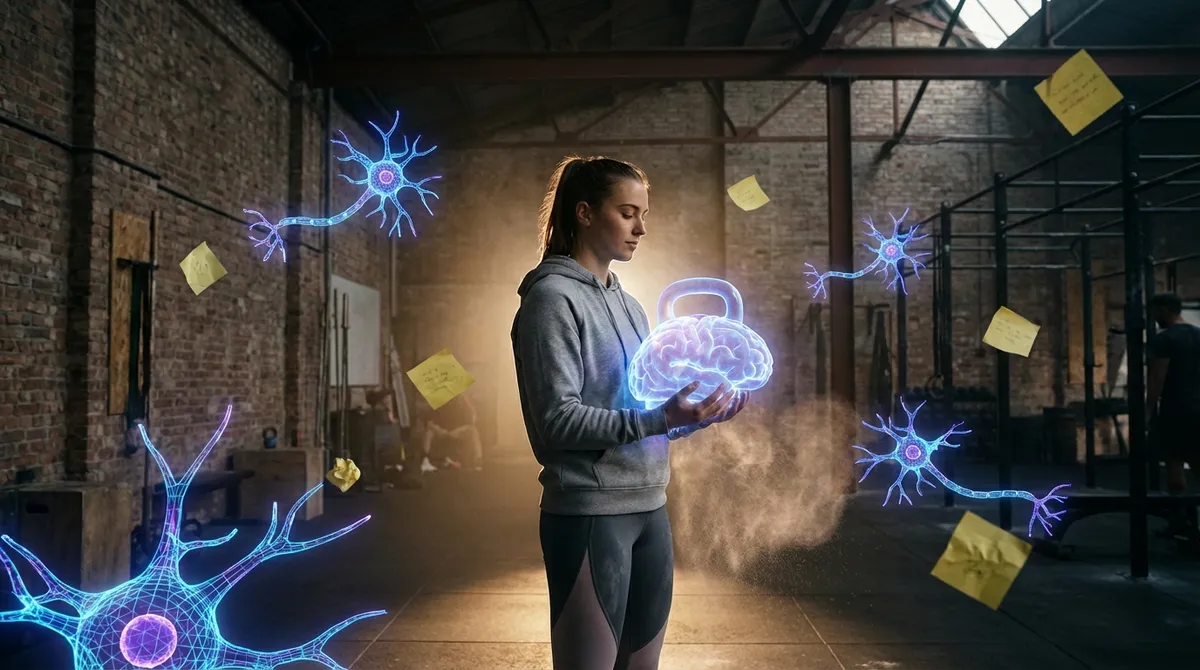
The big shift in my head was this: muscles don’t get stronger from flexing once in a while. They grow from repeated, slightly uncomfortable stress, followed by recovery. I wondered whether the same principle — progressive overload — could work on attention, memory, and mental flexibility.
Spoiler: it can. But not at all in the way I first expected.
What Neuroscience Says About “Training” Your Brain (Without the Hype)
Before I changed anything, I wanted to know if this whole idea even had real science behind it — or if it was just wishful thinking dressed in lab-coat language.
Here’s what I found digging through research (and yes, a lot of it was way less sexy than brain‑training app marketing):
- Your brain absolutely changes with training
Neuroplasticity isn’t a buzzword; it’s literally how you’re able to learn anything. Studies using MRI scans show that repeated mental practice can change the structure and connectivity of the brain. One classic example is the increased hippocampal volume seen in London taxi drivers who memorize complex city maps. Another: juggling practice changes gray matter in areas dealing with visual motion.
- But “brain games” don’t fully live up to the hype
When I tested a popular brain‑training app for a few weeks, I got way better at the games themselves… and not obviously better at real‑life stuff like staying focused in meetings. That lines up with large studies showing that most brain‑training effects are very task‑specific — you get good at the game, not suddenly good at everything.
- Real‑world cognitive “gains” usually come from two buckets
- General brain health: sleep, exercise, stress, nutrition, and social interaction. Boring, I know. But every serious review I read kept coming back to these.
- Targeted skill practice: learning a language, music, complex strategy, memory techniques — stuff that actually pushes your brain beyond its comfort zone.
What changed how I approached this was understanding that the brain is energy‑hungry. It uses about 20% of the body’s energy while being only ~2% of body weight. So when I felt mentally wiped after a focus session, that wasn’t weakness — that was literally my brain burning fuel, especially in the prefrontal cortex where decision‑making and attention live.
Once I accepted that, I stopped expecting focus to feel “easy” and started treating it like a workout that should feel tough, but not destructive.
My DIY “Cognitive Gym”: What I Actually Did Day to Day
I didn’t buy a single gadget, but I did build myself a simple framework: warm‑up, heavy lift, and cool‑down — but for my brain.
1. The Warm‑Up: Reducing “Cognitive Static”
I realized my brain was showing up to work every day already half‑fried. The fix wasn’t fancy:
- Sleep became non‑negotiable “brain fuel”
When I wore a sleep tracker for a month, the stats hammered me: on days after <6 hours of sleep, my reaction time was slower and my self‑rated focus felt like sludge. This matches research showing deep sleep helps consolidate memories and clear metabolic waste through the glymphatic system.
What I changed: I set a bedtime alarm, not just a wake‑up alarm. Unglamorous, but my morning thinking felt noticeably “lighter.”
- Caffeine timing: I stopped mainlining coffee on autopilot
I used to drink coffee immediately after waking up. After reading about adenosine (the chemical that builds up sleep pressure), I tried waiting 60–90 minutes before my first cup. When I tested this for a week, I noticed fewer mid‑afternoon crashes. Same total coffee, different timing, better stability.
- Morning “noise purge”
For the first 30–45 minutes, I stopped checking email and social media. Instead, I did one short, low‑stress task that involved reading or writing. It felt like a warm‑up set for my prefrontal cortex before throwing it under the bus with notifications.
None of this made me a genius. But it removed friction — like cleaning your glasses before trying to read fine print.
2. The Heavy Lift: Training Focus Like a Muscle
This was the biggest experiment — and the one that changed my day the most.
I started with what felt embarrassingly small: 15 minutes of distraction‑free focus, once a day, on something genuinely mentally taxing for me. No phone, no tabs, no music with lyrics. Just one thing.
At first, it was awful. My brain tried every trick: random urge to check weather, sudden need to reorganize files, deep concern about whether plants needed watering. But I stuck to it, timing each session.
Over a few weeks, I:
- Gradually increased to 25–30 minute “sets” (similar to a Pomodoro interval but without being weirdly religious about the timer)
- Added a 2–5 minute break where I deliberately did nothing stimulating: look out the window, walk a lap, stretch, stare at a wall
- Did 2–4 of these blocks on my best days, fewer on chaotic ones
Here’s what changed that I could actually feel:
- I hit “flow” more often — that delicious sense where time shrinks and work becomes absorbing
- I didn’t dread hard tasks as much; they felt like familiar heavy lifts, not monsters
- I could stay with a dense article or book chapter without bailing halfway through
It matched what I’d read about sustained attention: you don’t suddenly become someone who can focus for hours; you train up the time you can stay engaged before your mind slips.
3. The “Weird” Training: Forcing Cognitive Flexibility
I didn’t just want more focus — I wanted better mental agility. So I forced my brain into new territory.
Here’s what I tried that actually felt like it reshaped how I think:
- Learning a totally new skill that wasn’t directly useful
I picked up a bit of music theory and simple keyboard practice. I’m not trying to be a musician. But reading notation, coordinating both hands, and listening for intervals felt like giving my brain a new “language.” There’s solid evidence that musical training can improve certain aspects of attention and auditory processing, especially in younger people — but even as an adult, it felt surprisingly stimulating.
- Switching “modes” on purpose
My natural bias is verbal and analytical. So once a week, I’d force myself into a purely visual, spatial task: sketching, mind‑mapping, or trying to mentally rotate shapes (yes, like those spatial reasoning tests). It was clunky at first — I felt like a tourist in my own brain — but over time, it got easier to flip between big‑picture “map” thinking and detailed “text” thinking.
- Deliberately changing routines
I tried changing my usual walking routes, rearranging app icon positions, even brushing my teeth with my non‑dominant hand. Tiny, slightly annoying changes — but they forced more conscious attention. The effect is subtle, but it lines up with research that novel environments and behaviors can nudge plasticity because your brain can’t go on autopilot.
Did all of this make me dramatically smarter overnight? No. But it made my thinking feel less brittle. I bounced back faster when plans changed. I could switch topics with less “mental lag.”
The Stuff That Did Not Live Up to the Hype
I also tried things that either fizzled out or just didn’t justify the effort.
- Brain‑training apps
When I used a popular one daily for a month, I definitely improved my scores inside the app. Faster pattern recognition, better memory in their mini‑games. But outside the app? I didn’t clearly notice differences in how I handled reading, work, or conversations. That lines up with big meta‑analyses: transfer to everyday life is pretty limited.
- Multitasking “practice”
I thought maybe I could train myself to multitask better. Wrong move. When I tried to intentionally juggle email, chat, and writing, I didn’t level up — I just got anxious and produced worse work. Research backs this: frequent media multitaskers often perform worse on tasks requiring sustained attention.
- Overloading on supplements
I experimented briefly with some over‑the‑counter “nootropic” blends. Outside of basic stuff like caffeine and, arguably, omega‑3s (when you’re deficient), the effects were either too subtle to notice or totally absent. And the research on a lot of these combos is thin or done in specific contexts that don’t generalize well. For me, it wasn’t worth the money or the background anxiety of not really knowing what long‑term effects might be.
I’m not saying these things never work for anyone — just that for my brain, the ROI was much lower than changing sleep, movement, and how I structured focus.
The Sneaky Power Moves: Exercise, Food, and Stress (Yes, Really)
I wanted the cool, futuristic brain stuff. What actually worked best was more basic — annoyingly basic.
Moving my body = upgrading my brain’s operating system
When I paid attention, the pattern was so obvious it was embarrassing:
- Days when I walked or did even light cardio? I thought faster, especially in the afternoon.
- Days after resistance training? I felt more alert the next morning.
That’s not just vibes. Aerobic exercise is linked to increased blood flow, improved executive function, and changes in brain‑derived neurotrophic factor (BDNF), which supports neuron growth and connectivity. Resistance training is also associated with benefits for memory and cognitive performance, especially as you age.
I didn’t turn into a marathoner. I just treated movement as “brain maintenance”: 20–30 minutes of actual, heart‑rate‑up movement most days. That alone made focused work feel less like grinding gears.
Food choices that mattered way more than I wanted them to
I’m not a nutritionist, but my own experiments mirrored what a lot of research suggests:
- Heavy, high‑sugar lunches = afternoon brain fog
- Some combination of protein + fiber + healthy fats = more stable focus
- Long stretches without eating anything = distractibility disguised as “boredom”
I started thinking in terms of “stable glucose = stable focus.” The days I ate simple, balanced meals and didn’t go hard on sugar, my ability to stay with complex tasks was noticeably better.
Stress: the silent focus killer
Here’s what I noticed: it wasn’t the amount of work that wrecked my thinking — it was the feeling of overwhelm. On days when I felt cornered, my working memory collapsed. I’d forget simple steps, re‑read the same sentence, or impulsively change tasks mid‑way.
Chronic stress elevates cortisol, and high, sustained cortisol is linked to impaired memory and reduced volume in hippocampal regions over time. You don’t feel that as “my hippocampus is under threat.” You feel it as scatterbrain and decision fatigue.
I’m not zen now, but I found one thing that made a measurable difference: quick pattern‑breaking.
- 60 seconds of slow breathing (longer exhale than inhale) before big focus blocks
- Writing down everything I was worried about in a messy list, then picking one thing
- 5‑minute walks between mentally heavy tasks
Nothing mystical — just giving my nervous system a chance to downshift.
Where My Brain Actually Feels Different Now
After a few months of treating my brain like a muscle instead of a mysterious black box, here are the changes I genuinely feel:
- I can sit with difficult reading or thinking for longer before my mind runs away.
- Switching between tasks feels more like shifting gears, less like slamming the brakes.
- I forget fewer “where did I put that?” and “what was I about to do?” moments. Not zero, but fewer.
- I hit creative ideas more often — usually on walks or right after focus sessions.
There are also hard limits:
- I’m not suddenly immune to bad sleep; one rough night still trashes my focus.
- Stressful life events still punch a hole in my attention span.
- I’m not convinced my raw IQ changed at all — what changed is how efficiently I can use what I already have.
If anything, this whole experiment made me respect how physical thinking is. Your most abstract ideas still run on blood flow, neurotransmitters, and sleep cycles.
So if your brain feels “out of shape,” you don’t need a lab or a subscription. You can start with:
- Protecting sleep like it’s a deadline
- Scheduling one or two distraction‑free focus “sets” a day
- Moving your body for your brain, not just your mirror
- Adding small, weird bits of novelty into your routines
- Giving stress less silent control over your cognitive bandwidth
When I tested all this on myself, I didn’t become superhuman. I just finally felt like my brain and I were on the same team — and that alone changed how every day feels.
Sources
- National Institute of Neurological Disorders and Stroke – Brain Basics: The Life and Death of a Neuron – Explains neuroplasticity and how neurons adapt and change with experience
- Harvard Medical School – Regular exercise changes the brain to improve memory, thinking skills – Summarizes evidence on how physical activity supports cognitive function
- National Institutes of Health – Sleep, Learning, and Memory – Details the relationship between sleep, memory consolidation, and brain health
- Frontiers in Human Neuroscience – “Do ‘Brain Training’ Programs Work?” – Reviews research on the effectiveness and limitations of commercial brain-training programs
- American Psychological Association – Stress Effects on the Body – Explains how chronic stress impacts brain regions involved in memory, attention, and decision-making