Learn About Massage Techniques Used for Migraine Symptom Support
hts off, trying not to move because every heartbeat felt like a hammer behind my eye.
That’s when I started looking beyond painkillers and ice packs, and I kind of stumbled into the world of massage for migraine support. I was skeptical at first. Massage sounded way too spa-like for the kind of pain that made me consider canceling my life. But when I tested a few specific techniques (with guidance from a licensed massage therapist), some of them actually helped — not as magic cures, but as real, tangible relief.
This is what I’ve learned over a few years of trial, error, and a lot of neck rubs.
Quick reality check: Massage isn’t a cure for migraines
Before diving into techniques, let me be super clear: in my experience, massage is supportive, not curative.
What massage can sometimes do:
- Ease muscle tension in the neck, shoulders, and jaw (which can trigger or worsen migraines)
- Help calm the nervous system and reduce stress
- Improve sleep, which for many of us is a massive trigger
What it can’t do (no matter what an overconfident TikTok video says):
- Permanently “fix” the underlying neurological mechanisms of migraine
- Replace prescribed meds or medical care
The American Migraine Foundation and several neurologists I’ve spoken with position massage as a complementary therapy — something to stack on top of medication, hydration, trigger management, and sleep hygiene, not instead of them.
That said, when my pain goes from “I can’t function” to “I can answer an email” after 15 minutes of targeted massage, that’s a win.
Why massage can help: A quick nerdy breakdown
When I dug into the science, a few mechanisms kept coming up:
- Muscle tension relief: Many people (me included) carry ridiculous tension in the upper trapezius, suboccipital muscles, and jaw. That tightness can feed into migraine pathways.
- Circulation changes: Some studies suggest massage can increase local blood flow and help normalize vascular tone — relevant because migraine is partly a vascular and neurochemical storm.
- Nervous system downshift: Massage stimulates the parasympathetic nervous system (your "rest and digest" mode). That can lower stress hormones, which are notorious migraine triggers.
One 2016 randomized controlled trial in the International Journal of Therapeutic Massage & Bodywork found that regular massage reduced migraine frequency and improved sleep quality in participants over several weeks. The sample size was small — so we’re not talking gospel truth — but it lines up with what I and a lot of other migraine folks experience.
1. Trigger point therapy: My love–hate relationship
I recently discovered just how many trigger points were hiding in my neck and shoulders. Trigger points are those tiny, hyper-irritable knots in muscle that can refer pain somewhere else — very often to the head.
When I tested trigger point therapy with a trained massage therapist, here’s what happened: she pressed a thumb into the upper part of my trapezius, and I felt my migraine spot light up over my eye. Wild and slightly alarming.
How it’s done (professionally)
A therapist will:
- Palpate (feel around) the neck, shoulders, upper back, and jaw
- Find tight, ropey bands that reproduce or mimic your migraine pain
- Apply sustained pressure (usually 30–90 seconds) until the knot slowly releases
In my experience, this can feel uncomfortable for a few seconds before it relaxes. The key is staying just below your “too much, I want to punch you” pain threshold.
Self-try version (with caution)
I’m not a fan of aggressive DIY trigger point work during a full-blown migraine. But between attacks, gentle work can help:
- Use a tennis ball against a wall on the upper back or shoulder
- Lean in gradually until you feel a tender knot
- Hold pressure for 20–30 seconds, breathe slowly, then release
I’ve had sessions where this significantly reduced the intensity of migraines for a couple of days after. Other times…nothing. So, mixed but promising.
Pros: Very targeted, can reduce muscle-based triggers Cons: Can be sore afterward; needs expertise for deep work; not ideal in the peak of a severe migraine2. Suboccipital release: The tiny muscles that cause big trouble
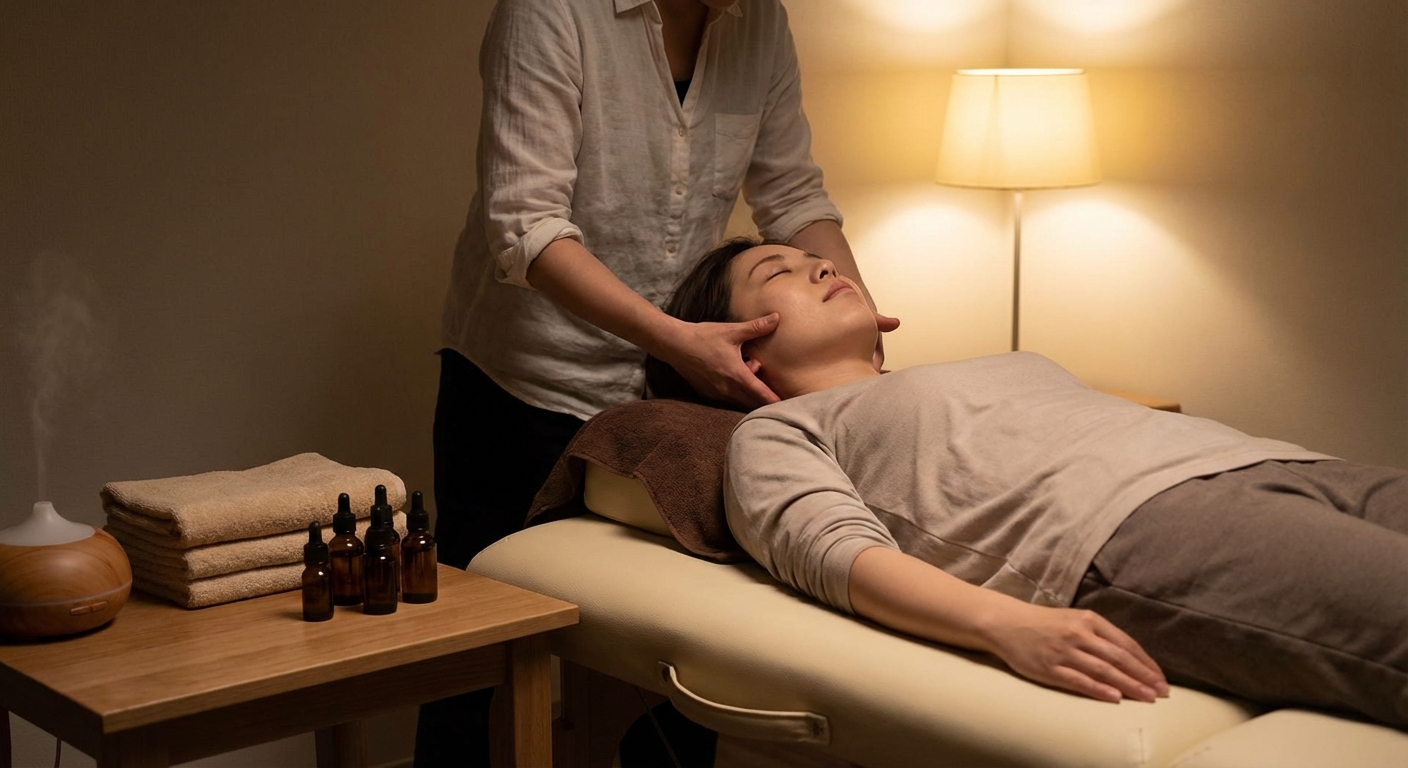
If you place your fingers at the base of your skull and gently move them side to side, you’ll feel a little shelf of bone. Just under that are the suboccipital muscles — four small muscles that love to tighten when you stare at screens, crane your neck, or clench through stress.
When my therapist first did a suboccipital release on me, I felt this weird, melting sensation behind my eyes. Then my headache backed off about 30%. Not gone, but noticeably dialed down.
What it looks like
On a massage table, you’d usually be lying on your back. The therapist:
- Slides fingers under the base of your skull
- Gently lifts and holds, letting the head get heavy in their hands
- Maintains a soft, steady pressure for several minutes
You’re not moving much. It feels more like being gently cradled than “massaged.”
Simple self-release version
Here’s what I do at home when I feel that neck-based migraine threatening:
- Lie on your back with knees bent
- Place two tennis balls in a sock, knot the end, and position them at the base of your skull (not on the neck muscles, not on the bone ridge – just under it)
- Let your head sink into the balls and breathe slowly for 3–5 minutes
Some days it’s a game-changer. Other days it’s “mildly helpful at best.” But it’s gentle, low-risk, and worth trying.
3. Scalp and temple massage: The underrated classic
Scalp massage sounds basic, but when my migraine is sitting like a helmet around my head, it can feel ridiculously soothing.
Techniques that have helped me
- Circular fingertip strokes along the temples and above the ears
- Gentle traction: placing hands on either side of the head and very slightly lifting
- Frontalis work: small circles across the forehead and eyebrow line, especially when I’ve been frowning at screens all day
I sometimes add a drop of diluted peppermint essential oil to the temples or back of the neck. There’s a 2012 study in Deutsches Ärzteblatt International showing that topical peppermint oil can help with tension-type headaches. It’s not a migraine cure, but I’ve noticed a cooling distraction effect that takes the edge off.
Warning: If your skin is sensitive or you’re prone to allergies, patch-test essential oils and always dilute them in a carrier oil.4. Jaw and neck work: Especially if you clench or grind
When I finally admitted to my dentist that I wake up with jaw pain, she basically said, “Yeah, your TMJ is screaming.” Jaw tension is a sneaky migraine trigger.
What professional TMJ-focused massage may include
- Gentle external work on the masseter (cheek area) and temporalis (side of the head)
- Light intra-oral work (inside the cheek, with gloves) for severe clenchers
- Slow, gliding strokes along the sternocleidomastoid (SCM) and scalene muscles in the neck
After a few sessions, I noticed fewer “morning migraines” — the ones I used to wake up with after a night of grinding.
DIY jaw release
Here’s what I do when my jaw is tight:
- Place fingertips on the masseter (clench your teeth to find it, then relax)
- Make slow circular motions downward toward the jawline
- Open and close the mouth gently while massaging
Again, keep it gentle. Overdoing jaw work can backfire and make everything more irritated.
5. Full-body relaxation massage: The long game
This one isn’t as dramatic as a trigger point release, but longer term it’s been just as valuable for me.
When I committed to a monthly 60-minute relaxation massage for three months, focused on overall muscle tension and stress, I didn’t notice a huge change right away. But by month two:
- My migraine frequency dropped slightly
- The severity of a few attacks was noticeably less
- My sleep improved, which almost always helps my head
Research backs this up to a point. Several small studies have shown that regular massage can lower cortisol levels, improve sleep quality, and reduce perceived pain intensity in chronic pain conditions — all of which are relevant to migraine.
Is it cheap? No. Is it accessible for everyone? Also no. That’s one of the big downsides.
When massage can backfire (yes, it happens)
I wish I could say massage always helps, but that’d be dishonest.
Times it’s made my migraines worse:
- When the therapist used too much pressure, especially on the neck
- When I had deep work during the aura or peak pain phase of a migraine
- When I was dehydrated or hadn’t eaten much beforehand
Some people are touch-sensitive during migraine attacks and can’t tolerate any contact. If that’s you, it doesn’t mean massage is off the table — it might just be something you use between attacks for prevention rather than in the middle of one.
Always check with a doctor or neurologist if you have:
- Unexplained new severe headaches
- Recent head or neck trauma
- Vascular issues, clotting disorders, or unstable blood pressure
Massage is usually safe, but not universally so.
How to work massage into a real-life migraine plan
Here’s what’s actually stuck for me, not just a fantasy wellness routine:
- During a mild attack or early warning signs: Gentle scalp, temple, and suboccipital work. Low light. No deep pressure.
- Between attacks: Occasional trigger point sessions with a licensed therapist plus short self-massage sessions for jaw, neck, and shoulders.
- Long term: Treat massage as one tool in the kit, alongside meds, hydration, food regularity, blue-light management, and keeping a migraine diary.
If you’re considering professional massage, look for:
- A licensed massage therapist (LMT or equivalent in your country)
- Someone who has experience with headaches or migraine patients
- A therapist who listens when you say “that’s too much” and doesn’t push through pain
When I finally found a therapist who didn’t treat my neck like it was made of steel cables to be “fixed,” my results got way better.
The bottom line from my migraine-prone neck and brain
Massage hasn’t cured my migraines. I still carry meds in my bag and plan big days around my triggers. But the right techniques — especially suboccipital release, gentle trigger point work, and jaw/neck massage — have:
- Reduced my overall muscle tension
- Helped some attacks feel less brutal
- Given me a sense of agency when I feel that familiar pressure building
If your migraines are ruining chunks of your life, massage alone probably won’t save the day. But as part of a bigger, realistic plan? It can absolutely be one of the tools that make your bad days a little less bad — and your good days a bit more frequent.
Sources
- American Migraine Foundation – Complementary and Integrative Therapies – Overview of non-drug approaches including massage
- National Institutes of Health (NIH) – Migraine – Clinical background on migraine mechanisms and treatment
- Mayo Clinic – Massage: Get in touch with its many benefits – Evidence-based look at how massage affects stress and pain
- International Journal of Therapeutic Massage & Bodywork – Massage therapy and frequency of chronic tension headaches and migraines – Research on massage and headache frequency
- Harvard Health Publishing – Peppermint oil for headaches – Discussion of evidence for topical peppermint in headache relief