Learn About Melanoma Skin Cancer Signs and Early Detection
It wasn’t painful. It wasn’t huge. It just looked…off. Darker than the others, with a shape that didn’t match. I kept telling myself, “It’s probably nothing, you’re overreacting.”
When I finally showed it to a dermatologist, she paused, leaned closer, and said very calmly: “I want to biopsy this today.”
That moment flipped a switch in my brain. I went from casually aware of skin cancer to borderline obsessed with recognizing melanoma early—because early is everything.
I got lucky. My biopsy came back as a severely atypical mole, not melanoma, but it was close enough to scare me straight. Since then, I’ve gone deep into the research, grilled dermatologists with questions, and tested every reminder trick I can to actually remember skin checks.
Here’s what I’ve learned that I wish I’d known sooner.
What Melanoma Actually Is (And Why It’s So Dangerous)
Melanoma is a type of skin cancer that starts in melanocytes—the pigment-producing cells that give your skin its color. While it’s less common than basal cell carcinoma or squamous cell carcinoma, it’s much more dangerous.
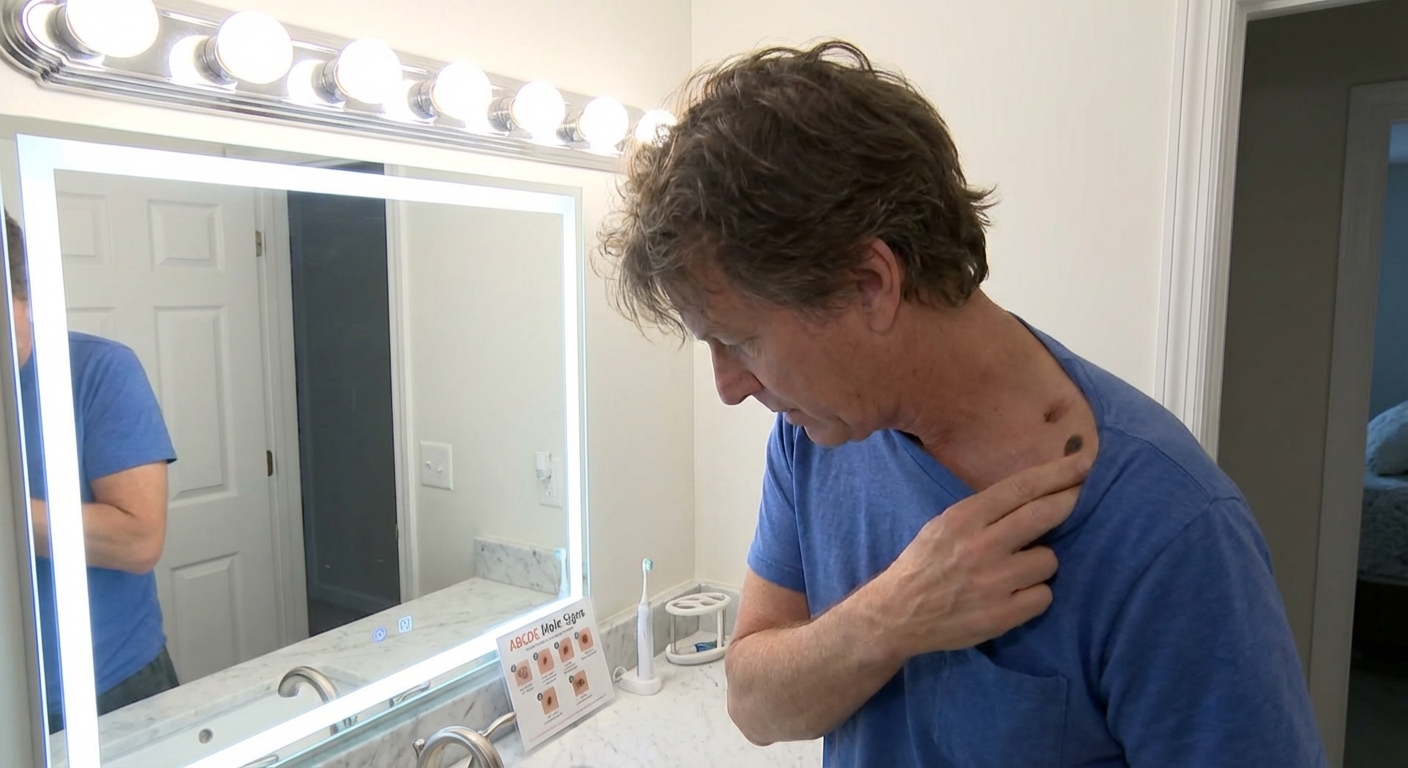
Why? Because melanoma is aggressive. It can spread (metastasize) to lymph nodes and organs like the lungs, liver, and brain faster than other skin cancers.
The American Cancer Society estimated about 100,640 new melanoma cases in the U.S. in 2024, with roughly 8,290 deaths. The part that really stuck with me: when melanoma is caught early and confined to the skin, the 5‑year survival rate is around 99%. If it spreads to distant organs, that number drops dramatically.
Those numbers are the difference between a quick outpatient surgery and life‑altering treatment plans.
The ABCDEs of Melanoma: The Rule I Now Use in the Shower
Dermatologists have this simple framework for spotting suspicious moles. The first time my dermatologist drew it out on the exam table paper, I literally took a photo so I’d remember.
A – Asymmetry
When I tested this on my own moles, it became so obvious: if you draw an imaginary line down the middle of the mole, do the two halves match?
- Normal mole: usually pretty symmetrical.
- Possible melanoma: one side is bigger, lopsided, or uneven.
B – Border
My “problem” mole had this subtle, smudged edge—like watercolor bleeding on paper.
- Normal mole: smooth, clear edges.
- Possible melanoma: irregular, jagged, blurred, or scalloped borders.
C – Color
This one freaked me out after I saw real photos: melanomas often have multiple colors.
- Normal mole: one consistent shade of brown.
- Possible melanoma: mix of tan, dark brown, black, sometimes red, white, or even blue.
D – Diameter
People often quote the “pencil eraser rule.” A standard pencil eraser is about 6 mm.
- Higher risk: moles larger than 6 mm.
- Reality check: some melanomas are smaller, so size alone isn’t a free pass.
E – Evolving
This is the one that finally got me into the dermatologist’s office.
- Any change—in size, shape, color, elevation, itching, bleeding, or crusting—is a red flag.
In my experience, the “E” is the most practical thing to watch. You know your own skin better than anyone. If something is clearly changing, don’t wait for it to “settle down.”
The Lesser‑Known Red Flag: The “Ugly Duckling” Mole
One tip I got from a skin cancer specialist that I’d never seen in a basic brochure: look for the ugly duckling.
Most people have a certain “style” of moles—same general color, size, and shape. The ugly duckling is the mole that doesn’t match the rest.
When I tested this idea on my own body, that shoulder mole absolutely stood out. Darker. Sharper edges. Just…off.
Dermatologists actually use this pattern recognition clinically. If you feel like one spot doesn’t look like your “normal,” that alone is enough reason to get it checked.
Who’s Actually at Risk? (Spoiler: Not Just People Who “Burn Easily”)
I used to assume melanoma was a “very fair skin only” problem. That’s dangerously incomplete.
Higher‑risk factors include:
- History of blistering sunburns, especially in childhood
- Indoor tanning (tanning beds can emit up to 10–15x the UV of midday sun)
- Fair skin, light hair, or light eyes
- Family history of melanoma
- Lots of moles (especially >50) or atypical/dysplastic moles
- A weakened immune system
But here’s the part that doesn’t get enough attention: people with darker skin can absolutely get melanoma, and it’s often diagnosed later because no one’s looking for it.
In darker skin tones, melanoma is more likely to appear on palms, soles, under fingernails or toenails, and on mucous membranes. Acral lentiginous melanoma (ALM), the type that appears on the soles and palms, was the kind diagnosed in Bob Marley—his started under a toenail.
That’s one reason I now include the weirdly awkward step of checking the bottoms of my feet and between my toes.
Where Melanoma Shows Up (Some of These Surprised Me)
The first time I did a full self‑exam, I felt absolutely ridiculous with a hand mirror in the bathroom. But I also found a mole on my scalp I didn’t even know I had.
Melanoma can appear:
- On sun‑exposed areas: face, ears, neck, arms, legs
- On relatively hidden areas: scalp, between toes, under nails, soles of the feet, buttocks
- On the eyes (ocular melanoma) and mucous membranes (like inside the mouth or genitals)
On men, melanomas are more common on the trunk (chest and back). On women, they’re more common on the legs. But there are exceptions to every pattern.
How to Actually Do a Monthly Skin Check (The Version I’ll Actually Stick To)
I tried perfectionist-level skin mapping once. It lasted…about three weeks. Too much work, too fussy.
What’s worked better for me is a simple, repeatable routine once a month:
- Pick a consistent date. I use the first Sunday of each month and set a calendar reminder.
- Good lighting + full-length mirror. Start with the front of your body, then sides, then back.
- Check these areas deliberately:
- Face, ears, neck (don’t forget behind the ears)
- Chest, stomach, sides
- Arms, hands, between fingers, under nails
- Legs, backs of knees, ankles, tops and bottoms of feet, between toes
- Use a hand mirror for: lower back, buttocks, backs of thighs, and shoulders.
- Scalp check: Part your hair in sections with a comb or ask a partner / friend / stylist to help.
I take quick photos of any mole that makes me pause—nothing fancy, just my phone. Over time, it’s easier to see whether something’s evolving.
Is this perfect? No. Can you still miss something? Yes. But it massively increases your odds of catching changes early.
What Happens If a Mole Looks Suspicious?
When my dermatologist decided to biopsy my mole, I panicked a bit. But the process itself was way less dramatic than I expected.
Here’s what typically happens:
- The area is numbed with a local anesthetic.
- The doctor removes part or all of the spot (a shave or excisional biopsy).
- The sample goes to a pathology lab, where a specialist looks at the cells under a microscope.
If it is melanoma, the pathology report will mention the Breslow thickness (how deep it goes into the skin), ulceration, and margins. These details guide how aggressive treatment needs to be.
Treatment options can include:- Wide local excision – removing extra tissue around the melanoma
- Sentinel lymph node biopsy – checking whether it’s spread to nearby lymph nodes
- Immunotherapy or targeted therapy for advanced cases (e.g., checkpoint inhibitors like pembrolizumab, BRAF/MEK inhibitors for tumors with certain mutations)
The pros: treatment has advanced a lot in the last decade. Survival rates and options for advanced melanoma have improved thanks to immunotherapy.
The cons: once melanoma spreads, treatment can be intense, with serious side effects, and outcomes are much less predictable.
This is why dermatologists get almost evangelical about early biopsies. It’s not overkill. It’s strategy.
Sun Protection: What Actually Makes a Difference
I used to be the person who tossed a half‑used SPF 15 in a beach bag and called it a day. Now I’m annoyingly specific.
What’s genuinely helpful:- Broad‑spectrum sunscreen (UVA + UVB) with SPF 30 or higher
- Applying enough: about a shot glass (1 oz) for your whole body, 15 minutes before going outside
- Reapplying every 2 hours, and after swimming or heavy sweating
- Seeking shade between 10 a.m. and 4 p.m.
- UPF clothing, wide‑brimmed hats, and UV‑blocking sunglasses
- Sunscreen is not an invincibility shield. People absolutely still get melanoma despite using it, especially if they rely on it to justify longer sun exposure.
- It doesn’t erase past damage. Those childhood sunburns still count.
I think of sunscreen the way I think of seatbelts: not a guarantee nothing bad will ever happen, but wildly better than going without.
When You Should See a Dermatologist (As in, Actually Book the Appointment)
From everything I’ve read, plus what multiple dermatologists have told me directly, these are strong reasons not to wait:
- A mole that’s new, especially after age 30
- A spot that itches, bleeds, or won’t heal
- Any mole that’s changing (size, shape, color, elevation)
- That one “ugly duckling” that doesn’t match your other moles
- A dark streak under a fingernail or toenail that isn’t from trauma
There’s no award for being the calm, rational person who waited just a bit too long. In my experience, dermatologists would much rather say, “That’s benign, you’re fine,” than have to say, “We should’ve caught this earlier.”
The Bottom Line I Wish Someone Had Told Me Sooner
You don’t need to be a doctor to spot most early melanomas. You just need three things:
- A basic visual checklist (ABCDE + ugly duckling)
- A once‑a‑month skin check habit
- The willingness to act on a hunch and get something looked at
Melanoma is scary, yes. But it’s also one of the most curable cancers when caught early.
My own brush with a borderline biopsy turned me from “I’ll get that checked…someday” into the person setting recurring reminders and shamelessly asking my barber to tell me if they ever see anything weird on my scalp.
If one small, awkward appointment now lets you dodge a much worse conversation later, that’s a trade worth making.
Sources
- American Cancer Society – Key Statistics for Melanoma Skin Cancer – Current incidence, mortality, and survival data for melanoma.
- U.S. Centers for Disease Control and Prevention – What Is Skin Cancer? – Overview of skin cancer types, risk factors, and prevention.
- National Cancer Institute – Melanoma Treatment (PDQ®) – Clinical details on staging and treatment of melanoma.
- Mayo Clinic – Melanoma: Symptoms and Causes – Detailed explanation of melanoma signs, risk factors, and complications.
- Harvard Health Publishing – Spotting Skin Cancer: The ABCDE Rule – Explanation and examples of the ABCDE and “ugly duckling” concepts.