Stability Devices at Home: Support for Safer Mobility
ught herself on a slippery towel rack (AKA: the worst “grab bar” ever invented), and my heart landed somewhere in my shoes.
That night, I went down a rabbit hole on home safety and stability devices. I thought I already knew a fair bit as a health writer, but when I actually started testing equipment in her home – and later in a couple of client homes – I realized how much we underestimate the physics of simply walking, turning, and getting up from a chair.
What I found surprised me: small, sometimes cheap stability upgrades can be the difference between living confidently at home and living one bad step away from a hip fracture.
Why Stability at Home Is a Bigger Deal Than We Think
When I dug into the data, I discovered something that honestly made me angry on my aunt’s behalf:
- According to the CDC, 1 in 4 adults over 65 falls each year in the U.S., and about 3 million end up in emergency departments for fall-related injuries.
- Falls are the leading cause of injury-related death among older adults.
Yet when I talked with families, most of them said some version of: “We’ll think about grab bars or walkers if things get worse.”
From what I’ve seen, that’s backwards.
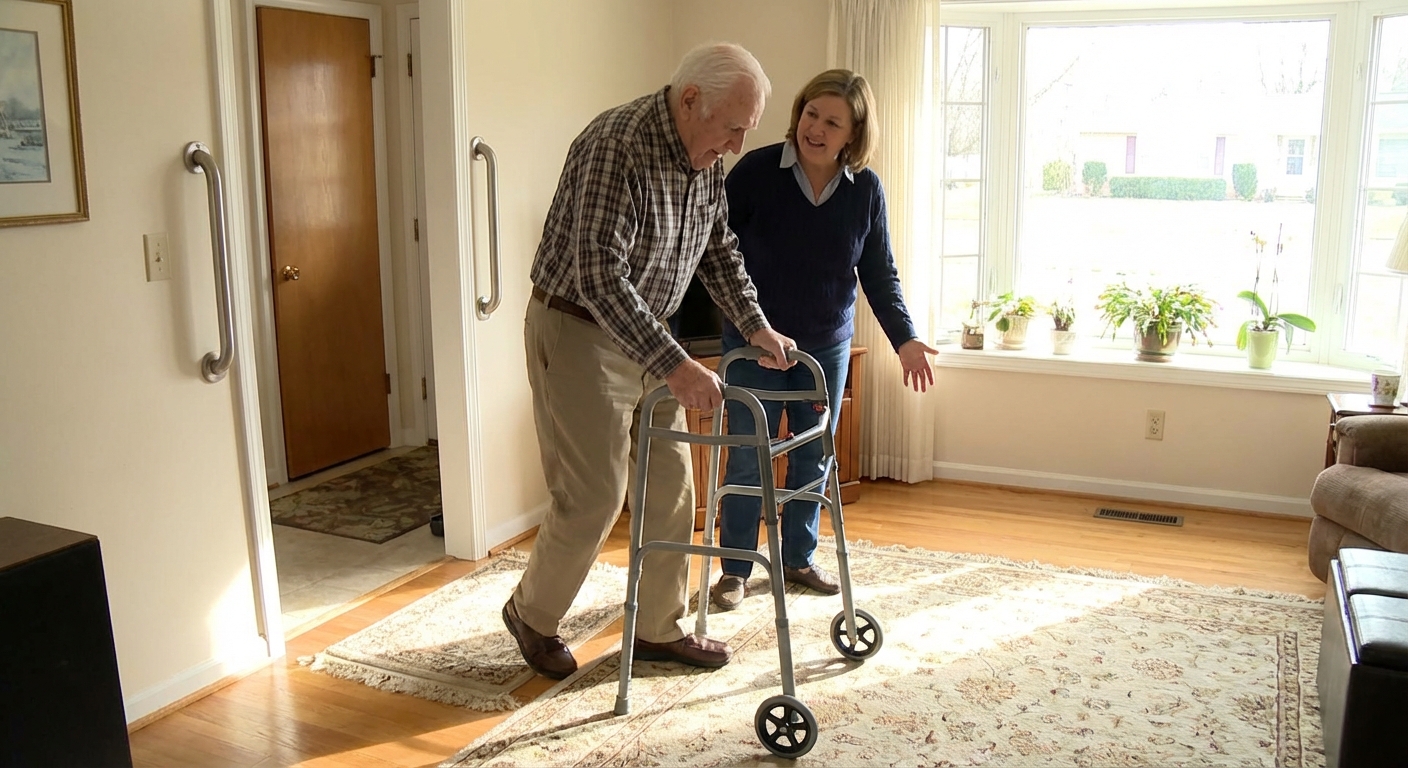
Stability devices aren’t just for when someone is “really bad off.” They’re for:
- People with arthritis who feel stiff getting up from low chairs
- Folks with dizziness, low blood pressure, or neuropathy
- Anyone recovering from surgery or a fracture
- People who just feel “a bit unsteady lately” but can’t quite explain it
When I started treating stability as preventive care instead of a last resort, the whole picture shifted.
What Are “Stability Devices” at Home, Exactly?
When I say stability devices, I’m not just talking about walkers and canes. I’m talking about anything that:
- Reduces the chance of losing balance (non-slip surfaces, railings)
- Gives something solid to hold onto (grab bars, furniture risers)
- Makes movement paths clearer and safer (lighting, layout changes)
Let’s walk through some of the main categories I’ve used and tested.
1. Grab Bars: The Unsung Heroes
I used to think grab bars were just for “old people bathrooms.” Then I tried standing up from a low toilet without using my hands, just to see what my aunt was dealing with. I nearly face-planted into the door.
Where grab bars actually help
From my experience, the most impactful spots are:
- Beside the toilet (horizontal or angled bar)
- Inside the shower and just outside the shower entrance
- Near steps with no railings (garage steps are a big one)
When I installed a properly anchored vertical bar just outside my aunt’s shower, her comment was: “Why didn’t we do this ten years ago?”
Pros
- Relatively low-cost
- Evidence-backed: studies show bathroom grab bars reduce fall risk and support independence
- Can be installed to look modern, not “institutional”
Cons
- Must be drilled into studs or solid backing – suction-cup-only bars are, frankly, a gamble
- Bad placement can make them useless (too high, too low, wrong angle)
I now always recommend involving an occupational therapist (OT) or experienced installer for placement. The angle and height can depend on a person’s strength, height, and range of motion.
2. Non-Slip Surfaces: The Quiet Fix That Matters
When I tested non-slip strips in my own shower out of curiosity, I realized how much I’d been skating around like a penguin before.
Key places I’ve upgraded:
- Bathtubs and showers – adhesive non-slip strips or full mats
- Entryways – flat, non-curling rugs with strong non-slip backing
- Kitchen “work triangle” – sink, stove, fridge areas where spills happen
Pros
- Cheap, fast to install
- Practically invisible if you choose clear strips
Cons
- Need to be replaced periodically as adhesive wears out
- Low-quality mats can themselves become a trip hazard when edges curl
If one change had to be first on your list, I’d put non-slip surfaces in the bathroom at the top.
3. Mobility Aids: Canes, Walkers, and Rollators at Home
The first time I tried a rollator (those walkers with wheels and a built-in seat), I misunderstood how to use it. I leaned too far forward, pushed it ahead, and the therapist supervising me said, “You’re walking the dog, not walking with support.” Point taken.
That’s when I realized how often mobility aids are used incorrectly at home.
Canes
Good when there’s mild weakness or pain on one side (like after a minor stroke or with knee arthritis).
In my experience, key mistakes I see:- Cane held in the wrong hand (it should go on the stronger side)
- Height not adjusted (handle should be around wrist crease when standing upright)
Walkers and rollators
Great for people who:
- Get tired easily
- Have balance issues
- Need to carry items but still want both hands free
But they have downsides:
- Rollators can pick up too much speed on slopes
- Indoor clutter (rugs, narrow hallways, low tables) can snag wheels
- Poor brake use can cause accidents
When I walked through my aunt’s hallway with a standard walker, I instantly saw furniture that needed to go. What looked “homey” to her looked like an obstacle course to me.
4. Bed, Chair, and Toilet Supports
Some of the most underrated stability devices don’t look medical at all.
Bed rails and pull-up aids
I tested a bed rail that slid between mattress and box spring and anchored with straps. What surprised me most was how much easier it made rolling to my side and pushing up to sit.
These help when:
- Someone struggles to sit up in bed
- Nighttime dizziness or blood pressure drops are an issue
- Falls are happening during late-night bathroom trips
Lift chairs and firm seating
Soft, deep sofas are secretly evil if you have weak quads. I watched one client practically get swallowed by hers.
What helped:
- A firm, higher chair with armrests
- A simple seat cushion to raise sitting height
- In some cases, a power lift chair that tilts forward to help standing
Raised toilet seats and toilet frames
Not glamorous, but wow, do they work. When I tried a raised seat myself, the difference in knee strain was obvious.
Pros:- Reduce the “deep squat” that strains hips and knees
- Often come with armrests for extra push support
- Can wobble if poorly fitted
- Some models are hard to keep clean
5. Lighting and Layout: The Invisible Stability Devices
I didn’t appreciate lighting as a “stability device” until I tried walking from my bedroom to the bathroom at 3 a.m. with the lights off, just using the faint light from my phone in the hallway. I caught my foot on the edge of a rug and immediately thought of my fall-prone clients.
Upgrades that made a huge difference:
- Motion-sensor night lights in hallways and bathrooms
- Consistent lighting levels – no super-bright room followed by a dark one
- Cleared pathways – no stacks, boxes, low tables, or decorative baskets in walkways
The best part: these changes don’t feel “medical.” They just feel like better design.
The Emotional Side: Pride, Stigma, and Saying Yes to Help
When I first suggested a grab bar to my aunt, she crossed her arms and said, “I’m not that old.” The resistance wasn’t about money or drilling holes; it was about identity.
What worked was reframing.
Instead of saying, “You’re at risk of falling,” I tried: “Let’s make your house work as hard as you do. Why should you have to use all your energy just standing up from the toilet?”
In my experience, these three approaches reduce pushback:
- Blame the house, not the person
- “This tub is slippery” instead of “Your balance is bad.”
- Test one thing temporarily
- “Let’s try this non-slip mat for a week and see if it feels better.”
- Normalize with data
- Sharing that millions of active, independent adults use stability devices as smart prevention, not a badge of frailty.
The Downsides and Limitations (Because Nothing Is Magic)
To keep this honest, here’s what stability devices don’t do:
- They don’t fix underlying issues like neuropathy, vision loss, or medication side effects. Those need medical review.
- They can create new hazards if installed incorrectly or used poorly.
- They may lull families into skipping other fall-prevention work like strength training, medication review, and vision checks.
One study I read on fall prevention pointed out that the most effective programs combine home modifications, strength and balance training, and medication review – not just hardware.
When I saw that, it made sense. Stability devices are the scaffold; your body and habits are the building.
How to Get Started Without Overhauling Your Whole House
If you’re feeling overwhelmed, here’s the simple approach I’ve used with family and clients:
- Walk the home like a detective
- Do a slow walk-through imagining you’re a little weaker, a little dizzy, or carrying a laundry basket.
- Note every “uh-oh” moment – slippery spot, sharp corner, narrow passage.
- Start with the “Big Three” fall zones
- Bathroom
- Bedroom-to-bathroom path
- Steps and entrances
- Add one stability device per zone
- Bathroom: grab bar or non-slip mat
- Path: night lights or clearing obstacles
- Steps: handrail or grab bar
- Get professional eyes if you can
- An occupational therapist home visit is pure gold. They’ll spot risks you didn’t know existed and recommend specific devices, not just vague “be careful” advice.
When I finally did this systematically at my aunt’s place, we didn’t turn her home into a hospital. We just upgraded certain spots so they worked with her body instead of against it.
Months later, she told me, “I don’t think about falling all the time anymore.” That, to me, is the real goal: not just fewer injuries, but more mental freedom to move around your own home.
Final Thoughts: Stability as an Act of Respect
When I really sat with it, I realized stability devices aren’t about age or weakness. They’re about respect — for your future self, for your body, and for the people who love you and don’t want that middle-of-the-night call from the ER.
If you or someone you love is feeling even a tiny bit less steady at home, don’t wait for a fall to validate that worry. Test one small change. Install one bar. Add one light. Lay down one non-slip mat.
From what I’ve seen, those “small” upgrades can quietly change someone’s entire experience of moving through their own home — from anxious and cautious to steady, supported, and actually free.
Sources
- Centers for Disease Control and Prevention – Important Facts about Falls - Key statistics and risk information on falls in older adults
- National Institute on Aging – Prevent Falls and Fractures - Practical strategies and home safety tips
- Mayo Clinic – Fall Prevention: Simple Tips to Prevent Falls - Expert guidance on reducing fall risk
- Harvard Health Publishing – Preventing Falls in Older People - Evidence-based overview of fall prevention approaches
- Cleveland Clinic – Grab Bars & Handrails for Home Safety - Clinical perspective on using grab bars and handrails safely at home