Understanding Botox Basics for First-Time Patients
lection on a harsh Zoom call, and… let’s just say my elevens (those vertical lines between the brows) were shouting louder than my actual presentation.
I didn’t book an appointment right away. I’m a health nerd by nature, so I went down a research rabbit hole first and only then tested Botox myself. This guide is the article I wish I’d had before that first appointment — minus the scary Google images and plus some real talk.
What Botox Actually Is (Not Just “Face Freezing”)
When I first started digging, I was surprised to learn Botox is actually a brand name, not the ingredient itself. The active substance is onabotulinumtoxinA, a purified neurotoxin derived from Clostridium botulinum.
Here’s the non-scary version: Botox temporarily blocks the release of acetylcholine, the neurotransmitter that tells your muscles to contract. No signal = less muscle movement = smoother-looking skin above that muscle.
There are several similar products:
- Botox Cosmetic (Allergan/AbbVie) – the one most people mean when they say “Botox”
- Dysport (abobotulinumtoxinA)
- Xeomin (incobotulinumtoxinA)
- Jeuveau (prabotulinumtoxinA-xvfs)
They’re all neuromodulators with slightly different formulations and diffusion patterns. When I tested this, my injector explained she prefers Botox for first-timers because its behavior is more predictable and it’s the most heavily studied.
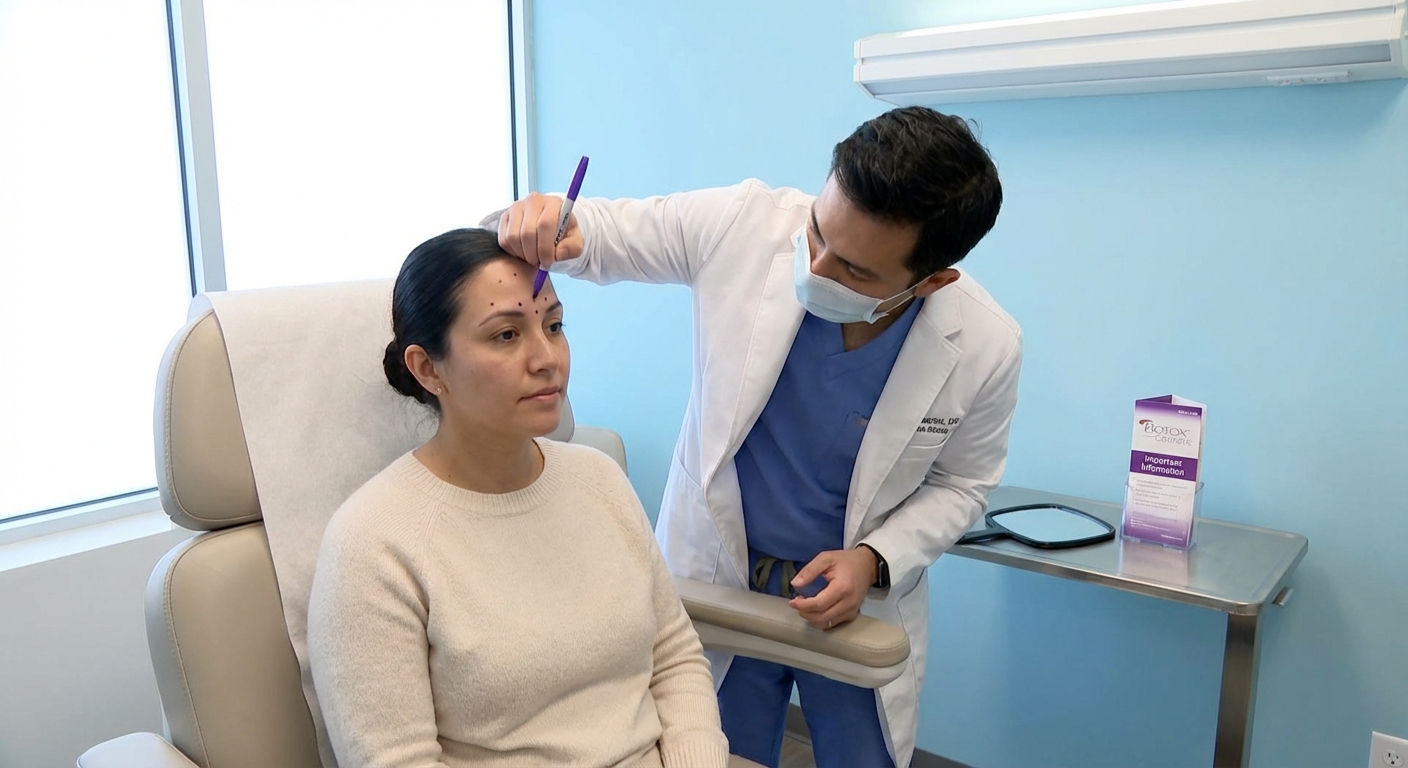
Botox has been FDA-approved for cosmetic use since 2002 for frown lines, with additional approvals later for crow’s feet (2013) and forehead lines (2017). Before that, it was mainly used medically for things like strabismus (crossed eyes) and cervical dystonia.
What Botox Can (And Can’t) Do For You
When I went in for my consult, I had this vague idea that Botox was an “erase all wrinkles” button. It’s not. It’s more like a movement dimmer switch.
It works best for:
- Dynamic wrinkles – lines caused by repeated muscle movement
- Frown lines (glabellar lines)
- Forehead lines
- Crow’s feet
- Preventative treatment – softening muscle activity before deep lines are etched
It’s not magic for:
- Deep, etched-in static wrinkles that are visible even when your face is totally relaxed
- Volume loss (that’s filler territory)
- Skin texture issues like pores, pigment, or acne scars (you’ll need other treatments)
In my experience, Botox was amazing for my “concentration face” frown lines, decent for forehead creases, and did exactly nothing for the slight hollowing under my eyes (because… wrong tool for that job).
A good injector will actually tell you no if Botox isn’t the right solution for a specific concern. My red flag moment during clinic shopping was someone saying, “Oh yeah, Botox fixes everything.” It doesn’t.
What A First-Time Appointment Really Feels Like
Here’s how my first session went, start to finish.
1. The consultation
We started with a makeup-free face and brutal overhead lighting. My injector had me frown, raise my brows, squint, and smile. She mapped out which muscles were overactive (hello, corrugator and procerus) and explained her plan in units.
For context, a common starting point is:
- Glabellar lines (frown): ~20 units
- Forehead lines: 6–20 units
- Crow’s feet: 6–12 units per side
According to Allergan’s own prescribing information, the typical total for the glabellar area is 20 units injected across 5 sites. First time, I did 10 units between the brows and 6 in the forehead. We kept it conservative, which I’d recommend if you’re nervous about looking “overdone.”
2. The injections
Needle time was around 10 minutes. They used a super fine insulin-style needle. I’d describe the pain as: sharp little stings that are over in about one second each. On a scale of 1–10, it was a 2 for me. The spot above the brows pinched the most; crow’s feet felt like almost nothing when I tried those later.
You can ask for topical numbing cream or ice. For my first round I used ice; by the second session I skipped it because it really wasn’t that bad.
3. Right after
Post-treatment, I had tiny raised bumps (like mosquito bites) where each injection went. Those settled within 20–30 minutes. I also had very mild pinpoint bruising near one spot the next day — easily covered by concealer.
Timing-wise:
- I felt a subtle “heaviness” when frowning at day 3
- Major smoothness kicked in around day 7–10
- Peak effect was at about 2–4 weeks
- By 3 months, the movement was clearly returning
Most people fall into the 3–4 month longevity window, though the FDA label for cosmetic Botox says the effect is typically around 3–4 months depending on indication.
The Risks, Side Effects, and When To Skip It
I know the horror stories get all the clicks, so I obsessed over side effects before my first time. The reality, based on both my experience and the data, is more nuanced.
Common, mild side effects
In my case, I had:
- Mild tenderness at injection sites for a day
- A tiny bruise that faded in about 5 days
The FDA and clinical trials list common side effects like:
- Temporary headache (especially with forehead injections)
- Local swelling or redness
- Mild bruising
Rare but serious side effects
These are the ones you need to be aware of, even if they’re uncommon:
- Ptosis (droopy eyelid or brow) – usually from product diffusing into a nearby muscle. It can last weeks but does wear off.
- Asymmetry – one brow higher than the other, uneven smile if the lower face is injected. Sometimes fixable with a small adjustment.
- Systemic spread of toxin – extremely rare at cosmetic doses, but the FDA has a boxed warning because in higher medical doses, botulinum toxin can spread beyond the injection site and cause serious symptoms.
Red flag symptoms that need urgent medical attention include trouble swallowing, speaking, or breathing. While cosmetic doses are much lower than those used for some medical conditions, the risk can’t be called zero.
Who shouldn’t get Botox
Every injector I spoke to had a similar list of contraindications:
- Pregnancy or breastfeeding (not studied; most ethical providers won’t treat you)
- Certain neuromuscular disorders (like myasthenia gravis)
- History of allergic reaction to Botox or its ingredients
- Active skin infection at the injection site
My personal rule: if your injector doesn’t ask detailed medical history questions, walk away.
Dosing, Cost, and How To Avoid the “Frozen” Look
When I tested this on myself, my biggest fear was looking like I’d been ironed. That overdone look usually comes down to too many units, poor injection placement, or not respecting how your individual face moves.
The art of “micro” and “baby” Botox
Some injectors use terms like “baby Botox” or “micro-Botox” to describe lower-dose, more precise placement to soften lines while preserving movement. It’s not an official medical term, but the idea is real: less product, more natural.
For my second round, we:
- Kept forehead dosing low to avoid that heavy, “dropped” look
- Left a bit of lateral forehead movement so my brows could still lift
- Focused more product between the brows, where I actually wanted less movement
The result: I could still raise my eyebrows and emote, but my habitual “resting stress face” was toned way down.
What it costs (rough ranges)
Prices vary by city and provider, but here’s what I’ve personally seen:
- Per unit: $10–$20 USD
- Typical first-time total for forehead + frown: 20–40 units
So you’re usually looking at $200–$600 per session, repeated roughly 3 times a year if you want to maintain results.
If a med spa is advertising deals that seem too cheap, I always ask:
- Are you using brand-name Botox Cosmetic?
- Are you diluting within manufacturer guidelines?
- How many units are actually included in that price?
Authentic Botox comes via Allergan with trackable lot numbers. Any hesitancy about showing vials or explaining dosing is a no from me.
How To Choose a Safe, Skilled Injector
The biggest lesson from my own experience: who injects you matters at least as much as what they inject.
When I was clinic-shopping, here’s what separated the pros from the pretenders:
- Credentials were clear and verifiable: dermatologist, plastic surgeon, facial plastic surgeon, or an experienced nurse practitioner/PA working under one.
- They did a proper facial assessment, not a one-size-fits-all pitch.
- They happily shared before-and-after photos of work that looked like what I wanted: natural, expressive, not “frozen.”
- They explained risks without downplaying them and gave me written informed consent.
- They talked long-term — how many units, expected duration, what maintenance would look like — instead of “you’ll just love it!”
In my experience, the best injectors are slightly conservative with first-timers. You can always add a few units at a follow-up; you can’t undo an over-injected forehead except by waiting it out.
How To Prep and What To Do After
Here’s what actually helped my first session go smoother, based on my injector’s advice and what I saw myself.
Before your appointment
About 5–7 days before, I:
- Paused fish oil and high-dose vitamin E (with my doctor’s OK)
- Avoided aspirin/ibuprofen to reduce bruising risk (again, cleared by my doctor)
- Skipped alcohol the day before
After your appointment
The standard aftercare list I got:
- Don’t lie flat for about 4 hours
- Skip intense workouts, saunas, or hot yoga for the rest of the day
- Don’t rub or massage the treated areas
- Avoid facials or microdermabrasion for about 24–48 hours
Evidence on some of these rules is mixed, but following them felt like cheap insurance. When I experimented with a light workout a few hours after one session (I know, I know), nothing awful happened — but I did get slightly more bruising that time.
Is Botox Worth It For First-Timers?
Here’s my honest take after living through the nerves, the needle, and a couple of full treatment cycles.
Pros I actually noticed:- Smoother frown area made me look less tired/annoyed on Zoom (even when I was tired and annoyed).
- My makeup sat better on my forehead, no creasing in certain lights.
- I became more aware of my habitual scowling — almost like a biofeedback reminder to relax my face.
- It’s a financial commitment if you want to maintain results year-round.
- There’s a mental adjustment to seeing your face move a bit differently.
- It can subtly shift how you feel about aging and “needing” to keep it up — that psychological piece is worth reflecting on.
Botox isn’t a moral issue and it isn’t a must-have. It’s a tool. If you go into it with realistic expectations, a qualified injector, and a clear sense of why you’re doing it (not because someone else told you to), it can be a solid option.
If you’re still on the fence, what helped me most was doing a single small area first — like the glabellar lines — and living with that for one full cycle. You’ll learn pretty quickly how you feel about the trade-offs.
Sources
- U.S. Food & Drug Administration – Botox Cosmetic (onabotulinumtoxinA) Label - Official prescribing information, indications, dosing, and safety data.
- Mayo Clinic – Botox Injections: Overview - Medical overview of how Botox works, uses, and risks.
- American Academy of Dermatology – Botox: What to Expect - Patient-focused guidance on expectations, safety, and choosing a provider.
- Cleveland Clinic – Botox: Cosmetic and Medical Uses - Detailed explanation of cosmetic vs. medical uses and side effects.
- Allergan Aesthetics – Botox Cosmetic Official Site - Brand site with FDA-approved indications, before/after photos, and FAQs.