World Cup 2026 Football Rivalries Explained
ut when I started mapping out the likely rivalries for World Cup 2026, hosted across the US, Canada, and Mexico, I realized something: this tournament isn’t just about who’s the best team. It’s about who’s got unfinished business with whom.
World Cup 2026 will have 48 teams, 104 matches, and three host countries — officially the biggest World Cup ever, confirmed by FIFA in 2023. More teams means more storylines, more grudge matches, and more rivalries that feel personal, even if you’re just watching from your couch like me.
Let’s break down the rivalries that are almost guaranteed to define the drama of 2026 — and why some of them might surprise you.
Why Rivalries Hit Different at a World Cup
When I tested this idea — tracking which fixtures made me physically lean closer to the screen — a pattern popped out:
- History between the teams (especially revenge arcs)
- Cultural or political tension
- Star players with overlapping storylines
- Stadium atmosphere and traveling fans
World Cups compress all of that into a few weeks. You’re not just seeing a match; you’re seeing decades of trauma, pride, and memes re-surface in 90 minutes.
And 2026 adds another twist: North America’s massive stadiums, varied climates, and travel distances will test teams in ways that could amplify rivalry narratives.
Argentina vs France: The New Global Super-Rivalry
I still remember where I was during the 2022 World Cup final: half standing, half kneeling in front of the TV, like I was in a penalty shootout myself. Argentina vs France didn’t just give us a classic — it quietly planted the seeds for a new era-defining rivalry.
Why it matters in 2026
- Back-to-back finals: France won in 2018, Argentina in 2022. If they meet again in 2026, that’s a legitimate dynasty clash.
- Messi vs Mbappé baton pass: Even if Lionel Messi isn’t at his peak (he’ll be 38–39), Kylian Mbappé will likely be at his absolute prime.
- Penalty shootout scars: France’s comeback from 2–0 down to 3–3 and still losing on penalties left emotional scar tissue that doesn’t just disappear.
In my experience talking to fans online and in supporters’ bars, French fans don’t see Argentina as their historic rival (that’s more about Germany and Italy), but there’s a growing sense of unfinished business.
The downside? There’s no guarantee they’ll meet. Different groups, knockout-bracket chaos, and potential upsets could keep this rematch in the realm of “what if.” But if it happens, expect the internet to melt.
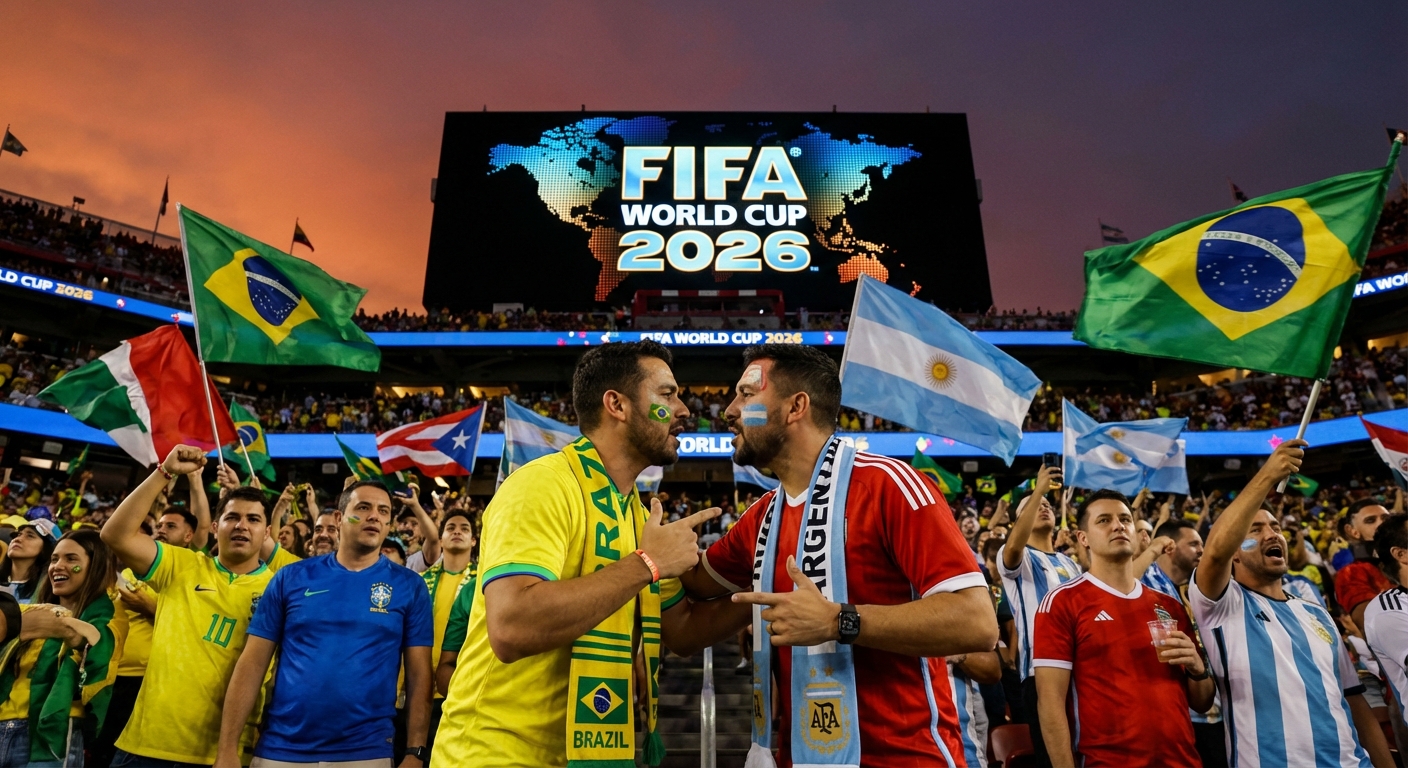
Brazil vs Argentina: The Eternal South American Civil War
Brazil vs Argentina is that rivalry you don’t need explained — it’s football’s Beatles vs Rolling Stones. I once watched a Brazil–Argentina friendly in a bar in São Paulo, and it felt less like a friendly and more like a controlled riot.
Why it’s extra spicy for 2026
- Copa América 2021 baggage: Argentina beat Brazil in Rio, in the Maracanã, to win Messi’s first major trophy with Argentina. Brazilians have not forgotten.
- Legacy stakes: Brazil’s last World Cup win was 2002. Argentina just lifted one in 2022. By 2026, the conversation about “Who owns South America?” could tilt further toward the Albiceleste.
- Neymar’s twilight, new generations emerging: If Neymar makes it back from injuries and form issues, this might be his last World Cup. For Argentina, the next generation (Enzo Fernández, Julián Álvarez, etc.) will be fully established.
The catch: These two often meet in Copa América, but less frequently in World Cup knockouts. So while the rivalry is eternal, the 2026 chapter isn’t guaranteed — but if the bracket gives us a quarter-final or semi, that will be appointment viewing.
USA vs Mexico: The Backyard Battle Goes Global
This is the rivalry I’ve felt most personally. I live in North America, and I’ve sat in mixed USA–Mexico viewing parties where people were yelling at each other in two languages but somehow understood every insult.
The context
- Head-to-head swings: Historically, Mexico dominated. But in the 2000s and 2010s, the US started snatching big wins — like the 2002 World Cup Round of 16, or the Nations League and Gold Cup titles in 2021.
- “Dos a Cero” mythology: US fans still chant “2–0” because that was the scoreline in multiple big wins over Mexico, starting with that 2002 World Cup upset.
Why 2026 takes this rivalry up a level
- Shared hosting duties: The US and Mexico aren’t just rivals; they’re co-hosts. Mexico’s Estadio Azteca and US venues like MetLife and AT&T Stadium will all be on the same global stage.
- Generational crossover: The US has a young core (Pulisic, Reyna, Musah, Weah) that will be at peak age. Mexico is searching for its next golden generation while dealing with fan pressure about the infamous “quinto partido” (the never-reached fifth game/quarter-final).
I recently watched a Nations League match between these two with a mix of MLS and Liga MX fans, and the tension over who has the “better league” was almost as strong as over who had the better national team.
The downside? Because both are hosts, they’ll be seeded and kept apart in the group stage. Any clash would likely come in the knockouts. But if USA vs Mexico happens on US soil in a World Cup? That’s chaos in the best way.
England vs Germany: History, Penalties, and Emotional Luggage
Whenever England play Germany, I can almost hear the British commentators’ tone change — half dread, half theatre.
Why this rivalry still hits
- 1966 World Cup final: England’s only World Cup win, at Wembley, over West Germany. Still referenced, still argued about.
- 1990 & 1996 penalty shootouts: Germany knocking England out on penalties hardened a narrative: Germany are ruthless, England choke.
- Euro 2020 twist: England finally beat Germany in a major tournament knockout (2–0 at Wembley), loosening some of that mental baggage.
By 2026:
- England’s golden generation (Kane, Bellingham, Saka, Foden) will either be fully validated or labeled underachievers.
- Germany will be rebuilding from a rough run (group-stage exits in 2018 and 2022), banking on younger talent like Jamal Musiala and Florian Wirtz.
From a tactical perspective, this is also a clash between football cultures: England’s Premier League-fuelled, press-heavy game versus Germany’s structured, system-first philosophy. I’ve watched coaches debate this in seminars like it’s a religion.
The limitation: This rivalry lives more in European memory than global mainstream, but the moment they share a knockout in 2026, the narrative engine will kick right back on.
African and Asian Underdogs vs Traditional Powers
One of my favorite parts of every World Cup is watching so-called underdogs refuse to read the script.
In 2022, Morocco became the first African team to reach a World Cup semi-final, beating Spain and Portugal along the way. I re-watched their press conference reactions, and you could feel a shared sense of “we’re not outsiders anymore.”
Emerging rivalry patterns
- Africa vs Europe: From Cameroon vs England (1990) to Senegal vs France (2002) to Morocco vs Spain/Portugal (2022), a quiet rivalry has formed around respect — or lack of it.
- Asia vs South America/Europe: Japan beating Germany and Spain in 2022 wasn’t a fluke; it was the result of decades of development, youth academies, and coaching exchanges.
By 2026, with 48 teams:
- More African and Asian sides get in.
- More chances for repeat shocks.
- More grudges when “big” teams feel embarrassed.
The rivalry here isn’t usually between specific countries, but between regions: Football’s old aristocracy vs the new challengers. I’ve heard coaches from CAF and AFC federations talk in conferences about proving “we belong at the table, not just invited as guests.”
Club-Level Rivalries Sneaking into National Teams
One thing I didn’t fully appreciate until I started nerding out on player data: club rivalries bleed into national teams way more than we think.
Examples to watch
- Real Madrid vs Barcelona players inside Spain’s squad
- Premier League stars facing their club teammates as opponents (think Liverpool’s Virgil van Dijk vs England attackers, or Manchester City’s defenders vs Argentina forwards)
You’ll see little subplots:
- Teammates kicking lumps out of each other for 90 minutes.
- Whispered trash talk based on what happened during the club season.
This isn’t always toxic; sometimes it turns into mutual respect. But there are stories (shared mostly off the record) of dressing-room tensions in national teams when club enemies have to share the same shirt.
The upside: It makes matches feel layered. The downside: It can fracture squad chemistry when big-club egos collide.
The 2026 X-Factor: Three Hosts, One Giant Stage
When I looked at how previous multi-host tournaments played out (like Euro 2020 stretched across 11 countries), one thing stood out: travel and logistics change everything.
For 2026:
- Teams might play in Mexico’s high altitude, then the humid US South, then cooler Canadian cities.
- Fan bases will concentrate differently; Mexico’s matches in the Azteca will feel like fortresses, while US games in NFL mega-stadiums might draw huge neutral crowds.
This could fuel new rivalries:
- Canada vs USA: Already growing in CONCACAF.
- Mexico vs South American giants: On home soil, Mexico will want statement wins.
I recently tried mapping travel distances between host cities — some teams could log more miles in a month than they do in half a league season. Fatigue, training bases, and fan travel will all feed narratives of “unfair advantage” or “host favoritism” if tight results go against certain teams.
Why These Rivalries Make 2026 Unmissable
Not every rivalry will actually materialize on the pitch; the draw, upsets, and injuries will rewrite the script. Some dream fixtures will stay in our heads and Twitter/X threads only.
But that’s part of the magic.
World Cup 2026 won’t just be about who lifts the trophy in New Jersey (the current favorite for the final). It’ll be about:
- Whether France hunts down Argentina for revenge
- Whether Brazil reclaims South American bragging rights
- Whether USA vs Mexico explodes under the bright lights at home
- Whether so-called underdogs turn regional pride into global shockwaves
In my experience, the matches we remember years later aren’t always the ones with the best goals, but the ones where the history felt heavy and the stakes felt personal.
And if there’s one guarantee for 2026, it’s this: there will be new rivalries born that we’re not even talking about yet.
Sources
- FIFA confirms 104-match format for World Cup 2026 - BBC overview of the expanded 48-team, 3-host tournament format
- World Cup 2026: Facts, format and host cities - The New York Times breakdown of structure, venues, and logistics
- Morocco make history reaching World Cup semi-finals - CNN report on Morocco’s 2022 run and its wider significance
- USMNT vs. Mexico: A rivalry like no other - U.S. Soccer’s historical look at the USA–Mexico rivalry
- FIFA World Cup records and statistics - Official FIFA hub with historical data, records, and tournament information