Buy Phones and Pay Later: Financing Overview
an my first used car. The salesperson smiled and said the magic words: “You don’t have to pay today.”
That was my first real dive into phone financing – buy now, pay later, zero down, 0% APR (sometimes), all the buzzwords. Since then I’ve tested carrier plans, manufacturer financing, BNPL apps, even a 0% credit card offer just to see what’s actually smart… and what’s a debt trap with pretty branding.
Here’s what I’ve learned the hard way.
How “Buy Now, Pay Later” for Phones Actually Works
When you buy a phone and pay later, you’re basically doing one of four things, whether the marketing says it or not:
- Installment plan with your carrier (Verizon, AT&T, T-Mobile, etc.)
- Financing directly through the manufacturer (Apple, Samsung, Google)
- Buy Now, Pay Later (BNPL) via apps (Affirm, Klarna, Afterpay)
- Using a credit card or personal loan
Let me break these down the way I explain it to friends who text me screenshots of offers at 11:58 pm asking, “Is this sketchy?”
Carrier Financing: Easy… and Sticky
I once “upgraded for free” at a carrier store. The phone wasn’t free. The monthly payments were just buried in a long line of charges on my bill.
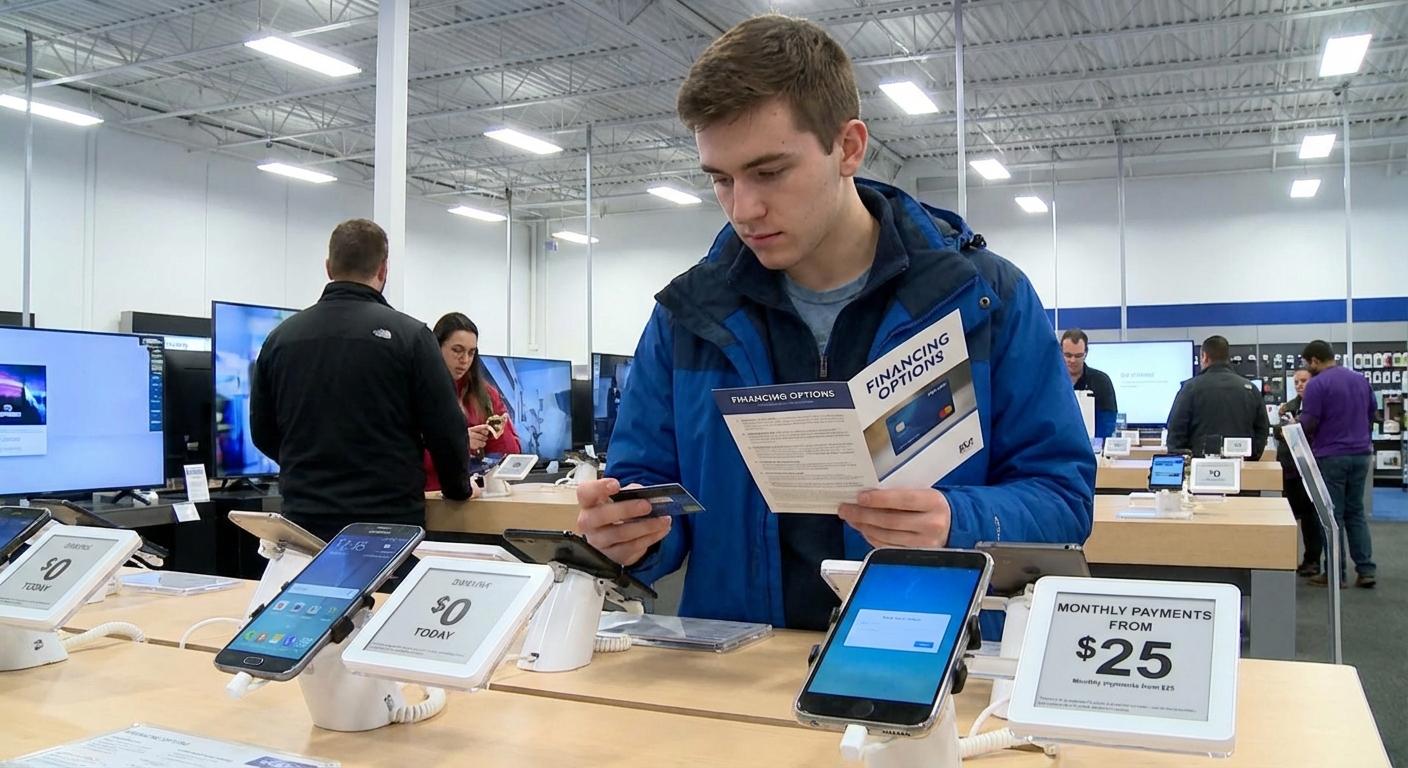
Most U.S. carriers now do:
- 24–36 month installment plans
- Often advertised as $0 down
- With a device credit that shows up as a discount every month
So that shiny $1,200 phone might look like $33/month for 36 months.
In my experience, here’s the real game:
- If you cancel early or leave the carrier, the remaining phone balance accelerates.
- Those “trade-in credits” often stop if you break the contract terms.
- You end up locked in for 2–3 years because leaving means a big lump-sum bill.
A 2022 Consumer Reports piece pointed out that carrier deals can disguise the real phone cost behind bill credits and promos, making it harder to compare total price versus buying unlocked.[^1]
When carrier financing can make sense:- You’re 95% sure you’ll stay with that carrier for 2–3 years.
- You’re getting a legit, high-value trade‑in (I’ve seen $800+ for older flagships during promos).
- The math actually shows you paying less than buying unlocked.
Manufacturer Financing: Cleaner, But Still Debt
When I tested Apple iPhone Payments and Samsung Financing, the experience felt smoother and more transparent than most carrier deals.
Typical setup:
- 0% APR for 12–24 months (if approved)
- Payments handled by a partner bank (e.g., Goldman Sachs for Apple Card, TD Bank for Samsung in the U.S.)
- Often includes the option to upgrade every year under certain programs
I liked that the portals usually show:
- Total device cost
- Monthly payment
- Number of months
- Any added AppleCare / Samsung Care+ costs
The catch? As always, the fine print.
- Miss a payment → potential late fees, possible interest if promo terms are broken.
- Your credit is checked, so this is still real debt.
- Some upgrade programs require you to return the old phone in good condition, or you pay more.
For disciplined people who budget well, manufacturer financing is often one of the cleanest ways to pay later without hidden bill tricks.
BNPL Apps: Fast, Flashy, and Risky If You Wing It
I tested an Affirm offer once on a mid-range Android just to see how it felt.
The upsides:
- Approval was instant.
- The app showed me exact dollar amounts, including interest, up front.
- I could sync payments with my payday.
BNPL players like Affirm, Klarna, and Afterpay often advertise:
- “Pay in 4” (4 interest-free payments) for smaller purchases
- Longer terms (6–24 months) for bigger devices, sometimes with interest
But here’s what I noticed and what research backs up:
- A 2023 Consumer Financial Protection Bureau (CFPB) report found BNPL users are more likely to also carry credit card, payday loan, and other debts at the same time.[^2]
- Because payments are small and spread out, it’s easy to stack multiple BNPL plans and lose track.
I caught myself doing the mental trick: “It’s only $40 a month” while ignoring that I had three “only $40 a month” things at once.
BNPL can work if:
- You track all your debts in one place (budget app, spreadsheet, or even paper).
- You treat it like a short-term loan, not free money.
- You know what happens with late or missed payments (fees, collection, credit ding).
If you’re already juggling bills, adding a BNPL phone plan may feel good now and miserable in month three.
Credit Cards & Personal Loans: The Stealth Expensive Option
I’ve done the “0% APR for 12 months” credit card move on a phone before. It can be brilliant or brutal.
Smart version:- New card with a 0% intro APR on purchases for 12–18 months
- Set automatic payments to divide phone cost over the promo period
- Pay it off before regular interest kicks in
- You only pay the minimum
- Promo period ends
- Suddenly you’re staring at 20–30% APR interest on a depreciating device
Personal loans can occasionally make sense if:
- The interest rate is lower than your credit card
- You’re rolling multiple debts into one payment
- You absolutely stick to the payoff plan
But for a single phone, I rarely see a plain personal loan as the best tool.
The Real Math: Depreciation vs. Payments
Here’s the part most ads never mention.
Phones are fast‑depreciating assets:
- A 2023 BankMyCell analysis found some flagship phones lose 40–60% of their value in the first year.[^3]
- By year two, it’s common for a $1,000 phone to be worth under $400 in trade-in or resale value.
Now layer that with financing:
- If you’re on a 36‑month plan, you may still be paying for a phone that’s already out of its major update window or barely worth trading in.
- If you pair long financing with yearly upgrades, you’re basically renting an expensive gadget on an infinite loop.
What I do now:
- I cap myself at 24 months if I finance at all.
- I check resale and trade‑in values when I buy, not when I’m desperate to upgrade.
- If the phone won’t reasonably last as long as the financing term, I skip the deal.
When Paying Later Is Actually Smart
Financing a phone isn’t automatically bad. In my experience, it can be rational if:
- You have stable income and a realistic budget.
- The financing is truly 0% APR and you understand the terms.
- The phone is a work tool, not just a flex – for example:
- You’re a creator who genuinely needs the camera upgrade.
- You use it to run your freelance or side-business life.
- You’d be draining your emergency fund to pay in full.
I’ve absolutely chosen a 0% plan over emptying my savings, and I’d do it again. Liquidity matters.
Red Flags I Watch For Before I Sign Anything
I’ve developed a checklist that’s saved me from a few “almost” regrets:
- No clear total cost shown → I don’t sign.
- “Free upgrade” that requires staying 30+ months → usually not actually free.
- Required add-ons (insurance, accessories) baked into the loan.
- Heavy pressure to decide right now, “deal ends tonight.”
- No documented answer to: “What happens if I cancel early?”
If a rep can’t calmly walk me through all the ways the deal can go wrong for me, I assume they either don’t know or don’t want me to know.
Practical Playbook: How to Buy a Phone and Pay Later Without Regrets
Here’s the process I now use personally:
- Set a real budget first. I decide the monthly number before I look at models. If the phone doesn’t fit, the phone doesn’t happen.
- Compare total costs, not just monthly payments, across:
- Carrier financing
- Manufacturer program
- BNPL or 0% credit card
- Check your upgrade personality. If you upgrade yearly, don’t sign a 36‑month plan unless you love pain.
- Read at least one full page of fine print. I focus on: late payments, early termination, interest triggers.
- Automate payments. I set auto‑pay for the exact amount so I don’t get hit with late fees because I lost track.
The most “viral” part of this topic is usually the hype about the newest model and how “you can afford it for just $X/month.”
The genuinely powerful move? Being the person who actually knows what that $X/month adds up to, and whether it matches your priorities.
I still love tech. I still occasionally treat myself. I just refuse to be surprised by my own phone bill anymore.
Sources
- Consumer Reports – How cell phone companies hook you with ‘free’ phones and big bills - Explains how carrier phone deals and bill credits really work
- Consumer Financial Protection Bureau (CFPB) – Buy Now, Pay Later: Market trends and consumer impacts - U.S. regulator’s analysis of BNPL usage and risks
- BankMyCell – iPhone depreciation statistics - Data on how fast smartphones lose value over time
- Federal Trade Commission (FTC) – Mobile Phone Plans & Services - Government guidance on reading and comparing cell phone plans
- Apple – iPhone Payments and Financing - Official overview of Apple’s phone financing options