Guide to Minimalist Packing for Backpack Travel
on a sweaty afternoon in Chiang Mai when I realized I’d worn the same T‑shirt three days in a row… while hauling around 18 kg of “just in case” stuff I never touched.
That moment sent me down a rabbit hole of ultralight forums, gear spreadsheets, and some truly chaotic field tests. When I tested my first real minimalist packing list on a month‑long trip across Portugal, Spain, and Morocco with only a 30L backpack, I felt weirdly… free. No checked bags. No decisions about which outfit to wear. No sore shoulders.
This guide is exactly what I wish I’d had before that first trip.
Why Minimalist Packing Changes the Whole Trip
In my experience, minimalist packing isn’t about suffering with one pair of socks and bragging rights. It’s about mobility and mental headspace.
When I switched from a 55L, 14 kg load to a 30L, ~8 kg load, a few things shifted:
- I stopped paying baggage fees and never waited at carousels.
- I could walk 20–30 minutes from stations to hostels without wanting to cry.
- I felt safer. A small pack stays with you on buses, trains, and in crowded stations.
A 2020 IATA report noted that carry‑on only travelers move through airports faster and experience fewer delays due to lost luggage. That seems obvious, but when you actually experience it—clearing customs and walking straight out while everyone else queues for a belt that might not even work—it hits different.
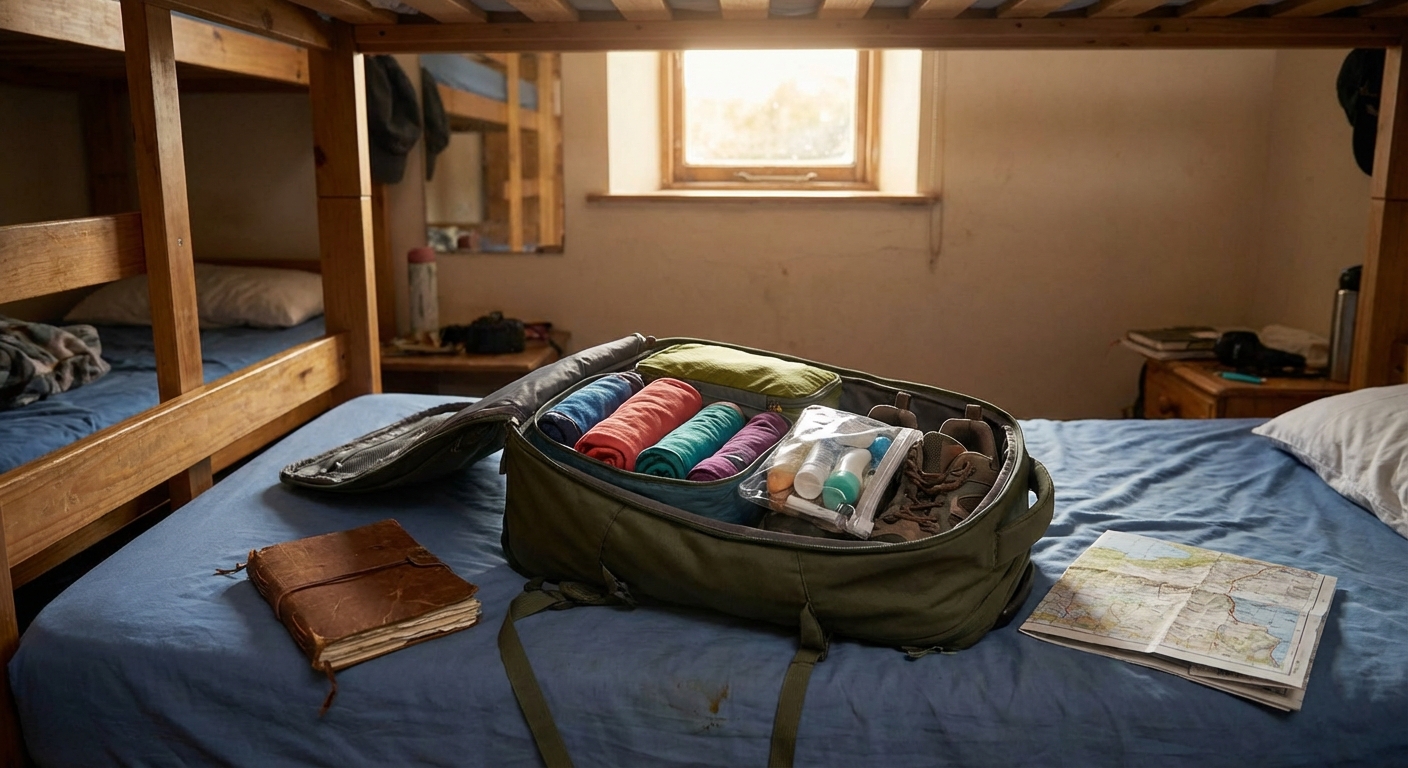
The big mental benefit? Fewer daily decisions. I had maybe 3–4 outfits total. Getting dressed took 10 seconds. That sounds tiny, but on the road, all those little decisions add up.
Step One: Choosing the Right Backpack
When I first tried going minimalist, I made a classic mistake: I used a giant trekking pack and told myself I’d “just not fill it.” Spoiler: I filled it.
Now I stick to a 30–40L backpack maximum. For most people, 35L is the sweet spot for multi‑week trips.
What actually matters in a pack (from testing too many):
- Front-loading (clamshell) opening: Top‑loading hiking packs are a nightmare in hostels. I switched to a clamshell design and instantly stopped exploding my stuff across dorm-room floors.
- Solid frame or structure: My frameless ultralight bag felt cool… until 8 kg of gear turned it into a lumpy potato. A light internal frame or stiff back panel is worth the grams.
- Hip belt & sternum strap: When I was walking 30–40 minutes in Lisbon’s hills, having weight on my hips instead of just shoulders literally changed my mood.
- Carry-on compatible: I strongly prefer bags within most airlines’ limits (~55 x 35 x 20 cm). That kept me in cabin baggage on budget airlines across Europe and Asia.
Well-known examples people often compare (I’ve either used or borrowed these on trips):
- Osprey Farpoint/Fairview 40
- Tortuga Travel Backpack 30/40L
- Patagonia Black Hole 32L
You don’t need the “perfect” bag to start, but if your pack is over 50L, your stuff will expand to fill the space—I’ve tested that hypothesis more times than I’d like to admit.
The Minimalist Packing Formula That Actually Works
When I finally forced myself to track what I wore vs. what just took a tour of Europe, I noticed a pattern. I was basically rotating the same 20–30 items.
Here’s the core system I use now for trips from 1 week to 2 months in mild to warm weather (all of this fits in a 30–35L bag):
Clothing (the real minimalist numbers)
For a typical low‑laundry, high‑mobility trip:
- 3–4 T‑shirts or tops (ideally quick‑dry; I like merino or light synthetics)
- 1 long‑sleeve layer (lightweight, works for sun and chill)
- 1 warm layer (thin fleece or light down jacket, packs small)
- 2 pairs of pants / or 1 pants + 1 shorts
- 4–5 pairs of underwear (7 if you hate frequent washing)
- 3–4 pairs of socks (merino lasts longer between washes)
- 1 pair of comfortable walking shoes
- 1 pair of sandals/flip‑flops (hostel showers, beaches, quick errands)
- 1 compact rain jacket or shell
When I tested this setup across 5 weeks in Eastern Europe, I never felt underpacked—but I did laundry roughly every 4–5 days. That’s the tradeoff: less weight = more frequent washing. For me, it’s worth it.
Toiletries (where a lot of people secretly overpack)
Here’s my “everything under one liter” kit:
- Travel‑size toothpaste, toothbrush, floss
- Solid shampoo bar (game changer; no liquids limit drama)
- Tiny bottle of all‑purpose soap (body + sink laundry)
- Razor (and a couple of blades)
- Deodorant (solid stick or travel size)
- Meds: a few painkillers, antihistamines, basic plasters, any prescriptions
I stopped bringing full‑size anything. Most places—even small towns—have pharmacies and supermarkets. A 2021 study on travel habits in Europe found 80%+ of travelers buy at least one toiletry on the road; I’ve fully embraced that statistic.
Tech & essentials
I’ve tested both ultra‑barebones and full “digital nomad” setups. My current middle ground:
- Phone + charger
- Compact universal adapter
- Lightweight power bank (~10,000 mAh)
- Kindle or small e‑reader (optional but I love it for long buses)
- Laptop only if I’m working; otherwise I leave it
- Copies of documents: passport, insurance, visas (digital + one printed)
Every extra cable or gadget adds bulk. When I forced myself to track usage, I found I’d carried a GoPro on three trips and used it a total of… four times.
Packing Tactics That Save Actual Space
The internet loves arguing about rolling vs. folding. When I tested both with the same gear and a 30L pack, here’s what I found:
- Rolling plus packing cubes gave me the best mix of space + organization.
- Compression cubes helped when I carried puffy layers, but made my bag denser and harder to rummage through.
My current system:
- 1 medium cube for tops
- 1 small cube for underwear/socks
- 1 small cube or pouch for electronics
- Toiletries in a flat, hanging bag
I also swear by a tiny “in-transit pouch” (a sling or small organizer) with:
- Passport and wallet
- Boarding passes or tickets
- Phone and headphones
- A pen (immigration forms are always waiting for the one person with a pen)
That way I’m not doing the awkward backpack‑in‑overhead‑bin yoga routine every time I need something.
The Hard Part: Letting Go of “Just in Case”
Minimalism sounds logical, until you’re staring at your favorite boots, second hoodie, and travel pillow thinking, “But what if…”
When I analyzed my own packing after a 6‑week trip through Southeast Asia, I realized about 25–30% of what I brought fell into the “never touched” category. The common culprits:
- Extra shoes beyond daily pair + sandals
- Bulky camera gear when I was happy with phone photos
- Full outfits for hypothetical fancy dinners
- Big first‑aid kits when pharmacies were on every corner
Now I use a simple rule that’s saved me from myself:
> If I can buy or borrow it within 24–48 hours at my destination for under $30, I don’t pack it.
This obviously has exceptions—prescription meds, glasses, specialized gear—but for most regular travel items, it holds up.
The real pros and cons of minimalist packing
Pros:- Less physical strain; my back and knees genuinely thank me.
- Faster movement through airports, stations, and city streets.
- Easier to keep track of everything (less risk of losing stuff).
- More flexibility with budget airlines and buses.
- You’ll wash clothes more often.
- Less variety in outfits (which can matter to some people, especially for photos or work trips).
- Specific situations—remote regions, harsh climates—may require more gear.
Minimalist packing isn’t a moral stance; it’s a strategy. For some trips (like a dedicated trekking expedition or extreme climates), I still go heavier and accept it. The key is being intentional, not defaulting to “bring everything.”
Safety, Comfort, and Health: What I Never Skip
There are a few things I tried leaving behind and regretted instantly:
- Travel insurance: I once spent a fun evening in a Croatian emergency clinic after a bike crash. Thankfully I was insured. The U.S. State Department and most government travel advisories strongly recommend insurance for international trips, and I’m fully on their side now.
- Basic first‑aid + personal meds: Not a giant kit, just: plasters, painkillers, antihistamines, and anything I personally rely on.
- Small microfiber towel: Hostels say they provide towels. Sometimes they don’t. Or they smell like a wet dog.
- Decent earplugs + eye mask: If you’ve ever shared a dorm with a snorer and a 4 a.m. pack‑exploder, you know.
These items weigh almost nothing but protect your sleep, health, and wallet.
How to Build Your Own Minimalist List
When friends ask me where to start, I suggest one simple experiment:
- Lay out everything you plan to bring.
- Create a “must use twice” rule: If you can’t imagine using an item at least twice on the trip (except safety and documents), it goes in the maybe pile.
- Pack your bag completely.
- Take a 30‑minute test walk around your neighborhood with it fully loaded.
- When you get home, remove 10–20% of the weight. You’ll instantly know which items you’re emotionally attached to vs. actually need.
When I tested this before a month in Mexico, I cut a whole pair of shoes, a sweater, and a stack of “backup” tops. I didn’t miss a single one.
Minimalist packing isn’t about being extreme. It’s about traveling lighter—physically and mentally—so you can focus on the actual point of the trip: the streets, the food, the people, the stories.
And maybe, just maybe, walking past the baggage carousel with a smug little grin.
Sources
- IATA - Annual Review 2020 - Data and analysis on global air travel patterns and baggage trends.
- U.S. State Department - Travel FAQs - Official guidance on documents, insurance, and preparation for international travel.
- REI Co-op - How to Choose a Travel Backpack - Expert breakdown of backpack types, capacities, and fit for travelers.
- Harvard Health Publishing - Smart Travel Tips - Evidence-based health and safety considerations for travelers.
- BBC Travel - Why We Pack Too Much - Analysis of psychological reasons behind overpacking and how to counter them.