Scooter Financing Guide
I’ll admit it: I almost signed a terrible loan agreement for a shiny electric scooter with LED strips that served absolutely no purpose except making me feel cool. Luckily, I stopped, read the fine print, and realized the financing would’ve cost me almost 40% more than the scooter’s sticker price.
This guide is exactly what I wish I’d had that day.
Why Finance a Scooter Instead of Paying Cash?
When I first started looking, I thought, “If I don’t have the cash, I shouldn’t buy it.” That’s not wrong… but it’s also not the full story.
In my experience, financing a scooter makes sense in a few situations:
- You need transportation quickly to get to work/school, but you don’t have the full amount saved yet.
- You’re replacing an expensive car commute (fuel, insurance, parking) with a cheaper scooter.
- You can lock in low interest and you’re disciplined about payments.
When I ran the numbers on my commute, I realized I was spending about $180–$220/month on ride-shares, transit plus occasional rentals. A financed scooter payment of $80–$120/month suddenly wasn’t so crazy.
But there’s a flip side.
Financing is a trap if:
- You stretch the term just to “make the payment smaller.”
- You don’t have a stable income.
- You’re already juggling high-interest credit card debt.
I’ve seen friends treat scooter loans like free money and then get wrecked by late fees, repossession threats, and wrecked credit scores.
The Main Scooter Financing Options (What I’ve Tried + Seen Up Close)
1. Dealer Financing
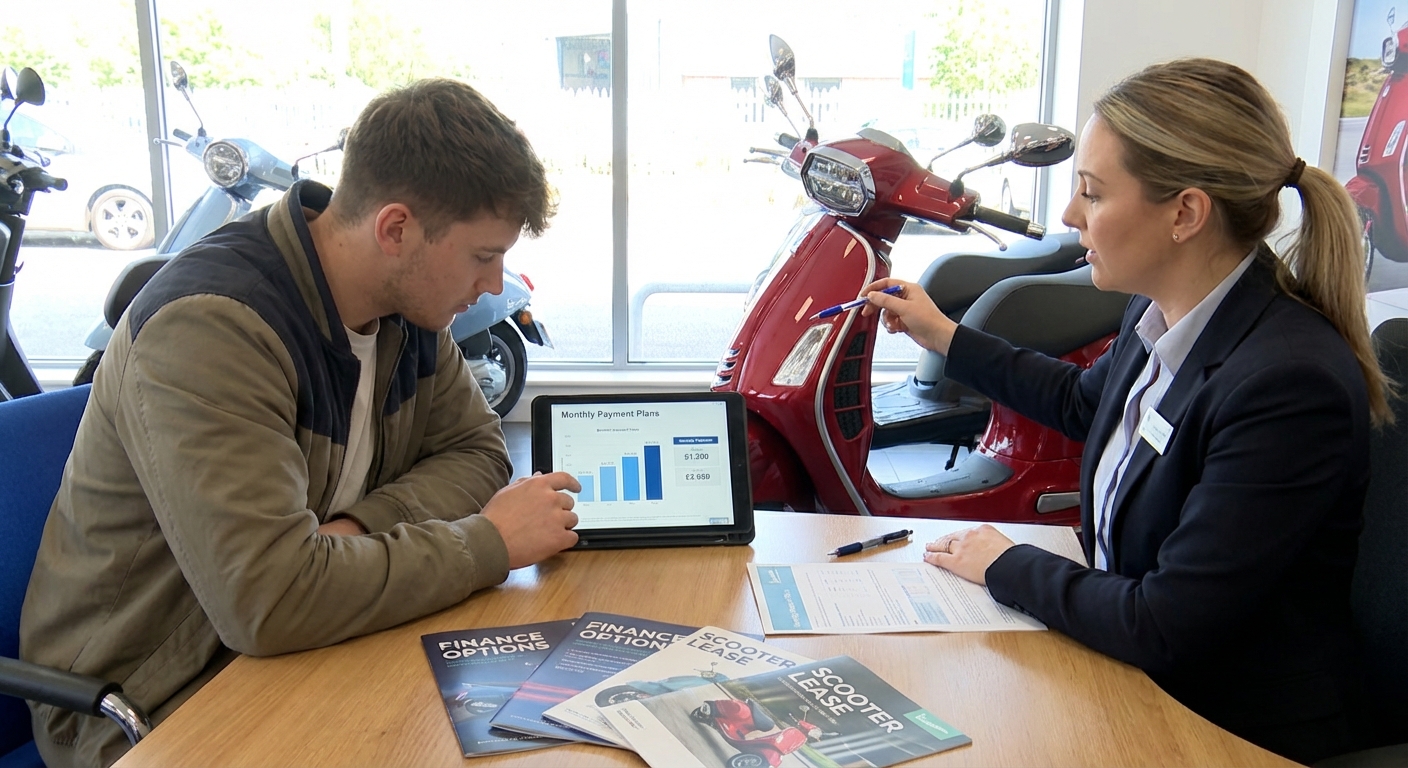
When I tested this route at a local Vespa/Yamaha dealership, it felt weirdly like buying a mini car.
How it works:- Dealer submits your info to partnered banks or captive finance arms (e.g., Yamaha Motor Finance, some regions).
- They quote you APR (annual percentage rate), term length, and monthly payment.
- Fast approval — I got a response in under 15 minutes.
- Sometimes promotional APR on certain models (I saw 0% for 12 months on one electric model).
- They’re familiar with scooter values and paperwork.
- They tried to push add-ons: extended warranties, gap coverage, theft insurance — all rolled into the loan.
- Higher APR if your credit isn’t good.
- Slight pressure vibe: “This deal is only today.” (Spoiler: it wasn’t.)
If you go this route, always get a written quote and take it home. Don’t be afraid to say, “I’ll think about it.”
2. Bank or Credit Union Loan
This is where the math started working better for me.
I went to my credit union and asked about a small vehicle loan. Some institutions treat scooters/motorbikes like auto loans; others call them “personal loans” but will still finance them.
What I found:- My credit union offered 6.9–10.9% APR on small vehicle loans, depending on credit score and term.
- Terms ranged from 24–60 months.
- They were totally fine with me buying from either a dealer or a private seller.
Credit unions tend to have lower interest rates than dealer-arranged loans; the Consumer Financial Protection Bureau (CFPB) has flagged dealer markups as a real cost driver in auto financing.
One downside: the process wasn’t instant. It took 1 business day and a bit of paperwork. But the savings over the life of the loan were worth being patient.
3. “Buy Now, Pay Later” & Online Financing
I briefly considered a BNPL plan offered at checkout on an online scooter site. It looked harmless — “Only $89/month!” — but once I dove into the terms, I wasn’t so thrilled.
BNPL providers like Affirm, Klarna, and others often:
- Offer quick approvals, soft credit checks initially.
- Split your purchase into fixed installments.
But:
- APR can jump up dramatically if promo periods end or if you miss payments.
- Fees are less obvious in the marketing.
A 2022 CFPB report specifically called out opaque terms and late-fee structures in BNPL products. When I saw the potential retroactive interest clause, I noped right out.
4. Personal Loans
I’ve also used a standard personal loan (for a different big purchase) and ran a hypothetical for a scooter.
Pros:
- No collateral — the scooter itself isn’t directly tied to the loan.
- You can shop anywhere: dealer, private listing, online.
Cons:
- Usually higher APR than secured loans.
- You might be tempted to borrow a bit extra “just in case.”
For many people, a credit-union personal loan with a fixed rate and clear schedule can still be better than high-APR dealer financing.
How Much Scooter Can You Actually Afford?
This is where my first attempt went wrong.
I walked into the showroom thinking, “If I can swing $150/month, I’m good.” That’s not a plan; that’s a vibe.
Here’s the framework I now use and recommend:
- Cap total transportation costs at ~10–15% of your take-home pay.
- That includes fuel/charging, insurance, maintenance, parking, and the loan payment.
- Aim for a loan term of 24–36 months.
- Extended 60-month terms on a depreciating scooter rarely make sense unless the rate is extremely low.
- Keep the down payment at 10–20% if you can.
- The higher your down payment, the less you pay in interest, and the lower your risk of going “upside down” (where you owe more than the scooter’s worth).
When I applied those rules, the fancy high-end model I wanted magically vanished from my options. But the mid-range scooter I ended up buying still gets me everywhere I need to go — quietly, cheaply, and without the panic when my bank app opens.
APR, Fees, and the Math You Can’t Ignore
When I compared offers, one lesson hit hard: the monthly payment is a distraction. The real number that matters is total cost over the life of the loan.
Here’s an example close to what I was quoted:
- Scooter price: $2,800
- Down payment: $300
- Amount financed: $2,500
Monthly: about $79
Total paid (principal + interest): about $2,850
Option B: 19% APR, 48 monthsMonthly: about $73
Total paid: about $3,500+
Option B felt cheaper at a glance — “Only $73/month!” — but I’d be paying over $650 more for the same scooter.
When I lined up offers, I created a simple spreadsheet and added:
- Amount financed
- APR
- Term (months)
- Total finance charge
- Total paid
Doing that turned a pushy “this is a good deal” speech into something I could actually evaluate.
If you don’t love spreadsheets, there are free online loan calculators (many from banks and universities) where you can plug in your numbers.
Credit Score Reality Check
When I pulled my credit report before shopping, I discovered a forgotten medical bill in collections. That single item was dragging my score down and would’ve added real money to my scooter loan.
Lenders use your credit score and debt-to-income ratio (DTI) to decide:
- Whether to approve you
- What APR to offer
Some rough patterns I’ve seen and that line up with published lending data:
- 740+ score: access to best offers, lowest APR bands.
- 670–739: generally decent, mid-range APRs.
- Under 650: approvals get harder, rates can get punishing.
I disputed the error on my report, paid off a small card balance, and waited a month. My score ticked up enough to move me into a better tier, saving me a few hundred dollars long term.
If you can wait even 30–60 days and clean up your credit a bit, your future self might genuinely thank you.
New vs. Used: Financing Differences I Didn’t Expect
I was convinced a used scooter would always be the cheaper move. Not always.
What I ran into with used scooters:- Some banks wouldn’t finance older models (over 7–10 years).
- Higher interest rates vs. new.
- Private sellers obviously don’t offer in-house financing.
But I also saw real wins:
- Depreciation hits scooters quickly in the first couple years.
- I found lightly used models at 30–40% off MSRP.
In my case, the used scooter I considered would’ve had a higher APR, but the overall total cost was still lower than a new model due to the big discount on price.
If you go used and finance it:
- Get a mechanical inspection (even if it costs $50–$100).
- Check title status and VIN.
- Make sure your lender is okay with financing that specific year/model.
Hidden Costs People Forget (I Forgot, Too)
When I budgeted for my scooter, I only thought: price + interest. Then reality arrived.
Additional recurring or one-time costs:
- Insurance – Some regions require motorcycle/scooter insurance; even where it’s optional, liability coverage is smart.
- Registration & taxes – These can add a few hundred dollars upfront.
- Helmets & gear – Don’t cheap out here; a decent DOT/ECE-rated helmet isn’t optional.
- Maintenance – Oil changes, tires, brakes, and on electrics, eventual battery degradation.
I built a monthly buffer of $30–$50 for maintenance and small surprises. That buffer saved me when I needed a sudden tire replacement and didn’t want to swipe a credit card.
Red Flags in Scooter Financing
There were a few moments in my shopping that sent every alarm bell ringing.
Watch out for:
- “No credit check” loans with super vague terms. These often hide sky-high APRs and brutal fees.
- Prepayment penalties. I always ask: “If I pay this off early, do I get penalized?” You want the answer to be no.
- Mandatory add-ons bundled into the loan without clear consent.
- Verbal promises not reflected in the contract. If it’s not in writing, it doesn’t exist.
When I hesitated over a clause I didn’t like, one salesperson said, “Nobody actually reads that; it’s standard.” That was my cue to walk.
When Financing a Scooter Actually Makes Sense
Based on my own experience and a lot of research, scooter financing can be pretty smart when:
- You’ve done a realistic budget and can comfortably afford the payment and the ongoing costs.
- The loan APR is reasonable (ideally under what you’re paying on any existing high-interest debt).
- The scooter will significantly reduce your transportation costs or increase your income (getting you to work reliably, for example).
- You’re willing to read the fine print and maybe walk away if it’s not right.
I ended up with a modest, mid-range scooter, financed through my credit union at a fair APR. I skipped the flashy extras and committed to paying it off early if I got any windfalls — tax refund, freelance side money, whatever.
The result: I freed up my commute, cut my monthly transport costs, and didn’t have that creeping sense of financial regret every time I turned the key.
If you treat financing as a tool — not as free money and not as a default — you can absolutely make a scooter work for you instead of the other way around.
Sources
- Consumer Financial Protection Bureau – Auto Loans - Guidance on vehicle financing, dealer markups, and loan terms
- Federal Trade Commission – Understanding Vehicle Financing - Overview of financing options and common pitfalls
- U.S. Department of Transportation – Motorcycle Safety - Safety and gear considerations for motorcyclists and scooter riders
- Forbes – How Auto Loans Work - Breakdown of APR, terms, and total loan cost
- Experian – What Is a Good Credit Score? - Credit score ranges and how they affect borrowing