What Is Laser Cleaning Technology?
oduction-ready” in a few seconds… without a single drop of solvent, and I was hooked.
So what is laser cleaning technology, really? And is it actually useful in business and industrial settings, or just another shiny gadget vendors love to pitch at trade shows?
Let’s dig into what I’ve seen, what actually works, and where the hype doesn’t match reality.
The Simple Version: How Laser Cleaning Actually Works
Laser cleaning (also called laser ablation) uses a high‑energy laser beam to remove contaminants from a surface:
- rust
- paint and coatings
- oxides and scale
- oil, grease, and residues
- even graffiti and soot
Instead of blasting the surface with media (like sand, dry ice, or chemicals), you focus a laser on it. When I tested a 200W fiber laser cleaning unit at a fabrication shop, it felt like using a pressure washer made of light.
The Physics, Without the Textbook
Here’s what’s happening under the hood:
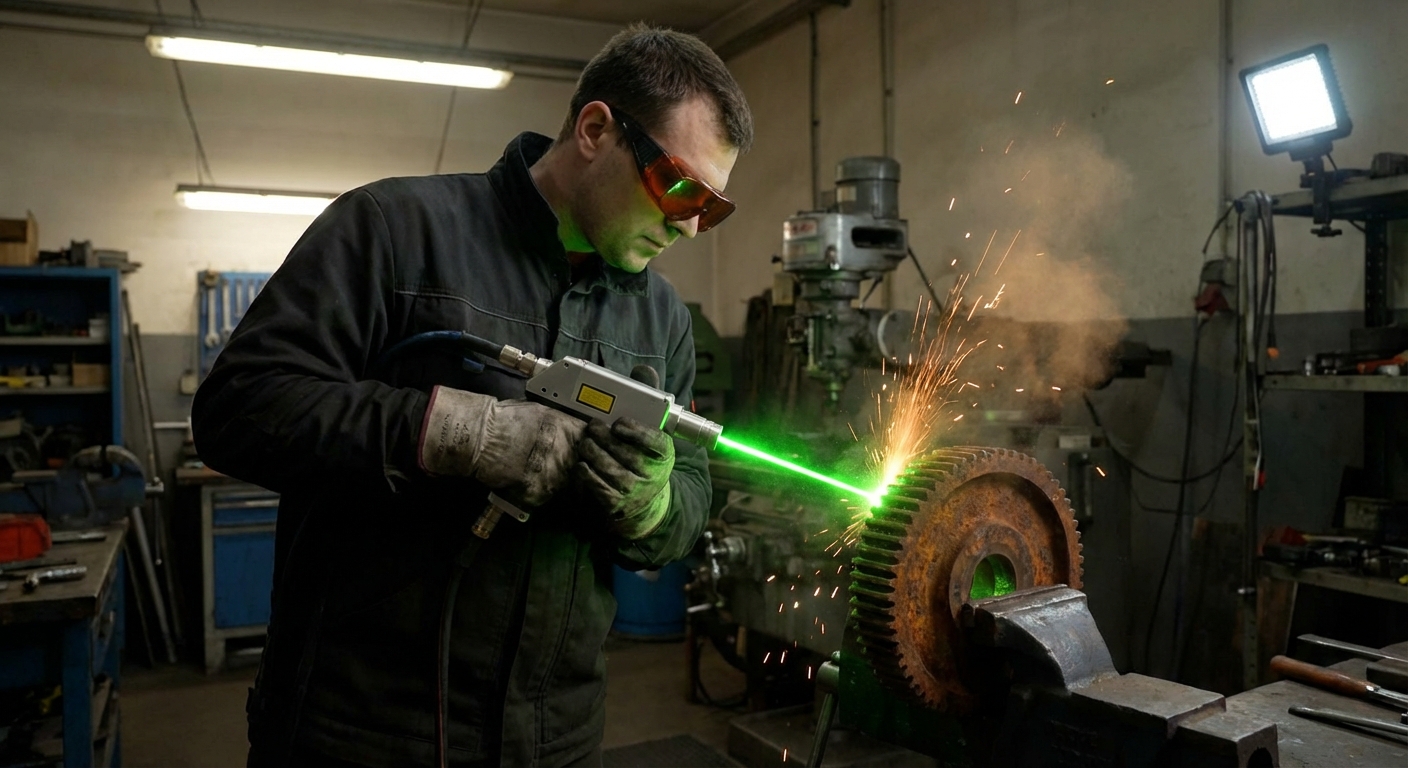
- Energy absorption – The contaminant layer (e.g., rust or paint) absorbs the laser energy more efficiently than the base material.
- Rapid heating – That top layer heats up in microseconds.
- Ablation – The heated material vaporizes or turns into plasma and literally ejects from the surface.
- Shockwave assist – The tiny shockwave helps blow off remaining particles.
Because the beam is highly controlled, you can tune the wavelength, power, and pulse duration so the contaminant is removed while the substrate (steel, aluminum, stone, etc.) is left mostly untouched.
In my experience, the magic is in the pulse parameters. When a technician let me crank up the power “just to see what happens,” we cooked a bit of the base metal. Lesson learned: a good process engineer is worth more than another 500 watts.
Types of Laser Cleaning Systems I’ve Seen on the Floor
There are a few main flavors you’ll run into:
1. Fiber Laser Cleaning Systems
These are the workhorses in industrial settings.
- Wavelength: typically ~1064 nm (near‑infrared)
- Power: from 50W “entry” units to 2kW+ monsters
- Use cases: rust removal, paint stripping, weld pre‑treatment, oxide removal, mold cleaning
In a stamping plant I visited in 2023, they used a 1kW pulsed fiber laser to clean die surfaces between runs. The die life went up by roughly 20% according to their maintenance manager, simply because they weren’t sandblasting the precise edges anymore.
2. Pulsed vs Continuous Wave (CW)
- Pulsed lasers fire in extremely short bursts (nanoseconds or picoseconds). These are the most common for cleaning because you get intense peak power but more control.
- CW lasers emit a constant beam. These are used more rarely for cleaning because they can overheat the substrate if you’re not careful.
Most serious industrial systems today are pulsed fiber lasers. Companies like IPG Photonics, TRUMPF, and Laserax have a lot of application notes on this if you like digging into spec sheets.
3. Handheld vs Integrated Systems
- Handheld systems – Basically a laser “gun” on a cable. Great for maintenance teams, field work, shipyards, or small batch jobs.
- Integrated/robotic systems – Mounted on robots or gantries in production lines. These are what you see in automotive plants cleaning weld areas and battery busbars.
When I tried a handheld unit on an old, badly oxidized pipe, the speed was wildly satisfying—but it’s definitely operator‑dependent. Robotic systems are where you get repeatable, certified results for aerospace, automotive, and other high‑spec industries.
Where Businesses Are Actually Using Laser Cleaning
I’ve seen it move from “cool demo” to “standard process” in a few particular niches.
1. Welding and Brazing Prep
Surface preparation is everything if you want strong joints.
- Before welding: Lasers remove mill scale, coatings, and oil from weld seams.
- After welding: They clean discoloration and oxides for better corrosion resistance or downstream coating.
A 2019 study in Journal of Materials Processing Technology showed laser‑cleaned steel welds had improved fatigue strength compared to mechanically cleaned surfaces, largely due to better surface consistency and less embedded contamination.
2. Paint and Coating Removal
This is where I first saw jaws drop.
Think:
- stripping paint from aircraft skins
- removing old coatings from bridges and structural steel
- cleaning molds in plastic and rubber production
Airbus has tested laser paint stripping on aircraft to replace chemical strippers that contain methylene chloride (a notorious health hazard). They’ve reported reduced hazardous waste volumes and more predictable process control.
3. Mold and Tool Cleaning
Injection molds, tire molds, glass molds—these all get dirty fast.
Traditional method? Sandblasting or chemical baths.
With laser cleaning:
- You can clean molds in place, inside the press.
- Surface texture (especially fine engraving) stays intact.
- There’s little to no secondary waste.
One tire manufacturer I spoke with claimed they cut mold cleaning time by about 50% and, more importantly, didn’t need to retexture molds after aggressive blasting.
4. Heritage & Restoration
Conservators use low‑power lasers to clean stone facades, statues, and delicate artworks. The Vatican Museums, for example, have used laser cleaning on sculptures and architectural details since the 1990s, because mechanical methods were too harsh.
Seeing a centuries‑old stone arch slowly return to its original color under a “light brush” of a laser is surprisingly emotional.
Why Manufacturers Are Drooling Over Laser Cleaning
I’m not a fan of hype, but there are some real advantages that explain the growing adoption.
1. No Consumables, Minimal Waste
No grit media. No solvents. No acidic baths.
You’re mostly dealing with:
- some particulate that gets vacuumed up
- maybe a small dust collection filter
For companies under pressure from ESG reporting and OSHA/EPA audits, that’s a massive plus.
2. Highly Selective and Precise
You can target tiny areas with millimeter precision. Want to clean just the weld zone but leave adjacent coatings intact? Totally doable with the right process.
Laser parameters can be tuned so the contaminant absorbs the energy while the base material reflects more of it. That’s why painted steel can be cleaned without gouging the metal underneath, when set up properly.
3. Automation‑Friendly
Robots and lasers are natural friends.
- Easy to integrate with vision systems
- Repeatable scanning paths
- Digital recipes for each part number
I’ve seen automotive lines where weld prep and post‑weld cleaning are just another robot station, logs and all.
4. Worker Safety & Ergonomics
“Safe” is relative—this is still Class 4 laser territory—but:
- No workers breathing blasting dust all day
- No chemical burns or chronic solvent exposure
- Less heavy manual handling of hoses and media bags
You trade that for strict eye protection, enclosed cells, interlocks, and proper training. But overall exposure risks tend to go down.
The Downsides Nobody Should Gloss Over
If this sounds too good so far, here’s the reality check I’ve gotten from maintenance managers and process engineers.
1. High Upfront Cost
Industrial‑grade systems aren’t cheap. As of 2024, expect ballpark ranges like:
- low‑end handheld: $20,000–$40,000
- mid‑range industrial: $60,000–$150,000
- fully integrated robotic cells: $200,000+ (easy)
Payback can absolutely make sense—especially when replacing chemical stripping or complex blasting setups—but you need volume or high value parts to justify it.
2. Not a Magic Eraser for Every Material
Laser cleaning works best when there’s a contrast in absorption between the contaminant and the substrate.
Where it can struggle:
- thick, multi‑layer coatings
- heat‑sensitive substrates (certain polymers, composites)
- highly reflective metals at the laser wavelength
I’ve watched a team try to remove a particularly nasty epoxy coating from aluminum with a mid‑power system. The result? Slow, inconsistent, and a bit of substrate discoloration. They ended up going back to a mixed process (partial laser, partial mechanical).
3. Throughput Isn’t Always Faster
For small or high‑precision areas, laser wins.
For enormous surfaces (think ship hulls, giant tanks), ultra‑high‑pressure water blasting or bulk media blasting can still be faster in raw coverage. Some shipyards are moving to lasers for specific spots (weld seams, tricky geometry) but not for everything.
4. Safety & Training Requirements
You’re working with high‑power lasers and high‑intensity light.
You need:
- proper laser safety goggles for the specific wavelength
- controlled or enclosed work area
- trained operators and regular audits
The technology itself is clean. Misused, it can still be very dangerous.
How to Decide if Laser Cleaning Makes Sense for Your Operation
When I walk plants that are curious about laser cleaning, I usually see three questions separate good candidates from bad ones.
1. What Problem Are You Actually Solving?
Laser cleaning makes the most sense when:
- Existing cleaning is slow, dirty, or heavily regulated (solvents, hazardous waste).
- Surface quality is critical (aerospace, EV batteries, medical devices, precision molds).
- You’re moving toward higher automation and want traceable, programmable processes.
If your current method is cheap, safe, and works fine… laser might not pay off yet.
2. Do You Have—or Can You Get—Process Expertise?
This isn’t like buying a pressure washer.
You’ll want:
- vendor application testing on your parts
- process parameters documented (power, speed, overlap, stand‑off distance)
- maybe a small pilot cell before you scale up
The best implementations I’ve seen always had a champion internally—usually a process engineer or maintenance lead who owned the project.
3. Are You Ready for a Different Safety Culture?
If you adopt laser cleaning seriously, you’re also adopting:
- laser safety officer roles (OSHA and ANSI Z136 standards in the US)
- signage, lockout systems, interlocks
- training refreshers and PPE enforcement
The tech feels “cleaner” than blasting, but the administrative controls are stricter.
Where Laser Cleaning Is Headed Next
From what I’m seeing in the field and in research papers, three trends stand out:
- Higher efficiency & smaller footprints – Lasers are getting more efficient; a 500W system now is smaller and more stable than some 200W systems from a decade ago.
- Process monitoring – Inline sensors (like optical emission spectroscopy) are starting to verify cleanliness in real time, which is huge for industries that need documented, certifiable prep.
- EV & battery manufacturing – Laser cleaning of copper busbars, aluminum tabs, and contact surfaces is exploding. Clean, oxide‑free surfaces are non‑negotiable for low‑resistance connections.
A 2022 Fraunhofer ILT report highlighted laser cleaning as a key enabler for reliable battery module interconnections. I’ve personally watched battery lines where laser cleaning is just as standard as welding.
So, What Is Laser Cleaning Technology Really?
Stripped of the buzzwords, laser cleaning is:
> A controllable, non‑contact, mostly dry way to remove unwanted material from a surface using focused light instead of media or chemicals.
When I first saw it, I thought: “Neat demo.” After watching it replace chemical stripping, extend mold life, and unlock cleaner welds, I’ve had to admit—it’s becoming real infrastructure in modern manufacturing.
Is it perfect? No.
- It’s capital intensive.
- It’s not ideal for every coating or material.
- It demands serious safety practices and process engineering.
But if you’re wrestling with dirty, hazardous, or poorly controlled cleaning steps in your operation, laser cleaning is no longer a fringe idea. It’s worth running real trials, with your real parts, and real cycle times.
And if you get the chance like I did—stand behind the glass, watch a rusted part go from orange and flaky to clean metallic gray in a few passes. It’s the kind of thing that makes you rethink what “cleaning” can look like in an industrial plant.