What Street Soccer Taught Me About Beating “Perfect” Training Plans
street game with half-broken cones and a deflated ball… and realized I’d missed something massive.
I’ve spent years obsessing over strength plans and interval workouts, but I recently discovered that the scrappy, chaotic world of street soccer has a superpower: it trains things no “perfect” program ever fully captures—decision-making, creativity, resilience, and that weird ability to just find a way to win.
This isn’t an “organized sport vs. streetball” debate. It’s about what happens when we combine both—and what I learned when I tested that blend on my own game.
How a Random Street Game Exposed a Massive Gap in My Training
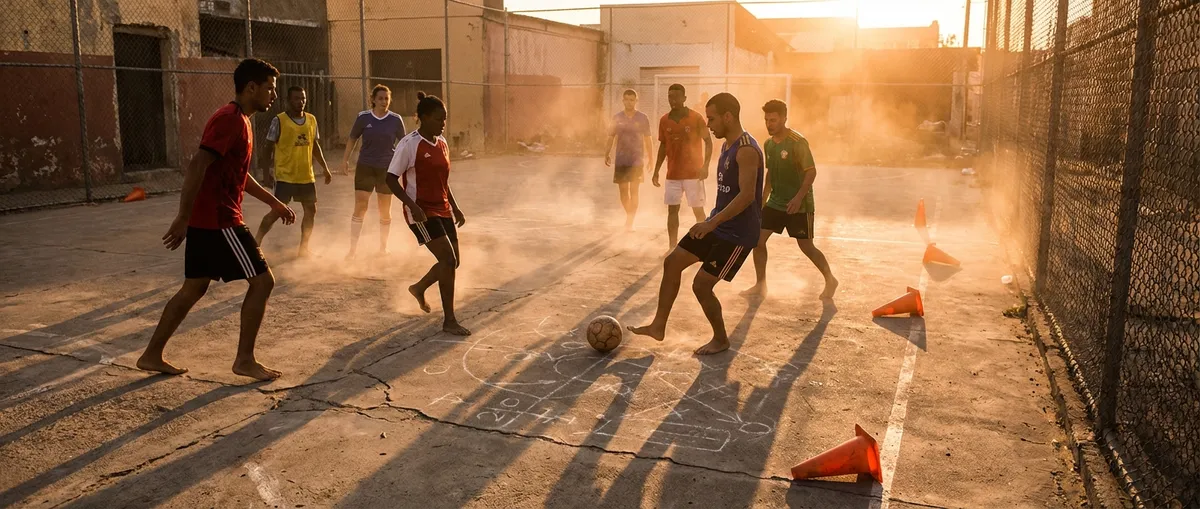
A few months ago, I jumped into a pickup game in a small neighborhood park—no referees, no bibs, no “official” field. Just 7v7, tiny goals made of backpacks, and the rule “winner stays.”
I came in with “organized” advantages: better conditioning, clean technique, and a head full of coaching cues. But within 10 minutes, I was:
- Getting beat to loose balls by smaller, skinnier players
- Struggling to adapt to uneven ground and random bounces
- Overthinking every touch while others played with instinctive flow
One kid, maybe 15, told me, “You’re good in drills, but you think too slow when it’s messy.” And it hit me—my training had been too clean.
When I dug into it later, I found I wasn’t alone. Studies in talent development talk a lot about “deliberate play” vs. “deliberate practice.” Deliberate practice is structured, goal-oriented, coach-led. Deliberate play is self-organized, creative, and fun-focused. Research from sports scientists like Jean Côté suggests both matter, but elite athletes often come from environments where unstructured play is huge early on.
Watching those kids, I could feel that research in real time. Where my training had given me controlled precision, their environment had wired them for chaos, improvisation, and pressure—skills you only get when losing means “off the court” and you really want to stay on.
Why Street-Style Play Builds Skills You Can’t Fake
When I started actually paying attention instead of just trying not to embarrass myself, a few patterns kept smacking me in the face.
1. Decision-making speed goes through the roof.There’s no coach stopping play to correct you. No cones dictating where to move. The ball’s constantly live. You’re forced to read bodies, angles, and space right now.
In my experience, 30 minutes of intense pickup often feels more mentally exhausting than an hour of isolated drills. You’re constantly choosing: pass, dribble, shield, or shoot—under collision-level pressure.
Sports analytics backs this up. In soccer, for example, players often make decisions in under a second, and training under contextual pressure helps build that automaticity. Cognitive load is real, and street games don’t let you hide from it.
2. Creativity becomes a survival skill, not a luxury.In street games, the rules are flexible and the surfaces are weird: potholes, fences, random trees. You learn to spin out of trouble, shield with your back, use walls, chips, toe pokes—whatever works.
When I tested this in my own training, I noticed something wild: once I spent more time in chaotic games, my “official” matches felt slower. I saw passes earlier. I trusted my instincts more. I stopped treating creativity like a risky “extra” and more like a default mode my brain leaned on.
This lines up with research on “representative learning design” in sports: the more your practice looks and feels like the real game (including its messiness), the more your skills actually transfer.
3. You get hardened to losing the ball—and bounce back faster.In drills, a bad touch earns a sigh and a reset. In street games, a bad touch earns a counterattack in your face and maybe some friendly trash talk.
I used to get stuck in my head after one bad pass. But on the street, you don’t get time to sulk. You sprint back, win the ball, and play on. That repeated exposure to immediate consequences quietly builds emotional resilience. You stop tying every mistake to your identity and start treating it as just… the next play.
Is this perfect? No. Pressure can spiral into toxic environments if the group culture’s bad. But in healthy pickup scenes, the invisible lesson is: “You’re allowed to mess up—but you’re not allowed to quit.”
The Hidden Trade-Offs: What Street Games Don’t Give You
After a few weeks playing regularly, I hit another wall—this time in the opposite direction.
My decision-making and confidence spiked, but:
- My top-end sprint speed plateaued
- My strength numbers dipped
- Some technical habits got sloppy (first touch under no pressure, body shape on receiving, etc.)
I’d accidentally gone too far into “just hoop/run/ball” mode and neglected foundational work. This is where structured training earns its keep.
When I looked into it, the pattern’s pretty well-documented: unstructured play builds versatility and game intelligence, but if you want elite conditioning, strength, and reproducible technique at the top level, you need targeted, boring, repetitive work.
Coaches aren’t useless. They’re the people who:
- Spot technical inefficiencies you don’t notice
- Build smart progression so you don’t hit the same ceiling every year
- Manage your load so your knees don’t file for divorce at 28
I had to admit there was a reason professional academies mix small-sided “street-like” games with very specific drills, gym work, and recovery protocols. It isn’t either “organize everything” or “let kids figure it out.” It’s the combination.
How I Blended Street Chaos with Structured Training (and What Actually Changed)
Curious how far I could push this, I gave myself a 6‑week experiment: keep my basic strength and conditioning, but deliberately inject “street-style” chaos into my weekly routine and see what changed.
Here’s how I mixed it:
- 2x per week pickup/street-style games
I stopped treating pickup like “just for fun” and framed it as high value cognitive and tactical training. No coaching, but high intent.
- 2x per week focused physical work
One strength-focused gym session (squats, hinges, pushes, pulls, core), one speed/conditioning session with short, intense intervals.
- 1x per week technical “cleanup” session
First touch, weak-foot work, passing against a wall, finishing technique. Low pressure, but high attention to detail.
What happened surprised me more than I expected:
- My match awareness improved fast. I started reading pressing triggers more naturally and picking pockets instead of chasing.
- My first touch under pressure got better—not from isolated drills, but because I was forced to control chaotic passes in tight spaces three times a week.
- My composure went way up. I still made mistakes, but they stopped derailing my entire game.
The downside: I had to watch fatigue. Pickup games can be deceptively brutal, especially with “winner stays” and no subs. Two weeks in, I noticed my hamstrings feeling cooked and had to actually schedule one true rest day and keep one pickup day a bit lighter.
So yeah, it worked—but it only worked when I treated both sides with respect. Chaos for the brain, structure for the body.
How You Can Borrow This (Even If You’re Not Chasing a Pro Contract)
You don’t need to be playing in a European academy or an NCAA program to use this. I’m not. I’ve got a regular job and a schedule that laughs at “three-a-days.”
What helped me most was shifting mindset, not just adding volume.
Here’s the practical version I’d give a friend over coffee:
- Say yes to messy games.
Join the scrappy 4v4, the late-night futsal, the weird small-sided basketball run, the lunchtime touch rugby. Treat those as brain and instinct training, not just “extra cardio.”
- Keep one “boring but foundational” day.
Whether it’s in a gym or a park, protect one session a week for strength, mobility, and basic mechanics. It’s not sexy, but it’s what lets you survive more chaos long term.
- Use small tweaks to streetify your drills.
When I trained alone, I’d add constraints:
- Only one touch allowed
- Must look away before receiving and then react
- Start every drill with a short sprint or change of direction
Just enough chaos to keep my brain engaged.
- Guard your body like you actually want to play for years.
I learned this the hard way ignoring a sore groin because “it’s just pickup.” Street environments rarely come with medical staff. If something feels off, downshift before your season (or knees) explodes.
I’m still not the best player at any given pickup game. The 14‑year‑olds still occasionally nutmeg me—and they absolutely let me hear about it. But now I smile, jog back, and think: “Cool. That’s another rep in the chaos bank.”
Conclusion
When I zoom out, here’s where I’ve landed: the clean, organized world of planned training made me efficient. The wild, unpredictable world of street soccer made me alive as an athlete.
Neither one is “correct” alone. But when I finally stopped treating pickup as a guilty pleasure and started seeing it as legitimate skill development, my entire approach to sports shifted.
I stopped chasing the perfect plan. I started chasing better instincts.
And sometimes, the fastest way to upgrade your game isn’t adding another drill—it’s stepping into that dusty side court, promising yourself you’ll stay until you lose, and learning how to think faster when everything feels a little bit out of control.
Sources
- FIFA: Small-Sided Games and Their Role in Player Development – Overview of why small-sided and street-style formats enhance decision-making and technical repetition
- American Psychological Association – Deliberate Practice and Skill Acquisition – Explains the science behind structured vs. unstructured practice and expertise
- “The Influence of ‘Deliberate Play’ on the Development of Expert Athletes” – Jean Côté (Queen’s University) – Research paper on how informal play environments contribute to long-term sport success
- UEFA Training Ground – Game-Like Training and Representative Design – Coaching resources on designing practices that resemble real match conditions
- NCAA Sport Science Institute – Overtraining, Recovery and Athlete Health – Discussion of managing workload, burnout, and the importance of recovery in high-activity environments