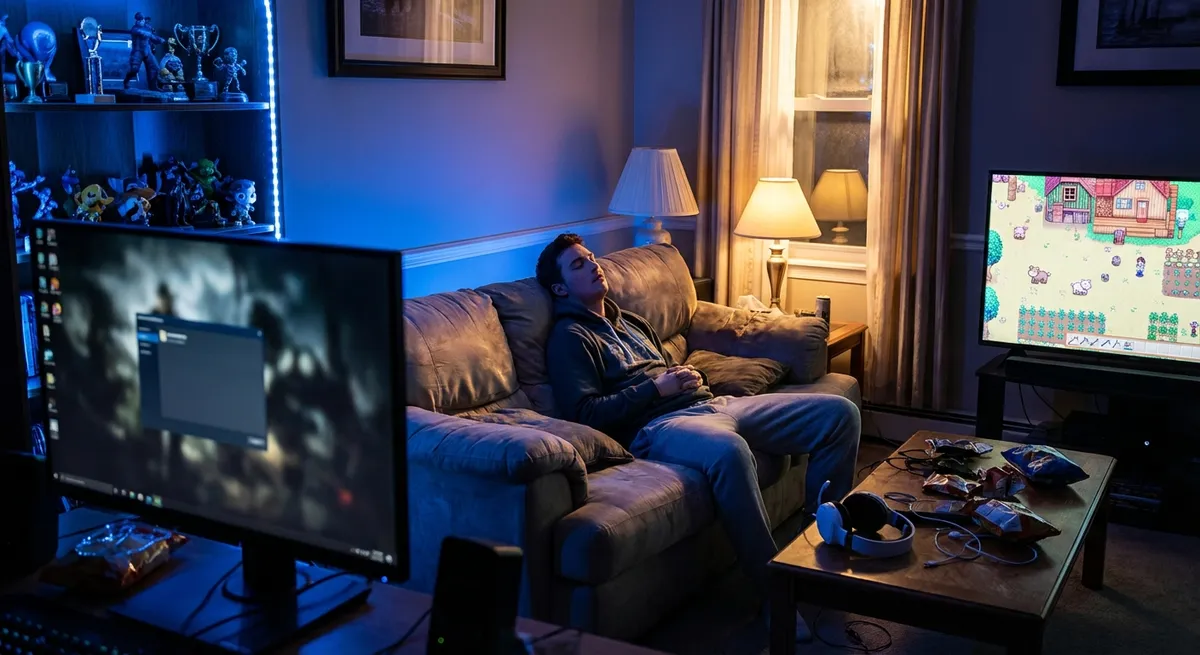
Why Cozy Co‑Op Games Are Taking Over My Game Nights
th a silly cooking game, and suddenly my hardcore friends were screaming about burning digital soup and laughing so hard they cried. That night completely rewired how I think about games.
What I’ve seen over and over—both from my own sessions and hanging around dev and player communities—is that cozy co‑op games are quietly becoming the real social network for a lot of us. Less rage-quits, more shared chaos. Less “git gud,” more “we’re all garbage at this and that’s fine.”
Let me walk you through why this trend is exploding, which games absolutely smashed at my own gatherings, and how to pick the right cozy co‑op for your friends without starting a friendship-ending “who keeps throwing the tomatoes away?!” war.
What Actually Makes a Game “Cozy Co‑Op”?
When I say “cozy co‑op,” I don’t just mean “multiplayer but not violent.” It’s more specific than that. After playing and testing dozens of titles with different groups—some full of non-gamers—I’ve noticed the best cozy co‑op games tend to have a few things in common.
First, low mechanical stress. That doesn’t always mean “easy,” but the skill floor is forgiving. When I introduced Stardew Valley’s co‑op to two friends who’d literally never touched WASD controls, they struggled at first, but it didn’t matter. If someone missed watering crops, we didn’t wipe, we just… had sad parsnips. Stakes were low, jokes were high.
Second, collaboration over competition. Even in chaotic games like Overcooked 2, everyone is technically on the same side. Yes, we yelled when my friend kept falling off the moving platforms with the dirty dishes, but the energy was “we’re in this together,” not “you cost us the match.”
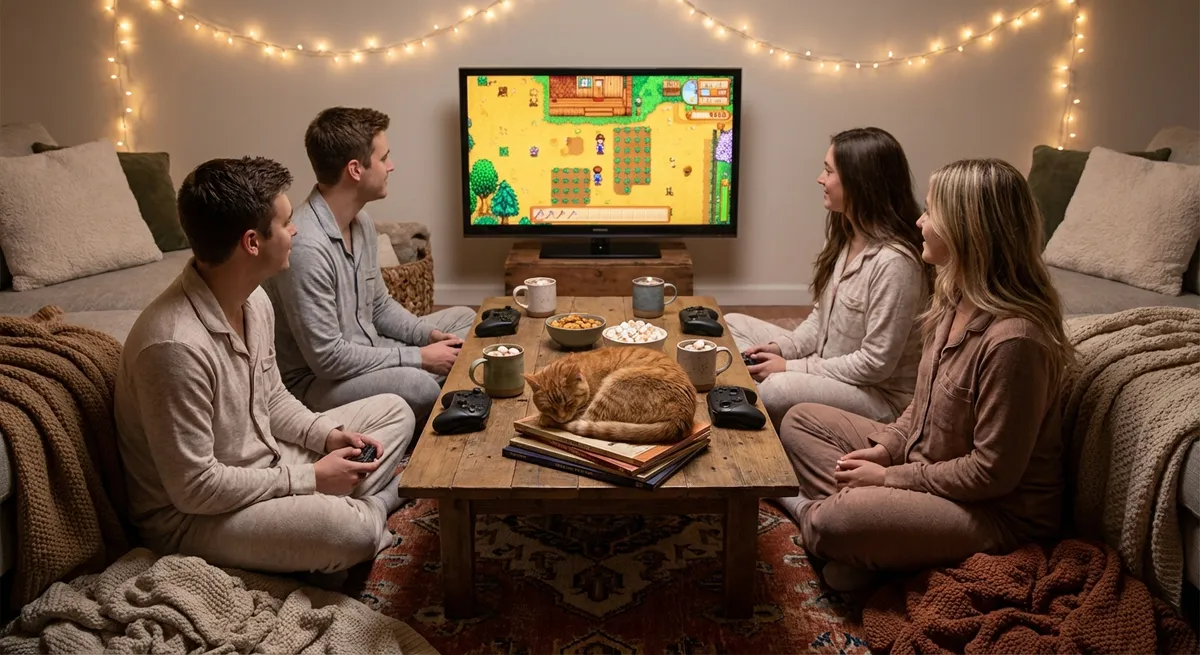
Third, comforting aesthetics. Warm lighting, soft colors, charming music, gentle sound effects—these things sound superficial, but they change how a session feels. There’s a reason games like Animal Crossing: New Horizons became a global comfort blanket during COVID-19 lockdowns; players literally reported using it to manage stress and isolation, according to coverage from outlets like The New York Times.
And finally, emotional safety. Most cozy co‑op games don’t punish you with harsh penalties or toxic lobbies. You’re playing with friends or family, not randos with anime avatars screaming slurs into a headset. That’s a huge deal for people who are game-curious but terrified of online culture.
How Cozy Co‑Op Changes the Vibe of Game Night (From My Couch, Literally)
I’ll never forget the first time I swapped a competitive shooter for a cozy co‑op line-up at a regular Friday night meet-up. Normally we’d rotate between battle royales and fighting games. The usual session: two people engaged, everyone else scrolling on their phones waiting their turn, lots of quiet “gg”s, not much actual conversation.
Then one week I said, “Let’s try something different,” and loaded Overcooked 2, PlateUp!, and Stardew Valley. What happened was… weirdly wholesome.
Within an hour:
- People who “don’t game” were fully involved, giving directions, grabbing controllers, or yelling “ONION! WE NEED MORE ONION!”
- There was way more trash talk, but it was playful and inclusive.
- Nobody cared about who was the “best”; we cared whether we could pull off three stars on a level before the kitchen literally caught fire.
Later, when I tested PlateUp! with a different crew—one friend is a professional chef, another hates kitchens—the dynamic flipped again. My chef friend started project-managing us like a real restaurant line (“You’re front of house, you’re dishwasher, no one touches my steaks”), while my kitchen-averse friend was running plates to customers like their life depended on it. By the end of the night, the chef was saying, “Okay, that was too real, but also… run it back.”
What changed wasn’t just the genre. It was:
- No waiting on the sidelines: almost every good cozy co‑op has everyone doing something all the time.
- Built-in conversation starters: “Why did you name our farm ‘Beanland’?” is a way better icebreaker than “So uh… nice weather?”
- Space for people to play how they want: I had one friend in Stardew who ignored farming and only decorated the farmhouse and managed the pets—and the game was totally cool with that.
Those are the moments that stick. It’s not “we won five matches,” it’s “remember when we accidentally served raw fish to a ghost customer and still got a tip?”
Standout Cozy Co‑Op Games I Keep Going Back To
I’ve rotated a lot of games through my living room and Discord calls. These are the ones that consistently land, along with the real pros and cons I’ve seen.
Stardew Valley (Co‑Op Farm Sim Comfort Food)
When I tested Stardew Valley co‑op with three friends over a weekend, we accidentally played until 3 a.m. the first night and didn’t realize how late it was. The loop of watering crops, mining, fishing, and fixing up the town is already addictive solo; with friends, it turns into this low-key group project.
What it nails:
- Extremely low pressure. There’s no “right” way to play. Want to spend all day fishing while your friend mines? Go for it.
- Easy onboarding. Most actions are simple and forgiving. There’s depth (especially in late-game optimization), but beginners aren’t punished.
- Cozy lore and characters. Gossiping about which NPC is the best marriage candidate becomes its own meta.
Drawbacks I’ve seen:
- Early days can feel slow for impatient players used to fast-paced games.
- Time moves quickly in in-game days; if your group likes to plan, you’ll sometimes feel rushed.
- There’s no official cross-play, so platform choices matter.
Overcooked 2 & PlateUp! (The “We Might Not Survive This” Kitchen Chaos)
If Stardew is a warm blanket, Overcooked 2 and PlateUp! are that same blanket catching fire in a moving bus.
When I ran Overcooked 2 with a mixed group—two gamers, one casual, one total novice—it was off-the-charts funny but also borderline relationship therapy. You’re running around a cartoon kitchen, chopping, cooking, washing dishes… while the floor falls away, pans catch fire, and the level literally rearranges itself.
Why it works:
- Instant chaos that everyone understands. You don’t need to “learn the meta”; you see an order ticket and know what to do.
- Natural teamwork. Someone ends up taking a leadership role, someone is the chaos agent, someone is the silent MVP washing 300 dishes.
- Short rounds. Perfect for rotating controllers and keeping energy high.
But fair warning:
- It can absolutely trigger frustration or blame if your group isn’t good at laughing at failures.
- High noise level. People shout a lot. If your game night is in an apartment with thin walls, your neighbors might not love you.
- Some levels are just plain stressful. Not ideal for players looking for purely chill vibes.
Animal Crossing: New Horizons & Cozy Online Visiting
This one’s a little different because it’s less “everyone mashing buttons at once” and more “parallel play with occasional chaos.” During the early pandemic, I joined friends’ Animal Crossing: New Horizons islands constantly—trading items, showing off museums, or just fishing in silence on a digital beach while we voice-chatted about real life.
Why it still hits:
- Extremely low friction. A lot of what you do is simple: pick fruit, arrange furniture, chat with villagers.
- Great for introverts. You can hang out without the pressure of constant talking or high-intensity gameplay.
- Creative expression. People pour hours into designing their islands, outfits, and rooms, and showing those off feels personal.
The downsides:
- Multiplayer onboarding is clunky: friend codes, airport travel, long loading screens when people arrive or depart.
- Progression can be grindy if you aren’t into decorating or collection.
- You need Switch hardware, which isn’t cheap if your whole friend group doesn’t already have it.
Still, when I revisited it recently for a low-energy Sunday hang with a friend in another city, it felt more like going over to someone’s apartment than “playing a game.” That social softness is rare.
Jackbox Party Packs & Low-Effort Laughs
When I need something that works for everybody—including the cousin who only plays Candy Crush—I default to Jackbox. I’ve hosted birthday parties where the only tech we used was a laptop, a TV, and people’s phones, and it still turned into one of the funniest nights we’d had all year.
Strengths:
- No controllers needed. You join via phone browser, which a 2019 Pew Research survey shows over 80% of adults in many countries already have.
- Wide variety of games: drawing, bluffing, trivia, wordplay. Different personalities shine in different ones.
- Perfect for remote hangouts, since you can screen-share in Discord or Zoom.
Limitations:
- Some packs are hit-or-miss; you’ll quickly form a “we only play these three games” pattern.
- A few games rely heavily on everyone understanding English well.
- The humor can skew silly/irreverent; not ideal for very formal or conservative groups.
From my testing, Tee K.O., Quiplash, and Fibbage are the most reliable hit-makers. There’s something uniquely bonding about seeing your friend’s cursed t-shirt design win a whole fake fashion show.
How to Pick the Right Cozy Co‑Op for Your Group
After many very scientific “let’s just see what happens” experiments, I’ve developed a simple mental checklist for choosing the right cozy co‑op flavor for a specific crew.
First question I ask: “What’s everyone’s energy level?” If people are tired after work and half the room just wants to vibe, I’ll lean toward Stardew Valley, Animal Crossing visits, or even a chill Minecraft server. If folks are buzzing and want to yell, it’s Overcooked 2, PlateUp!, or Jackbox time.
Second: “How comfy are people with controllers?” When I tested Stardew and Overcooked with my parents, the left stick alone was a challenge. Jackbox or touch-friendly games made way more sense there. If I’ve got a room full of seasoned gamers, something with tighter controls and more depth is fine.
Third: “Do we want progression or one-off sessions?” Some people love coming back to the same farm, restaurant, or island and watching it grow. Others want each session to stand alone. PlateUp! splits the difference nicely with its roguelike loops; Jackbox is pure one-off chaos.
Last: “Is anyone prone to tilt?” If a friend gets visibly stressed under time pressure, I avoid the more frantic games or at least keep sessions shorter. Even cozy co‑op can slide into “why are we doing this to ourselves?” territory if the wrong personality gets stuck in the wrong role.
The key is to be honest with your group. I’ll straight up say, “Okay, this next game will get loud and weird—everyone up for that?” or “This one is more slow-burn and cute; perfect if you just want to chat while we do tasks.”
Why These Games Actually Feel Good (Not Just Fun)
There’s more going on here than “haha funny kitchen game.” Psychologically, cozy co‑op taps into a few things our brains really like.
You get shared goals without high stakes. A 2018 study published by the American Psychological Association suggested that cooperative play can foster empathy and prosocial behavior—even in games that aren’t explicitly educational. When the worst-case scenario is “we serve cold soup to a cartoon penguin,” your brain gets the teamwork reward without the anxiety spike.
You also get what I’d call frictionless socializing. Social anxiety expert Dr. Ellen Hendriksen has written about how having a “side activity” (like walking, crafting, or yes, gaming) makes talking feel more natural because you’re not staring each other down. Cozy co‑op games are basically the digital version of that: something to do with your hands and brain so conversation doesn’t feel forced.
Finally, there’s a legit stress-buffer effect. The World Health Organization has acknowledged that recreational screen time can be beneficial in moderation, especially as a coping tool when combined with social connection. I’ve had brutal weeks where logging into a farm or chaotic kitchen with friends was the only thing that stopped my brain from doom-scrolling all night.
Of course, this isn’t magic. If you’re playing six hours a day and avoiding all your responsibilities, no amount of cozy aesthetics will fix that. But as a tool for connection and decompression? It’s genuinely powerful.
The Tiny Catch: Cozy Isn’t Perfect for Everyone
To keep it honest: I’ve also had cozy co‑op sessions flop, and it’s worth knowing the weak spots.
Sometimes the pacing is too slow for competitive players. A friend who lives on ranked ladders in Valorant tried Stardew with us and—his words—“felt like I was trapped in a very cute spreadsheet.” He was polite, but you could see the soul leaving his body by Year Two of turnip farming.
On the flip side, some “chill” games are actually stressful once the timer starts. I’ve watched people visibly tense up in Overcooked and PlateUp!, shoulders rising every time the order buzzer sounded. One friend told me afterward, “That was fun… but also that was my real restaurant job in nightmare mode.”
Then there’s the risk of social friction. Because these games emphasize cooperation, people’s real-life communication styles show fast. If someone naturally takes control or gets snappy under pressure, that can rub others the wrong way. I’ve seen minor in-game mishaps turn into “Why do you always talk to me like that?” moments.
That’s why I now set expectations out loud:
- “We’re going to be bad at this and that’s fine.”
- “If anyone feels stressed, say so and we’ll switch games.”
- “No blaming, only roast each other lovingly.”
Surprisingly, that tiny bit of meta-conversation makes nights feel safer—and therefore, way more fun.
Wrapping It Up on a Cozy Note
After a couple of years of experimenting—from kitchen disasters to quiet island visits—I’ve landed on this: cozy co‑op games are less about “beating” anything and more about creating tiny, ridiculous stories together.
You remember the time your whole restaurant caught fire because someone served a plate of raw steak and broccoli to a ghost, or the time your entire Stardew squad passed out in the mines because no one watched the in-game clock. Those micro-moments become group lore—inside jokes that last long after you power down.
If you’ve drifted away from gaming because ranked queues burned you out, or you’re a total newbie intimidated by esports-level reflexes, cozy co‑op is a ridiculously welcoming on-ramp. Try one or two of these with people you like. Lower the stakes on purpose. Laugh when it all goes wrong.
Because when a game night ends and someone says, “Same time next week?”—that’s the real win state.
Sources
- American Psychological Association – The benefits of playing video games – Overview of research on how games can support social skills, learning, and cooperation
- The New York Times – How ‘Animal Crossing’ Became the Game for the Coronavirus Moment – Explores why Animal Crossing: New Horizons became a major social and emotional outlet
- Pew Research Center – Mobile Fact Sheet – Data on smartphone ownership that underpins accessibility of phone-based party games like Jackbox
- World Health Organization – #HealthyAtHome – Physical activity – Guidance that discusses recreation and screen time as part of balanced coping strategies
- Stanford University – Social Anxiety and “Side-by-Side” Activities – Explains why activities done alongside others (like gaming) can ease social pressure and support interaction