American Downtowns: Revitalization and Urban Life
a vacant bank, three empty upper floors with fading curtains, and exactly one place open after 6 p.m.: a bar with flickering neon. I remember thinking, This can’t be it. This is the center of town?
Fast forward to a visit last year: the same street had a coworking space, a bakery that somehow sells both cronuts and barbecue, a kids’ art studio, apartments with bikes on the balconies, and a line out the door for a pop-up night market. Same street. Completely different life.
That whiplash transformation is basically the story of American downtowns over the last decade—some roaring back, some still struggling, all being reimagined in real time.
The Death of Downtown Was Greatly Exaggerated
I recently re-read an old magazine piece from the late 1990s predicting the death of downtown shopping districts because of malls and suburban office parks. Then ecommerce arrived, and the obituary got a sequel.
But when I started digging into data for a project last year, what I found was messier—and more hopeful.
- A 2023 report from the University of Toronto’s School of Cities found that several U.S. downtowns (like Miami, San Diego, and Phoenix) had already surpassed their pre-2020 activity levels, measured by mobile phone data.
- Others—San Francisco, Portland, Philadelphia—were still lagging well below 2019 levels, especially on weekdays.
So downtowns didn’t die. They fragmented. Some morphed into lifestyle districts, some into tourist playgrounds, some into half-empty office cores. And a few, if we’re honest, are still in limbo.
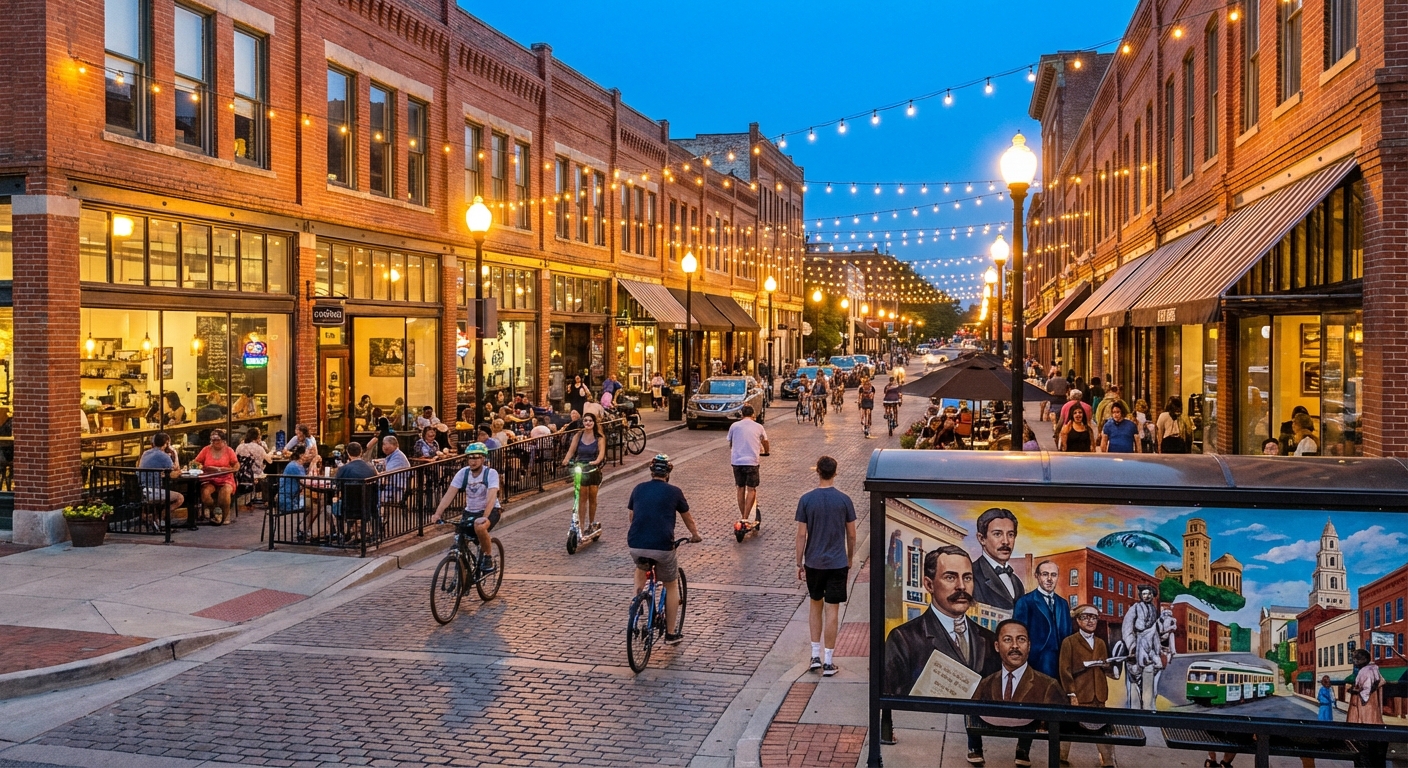
In my experience walking these places—literally, I’ve done the slightly nerdy thing of walking six U.S. downtowns with a notebook—the pattern is clear: the ones that feel alive have figured out one big thing.
They stopped centering commuters and started centering residents.
From 9‑to‑5 Office Core to 18‑Hour Neighborhood
When I tested this “resident vs. commuter” theory on different cities, the vibes were almost comically obvious.
- In Charlotte, I walked around Uptown (their downtown) at 7:30 p.m. on a Tuesday. Gym bags, dog walkers, people grabbing groceries—signs of actual neighborhood life.
- In a different city (I’ll spare the name), I stepped out at the same time and it was like someone flipped off the “ON” switch at 5:01 p.m. Empty plazas, closed coffee shops, security guards and nobody else.
Urban planners talk about “18-hour cities”—places that aren’t full 24/7 like New York, but stay active well beyond work hours. You don’t need Times Square levels of chaos; you just need enough people living nearby to keep lights on and sidewalks busy.
That’s why so many local governments and developers are suddenly obsessed with three phrases:
- Mixed-use zoning – letting residential, retail, and offices stack or sit side by side.
- Adaptive reuse – turning old office towers or warehouses into housing, hotels, or cultural space.
- Complete streets – prioritizing walking, biking, and transit over the old “six lanes and pray” model.
The U.S. General Services Administration even launched pilot programs to convert underused federal office buildings into housing. And in 2023, the Biden administration announced tools to push more office-to-residential conversions in downtowns with high vacancy rates.
I’ve walked by a few of these conversions mid-construction. There’s something oddly moving about seeing cubicle floors become future kitchens and bedrooms. It’s like the city is shedding an old skin.
What Makes a Downtown Feel Alive (Not Just “Revitalized” on Paper)
Here’s where the lived experience kicks in. I’ve been to places proudly labeled “revitalized” in glossy brochures that still felt dead the moment you stepped off the main block.
The difference, when you’re actually on the ground, comes down to a handful of human-level details:
1. Sidewalk Culture, Not Just Pretty Facades
When I tested my “15-minute rule” (could I find a coffee, a park bench, a grocery, and a public bathroom within a 15-minute walk?) in a few American downtowns, the winners weren’t the ones with the fanciest architecture—they were the ones with:
- Food trucks actually allowed to cluster
- Street musicians who weren’t chased away
- Benches you could sit on without feeling like you were loitering
- Cafes that opened early and stayed open late
A 2021 Brookings Institution report put this in more technical terms: successful downtowns emphasize “social infrastructure”—the physical places and organizations (libraries, plazas, parks, markets) that help people gather and build trust.
2. People Who Actually Live There
Revitalization isn’t real if there are no lights on after 9 p.m.
In Downtown Los Angeles, I stayed in a converted loft above what used to be a garment factory. The ground floor had a taqueria, a small grocery, and a nail salon. The building across the street had strollers in the lobby. It didn’t feel like an office district—it felt like a slightly chaotic, very real neighborhood.
Research backs this up. A 2022 Urban Land Institute report found that downtowns with higher residential density recovered faster from office slowdowns, because residents kept restaurants, gyms, and services alive even as workers stayed home.
3. Reasons to Be There That Aren’t Just Shopping
The downtowns that stuck with me most weren’t the ones with luxury retail; they were the ones with:
- Small galleries and maker spaces
- Libraries that stayed open late
- Street festivals, night markets, and outdoor movies
- Public art that actually invited interaction (I once watched kids climb all over a sculpture in Denver while exasperated parents pretended they were upset)
Economic development agencies like to chase “high-end retail,” but in lived reality, culture and community programming are what pull people in repeatedly, not just for a one-time shopping trip.
The Messy Side: Gentrification, Displacement, and Who Downtown Is For
I’d love to say revitalization is all farmers’ markets and rooftop gardens, but that’s not the full picture—and honestly, pretending it is would be dishonest.
When I visited Seattle’s downtown and nearby neighborhoods over a few years, I watched local diners close, replaced by sleek brunch spots. Same block, different price point, different crowd. The energy changed—and not everyone felt welcome anymore.
Urban revitalization often comes with:
- Rising rents and property taxes that push out long-time residents and mom-and-pop shops.
- Policing strategies that focus on “cleaning up” downtown by pushing unhoused people and street vendors out of visible spaces rather than addressing root causes.
- Token inclusion—a mural celebrating a marginalized community while that same community can no longer afford to live nearby.
Studies from organizations like the Urban Displacement Project (UC Berkeley) have mapped how “improving” neighborhoods often correlate with demographic shifts and displacement of lower-income residents.
In my experience, the most honest downtown efforts are the ones willing to wrestle with this openly: setting aside affordable housing units, supporting legacy businesses, and involving long-time residents in planning decisions before the cranes arrive.
One city planner I interviewed put it bluntly: “If your downtown ‘revival’ only works for newcomers with money, it’s not revitalization—it’s replacement.”
Safety, Perception, and the Reality on the Ground
Whenever I write about downtowns, someone inevitably says, “But they’re not safe anymore.”
The reality is more nuanced:
- FBI data show that violent crime in many major cities declined from the 1990s into the mid-2010s, even as perceptions of danger lingered.
- After 2020, some categories of crime did rise in certain downtowns, but the media often focused heavily on a few cities, especially San Francisco and Portland.
Walking around at night in different downtowns, I’ve felt the full spectrum—from totally relaxed, to mildly on edge, to “I should probably grab a rideshare.” That’s real. People don’t move through cities as spreadsheets; they move through them as bodies, with all our instincts and biases.
The most promising efforts I’ve seen pair environmental design (better lighting, clear sightlines, busy ground floors) with social services (outreach workers, mental health support, housing initiatives) instead of just more punitive policing.
If you want downtowns to feel safe and welcoming, you have to care about who’s being made invisible to achieve that feeling—and whether you’re actually solving problems or just moving them a few blocks over.
The Remote Work Plot Twist
When remote work hit, I remember assuming downtowns were finished. If the whole ecosystem was built around offices, and offices emptied out, what was left?
But when I tested working remotely from downtowns—plopping myself in libraries, public plazas, and cafes—I noticed something interesting: the people around me weren’t all traditional commuters.
There were:
- Freelancers camping out with laptops
- College students between classes
- Parents with strollers and laptops, taking Zoom calls from park benches
A 2023 McKinsey analysis argued that remote and hybrid work will permanently reduce office demand in many downtowns—but it also hinted at a new opportunity: converting those office-centric districts into mixed-use urban neighborhoods.
That’s the new frontier: can American downtowns become places where people not only work, but live, study, create, and hang out—even if their official job “office” is technically their kitchen table?
From what I’ve seen on the sidewalk, the answer can be yes, but only if cities stop clinging to the 9‑to‑5 fantasy and design for the messier, more flexible way people actually live.
How Regular People Shape Downtown’s Future (Not Just Planners and Developers)
Here’s the part that surprised me most as I started paying attention: my own tiny choices actually matter.
- When I choose to meet friends downtown instead of in a suburban mall, that’s a data point for a business on where to locate.
- When I support a local bookstore or diner instead of just a national chain, that affects who can afford to stay.
- When I show up to a boring-sounding “downtown plan” meeting (yes, I’ve done this, and yes, there were awkward name tags), I get a say in whether a vacant lot becomes parking or a park.
Downtowns aren’t just real estate plays; they’re shared stories. And those stories are being rewritten every day by:
- Business owners deciding whether to risk opening a shop
- Residents choosing to move into a converted office building
- City councils voting on zoning reforms
- Artists applying for grants to paint murals or run pop-up galleries
When I stand on a street corner in a “revitalized” district now, I try to look past the banners and branding. I watch who’s actually using the space—who’s laughing, who’s working, who’s just passing through, and who’s missing.
That, more than any marketing campaign, tells me how healthy a downtown really is.
American downtowns aren’t finished products. They’re live experiments in how we want to live together—and whether we’re willing to build cities around people instead of just cars, offices, and profit margins.
If there’s one thing my own wandering, note-taking, coffee-fueled walks have taught me, it’s this: the downtowns that feel most alive aren’t the ones that chased the biggest developers. They’re the ones that made room—for families and buskers, for small businesses and late-night taco trucks, for office workers and people who’ve never had an office at all.
And that kind of revitalization? That’s something worth fighting for.
Sources
- School of Cities: The Death and Life of the Central Business District - Research on post-pandemic downtown activity using mobile device data
- Brookings Institution – The future of central business districts - Analysis of how downtowns can adapt to hybrid work and become more people-centered
- Urban Land Institute – Downtowns: New Strategies for a Changing World - Report on residential growth and mixed-use strategies in U.S. downtowns
- McKinsey & Company – Empty spaces and hybrid places: The pandemic’s lasting impact on real estate - Data and scenarios on office demand and downtown adaptation
- Urban Displacement Project – Research and Data - Studies on gentrification, displacement, and neighborhood change in U.S. cities