Epoxy Flooring Design Ideas for Garages, Basements, and Retail Spaces
ed how I look at floors altogether. When I tested a few different epoxy systems side-by-side, I realized you can go from boring concrete cave to “wow, is this a custom studio?” in a weekend.
This isn’t sponsored—I’ve mixed the kits, lived with the results, and made the mistakes. If you’re considering epoxy flooring for your garage, basement, or retail space, I’ll walk you through what’s actually possible (and what’s overrated), plus design ideas that don’t look like everyone else’s Pinterest board.
Why Epoxy Works So Well on Concrete
Before diving into the pretty stuff, a quick reality check. Epoxy is a two-part thermosetting resin—you mix a resin and a hardener, it chemically cures, and bonds with the concrete surface. When it’s done correctly, you don’t just get paint sitting on top; you get a tough, plastic-like coating that can resist:
- Hot tire pickup (a big deal in garages)
- Oil, brake fluid, and most household chemicals
- Abrasion from carts, bikes, and heavy foot traffic
The American Concrete Institute (ACI) and ASTM International have testing standards (like ASTM D4060 for abrasion resistance) that many commercial-grade epoxies are rated against. When I tested a cheap “big box” kit versus an industrial-grade system, the difference in scratch resistance after just a few months was obvious.
The trade-off: good epoxy requires serious prep. If you skip cleaning, degreasing, and profiling the slab (usually with grinding or etching), even the prettiest design will peel.
Garage Epoxy Design Ideas: From Workshop to Showroom
My first epoxy experiment was in a 2-car garage that doubled as a workshop and gym. I’d lived with dusty, stained concrete for years, and every time I dropped a bolt it disappeared into a gray void.
1. Classic Gray with High-Contrast Flakes
This is the "starter" design, but it doesn’t have to look basic.
What I did:- Medium gray base coat
- Black, white, and a bit of blue vinyl flakes
- Satin topcoat instead of super high-gloss
That small shift to satin made the garage look more like a modern studio than a car dealership, and it hid dust better. Flakes also do a great job of visually camouflaging minor imperfections and dirt.
Design tips:- Choose 3–4 flake colors max to avoid visual chaos.
- If your walls are white, go one shade darker on the floor so the space feels grounded.
- For car enthusiasts, match one flake color to your car’s accent color—it creates a subtle, custom feel.
2. Two-Tone Parking Zones
In my next project, I helped a neighbor who wanted obvious parking spots for two cars and a tool area.
We used a two-tone layout:
- Dark charcoal epoxy “parking pads” under each car
- Light gray central strip and perimeter
- Thin, bright yellow “lane” lines separating zones
This not only looked like a mini professional shop, it kept oil spots visually contained. If you’re the type who loves clearly defined spaces, this works really well.
Pro tip: Use 100% solids or high-solids epoxy for parking zones if you park heavy vehicles or use jacks. The layer is thicker and more durable.3. Metallic Epoxy for the Car-Show Look
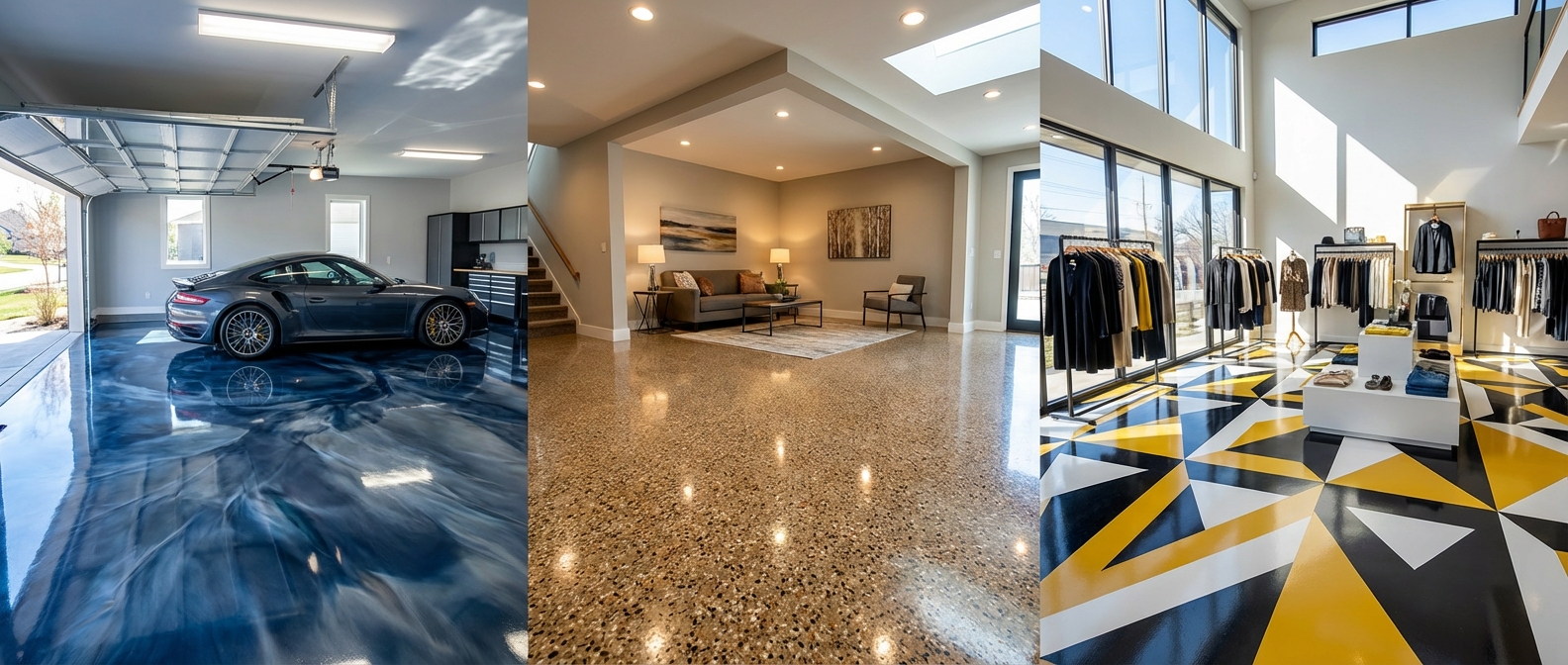
When I tested metallic epoxy in a friend’s garage, it was both spectacular and slightly over-the-top—in a good way.
We used a charcoal base with silver and graphite metallic pigments, creating a swirling, marbled effect.
Reality check:- Metallic epoxy is harder to apply evenly. You need wet-on-wet blending and some artistic sense.
- It will highlight dips and waves in old concrete.
This style works best if your garage is also a showcase space: think collector cars, home bar, or hybrid lounge.
Basement Epoxy Design Ideas: Cozy, Not Clinical
Basements are where I see epoxy misunderstood the most. People either do plain industrial gray (too harsh) or skip epoxy entirely because they think it’ll feel cold. When I tested warm-toned systems in a client’s basement, the space suddenly felt finished—and much easier to clean.
4. Warm “Polished Concrete” Look
You don’t have to go high-gloss showroom. One basement project used:
- A warm greige (gray + beige) epoxy base
- No flakes, just subtle pigment variation
- A matte or low-sheen polyurethane topcoat
The result felt like designer polished concrete without the dusting and porosity.
This works amazingly well for:
- Home gyms
- Playrooms
- Hobby spaces or studios
- Easier to clean than raw concrete or carpet
- Resists moisture better (when properly installed on a dry, tested slab)
- If you want it to feel truly “living room cozy,” you still need rugs and soft furnishings. Epoxy alone won’t give that.
5. Faux Terrazzo with Microflakes
One of my favorite basement designs used microflakes instead of the chunky garage-style ones. We mixed:
- Off-white base coat
- Tiny tan, gray, and soft blue flakes
Under a satin topcoat, it looked like terrazzo-lite: modern, playful, and bright.
This is great if your basement has low ceilings. Light floors bounce more light, and microflakes add texture without screaming “garage.”
6. Zoning with Color for Multi-Use Basements
In my own place, I used color zoning:
- Deep slate blue for the home gym corner
- Light gray for the laundry area
- Warm greige for the media area
Instead of hard lines, I feathered the transitions so it looked intentional, not like I ran out of paint. This kind of zoning works well if you’ve got an open-plan basement that serves several roles.
Retail Epoxy Design Ideas: Brand-First Floors
Retail is where epoxy can really flex. When I consulted for a small boutique, the floor became a branding tool, not just a surface.
7. Brand-Color Solid Floors
One clothing boutique I worked with went bold: a muted blush-pink epoxy floor with a non-slip clear topcoat. It made their neutral clothing pop and instantly differentiated the space from every other shop on the block.
Why this works:- Epoxy is tintable to precise brand colors.
- It provides a seamless, easy-to-clean surface for high traffic.
- Very dark colors show dust and scratches faster.
- Very light colors show every spill. Choose a mid-tone if maintenance is a concern.
8. Embedded Logos and Graphics
For a small gym, we embedded a vinyl logo decal between the colored epoxy base and the clear topcoat. Three years later (last I checked), it still looked brand new.
You can do:
- Directional arrows in grocery or warehouse-style stores
- Social distancing markers integrated into the design
- Branded zones (kids’ corner, self-checkout, etc.)
It looks much cleaner than stickers that peel and collect dirt.
9. High-Impact Metallic for Showrooms
Car dealerships and tech showrooms often use metallic epoxy for that luxe, fluid look. The trick I’ve seen professionals use is subtlety:
- Two close-toned metallic pigments (e.g., silver + light graphite)
- Gentle movement, not wild swirls
When I tested a busier metallic pattern in a mock-up, it distracted from the products. In retail, the floor should support the merchandise, not compete with it.
Pros, Cons, and Honest Limitations
From my experience—and backed up by manufacturers and building science research—here’s the balanced view.
Big pros:- Extremely durable when installed right
- Chemical and stain resistant
- Seamless and easy to mop
- Endless design options (color, flakes, metallics, graphics)
- Prep is everything: you often need mechanical grinding. Acid etching alone is rarely enough on oily or very smooth slabs.
- Moisture issues: if your slab has vapor pressure or no vapor barrier, epoxy can blister or peel. A moisture test (like ASTM F2170 in-slab RH testing) is worth the cost.
- Slipperiness: High-gloss finishes plus water can be slick. I always add anti-slip aggregate (aluminum oxide or silica) in garages, basements near exterior doors, and retail areas.
- DIY learning curve: You’ve got limited working time after mixing. If you’re prone to procrastinating or second-guessing, epoxy will punish you.
If the slab is badly cracked or constantly damp, a breathable coating or polished concrete system may be a better fit than epoxy.
DIY vs. Hiring a Pro: Where I Draw the Line
I’ve done DIY kits and I’ve worked alongside professional installers. Here’s when I’d personally call a pro:
- Retail spaces with high foot traffic
- Metallic or complex multi-color designs
- Large garages (3+ cars) where timing is tight
- Slabs with known moisture issues
For a small, straightforward 1- or 2-car garage or a utility basement, a good-quality DIY kit can be totally fine if you:
- Take surface prep seriously (degrease, inspect, grind/etch as needed)
- Follow the mix ratios and pot life religiously
- Work with a helper so you’re not racing the curing clock alone
When I rushed the prep on one small section—thinking “it’s just a corner”—that’s exactly where the peeling started six months later.
Final Thoughts: Start with Function, Then Layer in Style
Whenever I’m helping someone choose an epoxy design, I start with three questions:
- What abuse will this floor see? Cars, kids, moisture, carts, dropped tools?
- How much maintenance are you really willing to do? Are you okay with occasional re-topcoating?
- What feeling do you want when you walk in? Industrial, cozy, glam, minimalist?
Answer those honestly, then pick your design: flakes for forgiveness, solids for bold statements, metallic for drama, microflakes or subtle pigments for a refined, modern vibe.
When I tested all these approaches over different spaces, the most successful floors weren’t the wildest—they were the ones that balanced durability, light reflection, and personality. Do that, and your “just a garage” or “unfinished basement” can become the best room in the house.
Sources
- U.S. General Services Administration – Concrete Floor Coatings Guide - Background on coating types, prep, and performance
- Sherwin-Williams: Epoxy Floor Coatings - Technical info and product options from a major manufacturer
- University of Nebraska–Lincoln Extension – Concrete Floors and Moisture - Discussion of moisture issues with concrete floors
- ASTM International – Flooring Standards Overview - Testing standards relevant to coatings and flooring performance
- Forbes Home – Epoxy Flooring Cost & Considerations - Practical cost breakdown and pros/cons for homeowners