Home Design Trend: Updating Your Living Room
round and thought, wow, this looks like a waiting room from 2009.
That little moment kicked off a full living room refresh. I tested layout changes, paint colors, lighting tricks—you name it. Some things worked surprisingly well, some completely flopped, and a few small tweaks made a huge difference.
Here’s what I learned actually moves the needle when you’re updating your living room, without gut-renovation money.
Start With the Layout (Not the Sofa)
When I first started, I did what everyone does: I shopped for a new sofa. Big mistake.
When I tested different layouts before buying anything, I realized the real issue wasn’t my furniture… it was how I’d crammed it all against the walls like a furniture crime scene.
Interior designers talk a lot about circulation paths and conversation zones. Once I started thinking that way, everything clicked:
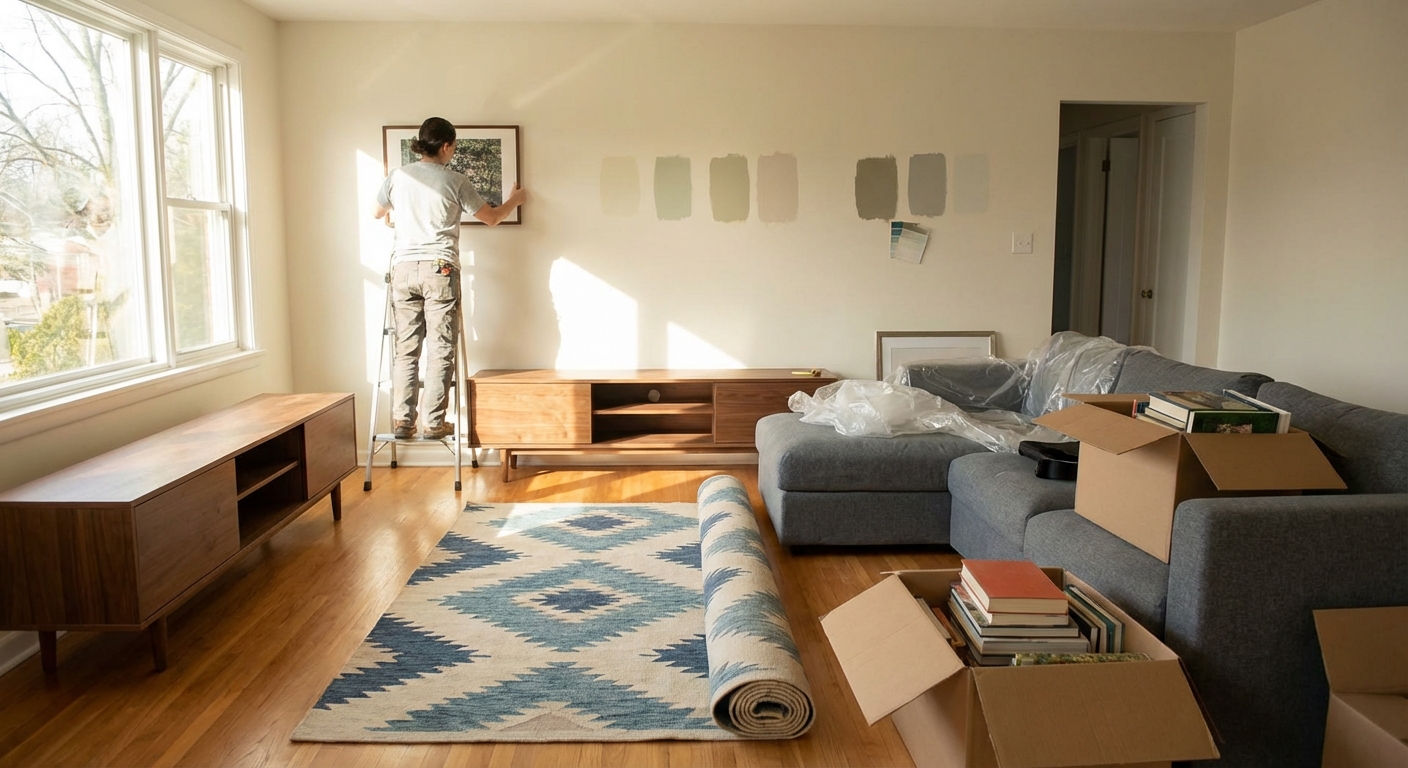
- I floated the sofa about 10 inches off the wall.
- I pulled the chairs in tighter so people weren’t shouting across the room.
- I created a clear path from the entry to the sofa so you don’t have to zigzag around tables.
The room instantly felt more intentional and more expensive—without buying a single new thing.
Pro tip I learned the hard way: Use painter’s tape on the floor to map out furniture footprints to scale. When I taped out the oversized sectional I thought I “needed,” it basically ate the room. I went one size down and it feels balanced instead of bulky.Color: The Fastest Way to Drag Your Room Out of 2013
My old living room was beige on beige with a side of… more beige. When I finally repainted, it was like someone dialed the resolution up on the whole space.
What actually worked
- I chose a warm, soft white with a hint of gray. Not “rental white,” but not yellow either. In my case, something in the zone of Sherwin-Williams Alabaster/Benjamin Moore White Dove did the trick.
- I kept the walls calm and brought color into textiles: cushions, throws, an area rug, and a huge piece of wall art.
Color psychology isn’t just Pinterest fluff. Research published in Frontiers in Psychology has shown that warm colors can feel more inviting while cooler tones feel more calming and spacious. I leaned warm in the living room because it’s where people actually talk (and snack) rather than meditate.
What didn’t work
When I tested a trendy deep green on all four walls, the room looked like a moody cave—great on Instagram, terrible at 7 a.m. with coffee. I ended up keeping bolder color on a single accent piece: a big canvas with rich greens and rusts that I can swap out someday.
If you’re nervous, sample paint in at least three spots and look at it at morning, afternoon, and night. I skipped that once. I do not recommend repainting an entire room because the “perfect greige” turned lavender at sunset.
Lighting: The Make-or-Break Detail People Ignore
When I recently swapped my single overhead light for layered lighting, friends assumed I’d bought new furniture. Nope. Just better light.
Designers obsess over three layers of light:
- Ambient – your overall light (ceiling fixtures, recessed lights)
- Task – for reading, working, or hobbies (floor lamps, table lamps)
- Accent – for mood and features (picture lights, wall sconces, LED strips)
In my experience, adding two floor or table lamps on separate sides of the room made the biggest difference. I put them on smart plugs so I can say, “turn on living room lamps,” and the room softly glows instead of blinding everyone like a gymnasium.
There’s actual science here: the U.S. Department of Energy notes that warm-white LEDs (2700–3000K) in living spaces create a more relaxing, residential feel compared with cooler color temperatures often used in offices. I keep my living room bulbs at 2700K, and anything higher feels weirdly clinical.
One thing to watch out for: Cheap LED bulbs can flicker and give you that low-key headache you can’t quite place. I learned that after a week of thinking I needed new glasses. Invest in good-quality, dimmable bulbs from reputable brands.Textiles: Where Comfort Meets “I Saw This on Instagram”
If your living room feels flat, it’s probably missing texture.
When I tested this, I swapped:
- A thin, scratchy rug for a dense, low-pile rug big enough that the front legs of the sofa and chairs actually sit on it
- Matchy throw pillows for a mix of textures: linen, bouclé, and a slightly ridiculous faux-fur one my dog has now claimed
- Basic curtains for floor-length panels hung higher and wider than the window
Hanging curtains about 4–6 inches above the window frame and a few inches wider made my not-very-tall ceilings look at least 6 inches higher. It’s the oldest trick in the book, and yes, it’s that good.
The downside: Textiles are dust magnets. The American Lung Association points out that fabrics and carpets can trap allergens, so if anyone in your home has allergies, choose washable covers and low-pile rugs, and actually vacuum them. (I now set a reminder, or it doesn’t happen.)
Furniture: Upgrade Strategically, Not All at Once
I used to think you had to replace everything for the room to feel new. When I priced that out, my wallet quietly left the chat.
So I did it in phases.
Phase 1: The anchor piece
For me, that was the sofa. I learned a few insider-ish details from talking to a salesperson who clearly knew their stuff:
- Look for a hardwood frame (kiln-dried if possible) instead of particleboard.
- Check that the seat cushions have high-density foam (1.8+ lb/ft³) with a down or fiber wrap.
- Sit on it how you actually sit—curled up, sideways, laptop open. I returned one sofa because the arms were too low to lean on comfortably.
Phase 2: The “supporting actors”
I swapped a bulky coffee table for a round one so it’s easier to move around, especially with kids visiting. I also added a slim console table behind the sofa for lamps and a place to drop keys and mail.
The con: once you start upgrading, you notice every piece that hasn’t been upgraded yet. I had to remind myself this is a marathon, not a sprint—or a Black Friday meltdown.
Personality: The Anti-Showroom Factor
When I first finished, my living room looked… good. Styled. But a little like a catalog. That’s when I started layering the weird, personal stuff back in.
I added:
- A stack of cookbooks on the coffee table because I actually read them
- A small vintage ceramic lamp I found at a flea market
- Framed black-and-white photos of family on a simple picture ledge
There’s research to back this up: environmental psychology studies suggest that personal objects in a space can increase feelings of comfort and belonging. I can confirm—once I brought “me” back into the room, I stopped feeling like a guest in my own house.
One balanced note: if every surface becomes a shrine to your hobbies, visual clutter spikes and the room feels chaotic. I keep one or two “hero” personal pieces in each zone and rotate the rest seasonally.
What I’d Do First If I Were Starting From Scratch
If you’re staring at your living room wondering where to even begin, here’s the order that gave me the biggest returns for the least chaos:
- Rearrange what you already have. Float the sofa, tighten the seating area, create a clear pathway.
- Fix the lighting. Add at least one or two lamps with warm, dimmable bulbs.
- Refresh textiles. A larger rug and better curtain placement can transform the room in a single afternoon.
- Then tackle color. Paint if you’re up for it, or start with pillows, throws, and art.
- Upgrade one major piece at a time. Usually the sofa or media console.
Updating your living room doesn’t have to be a full-scale renovation with dust everywhere and a blown budget. In my experience, it’s more like a series of smart tweaks that add up—and you learn what you actually like as you live with each change.
And the best part? The next time your camera flips on during a call, you won’t be silently judging your own background.
Sources
- U.S. Department of Energy – LED Lighting – Guidance on LED color temperature and residential lighting
- American Lung Association – Indoor Air Pollutants and Irritants – How fabrics and carpets relate to indoor air quality
- Frontiers in Psychology – The Influence of Color on Emotions – Research on how different colors affect mood and perception
- Harvard Graduate School of Design – Environmental Psychology and Design – Academic perspective on how interiors influence behavior and comfort
- Sherwin-Williams – Alabaster Product Page – Example of a widely used warm white wall color