Guide to Appliance Shopping: Seasonal Timing, Clearance Sections, and Price Tracking
o the weirdly strategic world of appliance shopping. I thought I’d just click “Add to cart” and move on.
I was wrong. And I’m glad I was.
What I found—testing price trackers, stalking clearance sections, and timing purchases around oddly specific holidays—cut hundreds off the sticker price. This guide is exactly what I wish I’d had before I started.
Why Timing Matters More Than You Think
When I first started comparing prices, I screenshotted a fridge at $1,899 on a random Tuesday in March. Two weeks later, the same model dropped to $1,399 during a weekend promo. Same store. Same SKU. No explanation.
That pushed me to actually watch pricing patterns, and there are patterns.
Best Seasons and Months for Major Appliances
Retailers plan appliance promotions around both model cycles and holiday traffic.
In my experience (and backed up by data from the Association of Home Appliance Manufacturers and multiple retailer calendars):
- September–November: Great for refrigerators and kitchen suites
- New fridge models usually roll out around early fall.
- Old models move to promo and clearance to make room.
- April–June: Strong for washers, dryers, dishwashers, ranges
- Spring sales (Memorial Day in the U.S.) kick off aggressive package deals.
- January: Quiet but sneaky‑good
- After holiday buying sprees, retailers clear out floor models and open-box returns.
Holidays That Actually Matter for Appliance Deals
From my price tracking experiments:
- Memorial Day, Labor Day, Black Friday/Cyber Monday are consistently the top three.
- President’s Day (U.S.) is underrated—my best washer/dryer quote came from a President’s Day bundle.
- Random “Friends & Family” or “Private Sale” events at specific retailers can beat the big holidays, but you usually have to be on their email list or app.
Not every sale is equal, though. When I tested this across three big-box stores, the pattern looked like this:
- Everyday sale: 5–10% off
- "Event" sale: 10–20% off
- Holiday doorbusters or package promos: 20–35% off (especially on last year’s models or when buying 3–4 pieces together)
The downside? If your fridge dies today, waiting three months for Labor Day isn’t exactly realistic. I’ll talk about emergency strategies later.
Clearance Sections: Where the Real Treasure Is
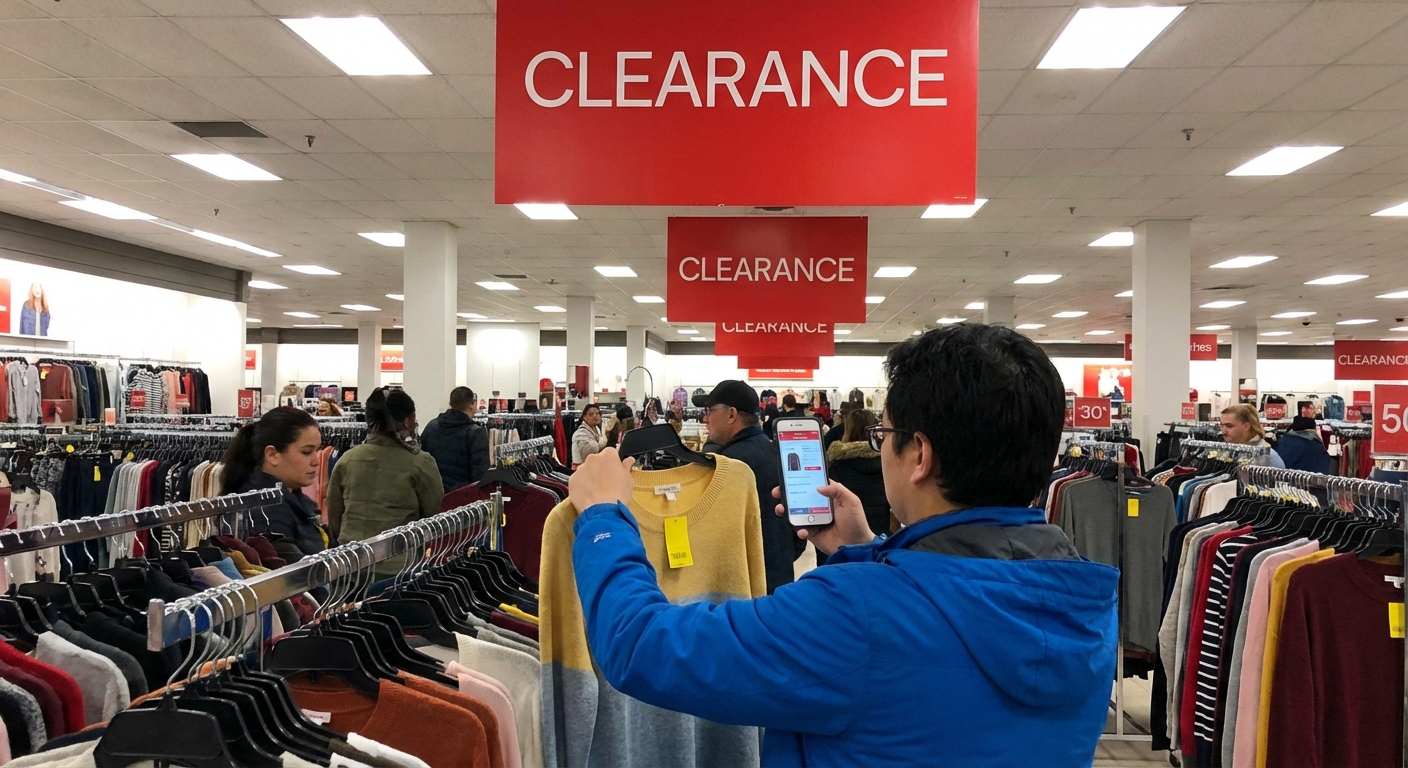
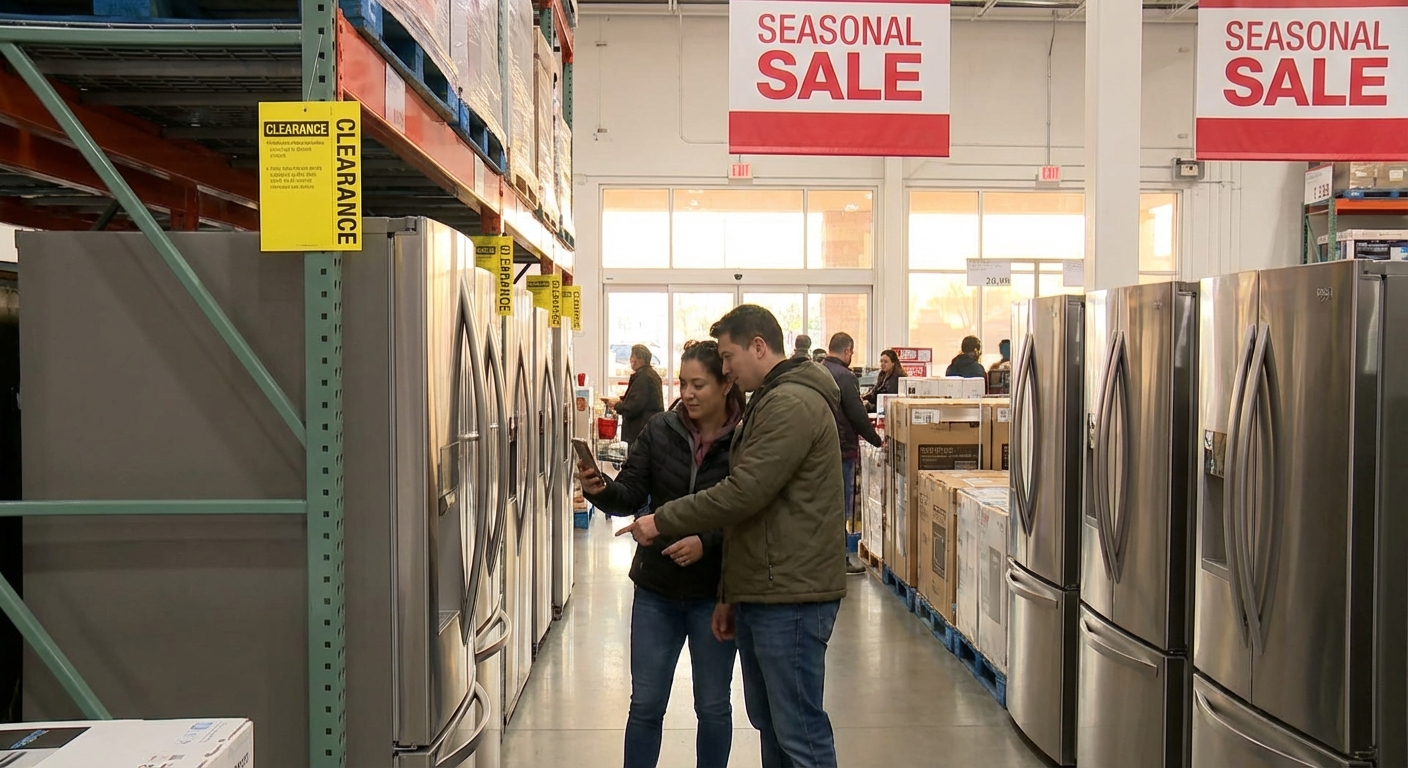
I used to skip the clearance section because it felt like the land of broken, mismatched misfits. Then I watched a couple next to me grab a $1,600 range for $780 because of a scratch on the side panel that would be hidden by their cabinets.
I stopped walking past clearance after that.
Types of Clearance Appliances (and Which Are Worth It)
From what I’ve seen on the floor and confirmed with store staff, clearance usually includes:
- Scratch-and-dent: Cosmetic damage only (ask to see every dent with the doors open and closed)
- Floor models: Display units that have been plugged in and touched a million times
- Discontinued models: New in box, but last year’s lineup
- Open box/returns: Customer changed their mind or had a failed delivery
In my experience:
- Best value: Discontinued and open-box with full manufacturer warranty
- Potentially great: Scratch-and-dent, if damage is in a hidden area
- Proceed carefully: Floor models—compressors and door hinges may have more wear
What I Always Ask in the Clearance Aisle
When I tested negotiating in three different stores, the clearance section was where I got the most traction. I’ve learned to always ask:
- “Is this the final price or is there flexibility?”
Sometimes they’re allowed to drop it another 5–15% or throw in free delivery.
- “Does this still include the full manufacturer warranty?”
You want yes to that. If not, you need a bigger discount.
- “Can I see this model number on your site or in your system?”
I’ve caught mislabeled tags where the clearance price wasn’t actually much lower than the regular sale price.
One of my favorite wins: a “clearance” dishwasher for $599 from a big retailer that still showed online at $899. I pulled it up on my phone, asked about the price difference, and they quietly dropped it another $50 for “price inconsistency.”
The Downsides of Clearance (That People Gloss Over)
To stay honest here, there are real trade‑offs:
- Limited selection: You can’t always get the exact color or feature set you wanted.
- Delivery constraints: Some clearance pieces are final sale and must be picked up within a few days.
- No returns: Many clearance policies are “as‑is, no returns.” You have to be meticulous with inspection.
If you’re extremely picky on aesthetics or matching a suite, clearance can be frustrating. But if you’re flexible, it’s where the biggest percentage savings usually live.
Price Tracking: How I Stalked a Fridge for 6 Weeks
I turned into a bit of a nerd with this part.
When I was hunting for a counter‑depth French door fridge, I watched prices bounce between $2,399 and $1,699 over about a month and a half. The model was from a major brand and sold at three different retailers.
I used a mix of tools and manual checks:
- Price history tools on retailers that show “Was: $X, Now: $Y” (then I screenshot dates)
- Coupon plugins like Honey and Capital One Shopping to surface hidden promo codes
- Retailer apps with price alerts where available
How to Actually Track Prices Without Going Insane
What’s worked for me, simplified:
- Narrow to 2–3 models first.
Tracking 15 SKUs is a fast track to madness.
- Make a rough spreadsheet or notes app list with:
- Model number
- Regular price
- Lowest price you’ve seen
- Store and date
- Check twice a week, not every hour.
- Set a “buy price” in advance.
Mine was: “If this hits $1,799 with free delivery and haul‑away, I’m done.”
When it finally dipped to $1,749 plus free install, I bought it instead of waiting for the absolute rock bottom. Could it have gone $50 cheaper six months later? Maybe. But there’s a real cost to analysis paralysis.
The Retailer Price Match Game
I’ve tested price matching with Best Buy, Home Depot, and Lowe’s.
What I learned:
- They almost always require the competing price to be in stock, same exact model, and not a “flash” or “limited quantity” deal.
- Some won’t match club warehouse stores or online‑only discounters.
- Price matching usually applies before purchase, not weeks later (though some retailers do offer a limited post-purchase adjustment window).
I once had Home Depot match a Lowe’s price and then stack their own promo that gave an extra 10% off if you opened a store card. That knocked another $120 off the dryer.
The flip side: another time, a store refused to match an “online only” sale from what they called a “non‑authorized dealer.” Fair, but annoying.
Balancing Features, Energy Use, and Price
The price tag is only part of the cost. When I replaced my old top‑load washer, I dug into Energy Star data.
According to the U.S. Department of Energy, Energy Star certified clothes washers can use about 25% less energy and 33% less water than standard models.
When I ran the math using my local utility rates, the more efficient washer I wanted could save roughly $35–$50 per year. Over 10 years, that’s $350–$500. So paying $150 more upfront made sense.
Stuff I now always factor in:
- Energy use (EnergyGuide yellow label and Energy Star rating)
- Repair track record (I check user reviews plus Consumer Reports and brand reliability surveys)
- Cost of parts/filters (water filters for fridges add up shockingly fast)
The honest trade‑off: sometimes the super high‑tech, Wi‑Fi‑everywhere models have more things that can break. For my own kitchen, I went for mid‑range models from brands with solid reliability scores rather than the flashiest smart fridge on the floor.
When You Can’t Wait for the Perfect Sale
Sometimes your fridge dies, your washer floods, or you’ve got tenants moving in next week. Waiting for Labor Day isn’t an option.
Here’s what I do when timing is terrible:
- Check clearance and open-box first.
Faster and often cheaper than waiting for a big holiday.
- Ask about “unadvertised” promos.
Store associates have shown me internal flyers that weren’t on the public site yet.
- Look at warehouse or local appliance dealers.
Regional shops sometimes beat big-box prices, especially on last year’s models.
- Prioritize reliability over every tiny feature.
You can live without a touchscreen, but you can’t live without a working fridge.
I had one emergency where my rental unit’s fridge died mid‑July. I ended up grabbing a slightly smaller discontinued model from a local dealer’s back room at 30% off with same‑day delivery. Not my dream spec sheet, but it solved the real problem.
Quick Checklist Before You Swipe Your Card
Here’s the mental checklist I now use for every major appliance purchase:
- Have I watched prices for at least 2–3 weeks (unless this is an emergency)?
- Is this model near its historical low or at least genuinely discounted?
- Did I check clearance/open box in at least one store?
- Am I buying in a strong season or holiday window, if I can wait?
- Is the warranty intact, and do I understand the return policy?
- Have I compared energy use and long‑term operating cost, not just sticker price?
If I can say yes to most of those, I feel pretty good about pulling the trigger.
I started this journey trying to replace a single screaming dishwasher. I ended up learning how predictable, messy, and weirdly negotiable appliance pricing really is. If you treat it like a game—with timing, clearance hunting, and price tracking as your main moves—you’ll almost always walk away with a better deal than the “I need it today, whatever it costs” version of you.
And your appliances might even stop screaming at you.
Sources
- ENERGY STAR - Clothes Washers - Official U.S. government-backed info on washer efficiency and savings
- U.S. Department of Energy - Appliances & Electronics - Guidance on appliance energy use and lifecycle costs
- Consumer Reports - How to Get the Best Deals on Appliances - Independent testing insights on pricing and timing
- Forbes - Best Time To Buy Appliances - Overview of seasonal timing and sale patterns
- AHAM (Association of Home Appliance Manufacturers) - Industry-level information on appliance trends and energy use