Guide to Choosing Hyaluronic Acid Products
rmulas on my dehydrated, flaky-but-weirdly-oily skin, and the difference was so obvious that friends kept asking if I’d secretly gotten filler.
So if you’re staring at 27 different “HA serums” in your cart and wondering what’s actually worth your money, I’ve been there. Let’s break this down like someone who reads ingredient lists for fun (guilty) but still wants skin to just…look good.
What Hyaluronic Acid Actually Does (and Doesn’t Do)
Here’s the thing: hyaluronic acid (HA) isn’t a “plumping miracle,” it’s a humectant. That means it pulls water toward itself. Your skin already naturally contains HA in the dermis and epidermis. According to a 2012 review in Dermato-Endocrinology, it can bind up to 1,000 times its weight in water.
When I first tried a basic 1% HA serum on damp skin and sealed it with moisturizer, my skin looked bouncier within minutes. But when I tried that same serum in the middle of winter with dry indoor heating and no occlusive moisturizer? My face felt tight and looked weirdly more wrinkly.
That’s the catch: if there’s no moisture to grab, HA can theoretically pull water from deeper layers and make surface dryness look worse. So HA is powerful—but only when used in the right way and with the right formula.
Step 1: Know Which Type of HA You’re Buying
Not all hyaluronic acid is the same. When I started actually reading the labels beyond the big bold “HYALURONIC ACID!!!” I noticed these terms popping up:
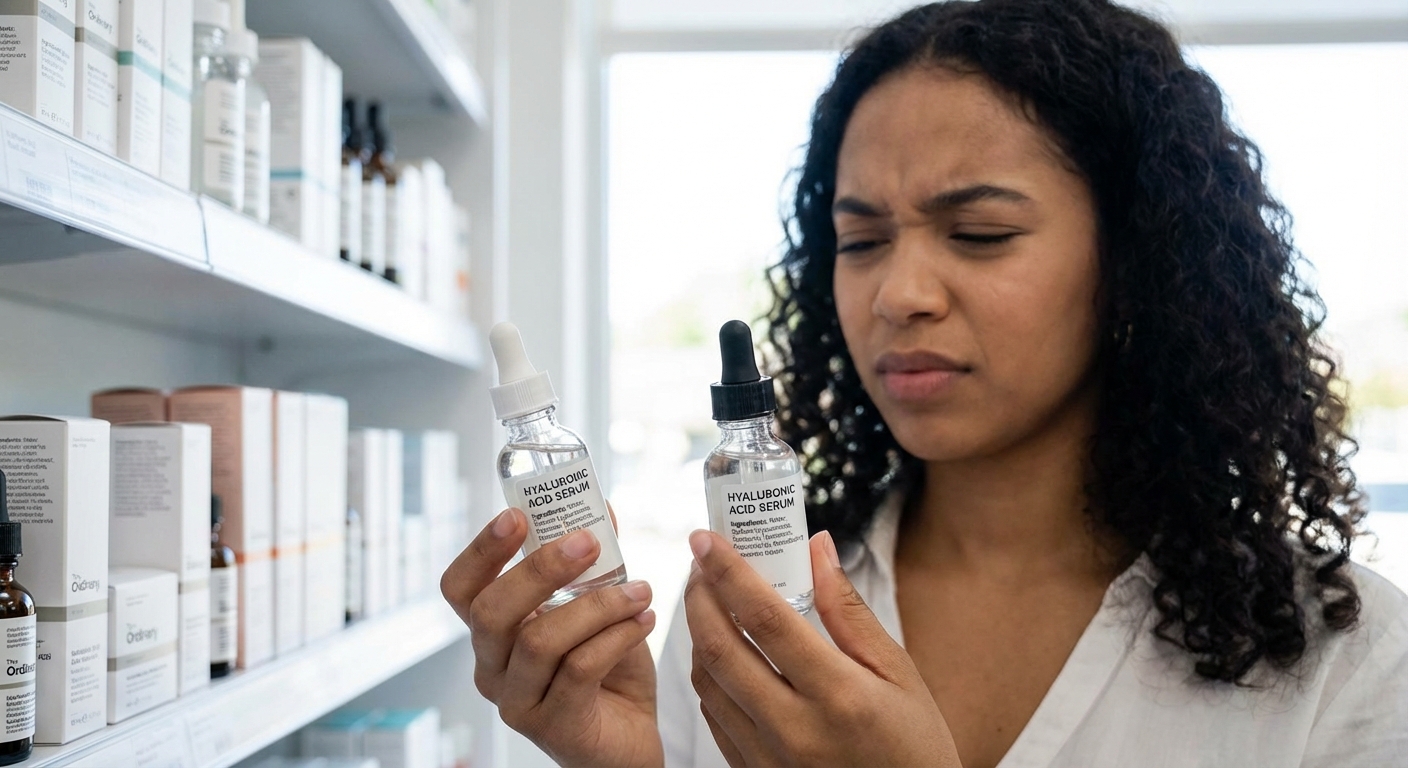
- High molecular weight (HMW) hyaluronic acid – Larger molecules, sit more on the surface. Great for immediate surface hydration and that dewy, glass-skin look. Less likely to irritate. Think: instant plump, shorter-term effect.
- Low molecular weight (LMW) hyaluronic acid – Smaller molecules, can penetrate deeper into the epidermis. Some studies show these can improve elasticity and fine lines over time, but they’re slightly more likely to cause irritation in very sensitive skin.
- Hydrolyzed hyaluronic acid – HA that’s been broken into smaller fragments. Often used in lighter serums or essences.
- Sodium hyaluronate – The salt form of HA, more stable and common in products. This is what you’ll see on a ton of INCI lists.
When I compared products that labeled their molecular weights vs ones that didn’t, the multi-weight formulas consistently gave me better, more “juicy” hydration all day. There’s actually research backing this: a 2011 randomized study in the Journal of Clinical and Aesthetic Dermatology found that topical low-molecular-weight HA improved wrinkle depth and skin elasticity after 8 weeks.
What to look for on the label:If a product mentions “multi-molecular weight HA”, “cross-linked HA”, or lists both “hyaluronic acid” and “sodium hyaluronate”, that’s usually a good sign. Some brands will even list specific sizes in kDa (kilodaltons) which is skincare-nerd heaven.
Step 2: Match the Texture to Your Skin Type
I’ve tested HA in almost every format at this point—serums, toners, creams, mists, even a weird jelly stick that felt like rubbing a gummy bear on my cheek. Here’s how I’d choose by skin type based on what actually worked on my face and on clients I’ve consulted with:
Oily or Acne-Prone Skin
When my T-zone is acting like a frying pan, I skip heavy creams and go for watery HA serums or essences.
Look for:
- “Oil-free” or “non-comedogenic” on the label
- Light, gel or water textures
- Bonus actives: niacinamide, zinc PCA, or gentle PHA
Avoid super-heavy balms as your only moisturizer on top; they can feel suffocating on oily skin.
Dry or Dehydrated Skin
My skin went full desert mode after a retinoid prescription. What worked:
- HA serum or lotion on damp skin
- Followed by a creamy moisturizer with ceramides or squalane
- At night, occasionally sealing it in with a light oil or balm
Seek products that combine HA with glycerin, panthenol (vitamin B5), and ceramides—they play really nicely together.
Sensitive or Reactive Skin
When my barrier was wrecked from over-exfoliating (don’t do what I did), even some HA serums stung.
In that phase I:
- Chose fragrance-free HA products
- Avoided strong LMW-only HA formulas
- Stuck with HA in gentle creams instead of watery serums that felt too intense
Patch test first, especially if you see “activated HA” or very high percentages.
Step 3: Check the Formula, Not Just the Buzzword
Just because a serum screams “2% HYALURONIC ACID” doesn’t mean it’s the best. Higher percentage isn’t always better; past a certain point, it can actually feel sticky or tight.
In my experience, the entire formula matters more than the HA percentage. A few things I always check:
- Where is HA on the ingredient list?
It’s usually somewhere in the middle or lower. That’s normal. HA is effective in low concentrations.
- What other humectants are in there?
I love seeing glycerin, betaine, aloe, panthenol. These support hydration so HA isn’t doing all the heavy lifting.
- Are there barrier-supporting ingredients?
Things like ceramides, cholesterol, fatty alcohols, and squalane help your skin actually hold onto that water.
- Potential irritants for your skin:
I personally avoid strong essential oils and added fragrance in leave-on products when my skin is sensitized. Some people are totally fine with them, but when my barrier’s fragile, they make me blotchy.
A study published in 2019 in the International Journal of Biological Macromolecules highlighted that combining HA with other moisturizing agents improved overall hydration and barrier function more than HA alone. That’s exactly what I’ve seen play out in real life.
Step 4: Use It the Right Way (This Matters More Than You Think)
The first time I used HA, I slapped it on dry skin and went straight to makeup. By noon, my face looked like a crumpled paper bag.
Once I fixed my technique, the same products worked 10x better:
- Apply on slightly damp skin.
After cleansing or toning, don’t completely dry your face. A thin layer of water gives HA something to grab.
- Use 2–4 drops, not half the bottle.
More isn’t better; more is sticky.
- Seal it in.
Follow with a moisturizer. If you live somewhere super dry or you’re blasting heating/AC, this step is non-negotiable.
- Always pair with sunscreen in the morning.
Hydrated skin + UV protection is the real anti-aging combo. SPF is still the main character.
Dermatologists like Dr. Shereene Idriss and Dr. Whitney Bowe have stressed this same routine in interviews and on social media: HA + moisture + SPF works with your skin biology instead of fighting it.
Pros and Cons That I’ve Actually Experienced
What I genuinely love about HA products:- Fast payoff – my skin looks plumper within minutes when I use a good formula.
- Works across ages and skin types – I’ve seen it help teen acne-prone skin and mature, menopausal skin.
- Plays well with other actives – I layer HA under retinoids and vitamin C to reduce that tight, stripped feeling.
- In very dry air with no occlusive moisturizer, my skin felt tighter and more lined.
- Some super cheap formulas just feel like sticky water with fragrance—no real, lasting hydration.
- If your barrier is damaged, even HA can sting or feel irritating.
So no, HA won’t replace a full routine, fix severe wrinkles, or act like injectable filler. But as a hydration backbone in your routine, it’s one of the most reliable things I’ve used.
How to Actually Pick One Off the Shelf (or Site)
If I had to distill years of trial-and-error, ingredient rabbit holes, and way too much money spent, here’s my quick checklist when I’m hovering over the “buy” button:
- Does it list hyaluronic acid or sodium hyaluronate? Great. Bonus points if it mentions different molecular weights.
- Is the texture right for my current skin state? Oily = lighter gel/serum. Dry = creamier or layered with a rich moisturizer.
- Are there other good hydrators and barrier-supports in there? Glycerin, panthenol, ceramides, squalane—yes, please.
- Fragrance and extras: dealbreaker or not for me right now? When my skin is cranky, I choose fragrance-free.
- Is my routine supporting it? Am I using it on damp skin, sealing it in, and wearing SPF? If not, I adjust expectations.
When I follow that checklist, I almost never end up with a dud anymore.
If you treat hyaluronic acid not as magic, but as a smart hydration tool that needs the right partners and environment, it goes from “overhyped trend” to “how did I ever skip this?” pretty quickly.
Sources
- Hyaluronan: A key molecule in skin aging – Dermato-Endocrinology (NIH/NCBI) - Scientific overview of HA’s role in skin and aging
- Hyaluronic Acid: A Key Molecule in Skin Aging – Journal of Clinical and Aesthetic Dermatology - Clinical discussion of topical HA benefits and molecular weights
- American Academy of Dermatology – Moisturizers: How to choose and use - Guidance on humectants, occlusives, and proper moisturizing technique
- Mayo Clinic – Dry Skin - Context on skin dryness and contributing factors
- Harvard Health – Choosing the right sunscreen - Explanation of why SPF is essential alongside hydrating actives