Guide to Choosing Natural Looking Wigs for Aging Hair
nner, and my confidence quietly slipped out the back door.
I remember standing under the brutal fluorescent lights of a wig shop, staring at a wall of perfectly curled mannequins that looked nothing like me. Every wig I tried either screamed “party city” or “news anchor from 1998.” I wanted something specific: a wig that looked like my hair—just… healthier, fuller, and a bit more youthful.
After testing synthetic, human hair, lace fronts, toppers, and even some very questionable Amazon finds, I finally cracked a system that consistently gives me natural-looking results, especially for aging hair.
This is the guide I wish I had on day one.
Step 1: Start With Your Real Hair, Not Your Dream Hair
When I first started, I made the classic mistake: I went for my fantasy hair—thick, long, and very much not age-appropriate for my face or lifestyle. On Zoom calls, people could tell something was “off,” even if they couldn’t say what.
In my experience, the most natural-looking wigs for aging hair usually:
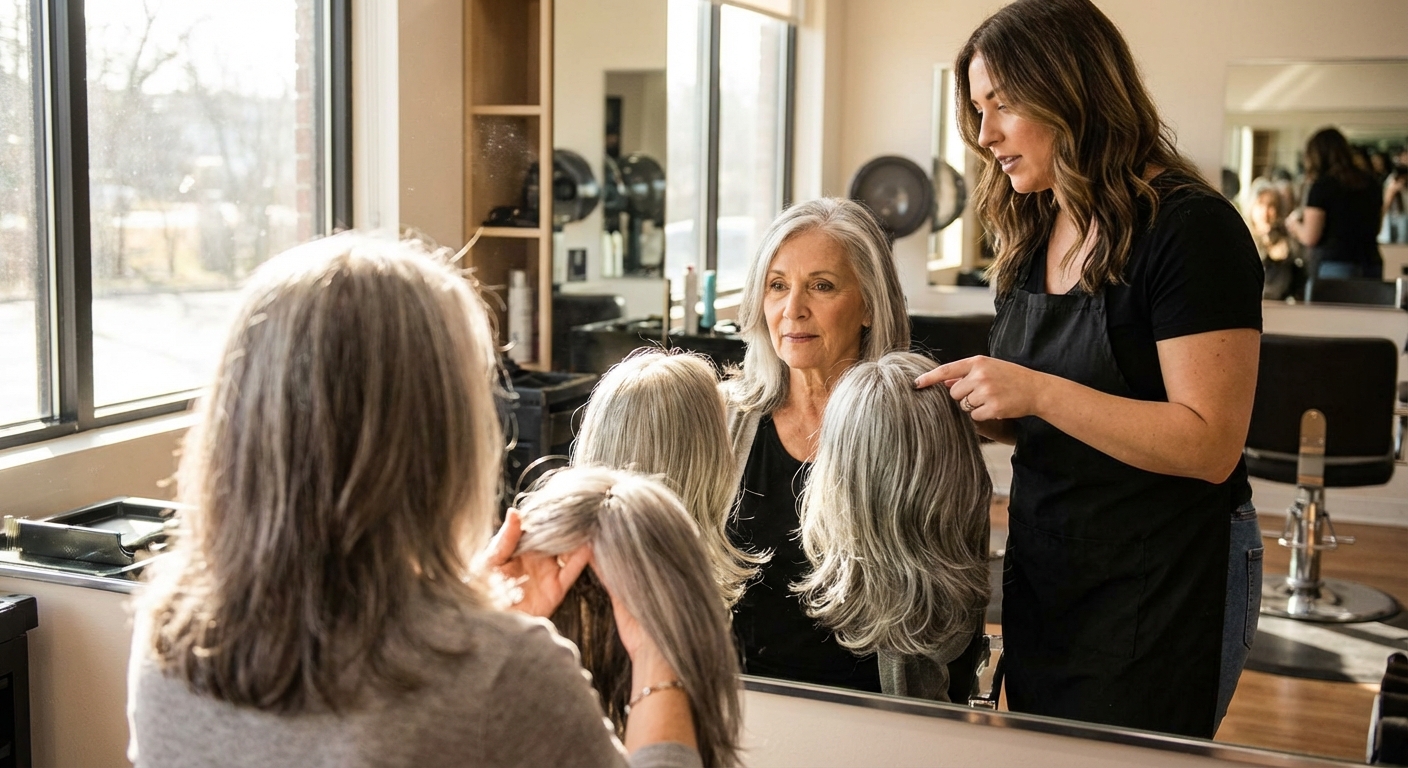
- Stay close to your current length (or just 1–3 inches longer)
- Mimic your natural texture (straight, wavy, coily)
- Sit within 1–2 shades of your present color
The goal isn’t to cosplay your 25-year-old self. The goal is to look like you on your best hair day in the last five years.
I actually brought old photos (pre-thinning) to a wig consultation. The stylist used those as a reference for density and style, not just color. That changed everything.
Step 2: Know Your Fiber – Synthetic vs Human Hair (vs Blends)
I’ve worn all three: synthetic, human hair, and blended fibers. Each has pros, cons, and a "realism" score that depends heavily on how you style and maintain it.
Synthetic Wigs
When I tested higher-end heat-friendly synthetic wigs from brands like Jon Renau and Raquel Welch, I was honestly shocked. They don’t have that Halloween shine if you choose well.
Pros:- Pre-styled: holds shape even in humidity (lifesaver in summer)
- Lower maintenance
- Often more affordable
- Color is super consistent
- Can’t be restyled as flexibly (heat-friendly versions can, but they wear out faster)
- Lifespan is shorter than human hair, especially with daily wear
These work beautifully for aging hair when you choose:
- A matte finish fiber
- Soft, natural movement (avoid super stiff curls)
Human Hair Wigs
My first human hair wig felt like magic. It moved like real hair because… it was real hair.
Pros:- Most realistic movement and feel
- Can be colored (by a pro), cut, and heat-styled
- Longest lifespan if you care for it
- Pricey—like, rent-level pricey in some cases
- Requires real styling time (blow drying, heat tools)
- Reacts to humidity like natural hair
For aging hair, human hair is amazing if you:
- Have the budget
- Either enjoy styling or don’t mind paying a stylist regularly
Blended Fibers
These combine human hair with synthetic. When I tested a human-hair/synthetic blend topper, it gave me the best of both worlds: better movement than pure synthetic, less maintenance than full human hair.
These can be a sweet spot if you’re not ready to commit fully to human hair.
Step 3: Cap Construction – The Hidden Secret to Looking Natural
Cap construction is the unsexy part of wig shopping, but it’s where the real magic happens.
Lace Front
A lace front wig has a sheer lace panel along the front hairline with individually hand-tied hairs. When I first put on a good lace front and pushed the hair back off my face, I nearly cried. It finally didn’t look like a wig.
- Look for temple-to-temple lace fronts if you like to tuck your hair behind your ears.
- Avoid harsh straight hairlines—some brands design a slightly irregular, “broken” hairline that looks more natural.
Monofilament Top or Part
Monofilament (“mono”) means the top section has hairs hand-tied to a sheer mesh, so it looks like the hair is growing from your scalp.
- Mono part: more affordable, natural-looking part
- Full mono top: you can change your part for different styling
When I tested non-mono wigs, the dense, stiff part gave me away instantly on camera. With a mono top, people kept asking what I’d done to my hair because it suddenly looked “so healthy.”
Hand-Tied vs Wefted
- 100% hand-tied caps: Most comfortable, lots of movement, and more natural if your hair is very fine or thinning all over.
- Wefted caps: Machine-sewn rows of hair. More volume at the roots and often more affordable.
For aging scalps that are more sensitive or prone to irritation, I found hand-tied caps genuinely feel better after a full day of wear.
Step 4: Color Choices That Don’t Fight Your Age
The biggest realism upgrade I’ve found isn’t the cap or fiber—it’s color dimension.
When I tried flat, single-tone colors, the wig sat on my head like a helmet. But the moment I switched to a shade with:
- Soft rooting (a slightly darker root)
- Light lowlights and highlights
- Or a shade that gently incorporated my own gray
…it suddenly looked like “my hair” instead of “my wig.”
For aging hair, consider:
- Going 1–2 shades softer around the face; it brightens the complexion
- Blended grays or “salt and pepper” tones if you’re already transitioning naturally
A 2021 review in Clinical, Cosmetic and Investigational Dermatology noted that hair thinning and graying significantly impacts self-esteem in midlife and older adults, but patients often feel better when solutions still look age-appropriate rather than overly “young.” That really tracks with what I’ve seen in the mirror.
Step 5: Getting the Fit Right (This Is Non-Negotiable)
My first wig technically “fit,” but it rode up in the back and gave me a faint headache. Surprise: I had never actually measured my head.
Use a soft tape and measure:
- Circumference: around your hairline
- Front to nape
- Ear to ear across the top
Most brands use these to categorize sizes (petite, average, large). An average size fits a lot of people, but if you’re on the smaller or larger end, getting the right size is huge for realism. A wig that’s slightly too big tends to bubble or shift—both dead giveaways.
Also, if you have sparse or thinning hairline, a wig grip band changed my life. It keeps the wig from sliding without needing aggressive glue.
Step 6: Styling Tricks That Make It Look Like Your Hair
When I tested wigs straight out of the box, they all looked… like wigs. The transformation happened with small tweaks:
- Get it professionally trimmed: I take every new wig to a stylist who understands alternative hair. A tiny face-frame cut or softened ends makes a massive difference.
- Break up the hairline: A clean, straight hairline looks fake. I carefully pluck 2–3 hairs at a time from the lace front and pull out a tiny bit of my own hair if it matches.
- Use dry shampoo: Especially on synthetic fibers, a light dusting at the roots knocks down any remaining shine.
- Skip perfection: Perfect curls and perfectly straight ends scream "styled piece." A bit of bend, some volume at the crown, and slightly messy ends look more believable, especially for aging hair.
I also learned the hard way not to over-style synthetic wigs. When I overused heat on a heat-friendly piece, the fibers got frizzy and rough fast. Now I limit heat and let the built-in style do most of the work.
Step 7: Wigs vs. Toppers for Aging Hair
If you still have hair on most of your head but your part, crown, or front hairline is thinning, you might not need a full wig.
Hair Toppers
Toppers clip into your existing hair and only cover certain areas. The first time I tried a mono-top topper, it felt less like a disguise and more like a subtle upgrade.
Pros:- Cooler and lighter than full wigs
- Lets your own hairline and length show
- Great if you’re thinning mostly at the crown or part
- You need enough bio hair to anchor the clips
- Can cause tension if your hair is already fragile
For many people with aging hair, starting with a topper feels less intimidating than going straight to wigs—and it often looks incredibly natural because part of what you’re seeing is your real hair.
Emotional Side: What No One Tells You
When I wore my first realistic wig out to brunch, I kept waiting for someone to say, "Nice wig." No one did. My friend just said, "You look really rested."
There’s no perfect solution for aging hair. Wigs can be:
- Empowering on good days
- Annoying on hot days
- Emotionally loaded on vulnerable days
It’s okay if you don’t want to wear them all the time. It’s okay if you only wear them for big events. And it’s okay if you feel weird at first—most of us do.
I’ve learned to treat wigs like great glasses: a tool that helps me feel more like myself, not less.
Quick Reality Check: Pros and Cons
What works really well:- Lace front + mono top for the most realistic hairline and part
- Slightly rooted, multi-dimensional color
- Professional customization (cut, thinning, shaping)
- Matching length and texture to your current or recent hair
- Ultra-long, ultra-thick hair on a much older face—it can look costume-y
- Super shiny, cheap synthetic fibers
- Overly dense hairlines with no customization
No wig is zero-maintenance, and no single piece will look perfect from every angle under every lighting. But with the right construction, color, and a little customization, you can absolutely get to the point where people just assume you suddenly found a miracle volumizing shampoo.
Sources
- American Academy of Dermatology Association – Hair Loss Types and Causes - Medical overview of different hair loss patterns and causes.
- Cleveland Clinic – Wigs, Hairpieces, and Scalp Coverings - Practical medical-center guide to wig types and considerations.
- Clinical, Cosmetic and Investigational Dermatology (DovePress) – The psychosocial impact of hair loss among adults - Review of research on hair loss and self-esteem.
- Memorial Sloan Kettering Cancer Center – Choosing and Wearing a Wig - Detailed guidance from a major cancer center on wig selection and fit.
- Johns Hopkins Medicine – Hair Loss and Your Self-Esteem - Discussion of emotional aspects of hair loss and coping strategies.