Guide to Choosing Tree Hut Scrubs
the bright jars, opened the tester of Tropic Glow… and suddenly I’m in a mango dessert shop instead of the body care aisle.
When I tested this scrub that night, I realized there’s a real difference between a random scrub and one that’s actually well-formulated. Since then I’ve gone a little deep—reading ingredient lists, comparing textures, checking dermatology sources, and yes, trying way more scents than I’d like to admit.
If you’ve ever stared at the wall of Tree Hut scrubs wondering which one to grab, this guide is for you.
Why Tree Hut Scrubs Got So Popular (Beyond TikTok)
From what I’ve seen, Tree Hut hit that sweet spot between
- sensory experience (the scents, the colors, the textures) and
- functional skincare (exfoliation that actually works).
The basic formula most jars share
Most Tree Hut shea sugar scrubs use:
- Sugar crystals – physical exfoliant that dissolves a bit with warm water and friction
- Shea butter – occlusive, helps soften and lock in moisture
- Plant oils – often safflower seed oil, sweet almond oil, or similar, which support the skin barrier
- Fragrance + extracts – where each variant gets its personality
From a skin-care nerd angle, the texture is interesting: it’s dense and paste-like rather than runny, which helps you control pressure and avoid over-scrubbing. When I compared it side-by-side with a cheap drugstore scrub that used jagged walnut shell powder, the difference on my skin was obvious—less redness, more glow.
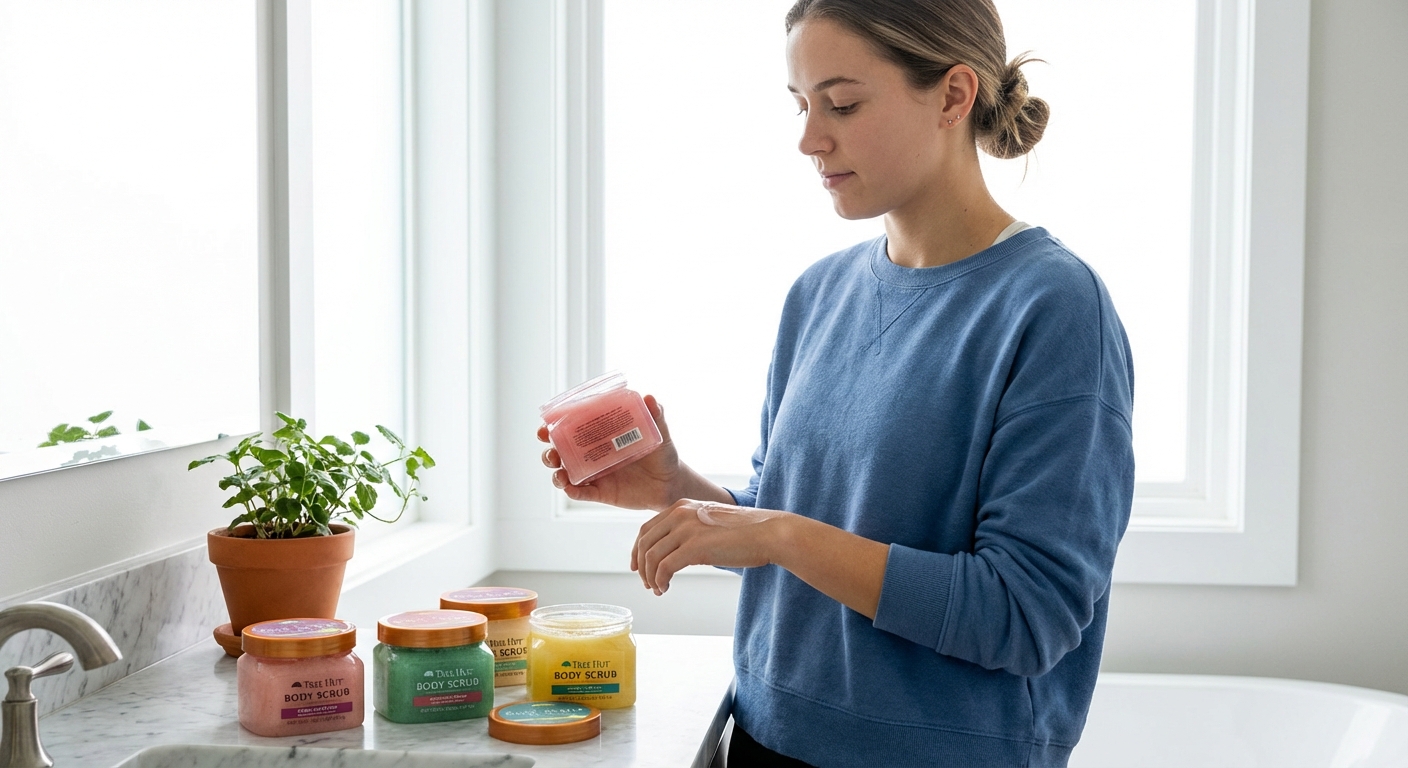
Dermatologists generally prefer sugar or jojoba beads over nut shells because sugar crystals are smoother and partially dissolve, reducing the risk of micro-tears in the skin barrier.
Step 1: Know Your Skin Type Before Picking a Scrub
I learned this the hard way. I have combo skin: drier legs and arms, oilier chest and back. I used to think, “Scrub is scrub, just grab whatever smells good.” Nope.
If you have dry or sensitive skin
In my experience, these perform better:
- Vitamin C Shea Sugar Scrub – has a slightly creamier base and includes ingredients like magnesium ascorbyl phosphate (a more stable vitamin C derivative in many body formulas).
- Coconut Lime – hydrating feel, lots of people with dry skin swear by the after-shower softness.
Tips from my own routine:
- Use once or twice a week, not daily.
- Apply on damp, not soaking wet skin, so you get slip without harsh friction.
- Follow with a fragrance-free or gentle body lotion if your skin is easily irritated.
If you have keratosis pilaris (KP) or bumpy “chicken skin”
Sea Salt and Exotic Bloom worked best for the tiny bumps on the back of my arms. The key isn’t just the scrub—it’s consistency.
What helped me:
- Scrub 2–3 times a week on bumpy zones.
- Gentle circular motions for ~30 seconds per area.
- Pairing the scrub with a chemical exfoliant body lotion (with lactic or salicylic acid) on off days.
Random but reassuring: the American Academy of Dermatology notes that regular exfoliation can help KP, but over-exfoliating can make it worse. I learned that balance the hard way when I went from “soft arms” to “angry red rash” after scrubbing daily.
If you shave or wax frequently
I recently tested using Tree Hut scrub before shaving versus after. Before won by a mile.
- Scrubbing before removes dead skin and helps prevent ingrowns.
- Scrubbing hard after shaving = stinging, irritation, and regret.
For pre-shave, I like:
- Coco Colada – lighter texture, nice slip.
- Moroccan Rose – super popular online; for me, it’s great on legs but too fragrant for freshly shaved underarms.
Step 2: Choose by Texture, Not Just Scent
I used to buy by scent alone. Then I realized not all Tree Hut scrubs feel the same on the skin.
Coarser, “grittier” scrubs
These are better for:
- Feet
- Elbows
- Knees
- Super-dry patches
When I tested Tropic Glow and Pineapple on my heels, the thicker sugar grains made a noticeable difference. My feet looked like I’d actually used a foot file, without the drama of one.
Softer, creamy-feel scrubs
These feel nicer on:
- Décolleté (chest)
- Inner thighs
- Stomach
On my skin, Vitamin C and Watermelon feel a bit creamier, like there’s more emollient base around the sugar crystals. That makes them more forgiving if you have a heavy hand.
If your skin gets red easily, go for the softer-feel formulas and use less pressure. Technique matters as much as the product.
Step 3: Be Real About Fragrance
Here’s where I have to be blunt: Tree Hut scrubs are heavily fragranced. That’s a huge pro or a huge con depending on your skin and your nose.
If you love bold scents
Tree Hut basically turns your shower into dessert:
- Tropic Glow – warm, sweet, almost like a Sol de Janeiro dupe vibe.
- Moroccan Rose – floral, feminine, one of the most viral scents.
- Coco Colada – vacation in a jar.
When I layered Moroccan Rose scrub + a light rose body mist + unscented lotion, the scent easily lasted half a day on me.
If you’re sensitive to fragrance
Here’s the honest downside:
- There isn’t a completely fragrance-free Tree Hut scrub at the time I’m writing this.
- If you have eczema or a history of fragrance allergy, you might react.
What’s worked for me with occasional sensitivity:
- Patch test on a small area of leg first.
- Avoid using on broken or freshly shaved skin.
- Rinse thoroughly and follow with a bland moisturizer if you’re unsure.
Dermatology sources consistently list fragrance as one of the top contact irritants in skincare. So even though I personally tolerate Tree Hut scrubs well on my body, I don’t use them on my face, neck, or any active rash.
Step 4: Match Your Scrub to Your Goals
When I stopped thinking “just scrub for smooth skin” and started asking, “What do I actually want from this jar?”, my choices improved a lot.
For glow and more even tone on body
Look for:
- Formulas marketed with vitamin C or brightening benefits (like the Vitamin C scrub).
Real talk: body scrubs alone won’t erase deep hyperpigmentation. Research on post-inflammatory hyperpigmentation points more to daily sunscreen and chemical exfoliants/retinoids than scrubs. But they do help surface dullness and product penetration.
For ingrown hairs and rough texture
What’s helped me most:
- Scrub 2–3x/week pre-shave (especially bikini line and legs).
- Use a salicylic or glycolic acid body product on non-scrub days.
Mechanical + chemical exfoliation (not on the same day if you’re sensitive) has given me fewer bikini-area ingrowns than either method alone.
For pure self-care, stress relief, and “shower ritual” vibes
I’m not going to pretend scent and texture don’t matter for mental health. There’s decent evidence that pleasant sensory experiences can reduce perceived stress levels.
On rough days, I deliberately reach for:
- Pineapple in summer – bright and fun.
- Moroccan Rose at night – definitely feels more “spa”.
The scrub becomes less about “fixing” your skin and more about reconnecting with your body, which honestly might be the best benefit.
Pros and Cons of Tree Hut Scrubs (From Actually Using Them)
What I genuinely like
- Price vs. performance: You get a big jar, solid texture, and nice results for a mid-range price.
- Effective exfoliation: On my legs and arms, I see immediate softness and more even-looking skin.
- Scent variety: There’s almost always a scent that fits your vibe or season.
- Widely available: Target, Ulta, Walmart, Amazon, etc.
Where they fall short
- Fragrance-heavy: Not great for very sensitive or allergy-prone skin.
- Jar packaging: You’re scooping with wet hands in the shower. I use a small spoon or spatula, but not everyone will.
- No true fragrance-free option: This excludes a whole group of people with reactive skin.
- Not a cure-all: They help texture and glow, but they won’t fix deep scars, strong KP, or chronic skin conditions by themselves.
How I Actually Use Tree Hut Scrubs in My Routine
Here’s my real-world routine that’s worked well over months of testing:
2–3 evenings a week:- Rinse with warm water and a gentle body wash.
- Turn the water down a bit so I’m just damp, not dripping.
- Grab about a tablespoon of scrub per leg (less for arms).
- Massage in circular motions for ~30–60 seconds per area.
- Rinse thoroughly—no grainy residue.
- Pat dry, then apply a body lotion or body butter.
On non-scrub days, I sometimes use a lactic acid body lotion on my arms and thighs. That combo (Tree Hut + chemical exfoliant on separate days) noticeably improved my KP and overall smoothness.
How to Pick Your First Tree Hut Scrub
If you’re standing in the aisle or scrolling online, here’s the quick decision path I wish I had at the start:
- Want something universally liked and feminine? Try Moroccan Rose.
- Want bright, warm, “vacation”? Go for Tropic Glow or Coco Colada.
- Have bumpy arms or legs and normal-to-tough skin? Choose a slightly grittier one like Tropic Glow or Pineapple.
- Have drier, more sensitive skin? Start with Vitamin C or Coconut Lime, use light pressure, and only 1–2x/week.
From there, adjust based on how your skin responds. If you notice stinging, redness that lasts hours, or itching, pull back on frequency or stop entirely.
Final Thoughts (From Someone Who’s Tried Too Many Jars)
Tree Hut scrubs aren’t miracle cures, but when I use them well, I genuinely get:
- softer skin
- fewer ingrown hairs
- that satisfying “my shower is a mini spa” feeling
The trick is to choose the formula that matches your skin type, your fragrance tolerance, and your actual goals, not just what’s trending on TikTok.
If you treat them as part of a bigger body-care routine—hydration, maybe a chemical exfoliant, and sunscreen for any exposed areas—they’re a fun, affordable, and pretty effective tool in the beauty arsenal.
Sources
- American Academy of Dermatology – Exfoliation: What You Need to Know - Dermatologist guidance on safe exfoliation and skin types
- Tree Hut Official – Shea Sugar Scrub Product Page - Official ingredient lists and product range
- Cleveland Clinic – Keratosis Pilaris: Treatment and Management - Medical overview of KP and role of exfoliation
- Harvard Health Publishing – Moisturizers: What They Do and How They Work - Explanation of emollients, occlusives, and skin barrier support
- National Eczema Association – Understanding Fragrance Allergy - Discussion of fragrance as a common irritant for sensitive skin