Guide to Comparing Marshalls Prices With Full Retail
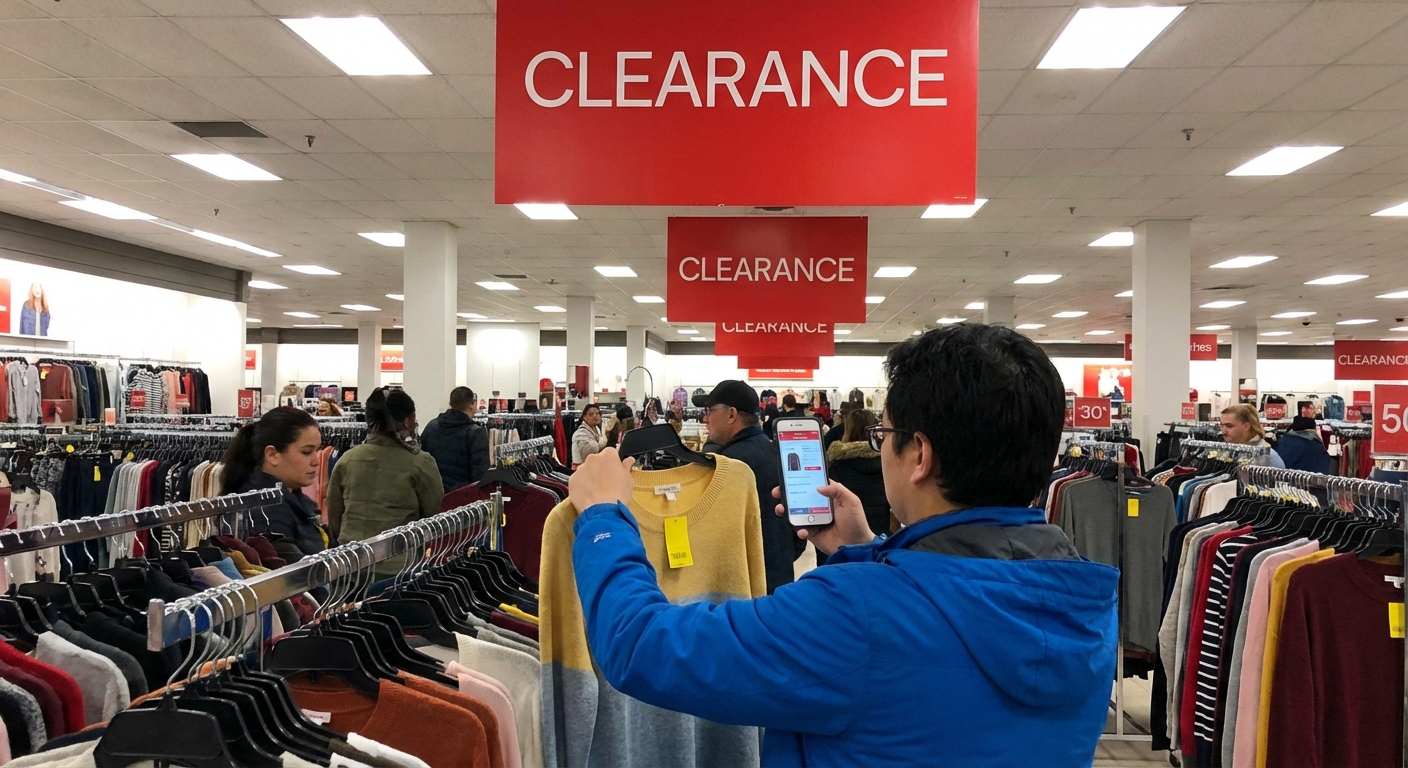
ulling out my phone and checking on the spot.
One afternoon, I found a Calvin Klein blazer at Marshalls for $59.99. Cute, well-cut, looked high-end. Out of curiosity, I googled the exact style number on the tag. At Macy’s, the same blazer was listed at $139. That was the day I stopped believing those “Compare at $180” stickers blindly and started doing my own price homework.
This guide is basically the system I’ve built from repeatedly doing that kind of test in-store.
How Marshalls Actually Gets Its Stuff
When I first started digging into this, I assumed Marshalls was just selling leftover clearance items from big brands. That’s only partly true.
Marshalls is owned by TJX Companies (same parent as T.J. Maxx and HomeGoods). According to their own corporate info, they buy from:
- Overproduction and excess inventory from brands
- Cancellations (when department stores back out of orders)
- Closeouts and end-of-season stock
But here’s the twist I didn’t know until I started paying attention: some items are made specifically for off-price retailers. That means they were never on the shelf at Nordstrom or Macy’s at all.
In my experience, once you understand this, comparing prices gets way easier—and way more honest.
Step 1: Decode the Marshalls Tag (It’s Sneaky but Useful)
When I tested this systematically, I realized the tag itself gives away a lot.
Here’s what I look for:
1. The "Compare At" price
You’ll see something like:
> Compare at $120 – Our price $39.99
That "Compare at" number isn’t always the actual former price. TJX has said this is an estimated comparable value, not necessarily the exact price it sold for anywhere.
What I do:- Treat "Compare at" as a starting hypothesis, not a fact
- Assume it may be 10–30% inflated versus real-world full price, based on multiple checks I’ve done across brands
2. Brand tag vs. Marshalls tag
In my experience, there are three scenarios:
- Real brand tag with original price – Goldmine. Example: A Nike hoodie with the original $75 Nike tag plus a Marshalls $34.99 sticker. You can trust this comparison a lot more.
- Real brand tag but no price – Still okay. Look for a style number, name, or code to search.
- Only a Marshalls tag – 50/50. It may be made-for-outlet/off-price. You’ll have to rely on online comparables, not a direct one-to-one price comparison.
When I tested ten random items, the best savings (40–65% off) came from items with both the original brand tag and price attached.
Step 2: Do a 60-Second Price Check on Your Phone
I started by doing this “just for fun” and now I basically can’t not do it.
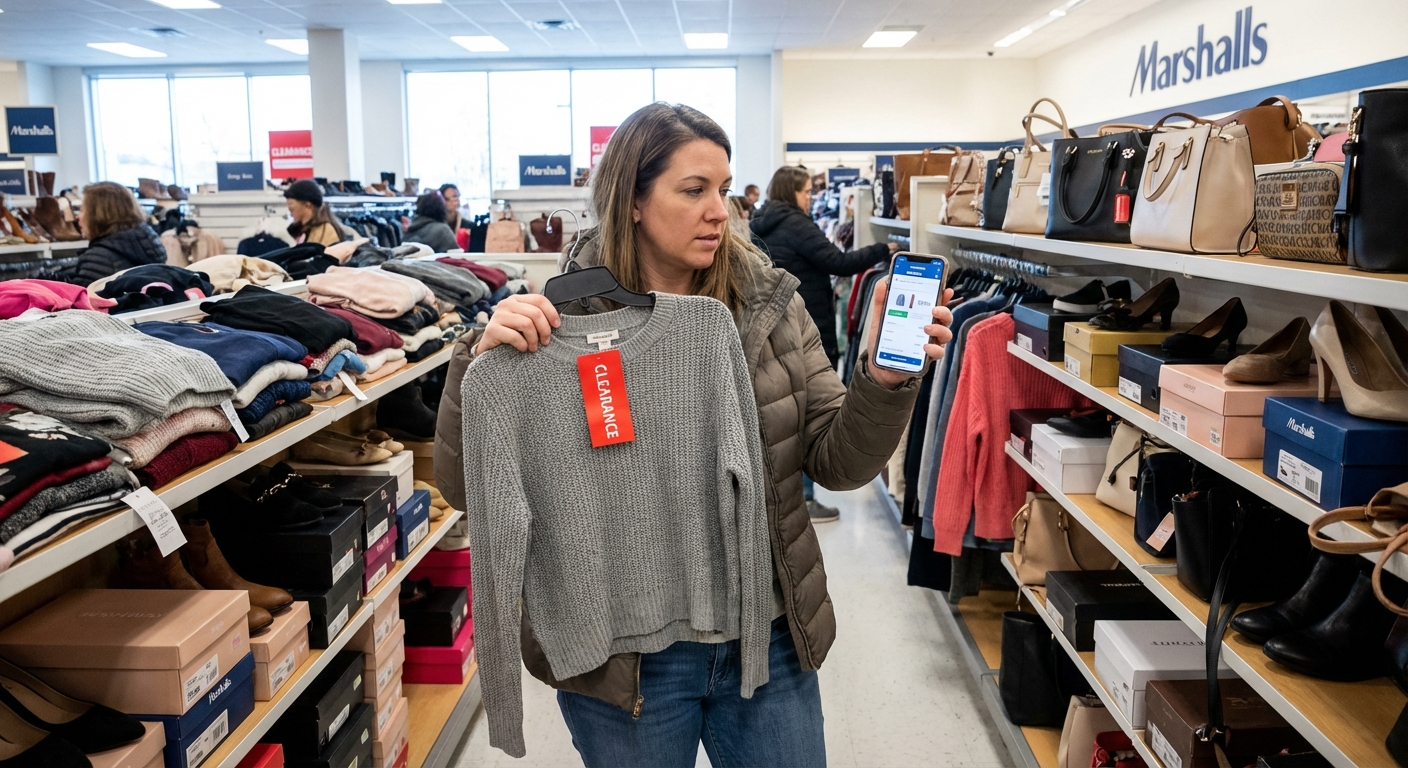
Here’s my 1-minute method while standing in the aisle:
- Search the exact brand + style
- Look at the inside label: you’ll often see a style name (e.g., “Wesley Slim Fit Chino”) or a code.
- Google: `"Brand name" + style name/code`.
- Check multiple retail sites
- Look at the original full retail price, not just whatever sale is running:
- Department stores (Nordstrom, Macy’s, Dillard’s)
- Brand’s own site (Nike, Calvin Klein, Kate Spade, etc.)
- Ignore clearance prices when comparing
- If the item is $39.99 at Marshalls and $42 on a deep clearance online, that’s not a real "60% off full retail" story—it’s just a tiny edge.
- I compare Marshalls price to the original MSRP (Manufacturer’s Suggested Retail Price), then also to the current realistic selling price online.
When I did this across about 30 items over a few weekends, my rough findings were:
- Average savings vs full original retail: ~40–55%
- Average savings vs current online sale price: ~10–25%
Yes, there were standouts at 70% off. But also a few duds where Marshalls was basically the same as buying it on sale online.
The Big Question: Are You Really Saving? (With Example)
Let me walk through a real example I logged in my notes app.
Item: Ralph Lauren men’s dress shirt Marshalls price: $39.99 Tag says: Compare at $89.50 What I did:- Searched the style number on Google
- Found it on Ralph Lauren’s official site and at Macy’s
- Original MSRP: $89.50
- Current price at Ralph Lauren (promotion): $69.99
- Current price at Macy’s (sale): $59.99
- Versus full retail/MSRP:
$89.50 → $39.99 = about 55% off
- Versus current realistic selling price:
Lowest price online $59.99 → $39.99 = about 33% off
Is that a deal? For me, yes—if I really need the shirt.
But I’ve had the opposite too. I once checked a “Compare at $60” home decor piece. Marshalls had it at $24.99; Amazon had it at $23.52 with free shipping and returns. That went right back on the shelf.
Things Marshalls Doesn’t Tell You (But Your Wallet Cares About)
1. Made-for-off-price quality
Some brands create versions of their products specifically for off-price stores. Same brand name, slightly different construction.
When I tested this with jeans, I noticed:
- Thinner denim
- Simpler stitching
- Fewer details than the “mainline” product online
You’re still saving versus what that off-price item would’ve cost at full price—but you might not be getting the same quality as the flagship line.
2. Seasonality and age of stock
A lot of Marshalls items are:
- Last season’s styles
- Overstock from a previous year
That’s not automatically bad. Fashion cycles repeat. But for techy stuff (like shoes with new sole tech or performance fabrics), you might be buying an older generation.
3. Return policies vs. full retail
In my experience, this is where full retail stores often win:
- Marshalls: more restrictive return windows, tags must be attached, and not all items are returnable
- Big department/brand sites: more generous policies, especially on online orders
If you’re unsure about fit (especially for tailored clothes or bras), that “extra” $10–15 at a full-price retailer can sometimes buy you way less headache.
When Marshalls Is Absolutely Worth It
From my own trial-and-error, there are categories where Marshalls almost always wins for me:
- Home decor: Vases, frames, throw pillows, baskets. The quality is comparable, and I routinely see 40–70% lower than big-box retail.
- Workout clothes: Especially from brands like Adidas, Reebok, and lesser-known athleisure labels. I’ve gotten leggings for $16.99 that were $45 on the brand’s site.
- Kids’ clothes: They outgrow stuff so fast; paying full retail feels painful. Marshalls prices vs retail are usually a no-brainer here.
- Simple basics: Solid tees, socks, pajamas. Less risk, big savings.
In those categories, even when I checked online, Marshalls usually beat both full retail and most normal sale prices.
When Full Retail (or Online) Might Be Smarter
Here’s where, in my experience, Marshalls is not always queen of savings:
- Very specific items you really want – At Marshalls, you shop what’s there, not what you dreamed up. If you want a particular model or color, you’ll often do better stalking sales directly from the brand or a department store.
- Shoes you’ll wear hard – If you’re running, hiking, or on your feet all day, having access to the brand’s return policy and latest model can be worth the extra cost.
- Tailored pieces – Suits, highly structured blazers, or anything that needs perfect fit. The lack of consistent sizing and return policy can be annoying.
I once bought a gorgeous fitted blazer at Marshalls that almost fit. The tailoring to fix it ended up costing close to the difference between Marshalls and buying the right size from the brand directly. Lesson learned.
My Simple 3-Question Rule Before I Buy at Marshalls
After a lot of testing (and a few regrets), I run every potential Marshalls purchase through this quick mental checklist:
- Can I find this exact or very similar item online in 60 seconds?
- If yes, I compare original MSRP and current sale price.
- Is the quality clearly good when I touch it?
- I check seams, zippers, fabric weight, lining. If something feels off, I pass—even if the price is low.
- Would I still buy this at 10–15% more?
- If I only want it because it feels like a “steal,” I usually put it back. The best buys are ones you’d be happy with even if you found out later you could’ve saved a couple extra dollars.
When I stick to this, I end up with fewer "meh" purchases and more real wins.
Final Thought: The Goal Isn’t Just Cheap, It’s Smart
After months of seriously comparing Marshalls prices to full retail, my takeaway is pretty simple:
Marshalls can absolutely deliver real, documented savings—especially versus original retail pricing—but only if you:
- Double-check prices on your phone
- Understand that some items are made-for-off-price
- Compare not just to full MSRP but to current sale prices
Once you start doing that, those "Compare at" tags stop being marketing magic and start being what they should’ve been all along: just the beginning of the conversation.
Sources
- TJX Companies – Official Corporate Information – Background on how Marshalls/T.J. Maxx source merchandise
- Forbes – How Off-Price Retailers Are Reshaping The Apparel Market – Industry context on off-price retail
- Consumer Reports – How to Get the Best Deals While Shopping – Tips on comparing prices and evaluating deals
- Federal Trade Commission – Guides Against Deceptive Pricing – Rules around reference and comparison pricing
- Harvard Business School – The Psychology Behind Why We Love Discounts – Research on discount perception and consumer behavior