Guide to Door Designs for Different Living Spaces
al) could change the entire vibe, light, and flow of a home.
When I tested different door designs with a designer friend, we literally swapped just three doors in my place — the entry, the bathroom, and the balcony — and the apartment felt bigger, brighter, and more expensive. Same furniture, same paint. Completely different energy.
So this is the guide I wish I’d had back then — practical, tested in real homes, and not written like a building code manual.
Entry Door: Security First, Style Close Second
Your main door does more than open and close. It handles security, noise, insulation, and that first impression everyone secretly judges.
In my experience, three things matter most:
- Core material – solid wood, fiberglass, or steel
- Security hardware – deadbolts, strike plates, hinges
- Weather & noise performance – seals, thresholds, insulation
Solid Wood vs Fiberglass vs Steel
When I replaced my old hollow-core entry door with a solid wood one, the street noise dropped so much I could suddenly hear my fridge humming. But wood needs maintenance.
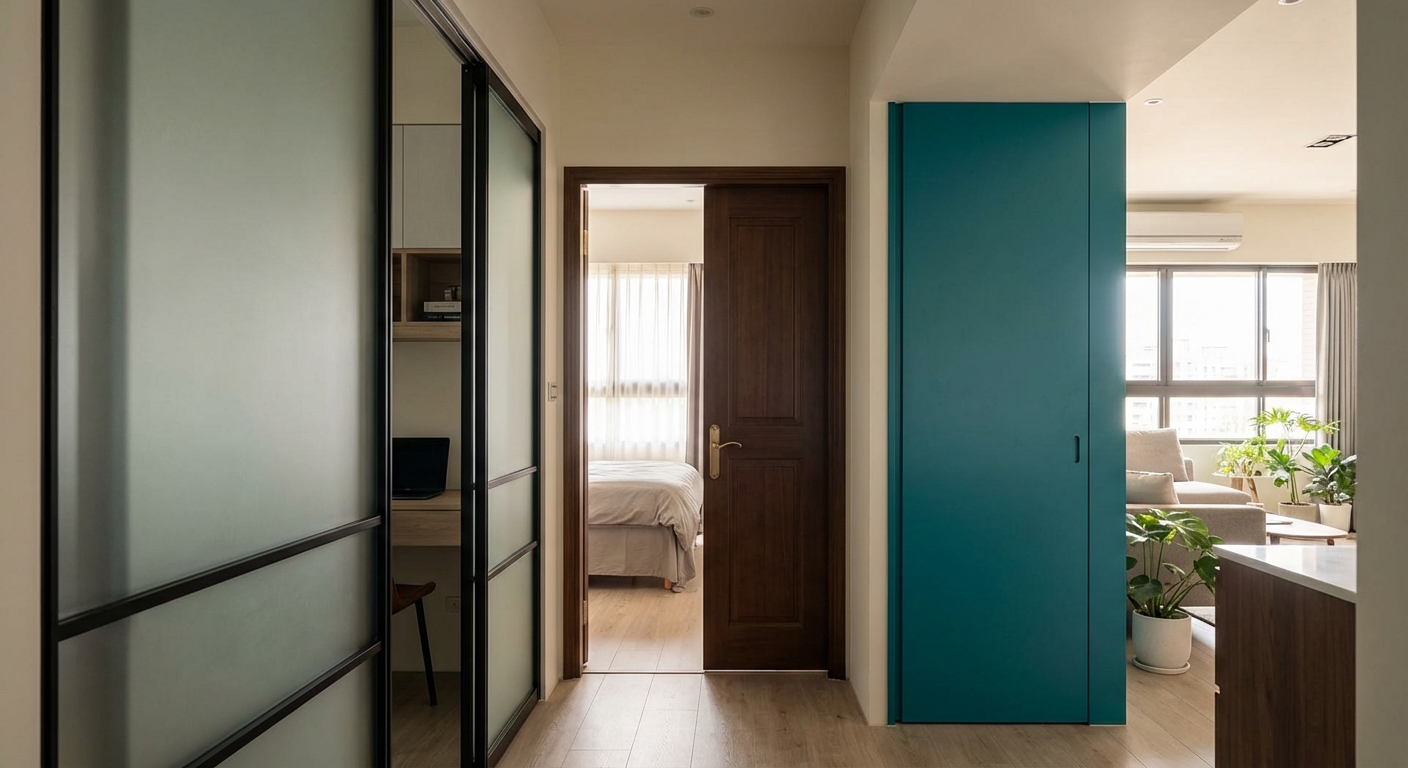
Here’s how they really compare:
- Solid wood doors (oak, mahogany, walnut)
- Pros: Warm, high-end look, can be refinished, great weight and feel.
- Cons: Can warp in humid climates, needs resealing, usually pricier.
- Best for: Covered porches, traditional or craftsman-style homes.
- Fiberglass doors
- Pros: Insanely durable, low maintenance, good at mimicking wood grain, great thermal performance.
- Cons: Cheap versions can look plasticky up close, repairs can be tricky.
- Best for: Harsh climates, busy families who don’t want to baby their door.
- Steel doors
- Pros: Top-tier security feel, cost-effective, fire-resistant options.
- Cons: Dents are forever, scratches can rust if not touched up, can look “commercial” if not styled well.
- Best for: Condos, urban locations where security is a bigger concern.
According to the U.S. Department of Energy, insulated steel and fiberglass doors generally offer better energy efficiency than solid wood, especially when they’re foam-filled and properly weatherstripped (energy.gov, 2023). I noticed my hallway stopped feeling like a wind tunnel in winter once I upgraded.
Glass or No Glass?
I recently tested two entry doors side by side in a client project: one solid, one with a narrow vertical glass lite.
- The glass version made the hallway feel wider and less cave-like.
- Privacy was fine once we used frosted and textured glass.
If you live on a busy street, go for frosted, reeded, or seeded glass. They still let in natural light but blur the view.
Living Room Doors: Framing the Social Space
Living rooms love doors that connect rather than separate. I’ve found three designs that can totally shift the mood: French doors, sliding doors, and pocket doors.
French Doors: Classic and Light-Filled
I once swapped a single solid door for French doors with clear glass between a living room and a small study. The study went from “storage dungeon” to “home library” in about three hours.
Why they work:- They visually enlarge spaces by keeping sightlines open.
- They share light between darker and brighter rooms.
- They can go from formal to casual depending on trim and hardware.
- Not ideal if you want serious sound isolation.
- More glass = more cleaning.
Sliding and Barn Doors: Stylish Space Savers
Sliding doors and barn doors exploded on Instagram for a reason: they photograph incredibly well.
When I tested a barn door in a narrow hallway, though, I learned the not-so-Instagram side:
- You need enough clear wall space for the door to slide open.
- Sound isolation is weaker because the door usually doesn’t seal tightly.
But for a tight condo or studio, a clean-lined sliding door with a soft-close track can be a lifesaver. They’re especially good for giving a bit of separation to a home office without needing swing clearance.
Pocket Doors: The Ninja Option
Pocket doors slide into the wall cavity. In my last renovation, adding a pocket door to a small den freed up enough wall space for a bookcase I’d been wanting for years.
Pros:- Maximum space efficiency – no swing arc.
- Great for awkward layouts, small living rooms, or where furniture placement is a puzzle.
- Harder and more expensive to retrofit (you’re opening walls).
- Hardware access and repairs are more involved.
- Not ideal where you need heavy-duty privacy or acoustic separation.
Kitchen Doors: Flow, Smells, and Sightlines
Kitchens are where door decisions either make your home flow beautifully… or drive you insane every time two people try to pass each other.
I’ve experimented with three approaches:
1. No Door, Just a Cased Opening
This is the default in many modern homes — and for good reason.
Works well when:- You’ve got good ventilation.
- You want an open-concept feel.
2. Glass or French Door to the Kitchen
This has become my favorite compromise.
- You get visual connection.
- You can close it when cooking strong-smelling food.
- You can use tempered glass (safety glass) which is required by most building codes near doors.
Tip: Go for full-height glass with minimal framing if your kitchen is dark. It turns the door into a giant light panel.
3. Swinging or Dutch Doors
I tested a traditional swinging door once and quickly realized how much it fought with the fridge door. Not fun.
Dutch doors (split horizontally so the top can open) are charming near back patios or side yards:
- You can talk to someone outside or hand things through.
- The bottom half keeps kids or pets in.
They’re less common, but in cottage-style homes they’re incredibly functional and add personality.
Bedroom Doors: Privacy, Quiet, and Comfort
Bedroom doors quietly do some of the most critical work in a home: privacy and sound control.
Solid-Core vs Hollow-Core
In my own apartment, swapping a hollow-core bedroom door for a solid-core one was one of the cheapest quality-of-life upgrades I’ve made.
- Hollow-core doors (the lightweight, echo-y kind in many rentals) are cheap but terrible at blocking sound.
- Solid-core doors use engineered wood or MDF inside and drastically reduce noise transfer.
The National Institute for Occupational Safety and Health (NIOSH) notes that every 10 dB reduction in sound is perceived as roughly halving loudness, and solid-core doors can significantly increase the Sound Transmission Class (STC) rating compared to hollow-core ones.
You don’t need to memorize STC ratings, but if you:
- Work night shifts
- Have kids with varying bedtimes
- Live with enthusiastic gamers
…solid-core is worth it.
Style & Hardware Choices
For bedrooms, I usually recommend:
- Simple panel designs that match trim and baseboards.
- Lever handles instead of knobs if accessibility is a concern.
- A good door sweep and weatherstripping if hallway noise is an issue.
If you want something bolder, a painted door (deep navy, charcoal, muted green) can make the room feel more curated with very little effort.
Bathroom Doors: Privacy, Ventilation, and Humidity
Bathrooms are the stress-test for doors: constant humidity, frequent use, and privacy expectations.
In my experience, three rules matter:
- Avoid cheap, thin hollow-core doors in high-humidity bathrooms.
- Use moisture-resistant paint and keep the top and bottom edges sealed.
- Think hard before using glass.
Pocket or Barn Doors for Bathrooms?
I’ve installed both. Here’s the honest version:
Pocket doors:- Great for tight hall baths.
- Fine for powder rooms.
- For primary bathrooms, I recommend quality hardware and a well-built wall cavity to reduce gaps.
- Look great from the bedroom side.
- Privacy and sound control are… not amazing.
For guest baths or powder rooms off a main area, I generally prefer a good old-fashioned hinged door.
Balcony, Patio, and Garden Doors: Blurring Indoor-Outdoor Lines
The biggest transformation I’ve seen from a single door change was in a client’s small living room that faced a tiny balcony. We swapped a regular door plus small window for a full-width sliding glass door.
The room felt at least 30% bigger. Not literally, but visually.
French vs Sliding vs Folding
- French doors
- Romantic, charming, great for traditional homes.
- Need swing space inside or outside.
- Typically better at sealing than cheap sliders.
- Sliding patio doors
- Space-saving, great for balconies and small decks.
- Modern versions with low-E, double- or triple-glazed glass dramatically cut heat loss and gain.
- Some high-quality models have excellent security and air sealing.
- Folding / bi-fold doors
- The showstoppers in high-end projects.
- Fully open a wall; perfect for mild climates.
- Expensive and require very precise installation and structural support.
The U.S. Department of Energy points out that doors with large glass areas should use energy-efficient glazing (low-E coatings, gas fill, warm-edge spacers) to manage heat transfer. In my projects, better glass has made a noticeable difference in both summer overheating and winter drafts.
Matching Door Design to Your Space (Without Losing Your Mind)
When clients feel overwhelmed, I walk them through three simple filters I’ve learned to rely on:
- Function first
- Do you need privacy? Sound control? Light sharing? Accessibility?
- Rank these. The top two will narrow your options fast.
- Architecture second
- A sleek flush door looks odd in a 1920s craftsman bungalow.
- Big, ornate panel doors can overpower a minimalist apartment.
- Budget last, but honestly
- If your budget is tight, splurge on the entry door and bedroom doors, and keep secondary spaces simple.
- Hardware (handles, hinges) can make an inexpensive door look more expensive.
When I renovated my own place, I went mid-range on most interior doors, high on the entry door, and used better hardware everywhere. No one has ever asked the price of the slabs themselves — but they always notice how the doors feel and sound.
Doors aren’t just “finishes”; they shape how you experience your home every single day. If you plan with function, light, and sound in mind, you’ll feel the difference every time you turn a handle.
Sources
- U.S. Department of Energy – Energy-Efficient Doors - Practical guidance on materials and insulation for exterior doors.
- NIOSH – Occupational Noise Exposure - Background on sound, decibels, and perceived loudness relevant to sound control.
- Harvard Graduate School of Design – Residential Building Systems - General reference for building envelope and door system considerations.
- Andersen Windows & Doors – Patio Door Types - Manufacturer overview of sliding, French, and folding door configurations.
- This Old House – How to Choose an Interior Door - Practical breakdown of interior door types, cores, and styles.