Guide to Engagement Ring Styles and Settings
iate asked, “So, what style are you thinking?” and my brain completely blanked.
If you’re there right now, breathe. I’ve been through this both for myself and helping two close friends shop, and once you understand ring styles and settings, the whole process stops feeling like rocket science and starts feeling…kind of fun.
This guide is everything I wish I’d had open on my phone while I was pretending to know what a prong setting was.
First: Style vs. Setting (They’re Not the Same)
When I first started researching, I kept seeing “style” and “setting” thrown around like they meant the same thing. They don’t.
- Style = overall look and vibe of the ring (classic, vintage, minimalist, glam, etc.).
- Setting = how the center stone is physically held and arranged on the band (prong, bezel, halo, pavé, etc.).
Think of style as the outfit and setting as the tailoring.
The Big Engagement Ring Styles (And Who They Suit)
1. Classic & Timeless
When I tested different rings at a local jeweler, the one that made me go “oh wow” wasn’t the flashiest—it was a simple solitaire on a delicate band.
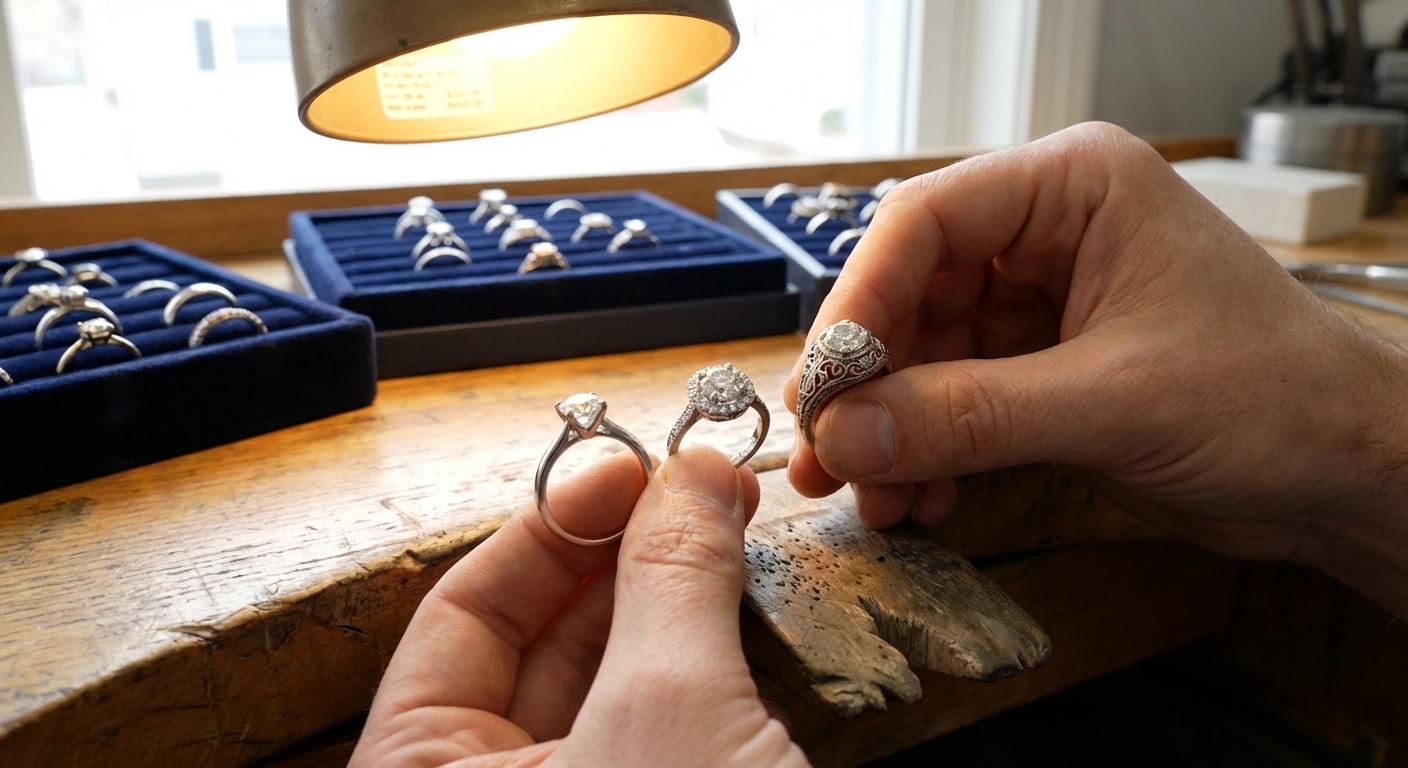
- Single center stone (usually round brilliant)
- Minimal side stones or none
- Plain metal band (yellow, white, rose gold, or platinum)
2. Vintage & Antique-Inspired
One of my friends is obsessed with old movies, and her ring looks like it fell out of a 1920s Parisian jewelry box.
Typical features:- Milgrain (tiny beaded edges)
- Filigree (delicate metalwork)
- Geometric shapes (asscher, emerald, cushion cuts)
- Floral or lace-like details
According to Christie’s and Sotheby’s auction data, genuine antique rings from the Edwardian and Art Deco eras (early 1900s–1930s) are still among the most sought after styles for collectors.
Pros:- Huge personality
- Often flatteringly low-profile (good if you use your hands a lot)
- Details can trap dirt; you’ll need to clean more often
- True antiques may be harder to resize or insure
3. Modern & Minimalist
When I discovered bezel settings (we’ll get to those), I went down a Scandinavian-design rabbit hole. Clean lines, smooth metals, very “I own matching glass Tupperware.”
Typical features:- Simple geometric shapes
- Thin or slightly squared bands
- Bezel or tension settings
4. Glam, Sparkly, Extra (In the Best Way)
If your person loves sequins, highlighter, and the biggest slice of cake, this section’s for you.
Typical features:- Halos (or double halos)
- Pavé bands
- Larger center stones or elongated shapes (oval, pear, marquise)
The Knot’s 2023 Jewelry & Engagement Study reported that halos and pavé bands are still among the top-requested styles, especially for people under 35.
Pros:- Maximum sparkle for the size (a halo can make a 1.0 carat stone look more like 1.3–1.4 carats)
- More small stones = more potential maintenance
- Can snag on sweaters or hair if the setting is high
Core Engagement Ring Settings (What Actually Holds the Stone)
This is where the engineering side comes in. When I tested rings, I realized quickly that comfort and practicality mattered as much as how they looked on my hand.
1. Prong Setting
This is the classic you see everywhere.
What it is: Metal claws (usually 4 or 6) grip the stone. Why people love it:- Lets in tons of light → more sparkle
- Works with almost all diamond shapes
- It photographed gorgeously
- I did snag it twice on a sweater because it sat a bit high
If your partner is super active, ask about low-set prongs or “basket” style prongs that hug closer to the finger.
2. Bezel Setting
This is the one I recently discovered that made me go, “Ohhh, so I don’t HAVE to worry about the stone catching everything.”
What it is: A rim of metal fully or partially surrounds the stone. Pros:- Very secure (great for nurses, chefs, athletes)
- Smooth edges, rarely snags
- Protects the girdle (edge) of the stone
- Slightly less light enters from the sides, so the stone can look a hair smaller
Gemological Institute of America (GIA) often recommends protective settings like bezels for softer gemstones (like morganite or emerald) because of the added protection.
Best for: Minimalist, modern, and practical everyday wear.3. Halo Setting
I used to think halos were “too much” until I tried one on. Then I got it.
What it is: A ring of smaller diamonds or gemstones circles the center stone. Why people love it:- Makes the center stone look larger
- Adds intense sparkle without paying for a massive center diamond
- All those tiny stones (melee) can eventually loosen; you’ll want periodic prong checks
- Some halos sit high and can bump into things
There’s also the hidden halo trend—tiny stones under the center stone. When I tested one, it looked pretty normal from above but exploded with sparkle from side angles. It’s like a secret flex.
4. Pavé & Micro-Pavé Bands
What it is: Tiny diamonds set closely together along the band, held by small beads or prongs.When my friend chose a pavé band, she said, “I want it to look like it’s dipped in diamonds,” and that’s…basically what pavé does.
Pros:- Makes the whole ring sparkle, not just the center
- Can be paired with almost any center setting
- Harder to resize without disturbing stones
- Tiny stones can fall out over many years if the ring takes abuse
If you (or your partner) are rough on your hands, consider “French pavé” (deeper notches to protect stones) or limit pavé to the top half of the band.
5. Three-Stone & Side-Stone Settings
I used to think three-stone rings were old-fashioned until I tried an emerald-cut trio. It felt like a tiny Art Deco skyscraper on my finger.
What it is: A center stone flanked by two side stones.Traditionally, people say it represents past, present, and future. Meghan Markle’s engagement ring is a famous three-stone example (a cushion-cut center with side diamonds from Princess Diana’s collection).
Pros:- More finger coverage and presence
- Tons of customization with different side stone shapes (trillion, baguette, pear)
- Can be harder to stack flush with some wedding bands
- Cleaning between stones will take a bit more effort
6. Tension & Faux-Tension Settings
These are the ones that look like the stone is floating.
What it is: The band’s pressure holds the stone in place (true tension), or small hidden prongs + design mimic that look (faux tension). Pros:- Very modern, sculptural look
- Center stone is super visible
- True tension settings usually can’t be resized much
- Not every jeweler offers them, and you’ll want a reputable one for this style
Matching Style & Setting to Real Life (Not Just Instagram)
When I finally stopped scrolling inspiration photos and started thinking about my actual life, a few things became non-negotiable:
- Lifestyle:
- If your partner works with their hands (healthcare, fitness, food service, mechanics), low-set prongs or bezel are safer than super-high, sharp halos.
- For someone at a keyboard all day, almost anything works; comfort and snag factor matter more than durability.
- Maintenance reality:
When I tested a very detailed vintage-style pavé ring for a week, I realized I didn’t have the patience to keep a toothbrush and jewelry cleaner on standby. More details = more cleaning.
- Future flexibility:
I’ve seen friends upgrade their center stone later but keep the original setting. Simpler settings (solitaire, plain halo, bezel) are easier to adapt down the line.
- Budget and illusions (the good kind):
- Ovals, pears, and marquise can look larger for the same carat weight than rounds because of their spread.
- Halos and slender bands create a visual “zoom” effect on the center stone.
Forbes has reported multiple times that couples are increasingly prioritizing design and symbolism over just raw carat size, especially as lab-grown diamonds have entered the scene and shifted price expectations.
Quick Metal & Color Pairing Tips
I was surprised by how different the SAME setting looked in different metals.
- Yellow gold: Warm, classic, flattering on most skin tones. Makes white diamonds pop but can emphasize warmth in lower-color stones.
- White gold / platinum: Modern, icy look. Platinum is heavier and pricier but more hypoallergenic and durable.
- Rose gold: Romantic, vintage-feel. Looks amazing with oval and pear shapes; slightly camouflages small prong details.
If you can, do what I did: try the same setting in at least two metals. I was convinced I wanted white gold…until I put on yellow gold and suddenly my hand looked alive.
How to Actually Shop Without Losing Your Mind
Here’s what worked for me after a lot of trial and error and way too many open tabs:
- Start with shape, then setting, then style.
- Shape: round, oval, cushion, emerald, pear, etc.
- Setting: prong, bezel, halo, three-stone, pavé, etc.
- Style: classic, vintage, modern, glam.
- Try on wildly different styles.
When I tested rings in person, the one I thought I’d hate (oval halo in yellow gold) ended up being my second favorite.
- Check the ring in different lighting.
Store lighting is designed to make everything sparkle. Step near a window or even use your phone flashlight for a more honest look.
- Ask about maintenance and warranty.
I always ask:
- “How often should I bring this in for prong checks?”
- “What happens if a small stone falls out?”
- Don’t ignore comfort.
Some settings have sharp edges or feel bulky between fingers. Wear it for a few minutes; flex your hand, grip something, put your hand in your pocket.
Final Thought: The Best Style Is the One They’ll Love at Starbucks on a Tuesday
The ring that wins isn’t the most expensive or the trendiest—it’s the one your partner catches themselves staring at while they’re waiting for their coffee.
In my experience, when you balance:
- their lifestyle,
- their personal style (clothes, jewelry they already wear), and
- your budget,
the “right” setting and style starts to feel obvious.
Screenshots your favorites, try them in person if you can, ask annoying questions, and remember: you’re not just buying a ring, you’re picking a tiny, shiny piece of everyday life.
Sources
- GIA – Choosing an Engagement Ring Setting - Technical overview of common settings and what to consider
- The Knot 2023 Jewelry & Engagement Study - Data on popular styles, budgets, and trends among couples
- Christie’s – A Guide to Antique and Vintage Engagement Rings - Insight into historic styles and enduring demand
- Forbes – How Much To Spend On An Engagement Ring - Discussion of budgets, lab-grown vs. natural, and buying behavior
- NYU Langone – Jewelry and Metal Allergies - Information on metal allergies relevant to ring metal choices