Guide to Evaluating Tiny House Rent Options
y house on the edge of a city, and it completely rewired the way I think about rent, space, and what we actually pay for.
If you're tiny-house-curious and trying to figure out whether renting one makes sense, this is the breakdown I wish I’d had before I signed my first lease.
Start With One Question: Why Tiny in the First Place?
When I first started evaluating tiny house rent options, I wrote one line at the top of my notebook:
> “What am I optimizing for?”
For me, it was lower housing costs and more flexibility. For friends I’ve talked to, it’s been:
- Escaping roommates without paying luxury-studio prices
- Trying out minimalism before buying land or a tiny home
- Living closer to nature while working remotely
- Testing a city or region before fully relocating
Your reason shapes every decision: location, budget, size, amenities, and lease terms. If you want to save money but end up paying city-luxury prices just because the tiny house is Instagrammable, the math falls apart fast.
Understanding the Real Cost Per Square Foot (and Beyond)
When I tested different tiny rentals, I noticed something that felt backwards at first: tiny houses often have a higher rent per square foot than regular apartments.
In one market I tracked:
- Standard 1-bedroom apartment: ~$1,600/month for ~650 sq ft → about $2.46/sq ft
- Tiny house on wheels outside city: ~$1,100/month for ~260 sq ft → about $4.23/sq ft
So why can the smaller space be “more expensive” per square foot?
Because the value’s not just the square footage; it’s:
- Fully furnished interiors
- Custom, often high-quality build-outs
- All utilities bundled (sometimes including Wi-Fi)
- Premium locations (views, privacy, nature)
What actually matters is total monthly out-of-pocket:
- Base rent
- Utilities (electric, water, sewer, trash)
- Internet
- Parking or pad rent (if you’re renting a spot for a tiny house on wheels)
- Pet fees
- Propane (for some heating/cooking systems)
I literally put this into a spreadsheet comparing a regular studio vs a tiny house. Once I factored ALL of that in, the tiny house came out about $320 cheaper per month than a conventional studio. On paper, that was the first big win.
Land, Zoning, and Legal Stuff You Don’t Want to Ignore
This is the part a lot of cute YouTube tours skip.
When I first considered renting a tiny house on wheels (THOW), I called the local planning department to ask about parking it on a friend’s land. The planner politely told me: “Technically, that’s not allowed here for full-time residential use.”
That sentence could’ve saved me thousands if I’d already signed something.
Some quick zoning realities I’ve run into:
- Tiny homes on foundations (built to local residential code) are usually treated like small houses or accessory dwelling units (ADUs).
- Tiny houses on wheels can be treated like RVs or “temporary structures” and may have strict limits on full-time occupancy.
- Some cities are experimenting with tiny-home villages or ADU-friendly policies, but enforcement can vary wildly.
I got into the habit of asking landlords and hosts very direct questions:
- “Is this permitted as a legal dwelling unit?”
- “Is the tiny house built to RVIA standards or local building code?”
- “Has the city ever inspected this?”
- “I work from home—am I allowed to do that here?”
I also cross-checked addresses with city GIS maps and zoning codes. It sounds nerdy, but a quick look at official city or county zoning info can reveal whether that gorgeous tiny house in the listing is technically… just a nice shed.
Where You Can Actually Find Tiny House Rentals
I’ve tested a mix of platforms to find realistic, long(er)-term options:
- Airbnb/VRBO: Great for testing tiny living for a weekend or month. Some hosts offer monthly discounts. I did a 4-week stay this way to see if loft ladders and tiny kitchens worked for me.
- Furnished Finder & mid-term platforms: Better if you want 1–6 month stays and need something more stable than vacation pricing.
- Local Facebook groups / Tiny house groups: Surprisingly useful, but higher risk. I asked for videos, Facetime walk-throughs, and a simple written agreement.
- Dedicated tiny home communities: These are growing. Some are RV-park style, others are design-centric villages with shared laundry, community gardens, and co-working spaces.
Each option comes with a different trade-off between flexibility and security. Month-to-month Airbnb? Super flexible, less stable. Tiny house in a regulated community with a 12-month lease? More commitment, more protection.
What to Inspect Before You Sign Anything
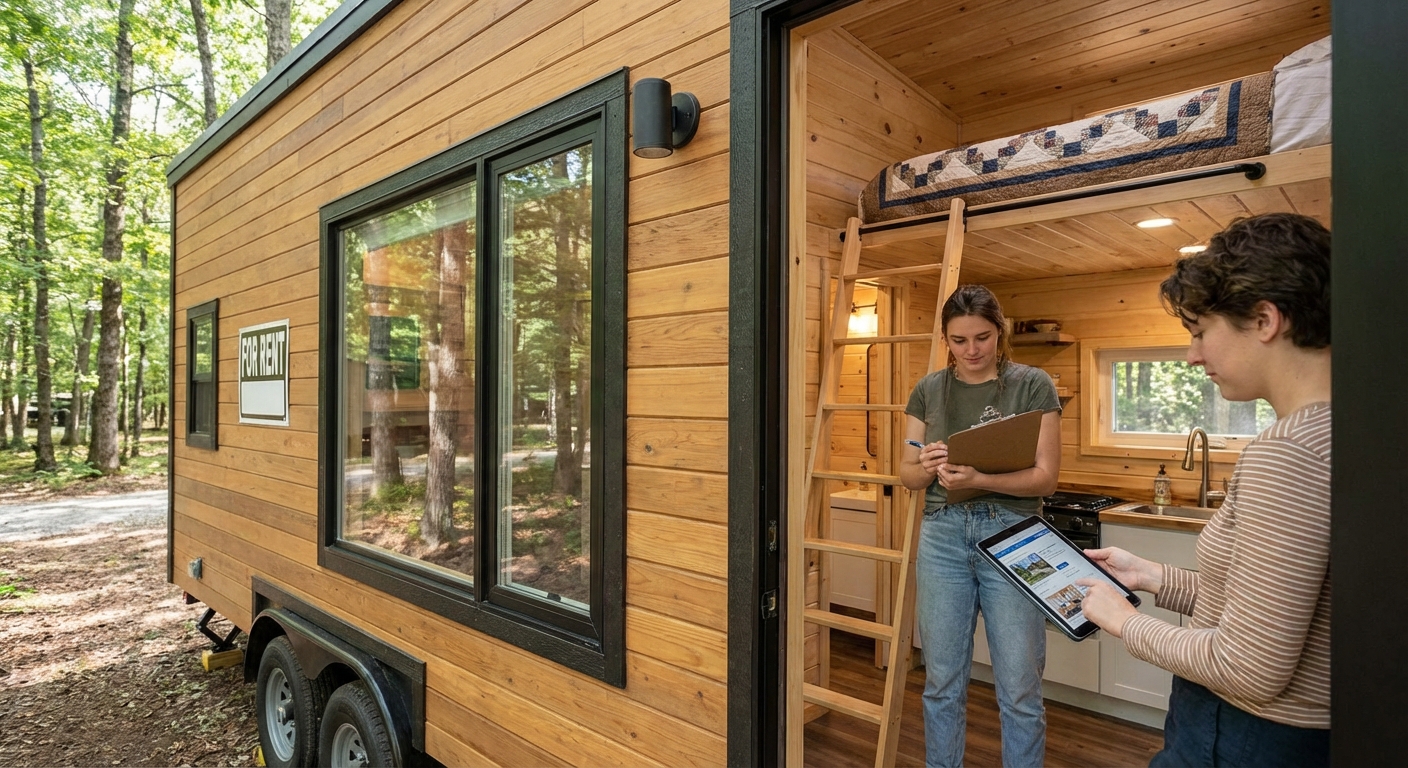
When I walked into my first tiny rental, I was so hypnotized by the shiplap and clever storage that I almost missed the red flags. After a couple of test stays, this became my mental inspection checklist:
1. Utilities and Systems
- Electrical load: Tiny houses with electric heat, hot plates, and space heaters on a 30-amp hookup can trip breakers constantly. I asked: “What amperage is the service?” and “Can I run the A/C and induction cooktop together?”
- Water & sewer: Is it on grid? Using a composting toilet? Greywater system? One tiny rental I tested had a composting toilet but no one explained maintenance. I figured it out via YouTube at 11 pm. Not ideal.
- Heating and cooling: Mini-splits are common and efficient, but check insulation. One winter rental I tried had thin walls and felt like a fancy refrigerator.
2. Layout and Everyday Usability
Ask yourself how your actual life fits in:
- Can you work from a laptop comfortably?
- Is there a real spot for your clothes—not just two hooks?
- Are you okay climbing a ladder to bed at 2 am?
- Is the shower big enough to actually turn around?
For me, loft beds were a dealbreaker long-term. During a month-long stay, my back started complaining every morning from crouching to make the bed.
3. Noise, Privacy, and Land Use
A tiny house can feel serene or like a fancy RV in a parking lot.
I learned to visit (or at least ask) about:
- Proximity to roads, rail, flight paths
- Other units on the same lot (privacy)
- Any rules about guests, quiet hours, or outdoor space use
One of my favorite stays was a tiny home at the back of a large backyard, shielded by trees. The worst was one squeezed between two RVs with someone’s generator running half the night.
The Financial Trade-Offs: When Tiny Rent Actually Wins
A lot of people assume tiny = cheap. Sometimes that’s true; sometimes it’s just… tiny.
From rentals I’ve analyzed and tested, tiny houses tend to make financial sense when:
- You’re replacing a high-rent studio in a hot market
- Utilities are bundled and the landlord is transparent
- You don’t need storage units on top of it (those can kill your savings)
- You’re reducing car use by living closer to work or nature
Where it doesn’t always work:
- Overpriced “Instagram” tiny homes in trendy areas that cost as much as proper apartments
- Places where zoning is grey and you could be asked to leave if the city cracks down
- Situations where you end up paying for storage, co-working, and frequent moves
When I did my own numbers after six months of mostly-tiny-house living, my housing-related costs were about 22% lower compared to my old conventional lease. But that only worked because I:
- Sold a lot of stuff (no storage unit)
- Picked legal, permitted setups
- Chose locations where I didn’t need to drive as much
Red Flags I Watch for Now
Based on my own hits and misses, these are instant “ask more questions” signals:
- Rent is oddly low compared to local market with no explanation
- Host or landlord dodges zoning or permitting questions
- No clear lease or written agreement for stays longer than a month
- Vague about utilities: “Yeah, it’s usually not much” instead of actual numbers
- Composting toilet but no written instructions or maintenance plan
Any one of these isn’t an automatic no, but I treat them as a prompt to slow down and get specific.
How to Test Tiny Living Before Fully Committing
When I recently talked to a couple in a tiny house village near Austin, they said something that matched my own experience: “Our trial month saved us from making expensive mistakes.”
A smart path I’ve seen (and lived):
- Do a 3–7 day stay in a tiny rental just to see how your body and brain react.
- Do a 1–3 month stay in a place structured closer to how you’d actually live: working, cooking, bad weather days.
- Only after that consider longer-term leases or plans to buy/finance your own tiny home.
During my first trial month, I realized:
- I actually loved the small kitchen because it forced me to keep it clean.
- Loft beds were not for me.
- I needed a dedicated desk; the fold-down table looked cute, but I hated working at it.
That experience completely changed the kind of tiny rentals I looked at afterward—and which ones actually made financial and lifestyle sense.
Tiny House Rent Can Be Brilliant… If You Run the Numbers and Ask the Hard Questions
When I strip away the aesthetics and the dreamy cabin vibes, evaluating tiny house rent options comes down to a few blunt filters:
- Is it legal and permitted?
- Does the total monthly cost (including everything) beat or at least match your alternatives for what you’re getting?
- Does the layout support your actual daily life—not your fantasy weekend life?
- Are you willing to live with the trade-offs: less storage, more maintenance awareness, and sometimes less sound insulation?
If you’re willing to test it methodically—run the numbers, ask the unsexy questions, and try a short stay first—a tiny house rental can be a genuinely smart, flexible way to live. And yeah, the view from a tiny front porch can be ridiculously good.
Sources
- U.S. Census Bureau – Housing Vacancies and Homeownership - Official data on rents, vacancies, and housing trends
- HUD – Accessory Dwelling Units (ADUs) - Federal overview of small housing and land-use policy
- Forbes – The Economics Of The Tiny House Movement - Breakdown of tiny house costs and trade-offs
- NYTimes – The Rise of the Tiny House, and What It Says About Us - Reporting on tiny house trends and lifestyle impacts
- Portland State University – Accessory Dwelling Units in Portland - Research on small dwelling units, regulations, and affordability