Guide to Makeup Products for Any Occasion
ooked too heavy for brunch and too weak for night-outs, and my lipstick was always wrong.
Over the last few years, testing products on clients and on my own face (sometimes disastrously), I’ve built a flexible, occasion-proof routine. Think of this as your cheat sheet: the products that actually pull their weight—from gym days to gala nights.
Step Zero: Skin Prep That Works With Any Look
I learned this the hard way: no makeup product looks good on dehydrated, unprepped skin. The fanciest foundation will cake if your base is cranky.
What usually works for most skin types (including mine – combo, slightly sensitive):- Gentle cleanser: I avoid harsh foaming cleansers before makeup; they make my T‑zone oilier later. A hydrating gel or cream cleanser gives a more balanced canvas.
- Lightweight moisturizer: When I tested heavy moisturizers under full-coverage foundation, it slid off by lunch. Now I use a gel-cream for day looks and a richer cream only for dry or mature skin clients.
- Targeted primer (optional but clutch): I don’t always use primer, but for events or long days, a silicone-free gripping primer on my T‑zone really improves longevity.
Dermatologists consistently remind us that sunscreen is non‑negotiable. The American Academy of Dermatology recommends SPF 30 or higher daily, and I’ve seen firsthand how mineral or hybrid sunscreens with a subtle tint double as a skin-smoothing base.
Everyday Makeup: Office, Brunch, and Zoom Calls
For everyday looks, I aim for “you, but well-rested and suspiciously put-together.” When I tested various routines for busy mornings, anything over 10–12 minutes just wasn’t sustainable.
Base: Light, Flexible Coverage
On normal days, I reach for:
- Tinted moisturizer or skin tint instead of full foundation
- Concealer only where needed – under eyes, around nose, spot concealing
In my experience, formulas with sheer-to-medium coverage and a natural finish work best for everyday wear. Look for phrases like “skin-like finish,” “radiant natural,” or “lightweight complexion tint.” I avoid super-matte base products for daily use because they tend to emphasize texture by 3 p.m.
Brows, Lashes, and Soft Definition
A simple formula I swear by:
- Tinted brow gel to add color and hold
- Tubing or smudge-resistant mascara – especially if your eyes water or you commute
- Cream blush that doubles as lip color
When I tested cream vs powder blush for long office days, cream almost always looked more natural and wore off more gracefully, whereas some powders went patchy if I got even slightly sweaty.
Everyday Lip Option
My go-to: a sheer, hydrating lipstick or tinted balm. It fades nicely, doesn’t require a mirror to reapply, and doesn’t freak out if you skip lip liner.
Gym, Errands, and Low-Key Days
I’m not pro “you must wear makeup to the gym,” but I totally get wanting a bit of polish. I had to experiment to find products that survive sweat without clogging everything.
Sweat-Friendly Essentials
For these situations, I use:
- Water-resistant brow gel – keeps brows from disappearing in sweat
- Clear mascara or lash lift – less smudging than regular formulas
- Tinted SPF – light blur plus sun protection
Non-comedogenic and fragrance-free products tend to play nicer with sweaty or acne-prone skin. When I used heavy, fragranced foundation during workouts (yes, I made that mistake), my skin revolted within a week.
What I Avoid for Active Days
- Full-coverage foundation
- Heavy cream contours
- Thick lipsticks that smear on water bottles
If I want a hint of color, I’ll tap on a tiny bit of cream blush over my SPF, nothing more.
Date Nights, Parties, and Events
Here’s where the fun starts. When I tested bold looks on myself versus clients, I noticed one thing: event makeup needs structure. Cameras, dim lighting, and flash can wash you out, so you need more contrast—without turning into a contour meme.
Base for Long Nights
For evening looks:
- I choose a medium-to-full coverage foundation with a long-wear claim (but still buildable). I apply thin layers instead of one thick coat.
- I set strategically: loose powder on the T‑zone, a light dust under the eyes. Over-powdering adds 10 years in photos.
Oil-controlling powders with silica or talc can be great for longevity, but if you have dry or mature skin, I’d go very light-handed and maybe choose a finely milled, luminous setting powder instead.
Sculpting Without Looking Muddy
Most of my clients fear contour because they’ve seen it done badly. The trick is undertone and placement:
- Contour: cooler, shadow-like shade under cheekbones, along jawline, very lightly on sides of nose.
- Bronzer: warmer tone on areas where the sun naturally hits – forehead, temples, top of cheeks.
When I tested warm bronzer as contour on camera, it looked like an orange stripe. Cooler, taupe-leaning powders mimic actual shadows much better.
Eyes: Soft Glam vs. Statement
For events, I usually pick one feature to emphasize.
- Soft glam: neutral mattes in the crease, soft shimmer on the lid, a deeper tone in the outer corner, thin winged liner, black or dark brown mascara.
- Statement eye: colored liner (deep emerald or navy looks surprisingly wearable), smudged kohl on the upper lash line, and extra mascara or wispy lashes.
I also like waterproof gel liners for long events because they don’t transfer as much as kohl pencils. However, they can be stubborn to remove, so I always keep a good oil or balm cleanser on hand.
Evening Lips
If my eyes are bold, I lean for:
- A satin nude close to my natural lip tone, not too pale (ghost lips in flash photos are real).
If my eyes are softer:
- A red, berry, or deep rose with a matching liner. Long-wear liquids look great but can be drying; I prep with balm, blot, then apply.
When I tested dozens of reds, blue-based shades tended to make teeth look whiter, while orangey reds looked amazing in natural light but sometimes off under harsh indoor lighting.
Weddings, Photoshoots, and High-Stakes Occasions
Wedding and photoshoot makeup is its own beast. When I do bridal makeup, the brief is always the same: “I want to look like myself, but flawless, and it has to last 12+ hours through tears, sweat, and cake.” No pressure.
Base Built for Cameras
- I avoid foundations with high SPF for flash photography because some formulas (especially older zinc/ titanium-heavy ones) can create a white cast.
- I test the full look with flash photos. When I didn’t do this early in my career, I once sent a bride out with under-eyes that looked great in person and ghostly white in photos.
Layering is crucial: thin layers of foundation, concealer, cream blush/bronzer, then light powder, then a bit of powder blush. This kind of sandwiching creates longevity without thickness.
Resilient Eye and Lip Products
For these occasions, I’ll almost always use:
- Eye primer – prevents creasing and color fading.
- Waterproof or water-resistant mascara and liner – for tears and humidity.
- Lip liner under lipstick – even if it fades, the shape holds.
I also hand the bride or client a tiny touch-up kit: lipstick, blotting sheets, mini powder, and cotton swabs.
Quick Occasion-Ready Starter Kit
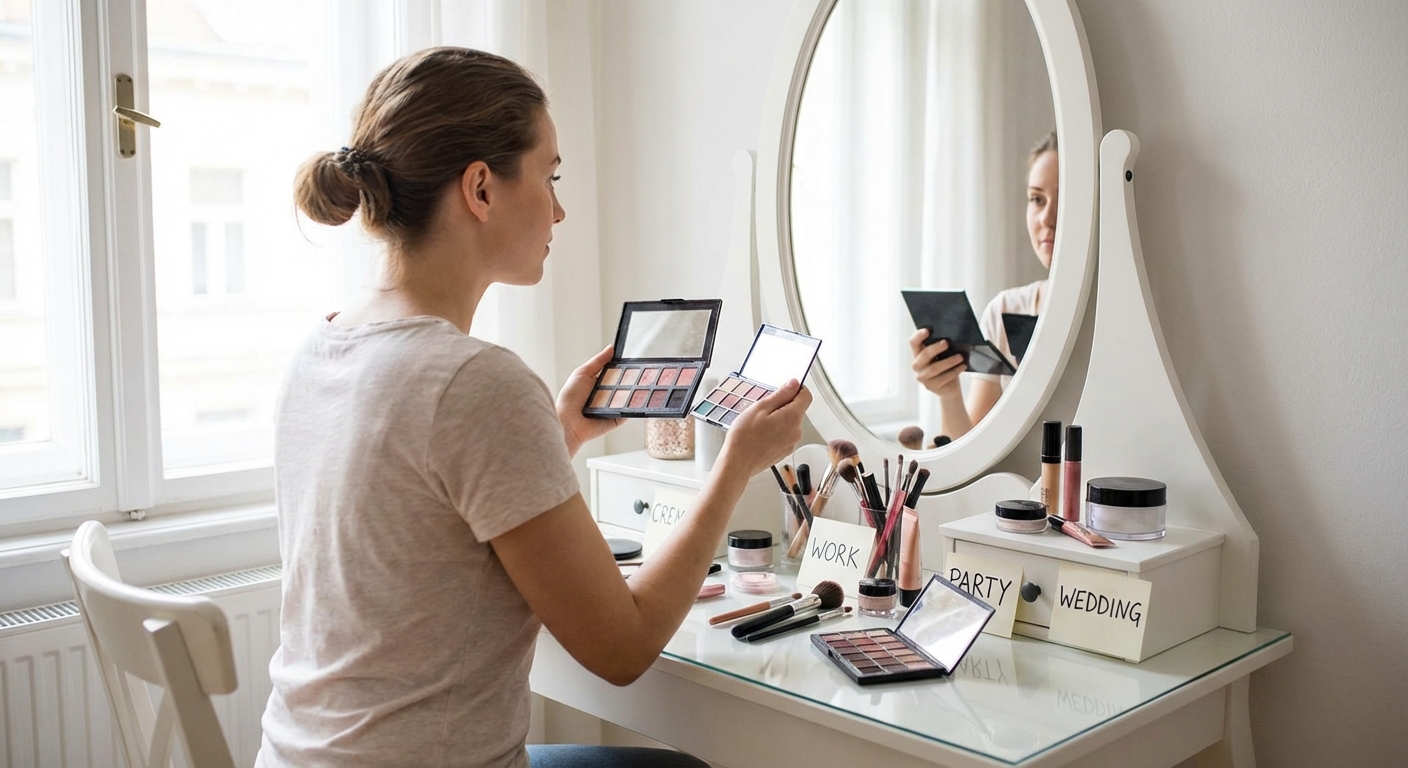
If you’re building a streamlined collection that can flex for any occasion, I’d prioritize:
- Sheer/light base + medium coverage foundation – mix and match for day or night.
- Concealer that matches your skin (not too light) for both under-eye and spot concealing.
- Translucent setting powder – finely milled, not chalky.
- Neutral eyeshadow quad – matte light, matte mid-tone, deeper shade, and a shimmer.
- Brown and black liner – pencil or gel.
- Neutral cream blush that suits your undertone.
- Bronzer + subtle highlighter.
- Everyday lip (tinted balm) + event lip (bold or deeper shade).
- Brow pencil or tinted gel.
I recently challenged myself to do every kind of look—work, gym, brunch, wedding guest—using only a 12-product kit. It wasn’t perfect, but it proved you don’t need 50 palettes and 30 lipsticks to be “prepared.” It’s about textures and undertones, not sheer volume.
Pros, Cons, and Honest Limitations
From my experience and from client feedback:
- Full-coverage, matte foundations: Great for longevity and oil control, but can emphasize texture and lines, especially on mature or dry skin.
- Dewy, radiant formulas: Beautiful in person and on dry skin, but sometimes too shiny in flash photos or on very oily skin unless set well.
- Waterproof products: Essential for long events and humidity but harder to remove and can irritate sensitive eyes.
- Cream products: Natural and forgiving, especially on textured or mature skin, but can slip on very oily skin or in extreme heat.
No single product works perfectly on every face, in every climate, for every occasion. Patch testing, sampling, and taking a photo with flash before a big event can save you a lot of regret.
When I tested looks under different lighting—bathroom fluorescent, natural daylight, and phone flash—the differences were dramatic. So whenever you’re prepping for a big moment, do a test run at least once. Your future self (and your photos) will thank you.
Sources
- American Academy of Dermatology – Sunscreen FAQs - Evidence-based guidance on sunscreen use and SPF recommendations
- Harvard T.H. Chan School of Public Health – Skin Conditions and the Sun - Discussion of sun exposure, skin health, and protective strategies
- Mayo Clinic – Makeup: Tips for Choosing and Using Cosmetics - Medical perspective on choosing makeup and avoiding irritation
- Cleveland Clinic – How to Keep Your Makeup From Causing Acne - Guidance on comedogenic ingredients and acne-safe makeup use
- UCLA Health – Skin Care Basics - Dermatologist-backed fundamentals that support better makeup application