Guide to Safety and Hygiene Standards for In-Home Spa Services
facial that left me with a lovely glow… and a not-so-lovely breakout two days later. That’s when I got serious about safety and hygiene for at-home spa services.
If you’re inviting practitioners into your home for facials, massages, waxing, or nail services, you’re basically turning your living room into a mini spa studio. And just like any professional spa, there are real health standards that should apply.
This guide is the one I wish I’d had before I started testing in-home spa apps and private therapists.
Why Safety and Hygiene Matter More at Home
When you walk into a licensed spa, you can usually see the setup: sterilizers, sinks, labeled disinfectants, clean linens stacked neatly. At home, it’s easier to overlook those details because you’re distracted by being… well, at home.
In my experience, the risk isn’t usually “disaster-level” infections; it’s the slow, sneaky stuff:
- Mild skin infections from reused tools
- Nail fungus from poorly disinfected files or foot baths
- Cross-contamination from waxing sticks being double-dipped
- Irritation from strong products applied without proper skin assessment
The awkward part? You’re the client and the venue. So you share responsibility for making sure safe standards are followed.
The Non-Negotiable Basics Every In-Home Spa Pro Should Follow
Over the last couple of years, I’ve tested services from independent therapists and big-name apps in cities like New York and LA. The best practitioners all had a few things in common.
1. Hand Hygiene Like They Actually Mean It
When I tested different therapists, I started watching what they did in the first 2 minutes. The pros:
- Washed their hands for at least 20 seconds or used an alcohol-based sanitizer with at least 60% alcohol (the CDC standard)
- Repeated hand hygiene after touching their phone, bags, or the floor
If your provider walks in, says hi, and immediately reaches for your face or feet without washing or sanitizing their hands? That’s a red flag.
2. Clean Linens Every. Single. Time.
I once had a therapist pull a slightly crumpled sheet from the bottom of her bag and say, “I only used this for one client earlier.” I almost yeeted myself off the table.
Minimum standard:
- Fresh, clean sheets and towels for every client
- Towels washed in hot water (at least 60°C / 140°F) and fully dried
- No visible stains, smells, or “it’s probably fine” areas
If you’re providing your own towels and sheets, you still want that same standard.
3. Proper Tool Disinfection (Not Just a Quick Wipe)
This is where the real professionalism shows. For tools like cuticle nippers, metal files, tweezers, extraction tools, gua sha stones, or massage cups:
In my experience, the best practitioners:
- Used an EPA-registered disinfectant or hospital-grade solution
- Followed contact time (e.g., 10 minutes fully immersed, not a 10-second dip)
- Stored clean tools in a closed, clean container — not loose in a random makeup bag
For single-use items (wooden spatulas, nail files, buffers, sponges), they should:
- Open them in front of you or clearly show they’re fresh
- Throw them away after the service
If you ever see someone using visibly used disposable tools? You’re allowed to say no.
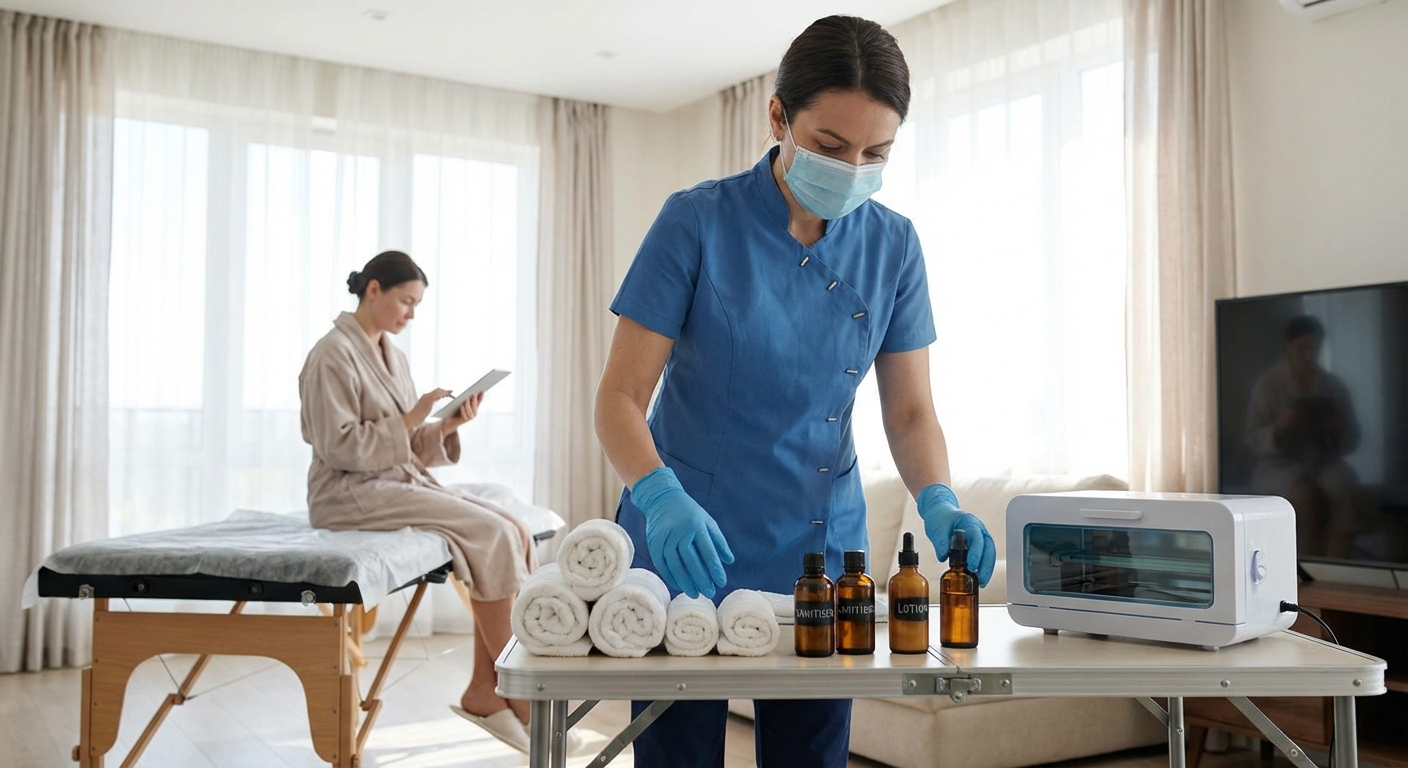
What You Need to Prep at Home
Here’s the twist: in-home services are a partnership. Your practitioner brings their skills and kit; you provide the environment.
What I always do before any session:
- Clear a clean, hard surface area for tools (table, counter) and wipe it with a household disinfectant
- Make sure there’s a sink nearby with soap and clean hand towels or paper towels
- Keep pets out of the room (your cat doesn’t need to “help” your massage therapist)
- Turn on good lighting — it’s crucial for facials, waxing, and nails
I learned the hard way that dim “spa mood” lighting is great for ambience and terrible for seeing what’s actually clean.
Service-Specific Hygiene Standards You Should Look For
Different treatments have different risks. Here’s how I vet each one now.
In-Home Facials
When I tested multiple facialists at home, the standout pros:
- Conducted a proper consultation: allergies, current products, meds like isotretinoin or retinoids
- Used spatulas or pumps to remove product — not fingers inside jars
- Swapped out sponges, brushes, and headbands between clients
- Disinfected extraction tools and wore gloves during extractions
I also ask what brands they use and whether they patch-test active ingredients (like AHAs, BHAs, or retinoids) on new clients.
Massage and Bodywork
Massage looks “low risk,” but there are still hygiene rules:
- Clean linens for every client
- Oils in pump bottles or squeeze bottles, not open bowls collecting dust
- No sharing of unsanitized bolsters or face cradle covers
- Therapist’s nails short and clean (you’d be surprised…)
Good therapists also ask about:
- Recent surgeries
- Blood clots, varicose veins, or circulation issues
- Pregnancy (and what trimester)
If they don’t ask any health questions and just start kneading like you’re pizza dough, that’s not professional.
Manicures & Pedicures
Nails are where I see the most hygiene shortcuts.
Baseline standards I look for:
- No reused disposable files or buffers
- Metal tools: fully disinfected in front of you or clearly stored in a sanitized pouch/container
- Foot baths: lined with a disposable liner or thoroughly disinfected between clients
- No aggressive cutting of cuticles until they bleed — open skin = infection risk
I now always decline “razor callus removal” at home. Many states heavily regulate or ban it in salons, and at home it’s even more risky without controlled conditions.
Waxing & Sugaring
This one’s simple:
- No double-dipping wax sticks. Ever.
- Fresh gloves for intimate areas, underarms, or facial waxing
- Skin cleaned and dried before waxing, and a soothing, non-irritating product after
I once had a therapist who almost double-dipped out of habit. She caught herself midair, laughed, and grabbed a new stick. That’s the level of awareness you want.
Licenses, Insurance, and Red Flags
When I started checking more carefully, I found that some in-home providers were fully licensed… and some were “Instagram certified.”
What I now ask before booking:
- License number and issuing state/country (for estheticians, cosmetologists, massage therapists, nail techs)
- Proof of liability insurance (many pros will show a digital copy)
- How long they’ve been practicing, and where they trained
You can often verify licenses through your state’s licensing board or cosmetology board website.
Red flags I’ve personally seen:
- “I don’t really need a license; I learned on YouTube.”
- Refusal to answer questions about disinfection (“I just keep everything clean, don’t worry.”)
- No intake form or verbal health questions
- Strong push toward unregulated injectables or medical-grade peels with no medical supervision
What Changed for Me After One Bad Experience
The facial that wrecked my skin for a week? The therapist double-dipped extraction tools, used harsh glycolic acid on my already sensitized skin, and didn’t ask a single question about my routine.
I wasn’t blameless. I didn’t speak up, didn’t ask about products, didn’t check her setup. I just assumed that because she was on a “reputable” app, everything must be vetted.
Since then, I’ve changed my approach:
- I treat my home like a mini studio and prep it properly
- I ask specific hygiene questions before booking
- I watch the first 5 minutes like a hawk — handwashing, tool layout, linen quality
The result? I still love in-home spa days — honestly, even more now — but I haven’t had a single infection, rash, or sketchy moment since.
What to Say if Something Feels Off
Advocating for yourself can feel awkward, but you can stay polite and firm. I’ve literally used lines like:
- “Could you please sanitize your hands again before we start?”
- “Can you show me how those tools were disinfected?”
- “I’m not comfortable with double-dipping wax sticks; can you use a new one each time?”
- “Let’s skip extractions today — my skin’s been reactive.”
Any professional worth your money will respect that. If they get defensive, that’s a sign to end the service and not rebook.
Final Takeaway: Relaxed, But Not Careless
In-home spa services can be fantastic: no commuting with post-massage hair, no walking through reception with mask-flushed skin, no waiting room chatter. But the more relaxed the experience feels, the more intentional you have to be about safety.
If you remember nothing else from this guide, keep these three standards in mind:
- Clean hands, clean tools, clean linens — every client, every time.
- Licensed, insured professionals who can explain their hygiene routine clearly.
- A home setup that actually supports safety: clean surfaces, good lighting, and a sink.
That’s the real luxury: not just a spa vibe, but the confidence that your at-home treatment is as safe and professional as any high-end studio.
Sources
- Centers for Disease Control and Prevention – Hand Hygiene Recommendations - Official guidance on effective hand hygiene practices
- U.S. Environmental Protection Agency – List N: Disinfectants for Use Against SARS-CoV-2 - EPA-registered disinfectants and usage details
- U.S. Food & Drug Administration – Nail Care Products: Safety Information - Safety considerations for nail services and products
- Mayo Clinic – Spa Safety: Avoiding Infections at Salons and Spas - Medical perspective on infection risks and prevention in spa environments
- New York State Department of State – Appearance Enhancement Licensing - Example of state licensing requirements for cosmetology and spa professionals