Guide to Target Clearance Deals and Discounts
ing it” and actually learned how Target’s clearance system works.
Over the last few years, I’ve tested every hack, talked with store employees, tracked price patterns, and yes, made a frankly embarrassing number of Target runs “for research.” This is the guide I wish I’d had when I started hunting Target deals instead of just hoping to stumble on them.
How Target Clearance Actually Works
When I first started paying attention, I kept seeing those little red clearance stickers but had no clue what the numbers meant. Once I learned to read them, my savings basically doubled.
Understanding the Clearance Stickers
When I tested this on a random cart of items, the pattern was ridiculously consistent:
- Clearance stickers usually show the original price, the current clearance price, and a tiny percentage off in the corner (often 15%, 30%, 50%, or 70%).
- Most non-seasonal items tend to go through discount stages: 15% → 30% → 50% → sometimes 70% off.
- Seasonal and holiday merch can hit 90% off if it lingers long enough (I once grabbed Halloween décor at 90% off on November 3rd—pure joy).
In my experience, if something is already at 70% off and there’s still a decent amount of stock, it often won’t go any lower before it’s pulled.
The Mark-Down Rhythm (The “Schedule” Myth and Reality)
If you’ve ever seen those graphics on Pinterest claiming “Target marks down home on Monday, clothing on Tuesday” and so on—there is some truth, but it’s not a universal rule.

I asked three different employees at three different locations about this. The unofficial consensus:
- Teams usually have department-specific mark-down days, but they vary by store.
- Many stores start markdowns in the morning, but I’ve seen clearance tags roll out mid-afternoon when they’re catching up.
What worked best for me: I shopped the same store at the same time of day (around 10 a.m.) once a week for a month and watched what changed. After two weeks, I could tell home goods tended to be freshly marked down on Thursdays at that location.
If you’re serious, just ask an employee in a friendly way: “Hey, do you guys usually mark down clearance in this section on certain days?” I’ve gotten surprisingly specific answers.
Where the Best Clearance Hides in the Store
When I started hunting instead of casually browsing, I realized Target hides some of the best deals in the least obvious corners.
1. Endcaps (But the Right Ones)
We all know endcaps, but the key is to focus on the back-of-aisle and side endcaps, not the pretty front-facing promotional ones.
On one test trip, I found:
- A $39.99 Threshold throw blanket for $11.99
- Kids’ graphic tees down to $3.00 from around $9–$10
These weren’t anywhere near their usual sections. They were clustered on a random endcap near the bedding aisle.
2. Seasonal Sections After Holidays
My best scores have always been 1–3 days after a major holiday:
- Christmas: Gift wrap, ornaments, lights
- Halloween: Costumes, décor, candy
- Valentine’s Day & Easter: Candy, décor, small gifts
Target corporate has publicly emphasized its seasonal push as a core traffic driver, which lines up with how aggressively they clear it out afterward to make room for the next season.
Quick example from my own receipt history:
- Valentine’s candy originally $4.99 → $1.49 (70% off) on February 16
- Halloween ceramic mugs originally $5 → $0.50 (90% off) on November 2
Timing matters a lot here. I’ve gone in the morning and scored a cart full of deals, then watched the section be almost empty by evening.
3. Electronics and Small Appliances
This is where I’ve found the strangest price drops. I once grabbed a $79.99 cordless vacuum for $23.98—because the model was being reset out of the planogram.
Watch:
- Endcaps near electronics, vacuums, and small kitchen appliances
- Items with older packaging or discontinued branding
Sometimes, these don’t even have the bold yellow “clearance” label on the shelf. That’s when the Target app becomes gold.
Using the Target App to Check Hidden Prices
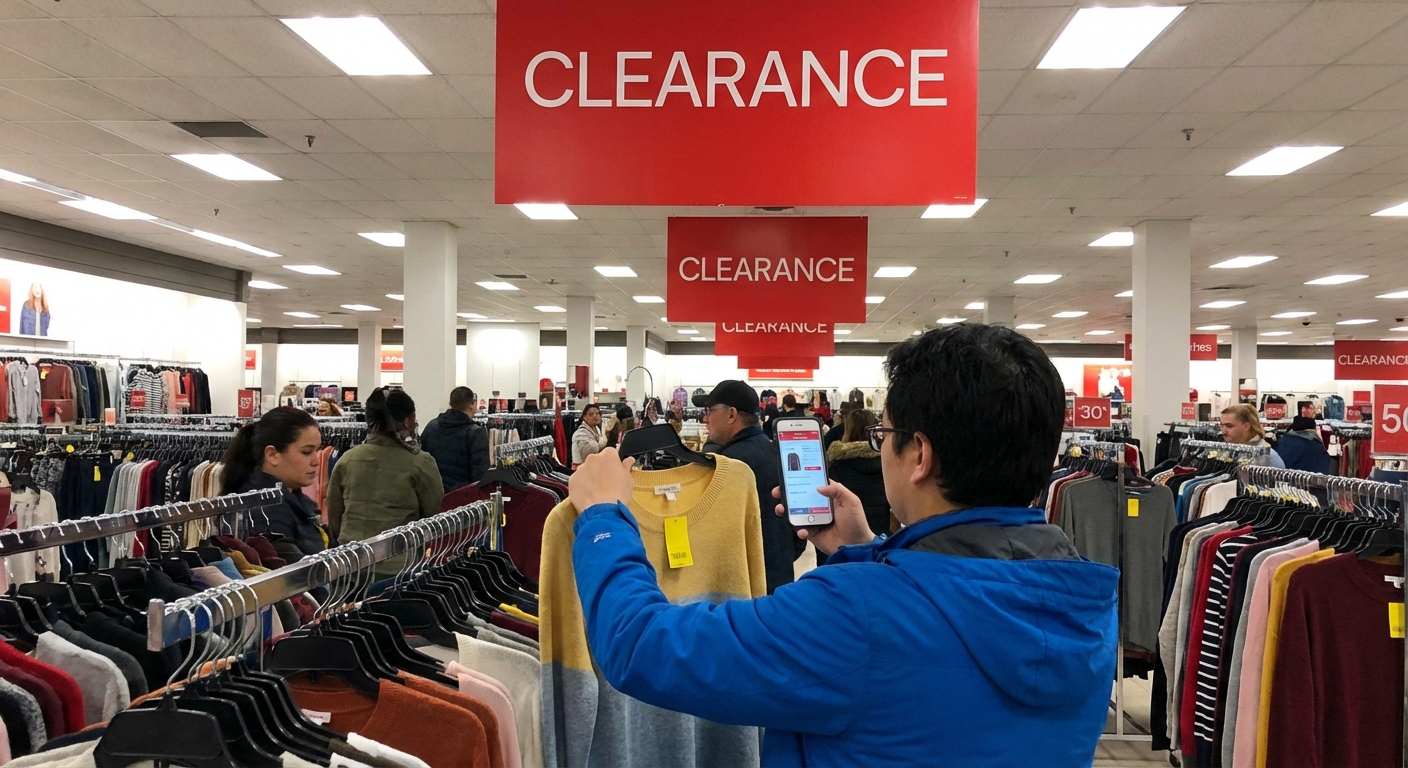
When I tested this, I walked around scanning random clearance items with the Target app and discovered a few were marked lower in the system than on the sticker.
Here’s what I do:
- Open the Target app and make sure your store location is set correctly.
- Tap the barcode icon in the search bar.
- Scan the item’s barcode.
- Compare the in-app price to the sticker or shelf tag.
More than once, I’ve taken something to the register with a sticker showing 30% off but had it ring up another few dollars lower because of a system markdown that hadn’t gotten a new label yet.
Small warning: sometimes the app shows online-only pricing that doesn’t match in-store, so I always check whether it says “in this store” or not.
Stacking Savings: Coupons, Circle, and RedCard
This is where clearance gets a bit nerdy—in a good way. When I stacked correctly, I saved over 80% on a small haul.
Target Circle Offers
Target Circle (their free rewards program) sometimes has category-wide offers like:
- “Spend $50 on home, get $10 gift card”
- “20% off one clothing item”
When I tested this, most of these did apply to clearance, as long as the fine print didn’t exclude it. I once used a “$10 off $50 home purchase” Circle offer on a cart that was mostly clearance throw pillows and picture frames.
Manufacturer Coupons
Clearance + manufacturer coupon is where things get fun:
- I’ve used a $2.00-off detergent coupon on a bottle already 30% off.
- I’ve combined deodorant clearance with a digital manufacturer coupon in the app.
The rule: if the coupon doesn’t say it excludes clearance, it usually works. I always double-check the coupon details because messing this up at the register is awkward at best.
Target RedCard
I resisted the RedCard for ages, but the extra 5% off does come off clearance too. On a large clearance haul, that 5% shaved another few dollars off.
Just to be transparent: the debit RedCard links to your bank account, the credit RedCard is an actual credit line. If you’re not great with credit or you’re paying interest, the 5% savings can get eaten by fees. Not worth it in that case.
Online vs In-Store Clearance: What I’ve Learned
I used to assume in-store was always cheaper. After tracking this for a few weeks, the reality is more nuanced.
When In-Store Wins
- Physical overstock: Big bulky items taking up shelf space tend to get slashed lower in-store.
- Local demand differences: I’ve seen patio furniture be way cheaper in a cold-weather region than online.
When Online Wins
- Sometimes Target runs online-only clearance promos that stack with additional discounts.
- I’ve seen clothing and bedding run cheaper online, especially in odd sizes or discontinued colors.
My habit now: if I see something on clearance in-store and I’m on the fence, I open the app and check the online price and nearby store stock. If another location shows it cheaper or online is better, I can decide how much I care.
The Downsides and Traps (Because They’re Real)
I love a clearance sticker as much as anyone, but I’ve also made some dumb purchases that taught me a few boundaries.
What I’ve learned the hard way:- Not all clearance is a deal. A $20 sweater marked down to $14 isn’t a win if you don’t actually like it or won’t wear it.
- Clearance is often final sale, especially in seasonal and beauty. I’ve been stuck with a weirdly scented candle I couldn’t return.
- Open-box items in electronics and home can be a gamble. I always check for missing parts or obvious damage.
- The “I’m saving money” high can easily turn into “I just spent $80 on stuff I didn’t need.” I now ask myself: Would I buy this at full price? If the answer is a hard no, I usually put it back.
A Simple Strategy to Actually Win at Target Clearance
Here’s the rough system I follow now, that’s worked well in my own weekly trips:
- Pick one or two “home” stores you visit most often.
- Learn their clearance hotspots: endcaps, specific aisles, seasonal areas.
- Visit at roughly the same time and day each week to learn their markdown rhythm.
- Use the Target app to scan every clearance item you’re considering.
- Stack Circle offers, manufacturer coupons, and RedCard when it makes sense.
- Give yourself a budget per trip so the thrill doesn’t wreck your actual finances.
When I stopped treating Target clearance as random luck and started treating it like a system I could decode, my cart changed from “impulse regrets” to “wow, I actually needed this and paid almost nothing.”
If you’ve never walked out of Target grinning because you paid 70–90% less than everyone else did for the same items… you’re honestly missing out on one of the small joys of modern shopping.
Sources
- Target Corporate – Company Fast Facts - Background on Target’s scale and operations
- Target Circle Program Details - Official info on Target’s loyalty and offer structure
- Consumer Reports – How to Save Money at Target - Independent tips and analysis on Target savings
- Forbes – How Retailers Use Clearance Pricing - Industry insight on clearance strategies
- Federal Trade Commission – Shopping Online and In Stores - Government guidance on smart, safe shopping practices