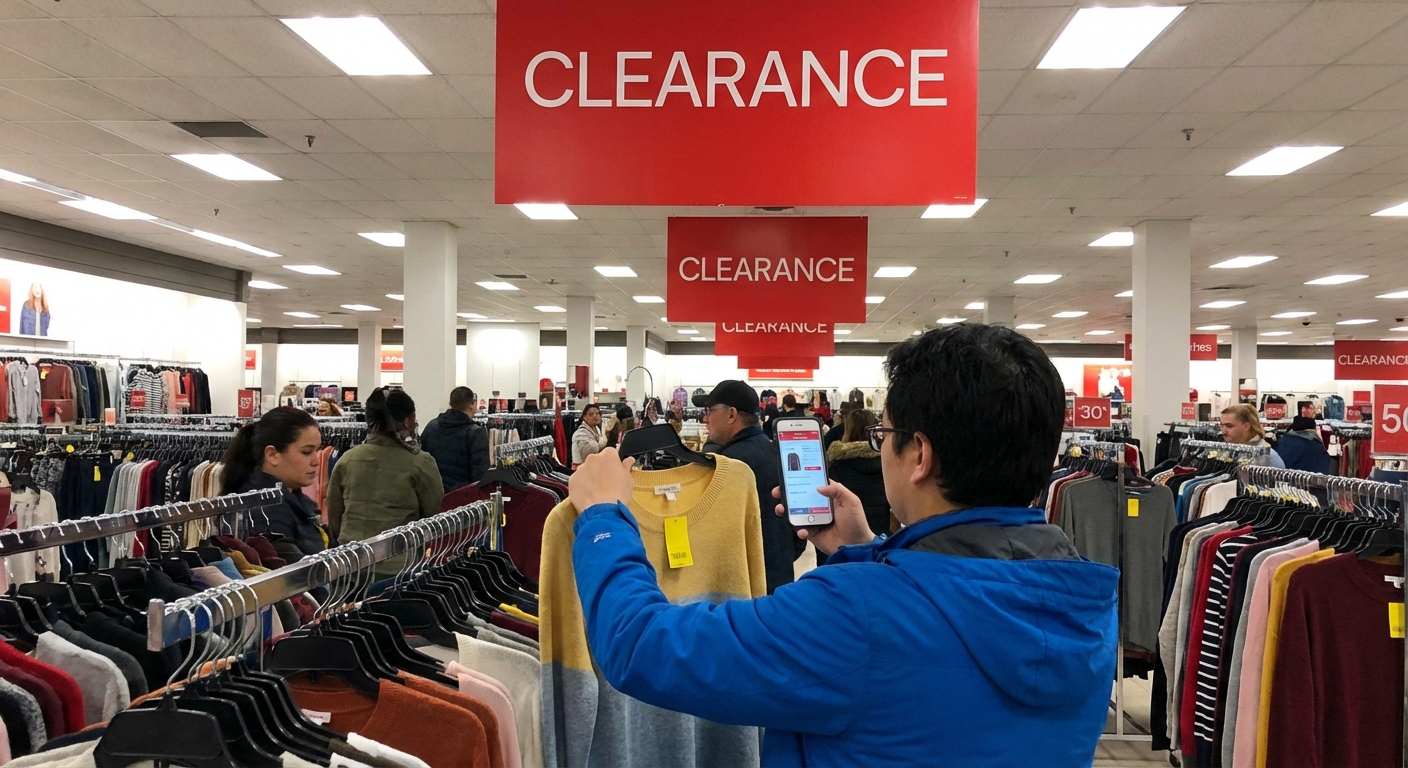
Guide to The Body Shop Clearance Products
, “Oh, we just marked down a few things at the back.”
Over the past few years, I’ve turned what started as random browsing into a bit of a system. I’ve tracked price drops, compared formulas, asked staff awkwardly specific questions about discontinuations, and yes, tested more body butters than any one human probably needs.
This is the guide I wish I’d had when I first stumbled into that red-tagged corner.
Why The Body Shop Clearance Is Its Own Little Gold Mine
When I first started paying attention to the clearance table, I assumed it was just sad leftovers nobody wanted. Totally wrong.
In my experience, The Body Shop uses clearance for a few predictable reasons:
- Packaging refresh – The formula stays almost identical, but they’re rolling out new branding, so the old look gets dumped into clearance.
- Seasonal scents – Christmas, summer limited editions, Valentine’s ranges… once the season ends, what’s left often goes straight to the sale and then clearance.
- Range reformulations – Sometimes they tweak ingredients (for example, removing certain preservatives or changing fragrance levels), and the older version gets heavily discounted.
- Full discontinuations – The heartbreaking one. Your favorite scent disappears forever, and the last few bottles hide in clearance like endangered species.
When I chatted with a store associate in London in mid-2023, she told me their typical cycle is: full price → promo or sale → deeper promo → clearance → gone. If you’re patient and slightly obsessive (hi), you can time your buys so you almost never pay full price for certain products.
How to Actually Find the Good Stuff (Online & In-Store)
1. The Online Hunt
I recently tested how consistent the UK and US online clearance sections were over a month. They weren’t. At all. That’s your first lesson: online stock is region-specific and often limited.
What’s worked best for me:
- Check the “Sale” or “Offers” tab, then filter by lowest price first. Hidden clearance items often sit at the end of long sale lists.
- Look for odd numbers – Prices like $6.37 or £3.87 often signal end-of-line clearance instead of a regular promo.
- Use “sort by: newest” and “lowest price” alternately – Some items get quietly added and never promoted on the homepage.
One quirk I’ve noticed: the same product will sometimes be labeled “Last Chance” in one country and just “Sale” in another, despite clearly being discontinued based on The Body Shop’s global range updates.
2. The In‑Store Treasure Map
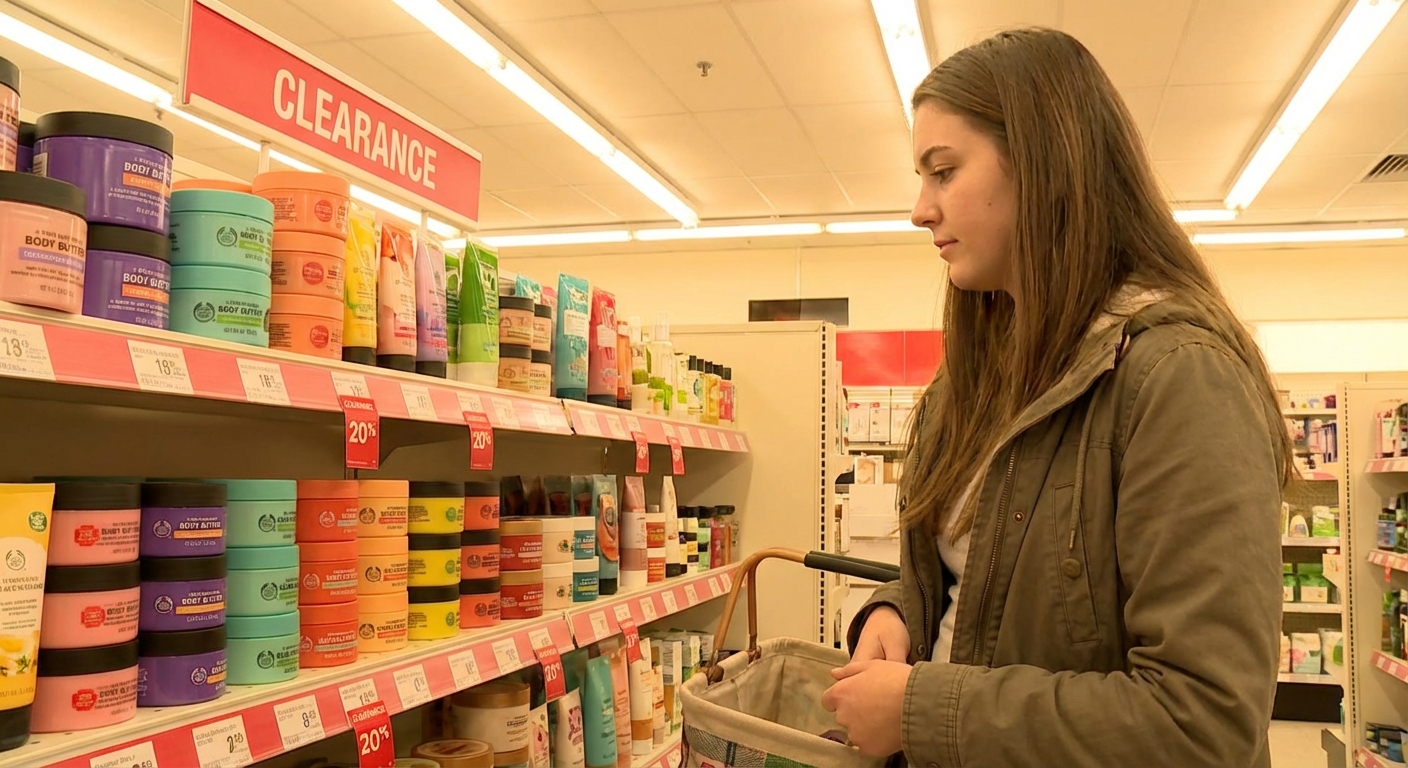
In stores, clearance is rarely front and center. In my experience, you’ll usually find it:
- On a low shelf near the back or next to the checkout
- Mixed into seasonal displays after a major holiday
- In unloved corners with a handwritten yellow or red price tag
I’ve learned to do a slow loop, top to bottom, instead of just scanning eye level. The best products I’ve found (like a half-price Vitamin E cream) were literally on the very bottom shelf, shoved behind gift sets.
Pro tip I picked up from a very honest staff member: ask directly – “Do you have any clearance or discontinued products in the back?” Sometimes they haven’t moved them onto the floor yet.
Products Worth Stalking in Clearance
Not all clearance is created equal. Some stuff is there for a reason (looking at you, overly glittery body mist from 2018). But some categories are almost always a good buy.
1. Body Butters and Lotions
This is where The Body Shop became famous, and where clearance gets genuinely exciting.
When I tested discounted body butters against the full-price versions (yes, I literally had one of each scent), I noticed:
- Packaging change ≠ worse quality – A Mango Body Butter in old-style tub performed the same as the new “vegan certified” packaging for my skin type.
- Thicker textures store better – They seem to handle time on the shelf without separating or turning weird.
What I grab in clearance:
- Classic scents (Shea, Almond Milk, Mango, British Rose)
- Seasonal but wearable scents (anything vanilla, berry, or citrus-based)
What I skip:
- Very old tubs with dust or faded labels
- Anything where the oil has clearly separated or there’s a weird grainy texture when you open the tester
2. Shower Gels & Scrubs
These are usually a safe clearance bet because they’re wash-off products.
In my experience:
- Clear gel formulas age better than creamy ones
- Sugar scrubs last longer than salt scrubs, which can get clumpy if not sealed well
If you’re sensitive, just be aware: clearance often includes strong-fragrance seasonal ranges that were too intense for some customers. I still remember a Christmas spiced scent that made my whole bathroom smell like a candle shop exploded.
3. Face Care (Proceed Carefully)
This is where I slow down.
I’ve scored incredible deals, like a nearly 50% off Vitamin C Glow-Boosting Moisturizer during a rebranding phase. But I’ve also regretted impulse buys of random “fun” masks my skin hated.
My rules now:
- I only buy face products in clearance if I already know my skin likes the range.
- I avoid anything with actives like strong acids or retinoids when it’s near the end of its shelf life.
Dermatologists generally recommend treating active ingredients with more caution as they break down faster over time. A 2019 review in the Journal of Dermatological Treatment highlighted how vitamin C and retinoids are particularly unstable without ideal storage.
So if you’re snagging a clearance serum, accept that you might not get the full advertised potency.
How to Check Dates, Quality, and Safety
I’m picky with discounted cosmetics, and you should be too.
When I tested my “rules” across multiple hauls, here’s what held up:
- Check the Period After Opening (PAO) symbol – That tiny jar icon with “6M”, “12M”, “24M”. That’s how long they recommend you use it after opening, not the expiration date, but it tells you how stable it is.
- Look for a batch code – Some The Body Shop products have stamped codes you can run through generic cosmetic batch-code checkers to estimate production date. Not perfect, but better than nothing.
- Texture & smell test at home – When I opened a clearance body yogurt that smelled slightly plasticky instead of fruity, I just didn’t risk it. The savings aren’t worth a rash.
If something looks separated, has changed color, or smells off, I don’t care how cheap it was—I don’t put it on my skin.
The U.S. FDA notes that while cosmetic products aren’t required to have expiration dates, manufacturers are responsible for product safety and stability over their intended shelf life. Once it’s clearly degraded, the risk of irritation goes up.
The Real Pros and Cons of Shopping Clearance
The Upsides
From my own haul history, the big pros are:
- Huge savings – I’ve routinely seen 40–70% off original prices.
- Chance to stock up on a favorite before it disappears – I once bought four tubs of a limited-edition vanilla pumpkin body butter and never regretted it.
- Low-risk testing – If you’re curious about a product but wouldn’t pay full price, clearance is the perfect excuse.
The Downsides
But there are real drawbacks I’ve bumped into more than once:
- No guarantee it’ll be back – If you fall in love with a discontinued scent, that’s it. When it’s gone, it’s gone.
- Older stock – You may be getting products that are closer to the end of their ideal life.
- Emotional buying – Red tags do weird things to our brains. I’ve bought stuff just because it was cheap, and it sat unused.
I’ve had to create one rule for myself: would I consider buying this at almost full price if money were no object? If the answer is a hard no, I leave it—even if it’s 80% off.
Insider-Level Tips I’ve Picked Up Along the Way
A few small habits have made my clearance hunts way more successful:
- Stack deals when possible – Sometimes store promotions or membership points still apply to clearance. I once combined a member reward with clearance pricing and walked out with three items for less than the price of one.
- Watch social media and email – The Body Shop’s newsletters and official Instagram often hint at ranges “leaving soon,” which is my cue to start stalking the clearance section.
- Know your hero ranges – Learn which lines consistently work for your skin (for me it’s Shea, Vitamin E, and some of the Tea Tree range). When those pop up in clearance, I don’t overthink it.
- Avoid gifting from deep clearance unless the product looks pristine and is clearly just old packaging. No one wants a slightly separated body yogurt wrapped in a bow.
When Clearance Is Actually Worth It
After years of messing up and getting smarter, here’s how I personally decide:
- Yes, grab it if:
- It’s a product or range you already love
- The packaging is clean, the texture looks normal, and the smell is right
- The discount is at least 30–40%
- Probably skip if:
- You’ve never tried the range and it’s a leave‑on face product with actives
- It’s clearly very old stock (dusty, faded labels, separated formula)
- You’re only attracted to it because it’s absurdly cheap
When I treat The Body Shop clearance like a curated hunt instead of a free‑for‑all, I end up with products I genuinely reach for every day, not a dusty graveyard of half-used jars.
If you’re willing to do a bit of digging, ask a few questions, and trust your eyes (and nose), that little clearance corner can be one of the most satisfying places to shop.
Sources
- The Body Shop – Official Website – Brand product information, ingredients, and promotions
- U.S. Food & Drug Administration – Cosmetics Overview – Safety and regulation background on cosmetic products
- Mayo Clinic – Skin care: 5 tips for healthy skin – General expert guidance on skincare products and irritation
- Journal of Dermatological Treatment – Stability of Dermatologic Preparations – Research discussing stability of active ingredients in skin products
- BBC News – The Body Shop brand history and business changes – Context on The Body Shop’s evolving product lines and ownership