How I Trained My Taste Buds: A Real-Life Journey Into Coffee Tasting
nd my morning cup has never been the same. I’m talking about tasting notes like “stone fruit,” “dark chocolate,” and even “jasmine,” without adding syrups or flavors.
This isn’t a snobby barista-only skill. When I tested a few simple tricks at home, I went from “it all tastes like coffee” to actually picking out flavors and roast mistakes. Here’s exactly how I trained my taste buds, what surprised me (spoiler: my “favorite” coffee was… bad), and how you can turn your regular morning coffee into a full-on flavor experiment.
How I Realized I’d Been Drinking Burnt Coffee for Years
I recently bought two bags of beans: one from a supermarket shelf, one from a local roaster with the tasting notes “berry, caramel, citrus.” I brewed both with the same method.
The supermarket coffee? Bitter, flat, vaguely ashy. The local roast? Bright, a little sweet, and I actually got this weird lemony zip at the end. At first I thought I was imagining it, so I did a blind taste test with a friend. We could both tell which was which every time.
That’s when I learned about specialty coffee—graded 80+ points on a 100-point scale by certified Q graders (yes, this is a real job) following Specialty Coffee Association (SCA) standards. Those scoring protocols look at aroma, flavor, aftertaste, acidity, body, sweetness, and uniformity.
Once I understood that there’s a framework for tasting coffee, not just vibes, I started treating my morning mug less like background noise and more like a mini science (and slightly chaotic) experiment.
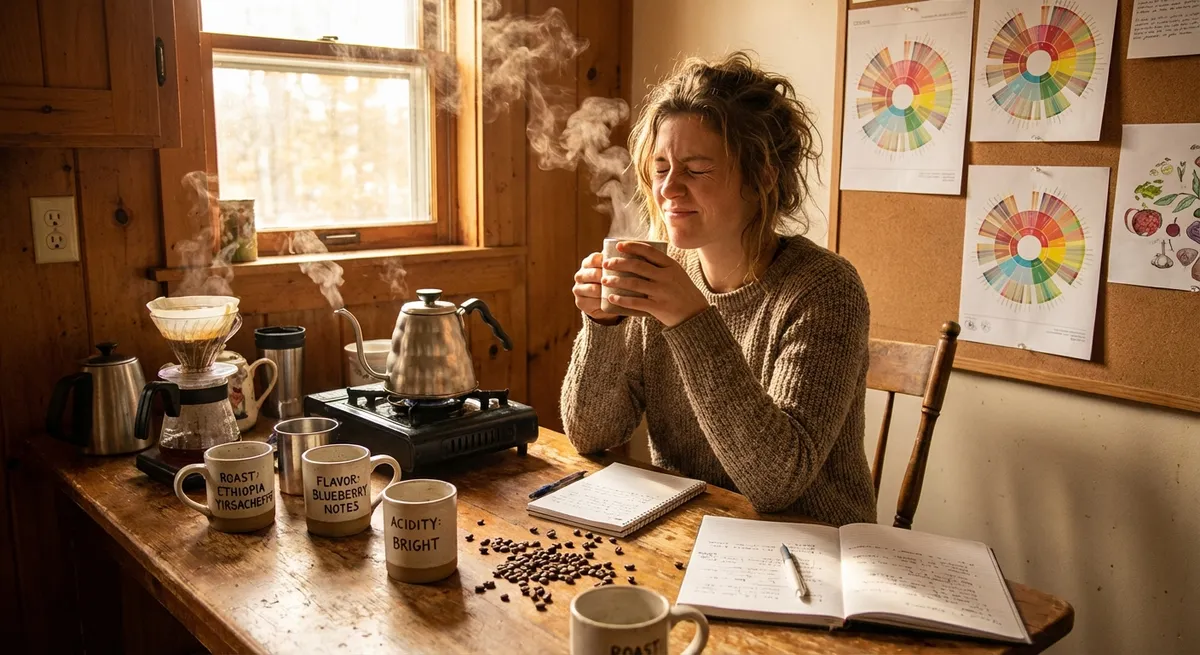
Step One: Resetting a Burned-Out Palate
When I first tried “tasting” coffee, everything just tasted like… coffee. Or bitterness. Or “hot.” So I backed up and focused on three things: smell, temperature, and contrast.
1. Smell first, sip secondIn my experience, aroma does half the work. I started sticking my nose embarrassingly deep into the mug and taking slow inhales before every sip. When coffee’s freshly brewed (especially around 4–8 minutes after), you get those volatile aromatic compounds at their peak.
I’d ask myself out loud (yes, I looked weird):
- Is it more nutty or more fruity?
- Does it smell like cocoa, toast, flowers, or… campfire?
The funny part: when I named anything, even if I wasn’t sure, my brain started catching that smell faster the next time.
2. Cooling the coffee changed everythingHot coffee hides nuance. When I let the cup cool to warm/room temperature, flavors popped. Lighter roasts got more transparent and tea-like; darker roasts showed more chocolate and smokiness.
When I tested this side by side—same coffee, one hot, one cooled for 10 minutes—the cooled one tasted way more structured. I could pick out acidity, sweetness, and aftertaste much more clearly.
3. Tasting in contrastTasting a single coffee on its own is tough. Tasting two coffees side by side is dramatically easier.
I’d brew:
- A light roast and a dark roast
- A washed-process Ethiopian vs a natural-process Brazilian
Sipping them back and forth, even as a total newbie, I could feel the differences:
- Washed coffees: cleaner, brighter, more citrus or floral
- Natural coffees: heavier, fruitier, sometimes funky or “winey”
This contrast trick alone made me feel like my taste buds gained superpowers in a week.
Nerding Out Just Enough: Acidity, Body, Sweetness & Aftertaste
Once I got past “this tastes nicer,” I wanted language for what I was feeling. That’s where I leaned on SCA-style categories, but in a normal-human way.
Acidity (aka the brightness)
I used to think “acidic coffee” meant “stomach pain.” Now I hear “acidity” and think of brightness or liveliness, like biting into an apple vs a banana.
In my experience:
- Lighter roasts and high-altitude coffees (like many from Kenya or Ethiopia) often have sharper, citrusy acidity.
- Lower-altitude or darker roasts feel rounder, more muted, sometimes “jammy.”
I started asking: Does this remind me more of lemon, orange, or berry? Or is it basically flat?
Body (how the coffee feels in your mouth)
Body is one of those “oh that’s what that is!” moments. It’s the texture—thick, thin, silky, gritty, heavy, or light.
When I tested:
- French press and metal filters gave me a heavier, almost creamy body.
- Paper filter pour-overs like V60 tasted cleaner, lighter, more tea-like.
Neither is “better”; they just fit different moods. On cold mornings, I lean into heavier-bodied brews. When I want to taste every tiny nuance, I go for a cleaner filter brew.
Sweetness (the subtle hero)
Real coffee sweetness is gentle. Don’t expect soda-level sweetness. I started noticing it most:
- Right at the start of the sip
- Or in the lingering aftertaste once the bitterness faded
If a coffee had zero sweetness, it almost always tasted harsh or thin, especially when over-extracted (too long brew or too fine grind).
Aftertaste (the flavor that refuses to leave)
This was the most surprising part for me. Sometimes the first sip was “okay,” but the aftertaste was amazing—like a chocolate finish that just lingered. Other times, the aftertaste turned rubbery, ashy, or sour.
Once I started paying attention to those last 10 seconds after swallowing, my rating of a coffee completely changed.
My Home “Cupping” Ritual (Bare-Bones, No Fancy Gear Required)
Professional tasters use strict cupping protocols. I didn’t go that hardcore, but I stole enough from their system to make it useful.
Here’s the stripped-down version I actually use at home:
1. Keep ratios consistentI stick to about 1:16 coffee to water by weight (for example, 15 g coffee to 240 g water). If you don’t have a scale, use the same spoon and same mug every time so at least it’s consistent.
2. Grind fresh if you canWhen I tested pre-ground vs freshly ground on the same beans, the pre-ground lost aroma insanely fast. Within 15–30 minutes, it already tasted duller. If a grinder is an option, it’s easily the biggest flavor upgrade.
3. Smell at every stageI make it a ritual:
- Smell the dry grounds
- Add water and smell the bloom (that first 30–45 seconds)
- Then smell again at 3–4 minutes
Each stage tells part of the story. Dry grounds sometimes smell chocolaty, the bloom smell can be super floral, and the final cup might lean fruity. It’s weirdly fun catching those shifts.
4. Slurp (yes, loudly)When I first saw people slurp coffee like they were vacuuming noodles, I thought it was an act. It’s not. Slurping sprays coffee across your tongue and mixes it with air, which spreads aroma into your nose.
Once I got past the awkwardness, I genuinely tasted more. Especially acidity and sweetness.
The Beans Matter More Than Your Fancy Machine (Sorry)
I used to obsess over gear. Maybe I needed a more expensive machine? Better kettle? But when I tested it, the biggest difference always came from the beans and how recently they were roasted.
From my experiments and what roasting research backs up:
- Coffee is usually best 4–14 days after roasting, depending on style and roast level.
- After about a month, even sealed, most coffees lose their top notes and taste flatter.
- Extremely dark roasts often taste more of the roast (smoke, char) than the bean itself.
When I compared:
- Freshly roasted specialty beans vs. a 6-month-old supermarket bag, same brew method, same ratio—the fresh beans absolutely crushed it every time. More sweetness, more clarity, less harsh bitterness.
Does that mean supermarket coffee is automatically bad? Not always. But:
- It’s often older
- Roast dates are rarely printed
- Blends may prioritize consistency and cost over flavor complexity
If you can, buying from a local roaster or a reputable online roastery with visible roast dates is a game-changer.
The Pros and Cons of Becoming “That Coffee Person”
I’m not going to pretend this is all upside. Training your palate rewires how you experience coffee. There are definite pros and a few annoying cons.
Pros I’ve felt personally:- I enjoy cheaper coffees more when they’re brewed well. Even a simple medium roast can taste great with decent extraction.
- I waste less money on random “premium” coffees because I know what origin and roast levels I actually like.
- Cafés visits got more fun—I can read a menu and pick something that fits my mood (bright and fruity vs heavy and comforting).
- Some old favorites suddenly tasted burnt or flat. I had a minor identity crisis over a brand I’d sworn by for years.
- I became that person who says “This is a little over-extracted” and then wants to un-say it immediately.
- You can overthink your cup and forget to just enjoy the moment.
What I’ve learned to do: switch between “nerd mode” and “comfort mode.” Some mornings I analyze every sip. Other mornings I dump in a bit of milk, don’t take notes, and just vibe.
How to Start Your Own 7-Day Coffee Flavor Challenge
If you want shareable, real results, this little home challenge gave me the clearest before/after difference—and it’s easy enough to do with whatever setup you have.
Day 1–2: Same coffee, different tempsBrew your usual coffee.
- Drink half hot.
- Let the rest cool for 10–15 minutes.
Write down 3 words for each. Don’t overthink—just write what pops into your head.
Day 3–4: Two coffees, side by sideGrab:
- One lighter roast and one darker roast (or two clearly different origins).
Brew them with the same method and sip back and forth. Ask:
- Which feels brighter?
- Which feels heavier?
- Which one lingers pleasantly?
Spend one day just focusing on smell. Every time you brew:
- Smell the dry grounds
- Smell right after pouring
- Smell at 5 minutes
Don’t even worry about flavor words yet—focus on “Do I like this smell or not, and why?”
Day 6: Add milk or no?Take one coffee you usually drink with milk or sugar. Taste it:
- First black (even a sip)
- Then the way you normally drink it
See what changes. Sometimes good coffee actually holds up better with milk because it has enough structure to shine through.
Day 7: Blind test with a friendBrew two coffees. Have someone pour them into labeled cups that only they can see. Try to guess:
- Which is which (light vs dark, or origin A vs B)
- Which one you genuinely enjoy more
I was embarrassingly wrong on my first try. But after a week of focused tasting, my guesses got a lot better—and so did my morning ritual.
A Few Honest Limitations (So This Stays Real)
Here’s what I won’t promise: that you’ll suddenly taste “mango chutney with a hint of bergamot” after reading one article. Even professional tasters train for months or years, and everyone’s palate is different.
Some real constraints I’ve hit:
- Genetics matter. Some people are more sensitive to bitterness or certain aromas. You might always hate very bright coffees, and that’s fine.
- Environment changes flavor. A coffee that tastes amazing at a café might taste different at home due to water, grinder, or even cup shape.
- Caffeine sensitivity is real. I had to switch some tastings to decaf in the evenings to avoid wrecking my sleep.
But what does hold up—and what studies on sensory training show—is that paying deliberate attention improves your tasting ability, even if you never become a pro.
Why This Turns Into a Shareable Habit, Not Just a Hobby
Once I started inviting friends over for “coffee flights,” it stopped being a nerdy solo hobby and turned into an easy social thing. We’d brew two or three small cups, pass them around, say what we tasted, and laugh at our wildly different descriptions.
My favorite part: one friend who swore all black coffee was “disgusting” ended up loving a lighter Ethiopian when we brewed it gently and cooled it down. Now she sends me pictures of random bags she finds, asking “Is this one a fruity one?”
If you post or share this kind of experiment—especially your honest tasting notes and blind test outcomes—you’ll be surprised how many people admit they secretly want to upgrade their coffee too, without turning into walking espresso machines.
At the end of the day, this isn’t about pretending to be an expert. It’s about turning something you already do every morning into a tiny, daily moment of discovery. And once your taste buds wake up, there’s no going back to “just coffee.”
Sources
- Specialty Coffee Association – Cupping Protocols & Best Practices - Official guidelines on how professionals evaluate coffee aroma, flavor, acidity, body, and more
- National Coffee Association (NCA) – Coffee Basics - Background on coffee types, processing, and brewing fundamentals
- Coffee Chemistry – Coffee Aroma and Flavor Science - Explains the chemistry behind coffee flavor, aroma compounds, and how brewing impacts taste
- Harvard T.H. Chan School of Public Health – Coffee and Health - Evidence-based overview of coffee’s health impacts, caffeine, and moderate consumption
- UC Davis Coffee Center - Research and educational resources on coffee science, sensory analysis, and brewing studies