Why I Ended Up With Both an EV and a Gas Car
A couple of years ago, I bought a used Nissan Leaf as a commuter experiment while keeping my aging but rock-solid Honda Civic. Friends kept asking: “So… is the EV actually better?” And my honest answer was: it depends on the day, the temperature, and whether I remembered to plug in last night.
I’m not sponsored by anyone, I paid for both cars myself, and I’ve dealt with the good, the bad, and the "why is the charger doing this to me at 2 a.m." moments.
Here’s what it’s really like to live with an EV and a gas car side by side — with numbers, real-world stories, and a few uncomfortable truths.
The Daily Commute: Where EVs Quietly Win
When I first tested the Leaf on my 40 km (25 mile) round-trip commute, I thought I’d be chasing range anxiety every day. Instead, I mostly forgot about range.
EVs are absurdly good at predictable, repeatable driving:
- No warm-up drama: I hit the start button, it’s silent, and the heater or A/C is instant. There’s no waiting for the engine to warm up. In winter, this alone makes it feel like cheating.
- Stop-and-go traffic: Regenerative braking is underrated. Once I got used to one-pedal driving, my right foot thanked me. My brake pads? Also grateful.
In my experience, the efficiency numbers are pretty close to what independent tests show. For example, the Leaf’s real-world consumption sits around 15–18 kWh/100 km (per owners’ data on sites like Spritmonitor and independent tests from outlets like Edmunds). At my local electricity rate (about $0.13/kWh off-peak), that works out to roughly $2–$2.50 per 100 km, versus $9–$11 per 100 km in my Civic at current fuel prices.
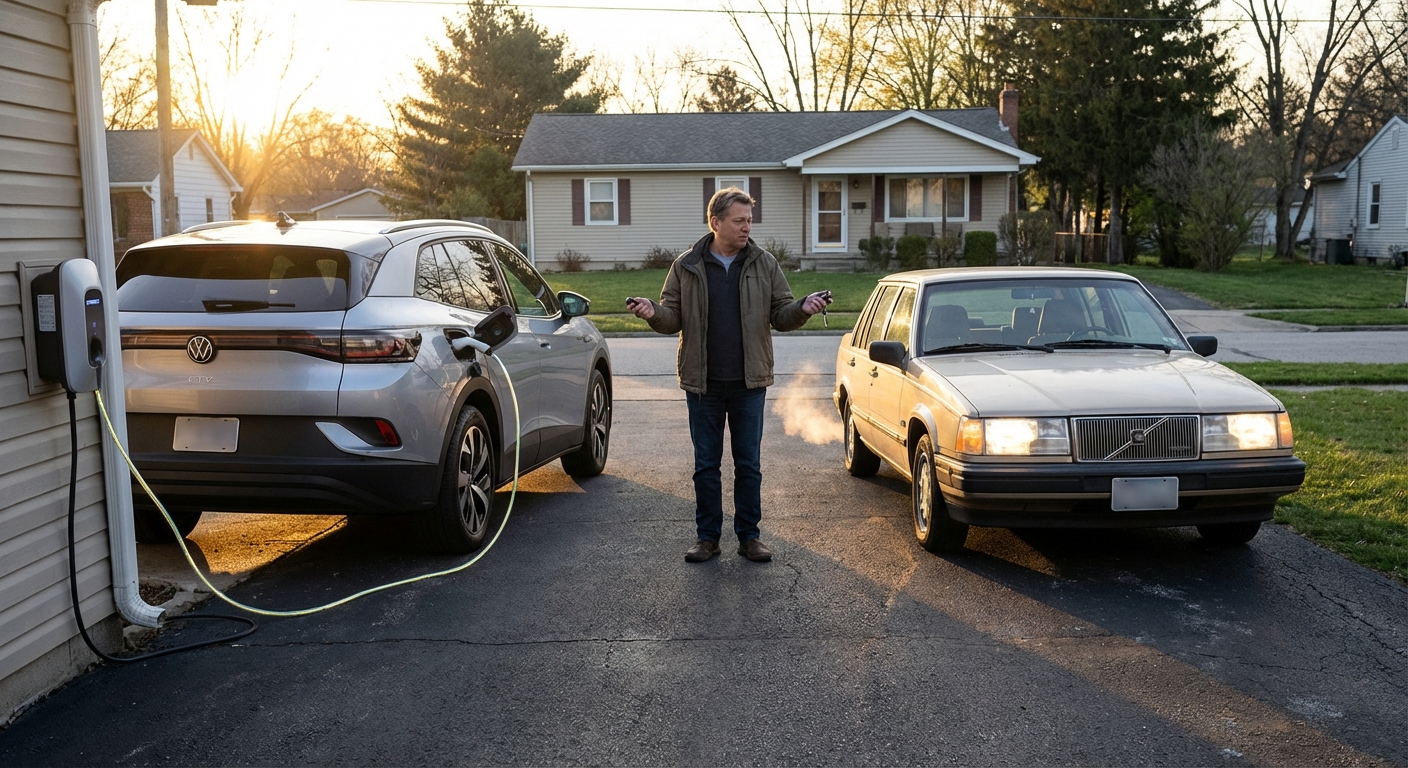
That’s a 4–5x difference. Over a year of commuting, I’m basically paying Netflix money for "fuel" instead of vacation money.
But there’s a catch.
The Hidden Mental Load: Charging Isn’t Just Plug-and-Play
I used to roll my eyes when people said charging was stressful. Then I took my first winter road trip.
Around town, home charging is a dream. I plug into a Level 2 charger at night, wake up with a full “tank.” Public charging? Different story.
One night, I stopped at a DC fast charger that should have delivered 50 kW. It gave me 23 kW… in -5°C weather… with two other cars waiting. What’s worse, the app glitched, and I had to restart the session three times.
This is where the data backs up the anecdotes:
- A 2023 J.D. Power study found that 1 in 5 public charging attempts in the U.S. failed due to equipment issues or software errors.
- According to the U.S. Department of Energy’s AFDC, over 60% of EV charging sessions still happen at home, which tracks with my life. Public chargers are Plan B, not Plan A.
For local driving, I’d pick the EV every time. For spontaneous long drives or when I don’t control the schedule? My gas car still has a job.
Cost of Ownership: Where The Spreadsheet Slaps You in the Face
I’m that annoying friend who builds cost-of-ownership spreadsheets, so when I added the Leaf, I tracked everything for 18 months.
Here’s roughly how it shakes out, using my real costs and backing them up with wider data from Consumer Reports (2020) and BloombergNEF:
EV Pros on Cost
1. Fuel savings are real, not marketing fluff.Even using conservative assumptions, EVs tend to be 40–60% cheaper per kilometer to "fuel" than gas cars, assuming home charging. My own numbers match this almost exactly.
2. Maintenance is boringly cheap.In my Civic: oil changes every 8,000–10,000 km, transmission fluid, belts, exhaust bits, occasional misfire drama.
In my Leaf: cabin filter, tire rotations, brake fluid… and that’s about it.
Multiple studies, including a 2020 Consumer Reports analysis, found that EV owners spend about half as much on maintenance and repairs over the life of the car compared to gas vehicles.
EV Cons on Cost
1. Upfront prices still sting.Even with used prices dropping, comparable EVs usually cost more than gas equivalents unless you factor in incentives, which change constantly depending on country and year.
2. Battery degradation is a psychological tax.When I bought my used Leaf, it had already lost about 10–12% of its original battery capacity. Totally expected for the age, and the range is still fine for me… but knowing there’s a ticking, expensive component under the floor is mentally very different from a traditional engine.
For context, long-term data from Tesla, Hyundai, and Nissan, plus independent trackers like Geotab’s 2020 EV battery study, suggest most EVs lose about 1–2% capacity per year on average, with no catastrophic cliff around year 8 like the horror stories claim. Still, replacement packs (where available) can run $7,000–$15,000+ if not under warranty.
I personally view the battery a bit like the roof on a house: it’ll probably last a long time, but when it goes, it’s not a small bill.
Driving Feel: This Is Where People Get Hooked
When I first floored the EV at a green light, I laughed. The instant torque is addictive.
- The Leaf isn’t a Tesla Plaid, but 0–50 km/h feels lively. EVs deliver torque from 0 rpm, so even "slow" EVs feel quicker around town than many gas cars.
- The Civic feels more "mechanical" and engaging on a twisty road. There’s something satisfying about rowing gears and hearing the engine rev that an EV just doesn’t replicate.
Journalists at outlets like Car and Driver and MotorTrend have consistently highlighted this split: EVs win at effortless, quick acceleration and quiet refinement; enthusiastic drivers often still prefer an ICE car for sound and analog feedback.
In my experience, when I’m commuting or running errands, I want the EV. When I’m taking the long, scenic route home for fun, I grab the keys to the Civic.
Environmental Reality Check (Without the Green Halo)
I originally justified the EV to myself on environmental grounds, but I forced myself to read the less-flattering studies too.
The 2023 IPCC reports and analyses from the International Council on Clean Transportation (ICCT) broadly agree: over the full life cycle (manufacturing + driving + energy production), EVs usually emit 50–70% less CO₂ than similar gas cars, especially in regions with cleaner power grids.
But there are caveats:
- Battery production is energy- and resource-intensive. Mining lithium, cobalt, and nickel comes with real environmental and ethical concerns, well-documented by groups like Amnesty International (2016 report on cobalt mining).
- If your local grid is coal-heavy, the climate benefit shrinks but almost never disappears. ICCT’s 2022 analysis still found EVs ahead, even in coal-dependent regions like parts of Eastern Europe.
I don’t get a moral gold star for driving an EV. It’s cleaner overall, but not impact-free. I think it’s more honest to call it: less bad, not magically good.
When the Gas Car Still Makes More Sense
There are days when the Civic obviously wins.
- Long road trips with tight schedules: I’ve driven 900+ km in a day. With the gas car, I stop three times, five minutes each, and I’m done. Doing that in the Leaf would be a multi-stop puzzle with longer breaks and route planning around chargers.
- Towing or heavy loads: Most mainstream EVs aren’t rated for serious towing, and the few that are (like certain trims of the Ford F-150 Lightning or Hyundai Ioniq 5) lose range fast when hauling. Real-world tests, like those by TFLtruck and Edmunds, show range drops of 30–50% when towing.
- Cold-soaked winter mornings without home charging: At -15°C, range shrinks noticeably, sometimes 20–30%. Studies from Recurrent Auto and AAA (2019) back this up. If you park outside and rely only on public charging, this gets old fast.
This is why I still tell some friends: "If you can’t charge at home or work, I’d wait or be very sure about local infrastructure before going full EV."
So… If I Had to Choose Only One?
People always ask me this. If I had to sell one car and live with a single daily driver, which would stay?
If my life looked like this:
- Predictable commute under 80–100 km per day
- Home or reliable workplace charging
- Occasional road trips but not weekly
I’d keep the EV and rent a gas car for the rare extra-long journeys. The math and the day-to-day experience just work.
But if my situation changed to:
- No home charging, apartment-only street parking
- Frequent 300–600 km last-minute drives
- Towing or hauling regularly
I’d reluctantly go back to a good hybrid or efficient gas car and wait for infrastructure and charging speeds to mature.
That’s the part most viral EV takes miss: context matters more than ideology.
How to Decide Which Side of the Fence You’re On
If you’re on the fence, here’s what actually helped my friends more than any spec sheet.
- Test your real life, not just the car. Rent an EV for a full week. Try your commute, your weekend errands, your usual visiting routes. Don’t baby it. Notice where it shines and where you’re annoyed.
- Map your must-do trips. If you regularly do a 400–600 km route, pull up a tool like A Better Routeplanner (ABRP), plug in a real EV model, and see how many stops it suggests.
- Be honest about your charging reality. Level 2 at home? You’re golden. No off-street parking and no chargers near work? Your experience is going to be very different from mine.
Owning both an EV and a gas car taught me that neither is the unquestioned winner. They’re tools. And like any tools, they’re brilliant at some jobs and hilariously bad at others.
If there’s one thing I’ve learned from late-night charging sessions and oil changes in cold driveways, it’s this: the “future of cars” isn’t one-size-fits-all. It’s you, your habits, your roads, and what you’re willing to trade.
And if you do end up sitting at a fast charger in the snow at 11 p.m., double-check the app before you walk away. Ask me how I know.