I Turned My Evenings Into “Analog Hours” — And It Broke My Screen Addiction
h every night. One Monday, after realizing I’d forgotten what I’d watched, read, or done the night before, I tried something small: one hour, no screens, only “analog” hobbies.
It felt awkward, like I’d forgotten how to be a person without pixels. But a few weeks later, those “analog hours” became the thing I look forward to the most. My phone now feels like an option, not a default.
This isn’t a digital detox fantasy or a “move to a cabin and raise chickens” situation. I still love tech. I work online. I watch Netflix. But I’ve carved out a daily window where I do something radically old-school: hobbies that exist in the real world, with my actual hands, at human speed.
Here’s what happened when I turned my evenings into analog hours, what actually worked, what flopped, and how you can steal the idea without becoming a monk.
What I Mean By an “Analog Hour” (And Why It Feels So Weird at First)
When I say “analog hour,” I mean a chunk of time (for me, it’s 60–90 minutes at night) where I:
- Don’t use screens
- Don’t multitask
- Do something that produces a tangible result: a sketch, a bread loaf, a tiny Lego spaceship, a few journal pages, a cleaned shelf, a half-finished puzzle
The first night I tried it, I sat on my couch holding a book and… checked my phone three times in five minutes. Muscle memory is wild. I caught myself automatically reaching for it like a phantom limb.
I’d seen the stats before: adults in the U.S. now average over 4 hours a day on their phones, not counting laptops or TVs. Some estimates put total screen time at 7+ hours daily for many people. I thought I was the exception. I was absolutely not the exception.
The weirdest part? The analog hour didn’t feel peaceful at first. It felt like withdrawal. My brain kept begging for a quick hit of novelty: just one notification, one reel, one email refresh. Instead, I was… staring at a notebook.
But something clicked around day 5.
My attention span stretched. Ten minutes of drawing turned into forty without me noticing. I caught myself enjoying the texture of paper, the sound of a pen, the smell of bread baking in the oven while I read a physical book like it was 2004.
The discomfort early on was a clue: this wasn’t just about “fun hobbies.” It was about re-training my brain to handle slowness again.
How I Built a Realistic Analog Ritual (Without Going Full Cottagecore)
I knew if I treated this like a hardcore “challenge,” I’d last three days and then snap back to TikTok at 1 a.m. So I gave myself three rules that were strict enough to matter but flexible enough to be human.
Rule 1: The “Staging Area” Trick
I picked one spot — my kitchen counter — as the physical home of my analog hour. Every morning, I’d put one analog thing there before work:
- A puzzle box
- A sketchbook and pencil
- A non-fiction book I was halfway through
- A deck of cards and a simple solitaire instruction
- A knitting project
This did two things:
- It removed decision fatigue. At 9 p.m., I’m not going to “choose a fulfilling hobby.” I’m going to pick whatever is in front of me.
- It made the ritual visible. My brain started to link “thing on counter” with “we’re doing analog time later.”
When I tested this, nights where I pre-staged something had about a 90% “success rate.” Nights when I didn’t? I went straight from dishes to YouTube.
Rule 2: No “Productivity Disguised as Relaxation”
I banned myself from using the analog hour to do tasks that felt like work — no budgeting, no planning my week, no job-related reading.
My analog hour was allowed to be:
- Unproductive on purpose
- Badly executed (ugly art absolutely counts)
- Completely pointless by capitalist standards
The goal wasn’t “optimize my life.” It was “experience leisure that exists offline.”
When I tried to sneak in “useful” things (“I’ll just sort these documents!”), I ended the night feeling like I’d done more work instead of refueling.
Rule 3: Curiosity Over Performance
I gave myself permission to:
- Quit a new hobby after one try
- Be terrible at it
- Frankenstein hobbies together (sketching while listening to vinyl, handlettering random lyrics, journaling while timing bread proofing)
This killed the pressure to “become good” at anything. The analog hour became a playground, not a side hustle.
Over a month, I rotated between:
- Very low-skill stuff: jigsaw puzzles, coloring books, building a model kit
- Medium-skill learning: simple watercolors, beginner knitting, practicing chords on a cheap keyboard
- Mind-wandering stuff: journaling, freewriting, flipping through a big photo book
What surprised me was that the hobbies that stuck weren’t the ones I was “naturally good at.” They were the ones that made me forget to check the time.
The Surprising Side Effects: Sleep, Stress, and That Weird “Mental Quiet”
I didn’t track this with a sleep lab, but I did use a basic sleep tracker and journaling before and after starting analog hours. Over roughly six weeks:
- I fell asleep faster on analog-hour nights
- My late-night “anxiety spirals” dropped noticeably
- I had more vivid, coherent dreams (or maybe I just remembered them better)
This actually lines up with what sleep researchers have been saying for years. Blue light and cognitive stimulation from screens right before bed can interfere with melatonin production and make it harder to fall asleep and reach deep sleep. But I’d always shrugged that off as “yeah, yeah, but I’m fine.”
The big subjective shift wasn’t just sleep — it was what I’d call mental quiet.
On nights with an analog hour, my brain felt:
- Less “sticky” — thoughts flowed instead of looping
- Less hungry for micro-dopamine hits
- More willing to sit with ideas, especially when journaling or sketching
On nights when I skipped it and went back to full-screen mode, I could feel the difference: scattered attention, more urge to check apps, more restlessness when trying to fall asleep.
Was my stress magically gone? No. But I had a small daily space where nothing pinged, flashed, refreshed, or notified me. That reduction in digital noise made regular life feel a notch less overwhelming.
The Hobbies That Worked (and the Ones That Totally Flopped for Me)
What surprised me most was how different hobbies felt at 9:30 p.m. after a full day versus on a lazy Sunday afternoon. Some sounded great in theory and were absolute disasters after work.
Clear Winners in My Analog Hour
1. Jigsaw PuzzlesI underestimated puzzles hard. They were perfect for low-energy nights. There’s a satisfying “click” when pieces fit, and you don’t need a tutorial or talent. I’d put on an album, stand at the table, and just piece-hunt.
Bonus: it became a quiet social hobby. Friends would visit, see the half-finished puzzle, and automatically start helping while we talked.
2. Analog JournalingNot “dear diary, today I ate toast” — more like:
- Brain dumping everything stressing me out
- Capturing one thing I noticed that day (a conversation, a smell, a weird interaction)
- Writing out worst-case scenarios and then reality-checking them
The physical act of writing slowed my thoughts. There’s research showing expressive writing can reduce stress and improve mood. I didn’t do it for science, but on high-anxiety days, pen-and-paper journaling was my emergency brake.
3. Simple Sketching and DoodlingI’m not an artist. My early sketches looked like witness-protection renderings. But doodling while listening to a podcast (pre-downloaded so I didn’t touch my phone) became unexpectedly meditative.
I’d pick something ridiculously simple — objects on my desk, my own hand, the plant in the corner — and try to draw it badly but honestly. The goal wasn’t “good art,” it was focusing on seeing.
4. Cooking One Thing SlowlyNot making full meals — I’m not doing a 3-course dinner at 10 p.m.
Instead, I’d pick one thing that takes time but not mental energy:
- Letting bread dough rise and fold
- Stirring risotto while listening to an audiobook
- Roasting vegetables and actually paying attention to the smell and texture
Cooking as an analog hobby made me notice how often I normally hover over food while also scrolling. Doing it as a single focus made it oddly soothing.
Hobbies That Flopped for My Evenings
1. Learning Complex Skills From BooksI had this fantasy of reading thick manuals and emerging fluent in music theory. Reality: by 9:45 p.m., the pages looked like static. My brain didn’t want heavy cognitive load; it wanted gentle engagement.
2. Highly Precise CraftsI tried tiny model painting. Between bad lighting and end-of-day clumsiness, I just got frustrated. That kind of delicate work might be great earlier in the day. At night, I needed forgiving hobbies.
3. Hyper-Goal-Oriented ProjectsAny hobby where I obsessed about “finishing” or “perfecting” (like speed-solving a Rubik’s cube with a timer) made my analog hour feel like another performance arena. Not restful.
This is where personal experimentation matters. Someone else might love complex knitting patterns or chess problems at night. My main lesson: match the hobby’s intensity to your brain’s energy level.
How to Start Your Own Analog Hour Without Hating It
If you want to steal this idea, here’s what I’d actually recommend after testing it on myself (and casually on a couple of friends who tried it too).
Start Tiny and Cheating Is Allowed
Don’t start with “one full hour every night for the rest of my life.”
Try:
- 20–30 minutes
- 2–3 nights a week
- Same time block (for example, after dinner, before shower, or right after cleaning the kitchen)
If you’re used to constant stimulation, even 20 minutes of quiet can feel like a lot. That’s not failure — that’s your nervous system realizing this is different.
Also: if you absolutely must use your phone for something analog-related (like an offline metronome or a downloaded podcast), airplane mode is your best friend. I used it like training wheels.
Make It Social (But Not Performative)
I didn’t post about my analog hours at first. I wanted it to be mine, not content.
But once I mentioned it to a friend, we accidentally created a low-pressure accountability system. We’d text each other “Analog hour starting” and “What’d you do?” afterward.
We even had one night where we each did our own analog hobbies on video call: I was sketching, they were doing a puzzle. We barely talked. It felt like being in the same room working on separate things — quietly comforting.
Group analog nights are underrated: board games, card games, shared cooking, or everyone bringing a hobby to the same table.
Expect Boredom — Then Watch What’s Underneath
The first wave is boredom. Then restlessness. Then, if you stick with it, something else shows up: thoughts you’ve been dodging, ideas you forgot you had, stories your brain wants to tell when it’s not drowning in notifications.
Sometimes that feels nice. Sometimes it doesn’t. Both are data.
For me, analog hours surfaced:
- Big work decisions I was postponing
- Friendships I wanted to revive
- Old creative ideas I’d dismissed because “who has time”
That’s the slightly scary part of analog leisure: it gives your mind enough space to show you what it’s actually chewing on.
Why This Isn’t Just Nostalgia (And Why I’m Keeping It)
This isn’t about romanticizing “the good old days” before smartphones. I like living in a time where I can video call across continents and listen to any album instantly. Tech isn’t the enemy; it’s just a very persuasive roommate.
For me, the analog hour is:
- A daily reminder that I’m a body, not just a brain attached to eyes
- Proof that I can still focus without algorithmic help
- A way to reclaim a slice of my time from companies whose business model depends on my constant attention
The pros I’ve felt:
- Deeper sleep more often
- A little more creative energy leaking into my days
- Less urge to check my phone first when I feel uncomfortable or bored
- A mini identity shift: from “consumer of content” to “person who makes little things”
The cons:
- It can feel like effort, especially on exhausting days
- Friends or family might not immediately “get” why you’re suddenly offline at night
- It can surface emotions you’ve been numbing with screens, which is useful but not always fun
If you try it, don’t think of it as a moral upgrade or a detox. Think of it as adding one more room to the house of your life — a room where nothing needs charging, updating, or loading.
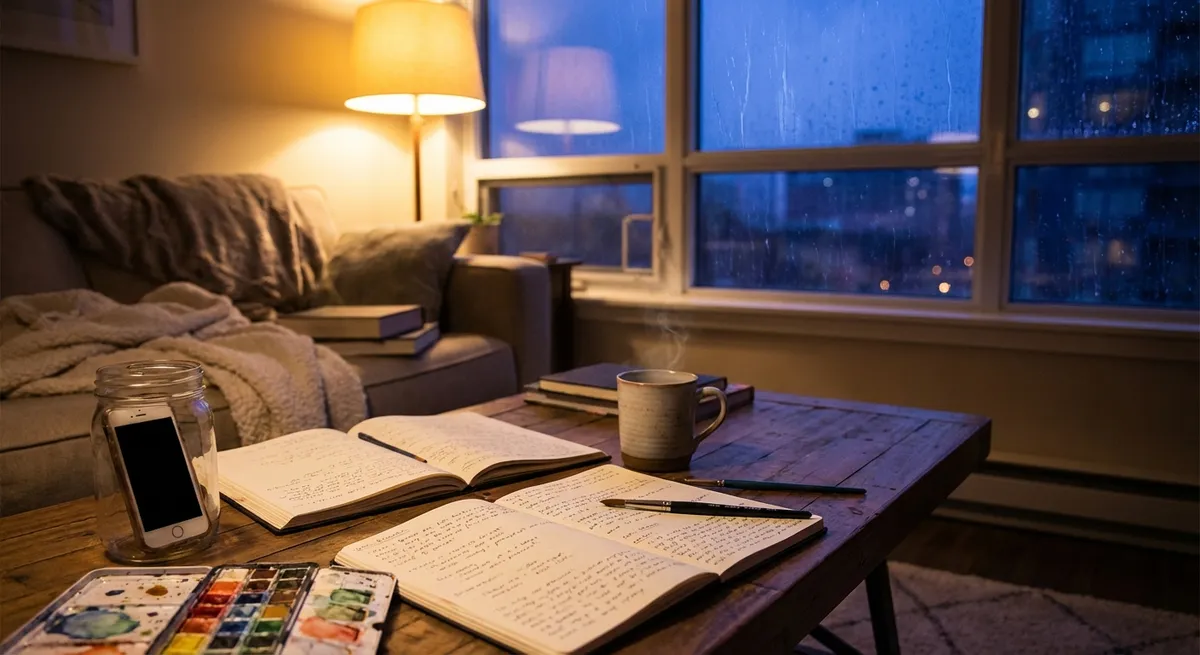
Mine has a puzzle on the table, a notebook with messy thoughts, and a cheap sketchbook full of bad drawings. It’s not pretty enough for Instagram, but it’s become my favorite place to spend an hour.
Sources
- Pew Research Center – Mobile Fact Sheet – Data on smartphone ownership and usage trends in the U.S.
- American Psychological Association – “Stress in America” Reports – Research on stress, technology use, and mental health connections
- Harvard Medical School – Blue Light Has a Dark Side – Overview of how evening screen exposure affects sleep and circadian rhythms
- National Sleep Foundation – Screen Time and Sleep – Discussion of the impact of digital devices on sleep quality and recommendations for nighttime habits
- University of Rochester – The Benefits of Expressive Writing – Summary of research on journaling and expressive writing for emotional well-being