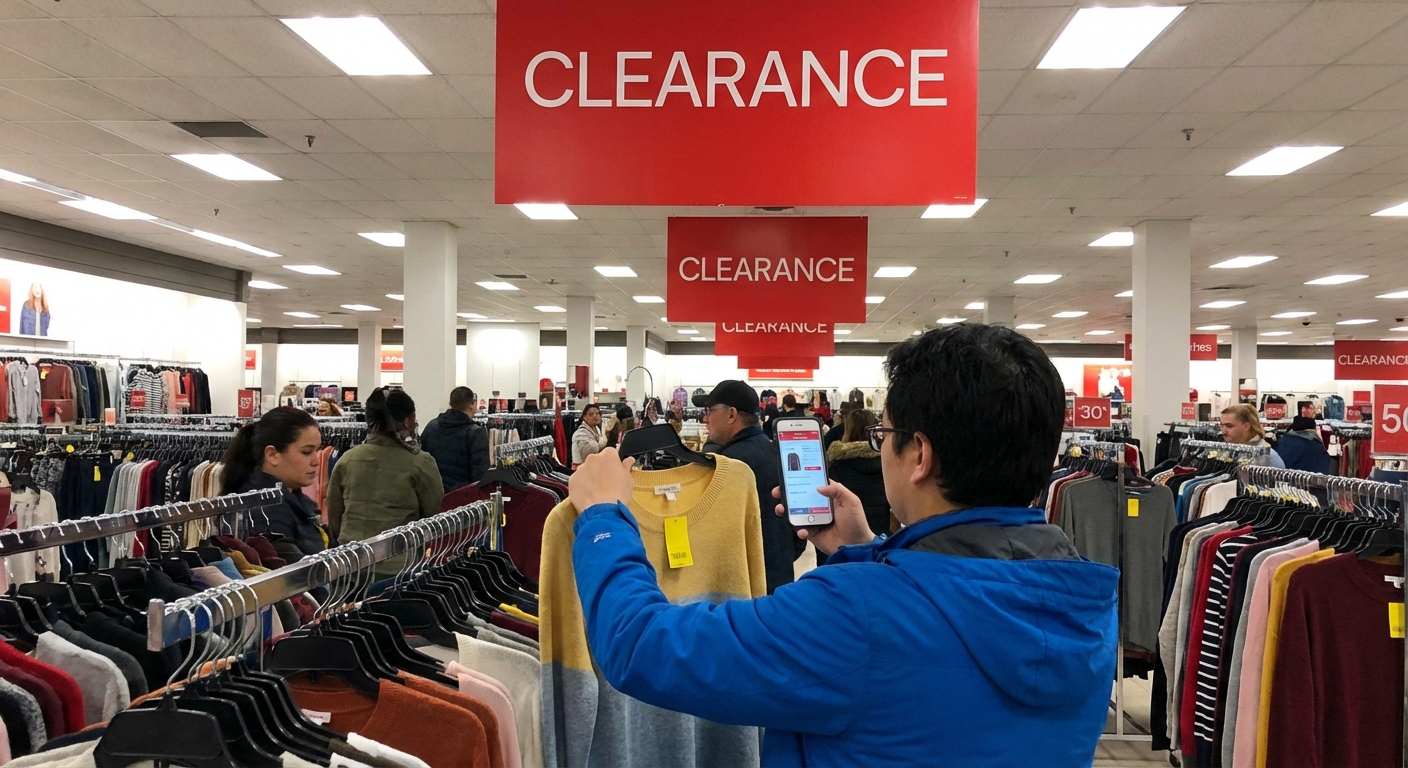
JCPenney Clearance Guide
actually learned how their clearance system works.
When I tested a few tricks I picked up from a former department supervisor (she casually dropped them while marking down sweaters), I walked out with $280 worth of stuff for about $70. That was the day my JCPenney clearance obsession officially started.
This JCPenney Clearance Guide is everything I’ve learned since—what works, what doesn’t, and how to stack promos without getting side‑eyed at the register.
How JCPenney Clearance Really Works
In my experience, JCPenney’s clearance isn’t random. It feels chaotic on the racks, but there’s a surprisingly logical markdown cycle behind it.
Here’s what I’ve seen play out multiple times:
- Full price → 25–40% off promo (still NOT clearance)
- First markdown → ~50–60% off (yellow or red clearance tags start showing up)
- Deeper markdown → 70–80% off (usually when a new season’s floor set comes in)
- Final markdown → 80–90% off (these are the “how is this $3?” moments)
JCPenney itself has acknowledged in past investor updates and earnings calls that clearance is a key part of their merchandising strategy, especially for apparel and home. They move a lot of seasonal inventory that way.
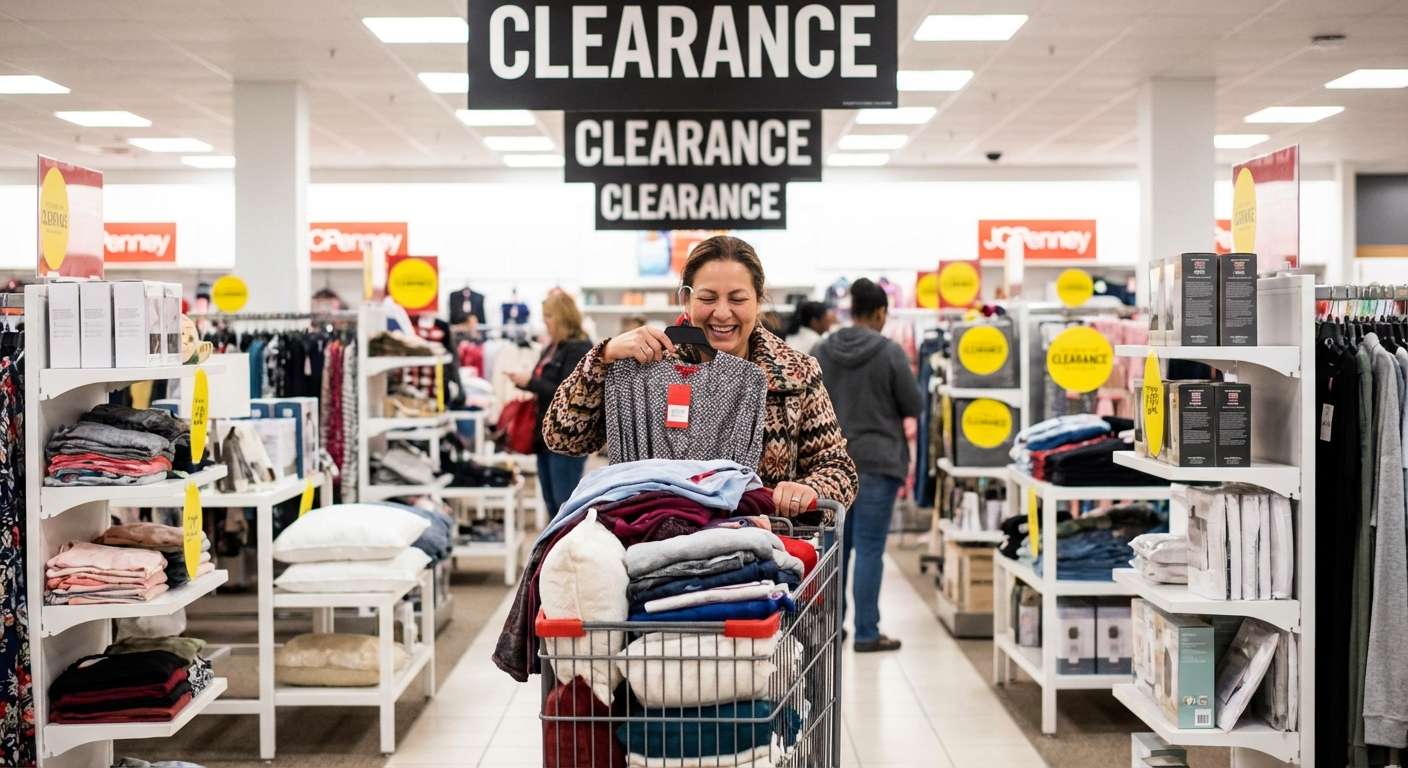
When I asked an associate in the men’s section about it, she told me: “If it’s still here after two or three resets, it just keeps dropping until it’s gone. We don’t want to send back more than we have to.” That lined up with what I’d been seeing—big price drops just before major holidays and season changes.
The Best Days and Times To Shop Clearance
You can find deals any day, but if you want those “I can’t believe this receipt” hauls, timing matters.
1. The Markdown Rhythm I’ve Actually Seen
Different stores tweak this, but across three JCPenneys I visit regularly, I’ve noticed:
- Midweek mornings (Tue–Thu) – Most reliable for fresh markdown stickers. When I tested this for a month, I consistently saw new clearance labels going out between about 10 a.m. and noon.
- Post‑holiday weeks – The week after big holidays (Christmas, Easter, back‑to‑school, Black Friday) is clearance gold. Seasonal and gift items drop fast.
- End of month – I’ve had good luck the last week of the month, especially in apparel, as they reset for the next floor set.
Is this an official policy? No. It’s pattern‑spotting plus what several associates casually confirmed to me. And patterns are your best friend when you’re chasing clearance, because the store won’t publish a schedule.
2. Morning vs. Evening
When I tried hitting the same store at 11 a.m. and then again at 7 p.m. a few days in a row, mornings consistently had:
- Neater racks
- More sizes
- Newly marked clearance that hadn’t been picked over
Evenings can still be good, but expect more clutter and less organization. If you hate digging, aim earlier.
Reading JCPenney Price Tags Like a Pro
Once I figured out the tags, everything changed. I stopped guessing and started targeting.
Clearance Tags and What They Mean
From what I’ve seen across multiple locations:
- Yellow or red clearance stickers – These usually indicate a reduced price below the original or promo price. The clearance price is the price on the sticker, not the original printed one.
- Multiple stickers layered – Every sticker down is a past markdown. If you see three or four stickers piled up, that item’s been through a few rounds and may be close to final markdown.
One associate told me that if an item’s been on clearance for a while and there’s a major sale event coming, there’s a good chance it gets dropped again—so it’s worth checking back for specific things.
Know the Departments That Drop Fastest
From my own hauls and receipts over the last few years:
- Women’s and kids’ apparel – Some of the fastest to hit 70–80% off, especially seasonal styles.
- Men’s dress shirts and ties – Regularly make it to 70% off, then stackable with promos.
- Home clearance – Bedding, rugs, and seasonal décor get aggressively marked down after major holidays.
- Shoes – Hit‑or‑miss, but when they go, they go hard—especially off‑season styles.
Electronics and beauty are less generous. Don’t expect 80% off on a name‑brand gadget the way you might see on a summer dress.
Stacking Coupons, Rewards, and Clearance (What Actually Works)
This is where it gets fun—and confusing.
When I tested stacking on a big clearance run last fall, here’s what actually worked at the register:
- JCPenney Rewards (their free loyalty program)
- Percent‑off coupons (like 20% off select items)
- Dollar‑off rewards ($10 off $25, $15 off $50, etc.)
What You Can Usually Stack
From my experience and from JCPenney’s published offers:
- Rewards certificates typically apply to clearance unless the fine print says otherwise.
- Many percent‑off coupons exclude “doorbusters” and special buys, but not all clearance.
- Online promo codes sometimes apply differently than in‑store coupons.
One time, I grabbed $120 of clearance bedding already marked about 70% off. At the register:
- I used a 20% off home purchase coupon (which applied to clearance due to the promo details that week)
- Then applied $20 in rewards I’d built up
Final bill? Just under $30 after tax. The cashier laughed and said, “You did good on this one.”
But I’ve also had days when the coupon simply wouldn’t attach because of fine‑print exclusions. That’s the reality—some weeks you stack like a legend, some weeks you don’t.
Check the Fine Print. Always.
JCPenney posts offer terms on their site. Before I drive over, I usually:
- Open the JCPenney app
- Tap the current offers
- Read which categories and price types are excluded
It takes 30 seconds and saves you that awkward “Oh, it doesn’t work on clearance” moment at checkout.
Online vs. In‑Store Clearance: What I’ve Learned
I used to assume online clearance would beat in‑store because of bigger inventory. That’s not always true at JCPenney.
Online Clearance Pros
- Searchable – You can filter by size, color, and discount level.
- “Today’s Deals” and promo codes – Sometimes online gets additional percentage‑off or free shipping perks.
- Ship to store – Handy if your location doesn’t have a big clearance section.
In‑Store Clearance Pros
- Final markdowns – I’ve found 80–90% off deals in‑store that were still sitting at higher prices online.
- Price checking – You can take an item to the scanner (or ask an associate) to see if it’s dropped further than the tag shows.
- Hidden gems – Returns, odd sizes, and one‑offs sometimes live on the racks.
When I tested this head‑to‑head with men’s dress shirts, I found a style at $11 in‑store that was still $24.99 on the website. Same brand, same color, same size. In‑store won that round by a mile.
Realistically, the best strategy I’ve landed on is: use online to find styles and brands you like, then hunt those labels in‑store clearance for deeper end‑of‑season steals.
Seasonal Strategy: When to Pounce
Clearance is all about being slightly out of season and okay with it.
Here’s what’s worked for me, looking back through my own receipts:
- Winter coats & heavy sweaters – Best deals: late January through February.
- Swimwear & summer clothes – Best deals: August into early September.
- Holiday décor & gifts – Best deals: the first two weeks of January.
- Back‑to‑school clothing – Best deals: late September into October.
If you’re shopping for kids, this gets trickier because they grow. I usually buy 1–2 sizes up on deep clearance, but not more than a year ahead. I learned that the hard way when my nephew jumped two sizes and skipped a whole stack of $4 jeans I’d proudly stockpiled.
Downsides and Things That Can Go Wrong
I love a clearance win, but it’s not all magic.
From my experience, here are the real downsides:
- Limited sizes and styles – Clearance is leftovers. If you need very specific sizing, this can be frustrating.
- Return policies may vary – JCPenney’s standard return policy generally still covers clearance, but super‑final markdowns or seasonal items can have tighter windows. Always check the receipt.
- Impulse buying – When everything’s $6, you start convincing yourself you “need” twenty things you don’t. Been there.
- Quality vs. price – A $7 sweater that pills after two washes isn’t actually a deal.
I try to ask myself one test question: Would I still buy this at twice the price? If the answer is no, it’s probably just the adrenaline talking.
Practical Game Plan: How I Shop JCPenney Clearance Now
Here’s the simple playbook I use now that consistently gets me the best results:
- Check offers in the app before I go – See if current coupons or rewards will apply to clearance.
- Go mid‑week, mid‑morning when I can – Cleaner racks, fresher markdowns.
- Hit my best‑bet departments first – Women’s, kids, home, then shoes.
- Scan suspiciously cheap items – Sometimes the system price is lower than the tag.
- Sort my cart before checkout – Pull out anything I only grabbed because it was cheap.
- Stack rewards last – Use dollar‑off rewards on already‑reduced clearance for maximum impact.
When I follow that routine, I consistently walk out with 60–80% off combined savings without doing anything sketchy or extreme.
Final Thoughts (From Someone Who’s Spent Too Much Time in These Aisles)
JCPenney clearance is not magic, but it is predictably generous if you understand how the markdowns, timing, and promos fit together.
In my experience, the people who score the wildest deals aren’t the ones camping out for Black Friday—they’re the ones quietly rolling in on a random Wednesday in February with a rewards certificate, a coupon that actually applies, and the patience to dig through a few racks.
If you treat this like a little game—spot the pattern, time the markdown, stack the right offer—you’ll win way more often than you lose.
Just…maybe set a budget first.
Sources
- JCPenney Official Website – Coupons & Offers - Current promotions, exclusions, and offer structures.
- U.S. Bureau of Labor Statistics – Consumer Spending Trends - Data on retail and apparel spending behavior.
- Forbes – How Retailers Use Discounting And Clearance To Drive Sales - Industry context on markdown and clearance strategies.
- Harvard Business School – The Science of Retail Markdowns - Research-backed insights into markdown timing and pricing.
- CNN Business – JCPenney’s Retail Strategy and Turnaround Efforts - Background on JCPenney’s business and inventory tactics.