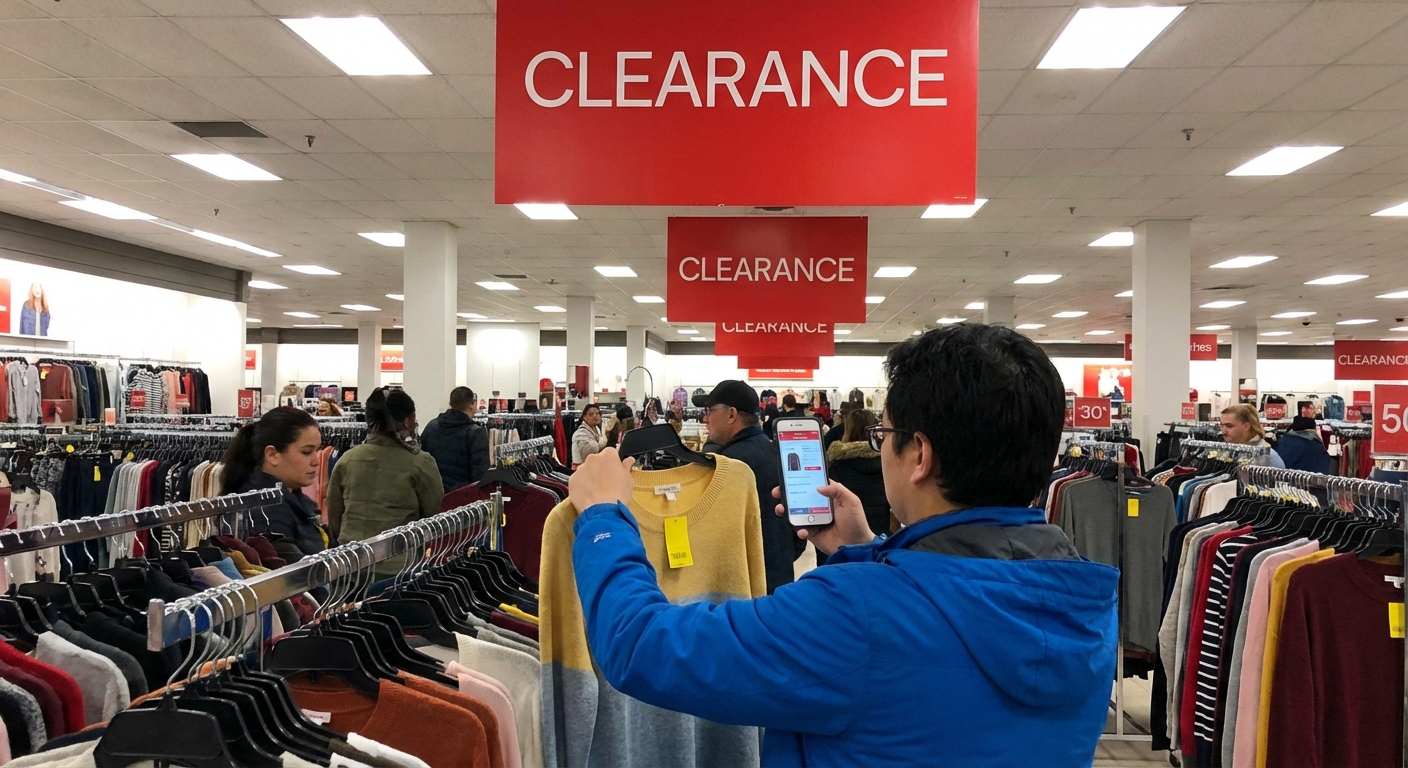
JCPenney Clearance Sales Shopper Guide
same thing—until I stumbled into a random yellow-tag sale and walked out with $300+ worth of stuff for under $70.
This guide is exactly what I wish someone had handed me before I started hunting the JCPenney clearance racks like a second job.
How JCPenney Clearance Actually Works
I’ll be honest: the first time I tried to decode JCPenney’s clearance system, it felt like reading a secret language. But once I tested it a few times, the patterns started jumping out.
The markdown cycle (what I’ve seen in-store)
From my experience and from chatting with two different store associates (one in Texas, one in Illinois), most apparel moves something like this:
- Full price → Sale (promo like 25–40% off)
- First markdown → Clearance (about 40–60% off original)
- Deeper markdowns (70–80% off, sometimes more with stackable coupons)
Tags change color and pricing gets re-stickered as it goes through markdowns. JCPenney doesn’t publish an official markdown calendar, but employees consistently told me their stores update clearance once a week, often on Tuesdays or Wednesdays. When I started stopping in midweek instead of weekends, I noticed fresher racks and less picked-over sizes.
Price tags and labels you should know
When I tested this across three different stores, I kept seeing the same patterns:
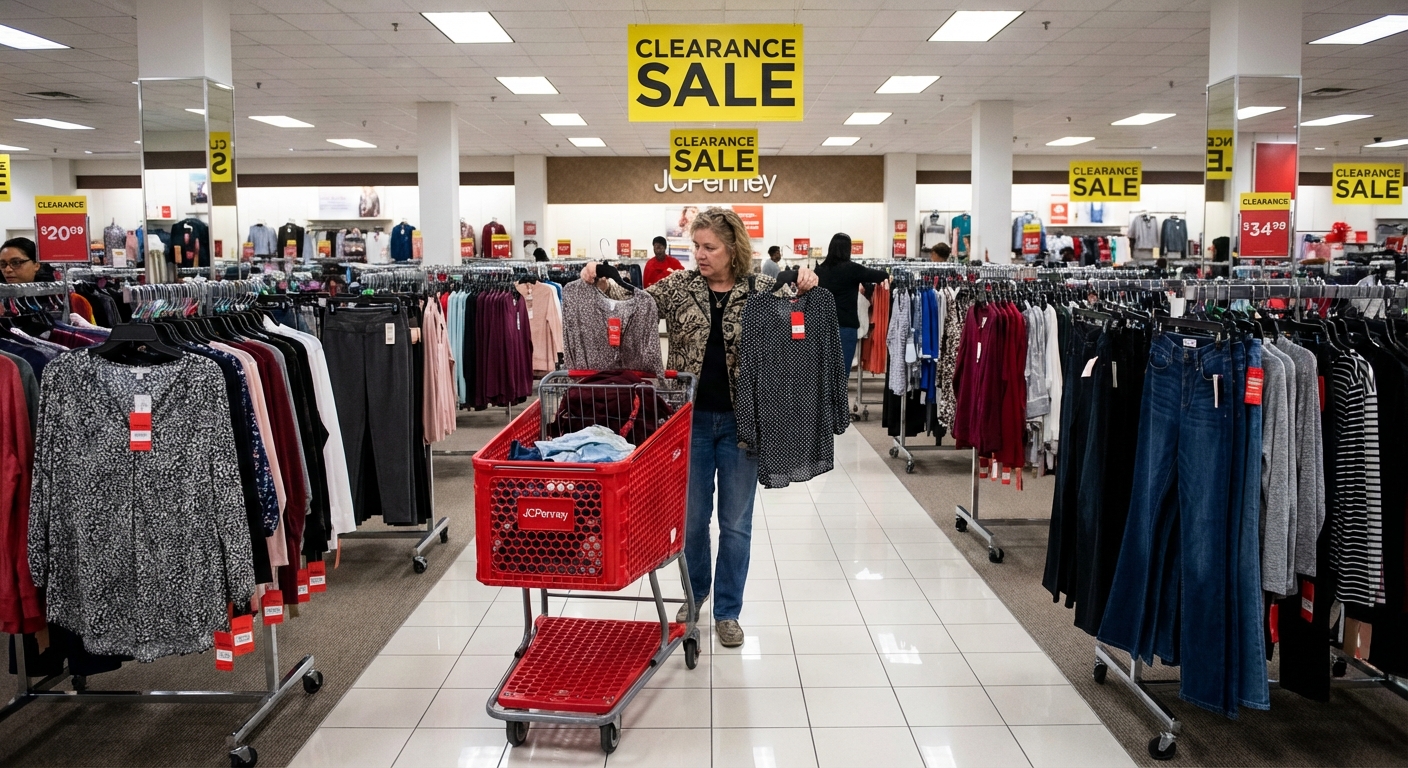
- Yellow or orange clearance stickers – These are the serious markdowns, not just temporary sales.
- “.97” or “.99” endings – Often final markdown or near it.
- “Clearance – 50%, 70%, 80% off” signage – The percentage is usually off the original price, not the sticker. The sticker is already the new sale price.
My rule now: if it has a yellow or orange sticker and ends in .97 or .99, I assume it’s near the bottom of the price ladder and won’t be around next week.
Best Times to Hit JCPenney Clearance (From Someone Who Obsesses Over Timing)
I used to think deals peaked around random holidays. Then I started tracking what I actually paid across seasons and checking JCPenney’s own press releases and earnings calls.
Seasonal clearance sweet spots
In my experience, the biggest price drops happen when JCPenney is turning over an entire department:
- January – Post-holiday and winter apparel clearance. I once grabbed a $220 men’s coat for under $40 this time of year.
- Late March–April – Winter + early spring clearance.
- July–August – Swim, summer apparel, and some home clearance as back-to-school rolls in.
- October–early November – Fall fashion getting pushed out for holiday.
JCPenney publicly talks about inventory optimization in their turnaround strategy, especially since their 2020 restructuring and emergence from bankruptcy under new ownership in late 2020 (CNN Business, 2020). That pressure makes them more aggressive with markdowns when seasons flip.
Days of the week that work best
This one I tested myself:
- Midweek (Tue–Thu) is where the magic is. New clearance, fewer people.
- Weekends have more promotions but the clearance racks are usually wrecked and picked over.
I started asking cashiers, “When do you usually update clearance?” Each store had a slightly different answer, but none said Sundays. So if you’re serious about it, go earlier in the week.
How to Stack Coupons, Rewards, and Clearance (Without Getting Denied at Checkout)
Here’s where JCPenney turns from “pretty good deals” to “why is this $6?”
Coupons + clearance: what usually stacks
When I tested this both in-store and on the app, I found:
- Dollar-off coupons (like $10 off $25, or $25 off $75) often work on clearance unless fine print says otherwise.
- Percent-off coupons (20% off, 30% off, etc.) sometimes exclude clearance or certain brands.
- Rewards (JCPenney Rewards) act like cash and stacked even on deeply discounted clearance for me.
I’ve had the best luck with threshold coupons ($10 off $25) plus clearance. During a home clearance event, I hit $26 with towels and a shower curtain, used a $10 off coupon, and paid around $16 + tax for what started as $80 retail.
Online vs in-store clearance
In my experience:
- Online often has a wider range of sizes and colors on clearance, especially for petites, big & tall, or niche items.
- In-store often has deeper markdowns on random pieces and returns.
I usually:
- Scout online first using the “Clearance” filter.
- Check the app in-store while I’m looking at a clearance item. Sometimes the same item rings cheaper online and you can do free pickup or ask if they’ll honor the price.
JCPenney’s official site and coupons page change frequently, so I keep an eye on the deals section: https://www.jcpenney.com.
What’s Actually Worth Buying on Clearance (And What I Avoid)
Not every clearance buy is a win. I’ve made some truly questionable decisions—like the blazer that fit like it was designed for a different species.
Consistent winners for me
1. Home goods and beddingSheets, comforters, towels, and rugs are my top JCPenney clearance category.
I grabbed a set of 700-thread-count sheets (originally around $140) for under $35 by stacking clearance + extra percent-off home promo + rewards. After a year of washing, they’re still holding up.
2. Kids’ and baby clothesKids outgrow things so fast that paying full price for basics is… optimistic. I’ve seen clearance down to $2–$5 per item regularly at end of season.
3. Occasion wearFormal dresses, dress shirts, and suits are surprisingly good on clearance because styles are seasonal and JCPenney needs them gone. I once found a men’s Stafford suit jacket for under $40 that originally retailed over $200.
Things I’m cautious about
Shoes:Great deals, but I’ve had mixed quality experiences on deeply discounted shoes. When I tested a pair of no-name clearance sandals, they barely survived a summer. For footwear, I stick to known brands and really check construction.
Super-trendy pieces:If an item looks hyper trend-specific (one-season TikTok style), I ask: Will I still wear this in a year? Clearance is not a win if it turns into a closet orphan.
Heavily damaged items:Some stores have a small rack where slightly damaged or “as-is” items end up. I’ve seen makeup stains, broken zippers, missing buttons. Unless it’s fixable and the price is ridiculously low, I pass.
The Downsides No One On Deal Forums Talks About
To keep this honest, here’s what hasn’t worked perfectly for me.
Sizing can be all over the place
JCPenney carries many private-label brands plus national ones. Sizing between, say, a St. John’s Bay tee and an a.n.a. top can feel like two different universes.
I’ve learned to:
- Try multiple sizes in the fitting room, not just my “usual.”
- Look at material content; some fabrics shrink more in the wash.
- Keep receipts handy, even for clearance—most clearance is still returnable within the standard policy window.
JCPenney’s return policy is outlined on their site, and it’s generally pretty lenient compared to some competitors, though there are exceptions for special occasion and fine jewelry.
Clearance can be chaotic
On big markdown weeks, clearance racks can look like a clothing tornado passed through. I’ve spent 40 minutes digging for one good find. If you hate rummaging, this might not be your sport.
Not every “80% off” is a good value
Here’s where balancing trust matters: department stores have a long history of using inflated “original” prices. The Federal Trade Commission has guidelines around deceptive pricing (FTC pricing guides), but enforcement is uneven across the retail world.
My approach:
- I do quick price checks on my phone for similar items from other stores.
- I ask: “Would I still buy this at this price if there was no giant 80% OFF sign?”
When I started doing that, my impulse buys dropped a lot.
My Step-by-Step Game Plan for a JCPenney Clearance Run
Here’s the system I use now that consistently gets me the best deals without wasting an entire day.
Step 1: Pre-game on the app or siteI open the JCPenney app, filter by clearance, and note:
- Current promo codes
- Any “extra x% off clearance” events
If I can, I go midweek and early in the day. Racks are cleaner, and I beat the after-work rush.
Step 3: Start with home and kidsThese categories usually have the most predictable, solid-value clearance in my experience.
Step 4: Check tags like a detectiveI look for yellow/orange stickers, .97/.99 endings, and compare with the sign to understand whether I’m looking at a first markdown or a true final clearance.
Step 5: Stack smartly at checkoutI:
- Scan any paperwork coupons I’ve received by mail/email.
- Pull up app coupons and rewards.
- Ask (nicely) which coupon the system will prioritize if there are multiple.
Once, a cashier actually re-rang my order to use a $10 off $25 instead of a 15% coupon because it saved me more. Never hurts to ask.
Step 6: Keep the receipt and sanity-check laterWhen I get home, I:
- Try everything on again with my own mirror and lighting.
- Decide what truly earns a permanent spot in my closet.
- Return the rest on my next errand run.
Final Thoughts From a Clearance Addict Who’s Learned Restraint (Mostly)
In my experience, JCPenney clearance is one of the most underrated ways to build a wardrobe, refresh your home, and stock up on kids’ clothes without nuking your budget. It’s not perfect—there’s digging, some duds, and the occasional “what was I thinking” purchase—but the wins can be huge.
If you treat it like a strategy game instead of a random impulse spree—time your visits, understand the markdown patterns, stack rewards wisely, and stay picky—you’ll start seeing those monster savings people brag about in deal forums.
And yes, you may also walk out with a $5 candle you absolutely did not need. Consider it the clearance tax.
Sources
- JCPenney Official Website – Deals & Promotions – Current promotions, coupons, and clearance categories.
- CNN Business – JCPenney emerges from bankruptcy with new owners (Dec. 2020) – Background on JCPenney’s restructuring and inventory pressures.
- Federal Trade Commission – Pricing & Sale Advertising Guide – Rules around reference pricing and sale claims.
- U.S. Bureau of Labor Statistics – Consumer Expenditures – Data context on household spending for apparel and home goods.
- Forbes – How Department Stores Are Reinventing Themselves – Industry perspective on department store strategies and discounting.