Natural-Look Makeup Routine: Base, Brows, and Long-Lasting Finish
hiny T‑zone, faded brows, patchy concealer) and realized: the best natural looks are actually sneaky little illusions. They’re structured, strategic, and surprisingly long-wearing.
Over the last few years, I’ve tested everything from skin tints that vanished by noon to “24‑hour” foundations that clung to dry patches I didn’t even know I had. What finally worked was building a simple routine around three pillars: a believable base, softly structured brows, and a long-lasting but undetectable finish.
Here’s exactly how I do it—and what actually holds up off Instagram and in real life.
Step 1: The Base That Looks Like Skin (Not Foundation)
When I tested this routine during a 10‑hour workday plus a sweaty subway ride, the biggest difference wasn’t the products—it was the prep.
Skin prep that makes everything smoother
In my experience, a “natural” base starts at least 5 minutes before makeup.
- Gentle cleanse – I use a low‑pH, non‑foaming cleanser so I’m not stripping my barrier. Over‑cleansing always makes my foundation catch on dry spots.
- Hydrating layer – Think hyaluronic acid or glycerin serum. There’s actual science behind this: a 2012 review in Dermato-Endocrinology highlighted how humectants like glycerin increase skin hydration and improve barrier function.
- Moisturizer matched to your skin type
- Oily/combination: gel-cream, non-comedogenic
- Dry: richer cream, ceramides or squalane
- Targeted primer (optional but useful) – When I skip primer, my makeup almost always melts faster. I like:
- Pore-blurring primer just on my T‑zone
- Gripping, slightly tacky primer (think milk makeup style) on cheeks and forehead
Foundation: less product, more strategy
For a natural look, I treat foundation like spot-treatment, not a blanket.
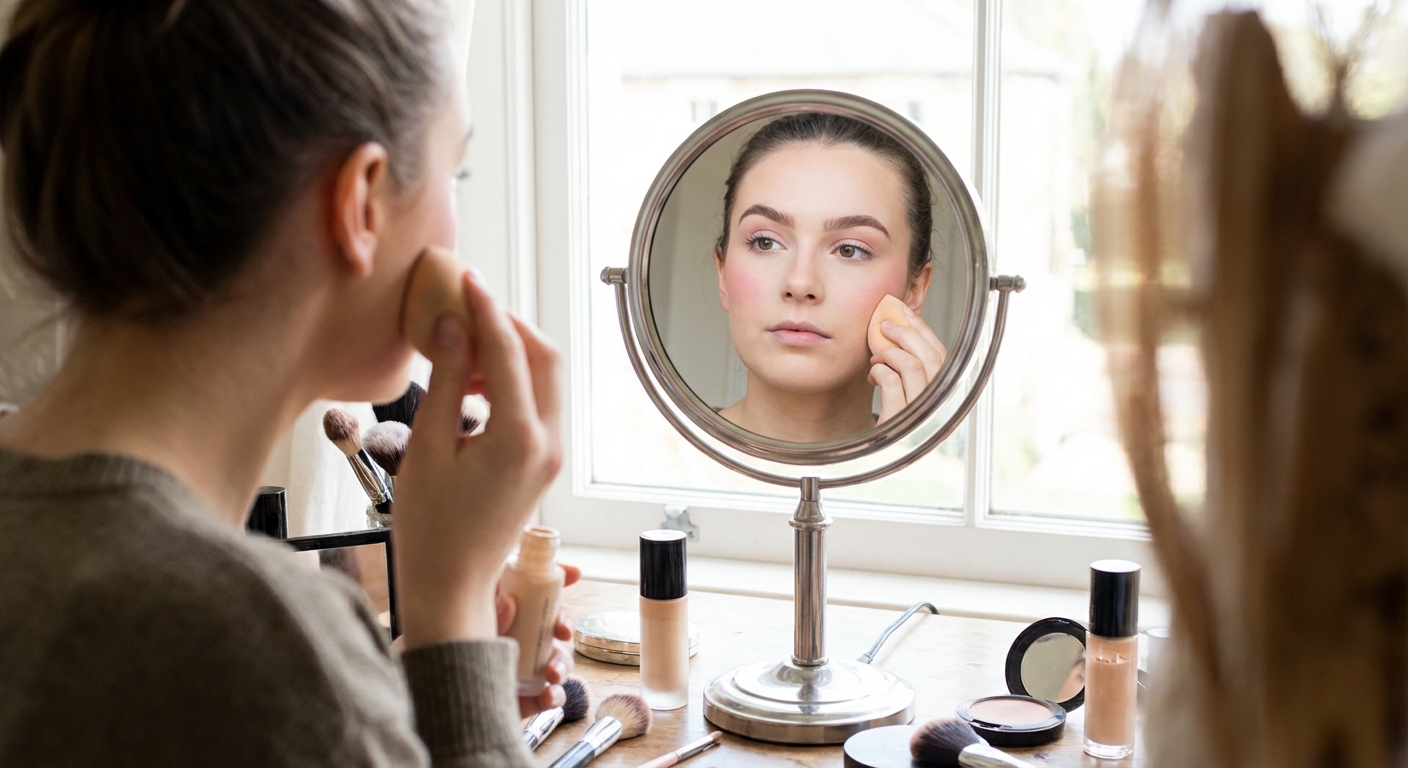
#### My method:
- I dot a light-to-medium coverage foundation or skin tint only where I actually need evening out: sides of nose, center of forehead, around the mouth, a bit on the chin.
- I blend with damp sponge when I want extra sheer, or a dense brush when I want more coverage. I always finish with fingers to melt edges.
I recently discovered that using two coverage levels gives me the most natural result:
- Sheer base: Skin tint all over, very thin layer.
- Pinpoint concealing: Higher-coverage concealer just on discoloration (around nostrils, acne marks, under eyes).
This mimics what a lot of pro makeup artists do backstage. Lisa Eldridge has talked about this approach for years: keep skin looking like skin by only using heavier coverage where absolutely necessary.
Concealer that doesn’t scream “concealer”
When I tested different under-eye techniques for a week (yes, I took photos in brutal office bathroom lighting), the most natural one was surprisingly simple:
- Color correct first if you have blue/purple circles. A peach or salmon corrector neutralizes the darkness so you can use less product on top.
- Use a thin, liquid concealer with a satin finish.
- Apply less than you think: 2–3 tiny dots at the inner corner and a bit toward the outer corner.
- Let it sit 20–30 seconds before blending—this gives more coverage without extra layers.
For blemishes, I switch to a slightly drier, creamier concealer and tap it with a tiny brush, then fingertip. If you blend too wide, it stops looking like skin.
Limitations: If you have very textured acne, no makeup will make it invisible. Even celebrity red-carpet skin has texture—light coverage plus smart concealing will at least make it less noticeable without looking cakey.Step 2: Brows That Frame the Face (Without Looking Stamped On)
I didn’t realize how powerful brows were until I overfilled mine and my friend gently said, “You look… intense.” That was the day I retired the sharpie-brow phase.
For a natural routine, brows are more about structure and direction than opaque color.
Map your real brow first
Before product, I brush my brows up and out with a clean spoolie to see what I’m working with. I follow the classic mapping points a lot of pros use:
- Start: side of nose straight up through inner corner of eye.
- Arch: nose through center of pupil.
- Tail: nose through outer corner of eye.
I’m not drawing new brows—I’m just filling within that natural framework.
Choose the right product for your brow type
Here’s what’s worked best for different brow situations I’ve tested on myself and friends:
- Sparse brows / gaps: A micro-brow pencil with a fine tip. I use hair-like strokes only where needed, especially through the arch and tail.
- Thick but unruly brows: Tinted brow gel or mousse. It deposits a bit of color and holds hairs in place, so you can often skip pencil.
- Barely-there brows (blonde or very fine): I like layering: a tinted brow gel first to “grip” the hairs, then a pencil to sketch in missing areas.
Insider tip I picked up from a brow artist: go one shade lighter than your hair if you have dark hair, and one shade darker if you’re blonde. It almost always looks softer and more natural.
Technique that keeps it soft
- I start at the middle of the brow, not the front. That’s where I want the most definition.
- With feather-light pressure, I draw short strokes in the direction of hair growth.
- I barely touch the front of the brow—just a few strokes and a good brush-through.
Then I lock everything in with a clear or tinted brow gel, brushing hairs up first and then very slightly sideways at the tails. Laminated, super-stiff brows can look cool, but they don’t always read “natural” in person.
Drawback: Brow gels that are too stiff can flake by the end of the day. When I tested a few drugstore versions, I noticed flaking especially when I overloaded the brush—wiping off the excess before application helped a lot.Step 3: Locking in a Long-Lasting but Natural Finish
This is where a lot of “no makeup makeup” looks fall apart: they look fresh for two hours and then disappear or slide off. When I wore this routine to a summer wedding, the setting steps made all the difference in photos after midnight.
Strategic setting powder (not all over)
Instead of dusting powder everywhere, I only set where I actually get shiny or creasy.
My go-to areas:
- Sides of nose
- Center of forehead
- Chin
- Smile lines
- Just under the eyes (lightly)
I use a finely milled, translucent loose powder on a small fluffy brush and press, don’t sweep. Research on light-scattering powders (often with silica or mica) shows they can blur texture without adding much visible coverage.
Pros:- Extends wear time, especially in humid weather
- Reduces transfer onto masks or clothing
- Can emphasize dryness or fine lines if overused
- Some powders cause flashback in photos—worth testing with your phone’s flash before events
Setting spray: the secret “skin fuse” step
When I tested skipping setting spray versus using it, the difference at the 6‑hour mark was massive. The side with spray looked more like skin and less like “makeup sitting on top.”
How I use it:
- Mist from about an arm’s length away in an X and T pattern.
- Let it almost dry, then gently press with clean hands or a damp sponge.
Look for words like “alcohol-free” or “low alcohol” if you have dry or sensitive skin. Some long-wear sprays rely heavily on alcohol, which can feel tight over time. On oilier skin, though, those formulas can be incredibly effective.
The tiny touch-ups that actually help
I carry two things for long days:
- Blotting papers – There’s even a 2018 paper in Skin Research and Technology showing that oil blotting tissues can significantly reduce surface sebum without disrupting makeup much.
- A mini pressed powder with a mirror.
My rule: blot first, then add powder only if needed. Powdering over un-blotted oil is a fast track to cakey.
Honorable Mentions: Little Tweaks That Keep It Natural
A natural-look routine isn’t just about base and brows, but they do a lot of the heavy lifting. I still add a few extras that keep things fresh but subtle.
Cream blush and bronzer
When I swapped powders for creams, my friends kept saying, “Your skin looks good,” not “Nice blush.” That’s always the goal.
- I use a neutral, skin-mimicking blush tone (think the color my cheeks turn when I exercise).
- I tap it on the high points of the cheek, not too close to the nose.
- For bronzer, I place it slightly above the natural hollows of my cheeks and around the perimeter of my forehead.
Cream textures tend to melt into the base and move with your skin. The tradeoff is sometimes slightly shorter wear than long-wear powders, but a light set with translucent powder over just the center of the face usually balances it out.
Soft definition on eyes and lips
Even in a natural routine, a little definition keeps the face from looking flat.
- Eyes: A wash of neutral cream shadow, tightlined brown pencil at the lash line, and one coat of mascara. I curl lashes but avoid heavy volumizing formulas that clump.
- Lips: I like balmy tints or a “my lips but better” nude. I’ll tap the same cream blush onto my lips when I want everything to look cohesive.
When I tested skipping eye and lip definition entirely, my skin looked great—but I looked half-asleep in photos. The tiniest bit of contrast really matters.
What Actually Makes It Look Natural (Not Just Minimal)
After a lot of trial and error, here’s what’s made the biggest difference in how natural my makeup looks and how long it lasts:
- I use sheer layers, not thick ones. Multiple thin applications almost always wear better and move more like real skin.
- I keep texture consistent: mostly creams and liquids together, or mostly powders. Mixing too many textures is where I’ve seen pilling and patchiness.
- I accept that some imperfections will show. When I tried to erase everything, I ended up with a mask. Leaving a bit of freckle or redness makes the whole face more believable.
Natural-look makeup isn’t about owning 50 products; it’s understanding how and where to use a handful of them so they survive real life—commutes, office AC, humidity, photos, and that random afternoon coffee spill.
Once you dial in a base that looks like skin, brows that quietly frame your face, and a finish that actually lasts past lunchtime, the whole “no makeup makeup” thing stops being a trend and just becomes… your face, on its best day.
Sources
- Dermato-Endocrinology – Skin Hydration and Barrier Function - Review of moisturizers, humectants like glycerin, and barrier support.
- Skin Research and Technology – Evaluation of Sebum and Antisebum Products - Discusses methods of reducing surface oil, including blotting.
- Harvard Health Publishing – The Truth About Skin Care - Evidence-based overview of skin-care basics relevant to makeup prep.
- NYTimes – The Right Way to Use Concealer - Expert tips from makeup artists on placement and technique.
- L’Oréal Paris – Makeup Primer Guide - Brand explanation and consumer testing insights on primer benefits.