Roomba 675 Clearance Guide
row.
That’s when I went down the clearance rabbit hole.
If you’re wondering whether the Roomba 675 will actually fit under your couch, glide past your bar stools, or survive that maze of chair legs in the dining room, this guide is exactly what I wish I had when I first set mine loose.
Roomba 675: The Key Clearance Numbers
Let’s start with the stuff that actually matters when you’re sizing things up.
Based on iRobot’s official specs and what I measured myself with a tape measure (yes, I crawled on the floor):
- Height: ~3.54 inches (9.0 cm)
- Diameter: ~13.4 inches (34.0 cm)
- Required space under furniture: Minimum 3.6–3.8 inches of true clearance
- Docking station clearance: About 18 inches of open space in front, a few inches to each side
When I tested this under my sofa that was exactly 3.5 inches from floor to frame, the Roomba 675 tried to wedge itself in like a raccoon going after a garbage can. It technically went in, but it kept scraping and sometimes got stuck on the lip.
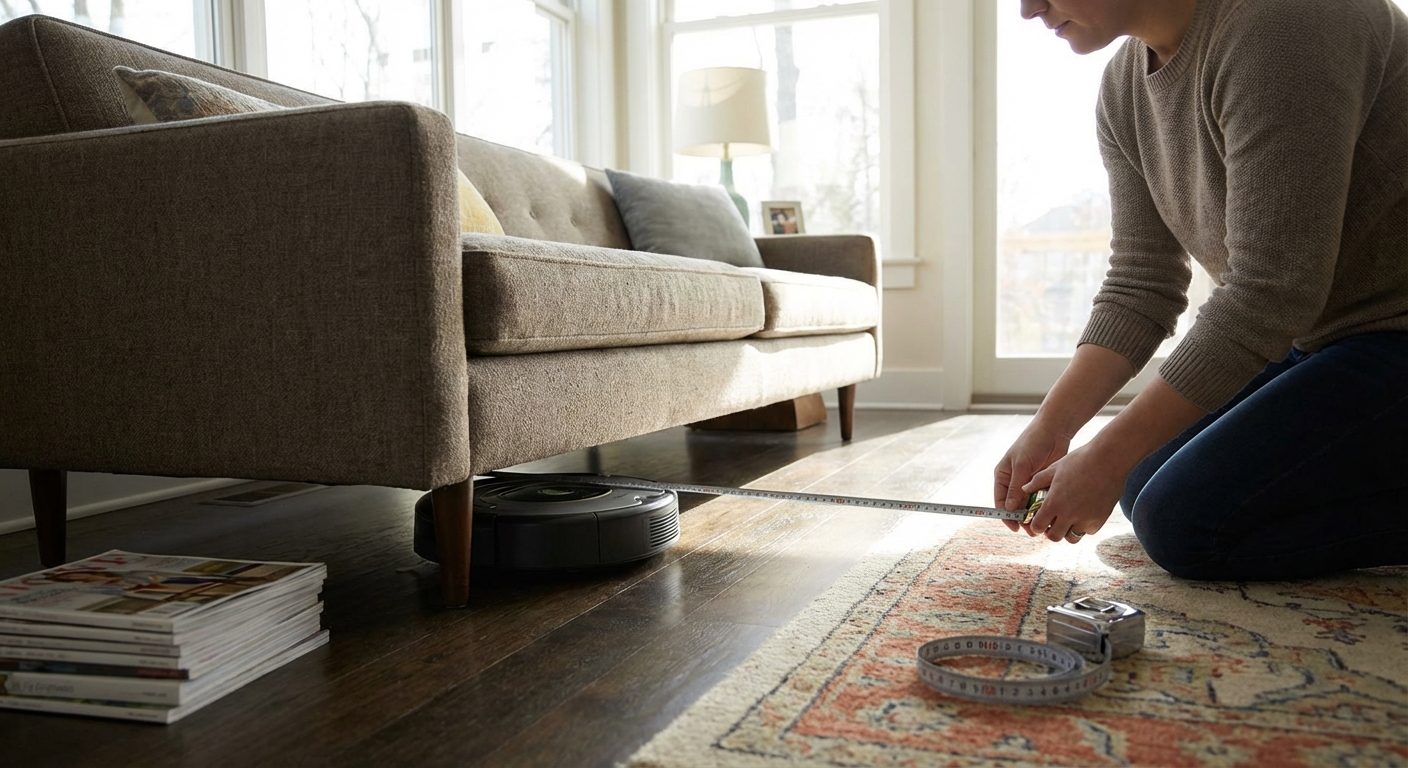
- If clearance is under 3.5 inches – the 675 will not go under.
- Between 3.5 and 3.75 inches – it might go under, but expect bumping, scraping, and possible stuck moments.
- 4 inches and up – you’re in the safe, happy vacuum zone.
How To Measure Your Home For Roomba 675 Clearance
When I first set mine up, I made the classic mistake of eyeballing everything. Spoiler: the Roomba won.
Here’s the method that actually worked for me.
1. Check Furniture Height (The “Can It Go Under?” Test)
Grab a tape measure and check:
- Couches and sofas – measure from floor to the lowest solid part (not the fabric skirt). My mid‑century couch was 4.25 inches: perfect. My bulky recliner at 3.3 inches? Roomba no‑go.
- Beds – platform beds are often too low. My guest bed had 3.6 inches of clearance; the 675 could squeeze in, but I eventually blocked the sides because it kept getting wedged on the support beam.
- TV stands & media consoles – these are sneaky; they often have uneven bottoms where the front looks high enough but the back rail is lower.
If anything is borderline, I literally slide a hardback book under it. If the book that’s around 3.5 inches thick gets stuck, the Roomba 675 will too.
2. Mind the “Overhang Trap”
Something I didn’t expect: my coffee table had a wooden apron that hung down lower than the edge. From the side it looked high enough, but the robot kept hitting the apron and backing off.
So don’t just measure the leg height. Measure the lowest point across the whole underside, including center supports and aprons.
3. Plan The Docking Area
iRobot recommends giving the dock:
- About 1.5 feet (0.5 m) of open space directly in front
- At least a few inches on each side
When I pushed the dock into a tight corner between a shoe rack and a plant stand, the 675 kept doing a 6‑point turn just to line up. Once I moved it to a bare wall with about 2 feet of open space, docking became nearly flawless.
Real‑World Clearance Challenges (And Fixes)
Here’s what I’ve personally fought with while living with the Roomba 675 in a small apartment—and how I solved each one.
Dining Chairs: The Roomba Obstacle Course
My dining area is basically a chair forest. The 675 would half‑clean, get trapped between chair legs, and then ping‑pong like a confused turtle.
What worked for me:- On deep‑clean days, I flip the chairs onto the table. It’s old‑school, but the room ends up dramatically cleaner.
- On regular days, I push chairs in fully and align them so the legs form a clear path instead of random angles.
The clearance under the chairs wasn’t the problem; it was the tight geometry. The 13.4‑inch diameter means if the gaps between chair legs are less than about 14 inches, the Roomba’s going to struggle.
Low Sofas & Recliners
My recliner is low and bulky. The Roomba 675 kept forcing its way just far enough in to get stuck.
What I tried:- Furniture risers: I added 2‑inch risers to the recliner. That bumped the clearance from 3.3" to about 5.3". After that, the 675 sailed under it and actually cleaned the dust bunnies I’d been ignoring for years.
- Virtual barriers: For furniture I didn’t want to raise, I used physical barriers (a storage bin, honestly) to keep the Roomba from even trying.
Area Rugs & Thresholds
While this guide’s about clearance, vertical transitions matter too. When I tested mine on a medium‑pile rug with a thick border, the 675 would sometimes high‑center.
In my experience, the Roomba 675 comfortably handles transitions of around 0.6 inches (1.6 cm). Thicker rug edges or metal thresholds can be hit or miss.
Pros & Cons Of The Roomba 675 From A Clearance Perspective
I’ve used a few robot vacuums, and the 675 sits in that sweet spot of “not ultra‑slim, not chunky.” Here’s how it shakes out purely from a clearance standpoint.
What It Does Well
- Low enough for many modern sofas and beds – My mid‑century style pieces with 4–5 inches of clearance are basically Roomba playgrounds.
- Round shape helps in tight corners – It can angle itself around table legs and plant stands better than I expected.
- Smaller footprint dock – I’ve had bulkier docks before; the 675’s is relatively compact as long as you give it front clearance.
Where It Struggles
- Very low furniture – Anything below 3.5 inches clearance might as well be solid floor from the 675’s perspective.
- Cluttered rooms – Lots of small obstacles (toys, low shelves, stacked boxes) reduce its effective cleaning area more than you’d think.
- Edge‑case clearances – Those 3.5–3.7 inch gaps are the worst: just enough to tease the Roomba, not enough to clean reliably.
If you have a lot of ultra‑low, heavy furniture you can’t move or raise, a slightly thinner model (like some of the newer, sub‑3.4" robots) might be a better fit. But in most average homes and apartments I’ve seen, the 675’s height is workable with some minor layout tweaks.
Simple Tweaks To Maximize Your Roomba 675’s Reach
Over a few months living with mine, these small changes made a surprisingly big difference.
1. “Zone Your Floor” Before A Run
I do a quick 2‑minute sweep:
- Lift up loose cables and chargers
- Move small bins or baskets that create mini‑dead‑ends
- Straighten bar stools so the legs line up cleanly
It feels fussy, but the 675 spends way less time bumping into nonsense and more time actually cleaning.
2. Raise What You Can
Risers aren’t glamorous, but they work. I’ve used 2‑inch wood blocks under a low bed frame in the past, and it instantly turned a no‑go zone into a fully cleanable space.
If you’re buying new furniture and plan to live with a robot vacuum long‑term, I’d honestly add “at least 4 inches of clearance” to your checklist.
3. Give The Dock The Best Wall In The House
I tried three locations before settling. The spot that worked best:
- Flat wall, no corners
- No shoes, plants, or baskets nearby
- Wi‑Fi signal strong enough for the app
Once I did this, the 675 almost never failed to return to base unless the battery was already nearly empty.
When The Roomba 675 Might Not Be The Right Fit
As much as I like mine, I wouldn’t recommend it for every layout.
It may not be ideal if:
- Your home is full of heavy, low, non‑movable furniture (3.25"–3.5" clearance everywhere)
- You have very thick rugs with high transitions between rooms
- You’re not willing to move or raise anything but still expect the robot to clean every square inch
The Roomba 675 is a workhorse, but it’s still a blunt instrument compared to the newer models with mapping and no‑go zones. If your space is particularly tricky, it can still work — you’ll just need to be more intentional about layout and clearance.
Final Take: Is The Roomba 675 Clearance‑Friendly Enough?
When I tested the Roomba 675 in my own apartment, it ended up cleaning roughly 75–80% of my total floor area on a normal run, without me doing anything special.
With a few tweaks — raising one recliner, moving the dock, and flipping chairs on deep‑clean days — I got that closer to 90%. The remaining 10% lives under a couple of ultra‑low cabinets and a bed frame I refuse to mess with.
From my experience, if most of your furniture has at least 4 inches of clearance, and you’re willing to slightly declutter floors and give the dock a good home, the Roomba 675 handles clearance surprisingly well for its price and age.
If you’re on the fence, I’d literally grab a tape measure and walk around your space. Measure the couch. Measure the bed. Measure that suspiciously low TV stand that’s hiding dust from 2017. Once you see those numbers, the decision about whether the 675 is the right match for your home’s clearance becomes a lot clearer.
Sources
- iRobot Roomba 675 Product Specifications – iRobot Official Site - Official dimensions and product details
- Consumer Reports: How to Choose a Robotic Vacuum - Independent testing and buying advice on robot vacuums
- Wirecutter (NYTimes): The Best Robot Vacuums - Expert reviews and performance comparisons, including clearance considerations
- U.S. Department of Energy – Household Vacuum Cleaners - Background on vacuum performance and efficiency