Store Brands vs Name Brands: How to Compare Quality and Ingredients on a Budget
ticed.
Not the foodie friend who swirls olive oil like it’s wine. Not the label-snob cousin who claims she can “always tell” when something’s generic.
I only told them after dessert. Reactions ranged from shocked to mildly betrayed. And that night pretty much locked in my obsession: how do you actually compare store brands vs name brands without wrecking your budget or sacrificing quality?
Here’s what I’ve learned from a lot of receipt-analyzing, ingredient label stalking, and a few taste tests that went very wrong (looking at you, off-brand ranch dressing from 2022).
Why store brands are secretly getting really good
When I was a kid, store brands were the sad, white-label cans that screamed “we’re saving money.” Now? You’ve got:
- Target’s Good & Gather
- Costco’s Kirkland Signature
- Walmart’s Great Value
- Aldi’s Simply Nature & Specially Selected
These brands are intentionally designed to compete with the big names on quality, not just price. And here’s the fun part: in many cases, they’re made in the same facilities as name brands.
I first picked this up while reading an interview with a former private label product developer who mentioned that manufacturers often run name-brand products during one shift and store-brand products during another on the same equipment. The formulations can be slightly different, but the production standards are usually similar.
Retailers have a huge incentive to make their own brands good: they make better margins when you buy store brand instead of national brands. So they invest in:
- Sensory testing panels (yes, people literally get paid to taste cereal and compare crunchiness)
- Consumer testing groups
- Reformulating based on complaints and reviews
That’s why some store brands quietly become cult favorites (hello, Kirkland vanilla ice cream).
How I actually compare products in the aisle (or app)
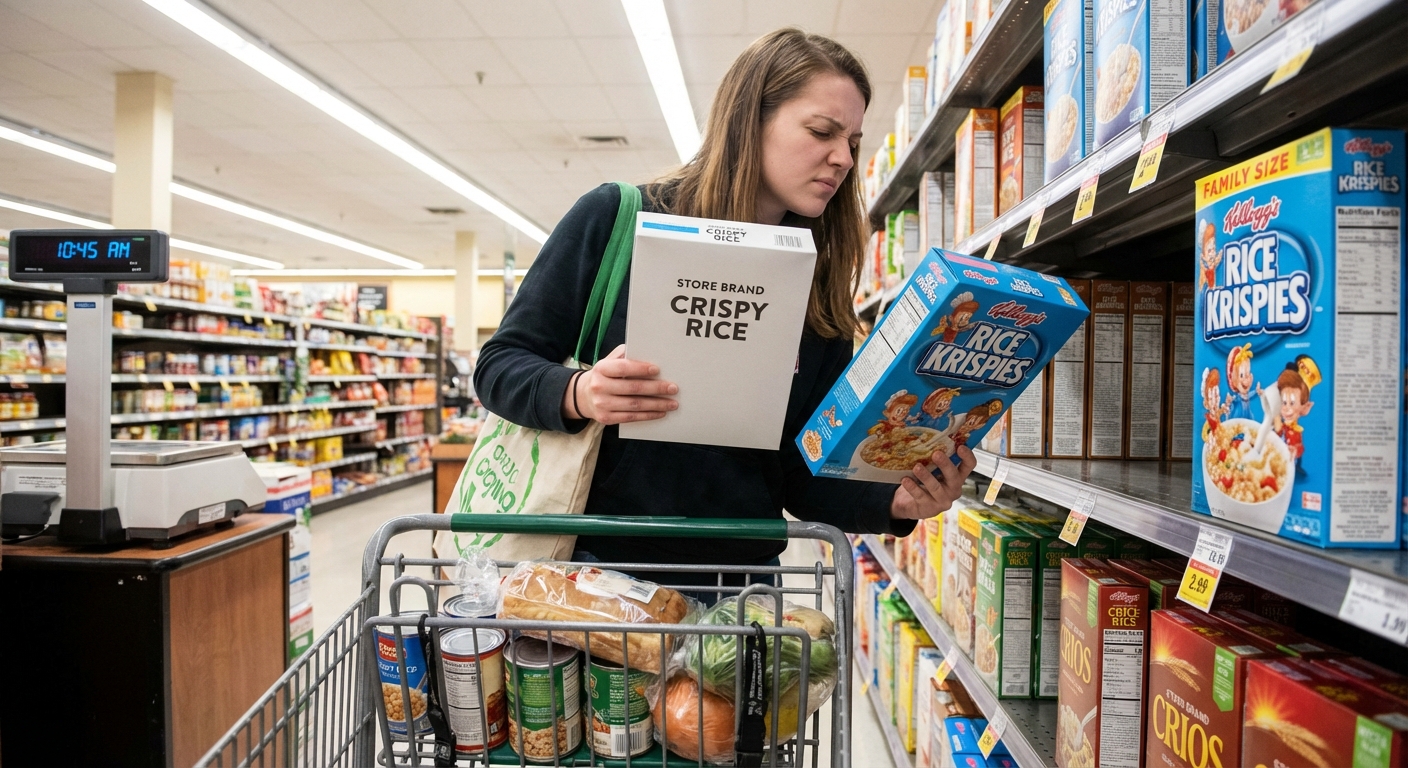
I used to just look at price and vibes. Now I have a simple system I use every time I’m debating, say, Heinz vs store-brand ketchup.
1. Start with the ingredient list, not the front label
Front label: marketing. Back label: reality.
When I tested this with peanut butter, here’s what I found:
- Name brand: Peanuts, sugar, hydrogenated vegetable oils, salt
- Store brand (natural line): Peanuts, salt
Same price per ounce, but totally different product philosophies. The one-ingredient-plus-salt version tastes more like actual peanuts and has no added sugar or hydrogenated oils.
What I look for:- Order of ingredients. Ingredients are listed by weight. If “sugar” is second on a pasta sauce, I put it back.
- Unnecessary fillers. Extra thickeners, artificial colors, or flavor enhancers in simple foods (like yogurt or cream cheese) are a red flag for me, but may not bother you.
- Oil types. For things like mayo or salad dressing, I check if it’s soybean oil, canola oil, or a blend. Sometimes the store brand quietly uses the same oils at a lower price.
2. Compare nutrition labels side-by-side
When I did a side-by-side on boxed mac and cheese (strictly for “research”), this jumped out:
- Store brand: Slightly less sodium, similar protein, same calories
- Name brand: A bit higher in sodium, but more consistent texture and stronger flavor
The numbers were close enough that I realized I was mostly paying for brand familiarity, not better nutrition.
Quick things I scan:- Sodium: especially in soups, sauces, frozen meals
- Added sugars: in cereals, yogurt, granola bars, pasta sauce
- Fiber: in bread, pasta, tortillas
- Protein: in yogurt, snacks, plant-based products
I don’t obsess over every digit, but if there’s a big gap (like double the sodium or sugar), I pause.
3. Check unit price like a hawk
I used to get tricked by sale tags constantly. “2 for $5” sounds like a steal until you realize the store brand is $1.79 regular price.
On the shelf tag, I look for the unit price (price per ounce, pound, or liter). That’s the only fair comparison.
When I tested this on canned tomatoes:
- Name brand on sale: $1.49 per can → $0.08/oz
- Store brand: $1.29 per can → $0.07/oz
Not huge on a single can, but over a year of buying multiples every month? It adds up to real money.
Short version: always compare unit prices, not just total price or sale tags.
When store brands absolutely win (from my cart history)
These are the categories where, after a lot of testing, I default to store brands most of the time:
1. Pantry basics
- Canned beans, tomatoes, corn – Once I rinsed and cooked them, I genuinely couldn’t tell the difference in dishes like chili or soup.
- Sugar, flour, salt, baking soda – Commodity products. As long as they meet standards, they’re usually functionally identical.
- Pasta – The mid-tier store-brand pasta often tastes the same once sauced. Some high-end Italian name brands are worth it for texture, but not for a basic weeknight pasta.
2. Dairy (with some exceptions)
- Milk & heavy cream – As long as pasteurization and fat percentage match, milk is milk. I do check for ultra-pasteurized vs regular for whipping cream because that affects performance.
- Shredded cheese – Store brands can be great, though anti-caking additives vary. For melting, I often prefer store brand blocks I shred myself.
3. Over-the-counter meds
This one changed my entire pharmacy strategy.
By U.S. law, the active ingredient, dosage, and route of administration in generic OTC meds must match the name-brand version to be considered equivalent. I checked the Drug Facts panel and found:
- Store-brand ibuprofen: 200 mg ibuprofen
- Advil: 200 mg ibuprofen
Same dosage, same active ingredient, big price difference.
I still check expiration dates and packaging integrity, but for basics like ibuprofen, acetaminophen, allergy tablets, I now go store brand almost every time.
When name brands really might be worth the extra money
I’m not anti-name-brand. There are some categories where I regularly stick with the big guys.
1. Highly processed products with signature flavor
Things like:
- Certain sodas
- Some chips and snacks
- Iconic condiments (think Sriracha, specific hot sauces, or that one ketchup your family insists on)
When I blind-tested store-brand cola vs Coca-Cola with friends, everyone picked the name brand. The flavor profile and carbonation were just better calibrated.
2. Specialty or performance-driven items
- Gluten-free baking mixes – In my experience, name brands often invest more in R&D for texture and stability.
- Plant-based milks and cheeses – Formulation matters a lot here. Some store brands nail it; others taste… like regret.
- Skincare with active ingredients – I’ll sometimes pay more when a brand has published clinical data or better-stabilized formulas (vitamin C, retinoids, etc.).
3. Products where consistency really matters to you
If your kid will only eat one specific brand of chicken nugget and that’s the hill they’ve chosen to die on, you’re balancing sanity vs budget.
For me, there’s a specific name-brand coffee I buy because every time I try a cheaper substitute, I hate my morning.
Sneaky ways labels try to fool you (and how I deal with them)
When I started really reading packaging, I noticed a few patterns that annoyed me.
“Natural”, “artisan”, “crafted”
These words are marketing, not regulated definitions (with very rare exceptions). I’ve seen:
- “Artisan bread” with the same ingredient list as the plain sandwich loaf
- “Natural” granola bars with just as much added sugar as the regular ones
Now I basically treat front labels like Tinder bios: a light suggestion, not the full story.
Health halos
Ever fallen for:
- “Gluten-free” on products that never had gluten (like potato chips)?
- “High protein” on cereal that gets most of that protein from added isolates rather than whole ingredients?
When I tested my own shopping habits, I realized I was more likely to toss these in the cart without checking price or sugar. Now I force myself to flip it over and actually look at:
- Grams of added sugar
- Fiber content
- Sodium
The health halo fades pretty fast once you see it’s basically candy in a gym outfit.
How to test without wasting money
If you’re curious but nervous about committing to a full store-brand lifestyle, here’s what worked for me.
1. The “one swap per trip” rule
Every grocery run, I pick one item to test as a store-brand replacement. Just one.
Week 1: Cereal
Week 2: Canned tomatoes
Week 3: Greek yogurt
I keep a simple note on my phone: Worth it / Not worth it. After a month, I had a personal list of go-to store brands and non-negotiable name brands.
2. Run your own tiny taste tests
I once poured store-brand and name-brand orange juice into identical glasses at brunch and asked everyone to pick favorites. Results:
- 3 people preferred store brand
- 2 preferred name brand
- 1 couldn’t tell the difference
Not exactly a peer-reviewed study, but enough to make me switch for good.
3. Use return policies
A lot of big retailers quietly offer satisfaction guarantees on store brands. Costco, Aldi, Trader Joe’s, Target – they generally let you return store-brand items if you truly hate them.
I used this once for a store-brand hummus that tasted like lemon-scented glue. They refunded me, no drama.
How I balance budget vs quality without losing my mind
My current grocery strategy is basically a three-bucket system:
- Always store brand – basics, canned goods, OTC meds, many dairy items.
- Usually store brand, but I compare – snacks, condiments, frozen foods, cleaning products.
- Mostly name brand – specialty items, specific coffees/teas, a few sauces and snacks where the exact flavor matters.
I don’t aim for perfection; I aim for progress that shows up in my bank account.
After a few months of consciously swapping, my grocery spend dropped by around 12–18% on average without feeling like I downgraded my lifestyle. The wild part? In some categories, I actually feel like I upgraded – especially where store brands had simpler, cleaner ingredient lists.
If you take nothing else from my rambling shopping experiments, try this: next time you’re in the aisle debating two products, ignore the logos for 10 seconds and compare ingredients, nutrition, and unit price first. Decide based on that, not the brand.
Your future self (and your grocery budget) will thank you.
Sources
- FDA – Overview of Food Ingredients, Additives & Colors - How ingredients and additives are regulated in the U.S.
- Harvard T.H. Chan School of Public Health – Reading Food Labels - Guide to understanding nutrition facts and ingredient lists.
- Consumer Reports – Store Brands vs. Name Brands - Testing and analysis comparing private label and national brands.
- FDA – Generic Drugs: Questions & Answers - Explains equivalence requirements for generic medications.
- NYTimes – Why the Store Brand Is Looking Better Than Ever - Reporting on the rise and improvement of store-brand products.