Vintage Christmas Ornaments That May Hold High Value
glass Santa with hand‑painted boots and a clip-on bird that looked like it belonged in a museum. Out of curiosity, I looked them up on my phone.
That little glass Santa? Recently sold for over $150 on eBay.
That was the moment I realized a lot of us might be hanging four‑figure collectibles on our trees without having the slightest clue.
In this guide, I’ll walk you through the types of vintage Christmas ornaments that may hold high value, how to tell genuine from junk, and the mistakes I made when I first started testing the resale market.
Why Some Old Ornaments Are Worth Serious Money
When I first dug into this, I assumed value was all about age. If it’s old, it’s gold, right? Not exactly.
From what I’ve seen (and what appraisers and auction data back up), value usually comes from a mix of:
- Rarity – Limited runs, discontinued lines, regional releases.
- Condition – Chips, paint loss, broken clips… they all matter.
- Maker – Brands like Shiny Brite, Christopher Radko, and early German glass makers have built-in demand.
- Desirability – Certain shapes and themes (space age, atomic, figural Santas) just attract more collectors.
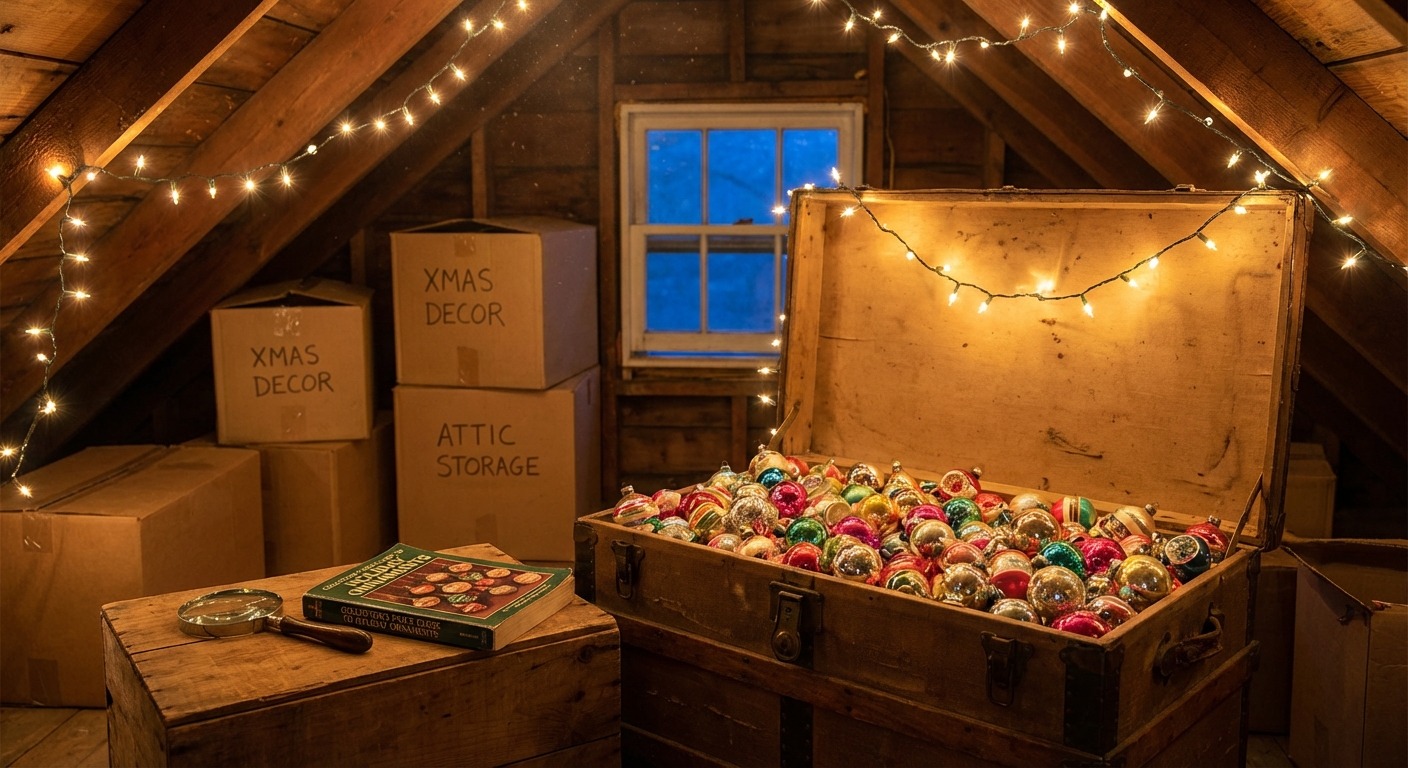
The trick is learning how to spot these features fast when you’re digging through yard-sale bins or your grandma’s attic.
1. Early German Glass Ornaments (Pre‑WWII)
The first time I realized just how intense this niche is, I was at a flea market and found a box labeled “Old glass, $5 each.” One ornament had a metal clip and a bird with a spun‑glass tail. Something about it felt different, so I bought it.
Later I learned it matched pre‑war German bird ornaments, and similar pieces were auctioning for $80–$200 depending on condition.
What to look for
- Country marks like “Germany” or “West Germany” stamped on the metal cap.
- Thin, delicate glass with hand‑painted details (often a little imperfect).
- Unusual shapes – grapes, fish, pinecones, Santas, birds with clip-on feet.
- Spun glass tails on birds rather than plastic.
Pre‑WWII German ornaments were often made in regions like Thuringia, and a lot were exported to the U.S. starting in the late 19th century. Some of the really early ones can cross into the several-hundred-dollar range per piece when mint and rare.
Pros and cons
- Pros: High potential value, especially rare shapes; strong collector demand.
- Cons: Extremely fragile; fakes and modern reproductions exist; condition issues can slash value.
When I tested reselling a small lot of German ornaments, the best prices came when I listed them individually with close-up photos of caps and paint—group lots tended to go cheaper per piece.
2. Shiny Brite: The “Everyday” Ornaments That Aren’t So Everyday
If you grew up in the U.S., there’s a decent chance your family had Shiny Brite ornaments without even realizing it.
Shiny Brite was the American mass-market Christmas ornament brand from the 1940s through the 1960s, founded by Max Eckardt. They were sold at Woolworth’s and other department stores, and for a while they were as common as tinsel.
How to identify Shiny Brite
In my experience, the box is half the value. Look for:
- Original cardboard boxes marked “Shiny Brite” with graphics (Santa, ornaments, etc.).
- Caps sometimes embossed with “Shiny Brite” or just simple metal caps on early examples.
- Classic styles: striped indents, stenciled designs, mica “snow” coating.
When I tested selling Shiny Brites, I noticed:
- Plain round balls in okay condition: maybe $10–$20 for a small lot.
- Indented, stenciled, or rare color schemes in good condition with box: often $40–$100+ for sets.
Watch out for
Modern reproductions exist (including licensed reissues). The reissues are fun to decorate with, but they’re usually not worth much. The older glass feels lighter and the printing and boxes have a more aged look (yellowing, older fonts, period graphics).
3. Vintage Hallmark Keepsake Ornaments
Here’s where things get surprisingly wild.
Hallmark launched its Keepsake ornament line in 1973, and some of those little plastic or resin figures you thought were “too new to matter” are now hitting triple-digit prices.
I tested this personally with a box of ‘80s and ‘90s Hallmark ornaments I rescued from my in-laws’ donation pile. I almost tossed a tiny 1984 computer-themed ornament in the “sell for $5” pile, then looked it up. Recent sold listings: $70–$100 in box.
What tends to be valuable
- First in series (e.g., early Frosty Friends, Lionel Trains, Classic Cars).
- Pop culture tie-ins: Star Trek, Star Wars, Disney, Peanuts.
- Tech nostalgia: Old computers, video games, phones.
- Limited editions sold only at conventions or special events.
Condition is huge here. A pristine box with original price tag can literally double the price compared to an ornament alone.
Pros and cons
- Pros: Strong, organized collector base; easy to research by year and name; Hallmark archives info on many ornaments.
- Cons: Market can be volatile; tons of supply for common years; heavy box wear hurts value.
If you’re unsure, Hallmark ornaments are one area where I almost always search the exact name and year before I donate or toss anything.
4. Mid‑Century Modern & Atomic‑Era Ornaments
When I started hunting specifically for resale, mid‑century pieces were the first to consistently flip fast.
Think:
- Sputnik and atomic shapes
- Tear‑drop and finial tree toppers
- Bold colors: turquoise, hot pink, chartreuse
Brands like Coby, Poland glass, and various unmarked imports from the ‘50s and ‘60s can be very desirable for people curating that Mad Men, aluminum-tree aesthetic.
One of my best flips was a set of elongated, striped Polish glass ornaments I found for $8 at a church sale. They were in rough but displayable shape and still went for around $90 as a lot.
What buyers want
- Cohesive color palettes (all pastels, all jewel tones, etc.).
- Original boxes labeled “Poland” or older U.S. brands.
- Dramatic shapes: big indents, long finials, unusual silhouettes.
These may not always hit the crazy prices of rare German figurals, but as sets, they can add up quickly.
5. Handcrafted & Studio Ornaments
Not every valuable ornament is mass-produced.
Over the past few years, I’ve watched interest grow in:
- Blown-glass studio ornaments signed by the artist.
- Early Christopher Radko hand‑painted glass (1980s–1990s), especially retired designs.
- Regional glass studios and limited editions from museum shops.
One time I picked up a weirdly elegant, heavy glass ball at a thrift store for $3. It had a subtle etched signature along the top rim. After some research, I traced it back to a small U.S. glass studio and sold it for $65 to a collector looking for that exact artist.
These take more research, but they’re often hiding in plain sight.
How to Tell If Your Ornament Might Be Valuable
When I’m sorting through a box, I use a quick mental checklist:
- Is it glass, metal, or early plastic? Modern shatterproof ornaments are usually low value.
- Any markings on the cap or box? Look for country of origin, brand names, or dates.
- Is the design unusually detailed or odd? Strange or highly detailed usually beats generic.
- Does it look hand‑painted or hand‑crafted? Brush strokes, uneven mica, signature marks.
- What’s the condition? Chips, cracks, peeling paint, missing tails—note everything.
Then I’ll do a quick search on eBay or other marketplaces using descriptive keywords like:
> “indented glass ornament Poland vintage” or “Hallmark Keepsake 1984 computer ornament.”
Checking the sold listings (not just asking prices) is where reality lives.
The Risks, Pitfalls, and My Own Mistakes
To keep this honest: not every “vintage” ornament is a hidden jackpot.
Some things I’ve learned the hard way:
- I once bought a “vintage German” lot that turned out to be mostly modern reproductions. The glass was thicker and the paint too crisp. I basically broke even.
- I overpaid for a huge box of ‘90s Hallmark ornaments thinking they all did well. Most of them were worth $3–$5 each; only a couple cracked $30.
- I underestimated shipping and packing costs. Fragile ornaments require serious packaging (double boxing, plenty of padding), and if you skip that, you’ll get breakages and angry buyers.
There’s also a nostalgia bias: pieces that look meaningful to you aren’t always valuable to the broader market.
How to Store and Protect Potentially Valuable Ornaments
When I realized some of my family’s ornaments were actually collectible, I immediately changed how I stored them.
What’s worked best for me:
- Acid-free tissue paper instead of newspaper (ink can rub off).
- Individual compartments in sturdy bins, especially for indents and finials.
- Cool, dry storage – avoid attics that swing from freezing to sweltering.
- Keep original boxes whenever possible; they add both value and protection.
Is it overkill? Maybe. But when you’re hanging something that could pay for a weekend getaway, a little bubble wrap feels worth it.
When To Get a Professional Opinion
If you stumble on:
- Extremely early-looking glass
- Very unusual figural designs (devils, circus figures, elaborate Santas)
- Ornaments with provenance (e.g., old department store labels, famous designers, or museum shop tags)
…it can be worth getting an expert opinion.
Antique appraisers, specialized Christmas-collectible dealers, and even some auction houses offer low-cost or sometimes free initial evaluations based on photos. When I sent photos of that first bird clip-on to a specialist dealer, their feedback confirmed my own research and helped me price it realistically.
Final Thoughts Before You Raid the Attic
The attic raid is honestly half the fun.
In my experience, the real payoff isn’t just the money; it’s the stories. That glass Santa I found in my parents’ box? Turns out my grandfather bought the set at Woolworth’s in the 1950s for less than a dollar. I could sell it for over a hundred… but I won’t.
Here’s how I’d approach your own stash:
- Sort out anything glass, unusual, or clearly branded (Shiny Brite, Hallmark, Radko, “Made in Germany/Poland,” etc.).
- Look up a handful of promising pieces using specific keywords.
- Separate “decorators” from “potential collectibles,” and treat the latter more gently.
You might not find a five‑figure rarity—but it’s very realistic to uncover a few ornaments worth $20, $50, or even $200 each.
Just maybe don’t tell your relatives what they could get for that weird old bird if they’ve been letting toddlers play with it.
Sources
- Hallmark Corporate – History of Hallmark Keepsake Ornaments - Background on the Keepsake line, launched in 1973
- The New York Times – ‘Collectors Deck the Halls With Vintage Ornaments’ - Overview of the vintage ornament collecting market
- Smithsonian Magazine – The History of the Christmas Ornament - Historical context on glass ornaments and early German production
- Library of Congress – America’s Story: Christmas Traditions in the United States - Background on Christmas traditions and decorations in the U.S.