4x4 Truck Features Explained: Drivetrain, Towing, and Off Road Modes
nodded like I totally knew what I was doing… then spent five minutes staring at a knob with icons of a mountain, a trailer, and a little truck climbing a hill.
If you’ve ever felt that same what-do-all-these-buttons-do panic, you’re in the right place.
I’ve spent years test-driving pickups, talking with engineers at media events, and towing everything from compact campers to car haulers. Let me walk you through how 4x4 truck features really work — drivetrain, towing tech, and those mysterious off-road modes — in plain, real-world language.
Understanding 4x4 Drivetrains (Without Needing an Engineering Degree)
When I first got serious about trucks, I realized most people toss around "4x4" and "AWD" like they’re the same thing. They’re not.
4x4 vs AWD vs 4x2
In my experience, this is the cleanest way to think about it:
- 4x2 (RWD) – Power only goes to the rear wheels. Classic work-truck setup. Great for fuel economy and towing on dry pavement, not so great on ice or mud unless you have weight in the bed.
- AWD (All-Wheel Drive) – Usually always on, computer-controlled, more common in crossovers and some light-duty trucks. Awesome for changing road conditions, less focused on hardcore off‑road.
- 4x4 (Part-Time or Full-Time 4WD) – What most pickups with a transfer case use. You can switch between 2‑High, 4‑High, and 4‑Low, and sometimes an Auto mode.
When I tested a 2024 Ram 1500 with the part-time 4x4 system, the drive selector had four main positions:
- 2H (Two-Wheel Drive High) – Rear-wheel drive, best for dry pavement and fuel economy
- 4H (Four-Wheel Drive High) – Sends power to both axles for snow, gravel, or light off-road
- 4L (Four-Wheel Drive Low) – Uses the transfer case to multiply torque at low speed; this is your “crawl out of a muddy ditch” mode
- Auto (if equipped) – Truck decides when to send power to the front axle, handy for mixed conditions
The Transfer Case: The Hidden Hero
The transfer case is that chunk of metal bolted behind the transmission that splits power to front and rear axles.
When I toured Ford’s proving grounds a couple of years ago, one engineer explained it beautifully:
> “Think of the transfer case as the DJ: the engine sends the music, and the transfer case decides how loud each speaker (front and rear axle) plays.”
In practical terms:
- 4H: Same gear ratios as normal driving, but power goes to all four wheels
- 4L: Different internal gearset that reduces speed and increases torque—perfect for rock crawling, deep sand, or pulling a boat up a slippery ramp
Towing Tech: More Than Just a Big Number on a Brochure
A lot of people fixate on the big towing number the salesperson circles: “13,500 lbs!” But when I towed a 6,000 lb enclosed trailer behind a half-ton truck rated for 12,000 lbs, I learned quickly: it’s not just about the max.
Key Towing Specs You Actually Need to Know
Here’s what I always check now, straight off the door sticker or the manufacturer’s towing guide:
- GVWR (Gross Vehicle Weight Rating) – Max weight of the truck itself + passengers + cargo
- GCWR (Gross Combined Weight Rating) – Max weight of truck + trailer together
- Payload – How much weight you can put in the truck (people, gear, tongue weight)
- Tongue Weight – The load pressing down on the hitch, usually 10–15% of trailer weight for conventional towing
The day I loaded four adults, a bed full of camping gear, and a 5,000 lb travel trailer, I realized I was close to my payload limit even though I was way under the towing capacity. That’s the catch nobody tells you at the dealership.
Trailer Modes, Tow/Haul, and Engine Braking
Modern 4x4 trucks wrap a ton of smart tech behind simple buttons.
When I tested a Silverado 1500 with a 6.2L V8 on a long downhill grade, I tapped Tow/Haul mode and instantly felt the shift strategy change:
- The transmission held lower gears longer
- The engine revved higher but the truck stayed more controlled
- Downshifts came earlier when I lightly braked — that’s engine braking helping out
Tow/Haul mode typically:
- Reduces constant hunting between gears
- Improves throttle response under load
- Uses downshifts to slow the truck, saving your brakes
Some trucks (like newer F-150s and Silverados) even have trailer profiles, where you can save info for your boat trailer, camper, or utility trailer and get:
- Trailer backup assist (steer with a knob, not opposite-wheel brain gymnastics)
- Trailer sway control
- Trailer brake gain presets
Downside? All this tech can make you feel safer than you actually are. I’ve seen drivers happily towing at 80 mph just because the truck “felt solid.” Physics still wins. Leave margin under your ratings and slow down.
Off Road Modes: What Those Little Icons Actually Do
Off-road drive modes used to be a luxury truck thing. Now, I see them in mid-trim pickups and even some base 4x4s. And they’re not just marketing fluff.
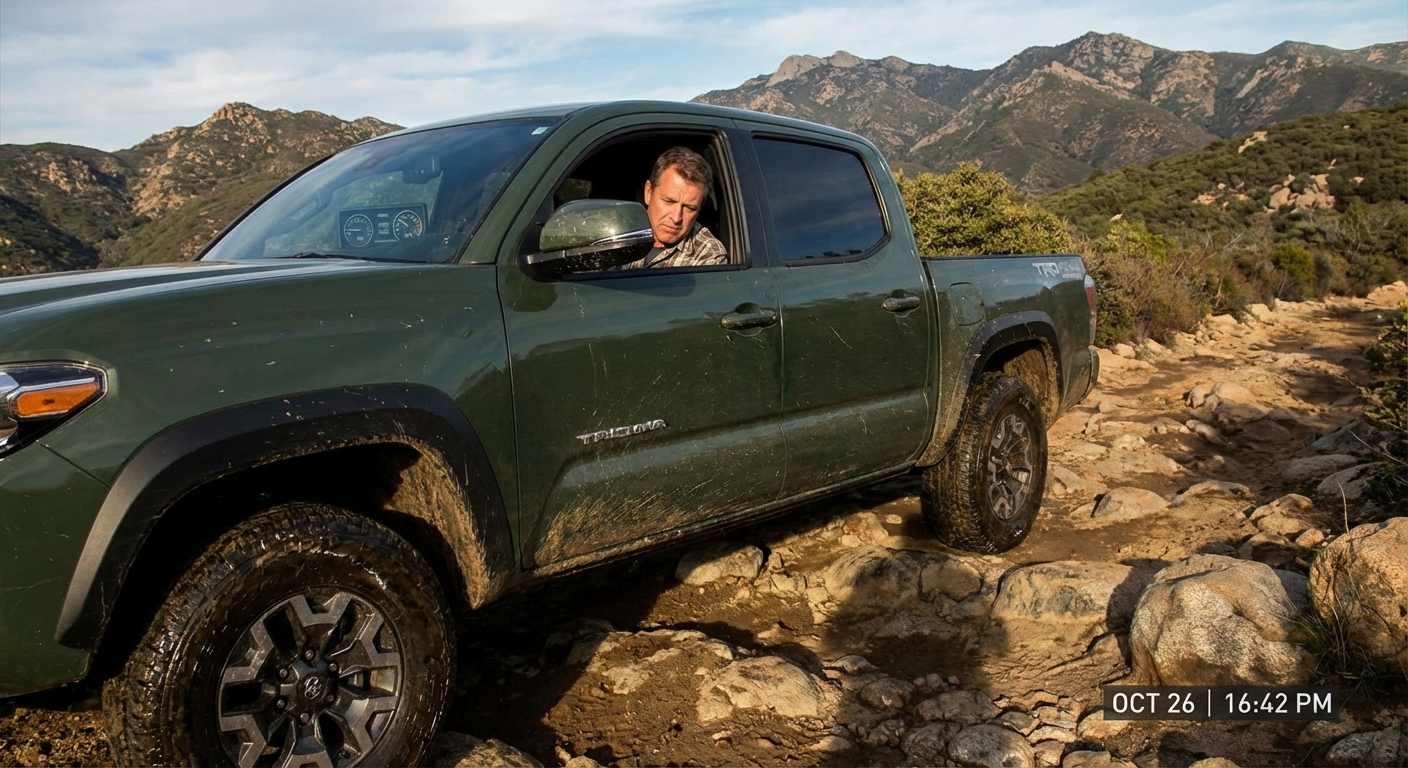
When I tested a 4x4 Tacoma TRD Off-Road on a mixed trail — sand, rocks, and a muddy hill climb — I cycled through:
- Mud & Sand mode
- Rock mode (with 4L engaged)
- Normal mode on the gravel road back
The difference felt massive.
Common Off-Road Modes (and What They Change)
While each brand names them differently, most modes tweak the same core systems:
- Throttle response – Softer for rocks, sharper for sand or sport
- Transmission shift points – Holds gears differently depending on the surface
- Traction control & stability control – Loosened or reprogrammed to allow wheel slip where helpful
- 4x4 system behavior – Some modes automatically lock the center coupling or recommend 4L
Typical modes you’ll see:
- Mud/Ruts – Lets some wheelspin help clear the tires, may lock the rear differential if equipped
- Sand – Aggressive throttle, more wheelspin, higher shift points
- Rock – Pairs with 4L, super fine throttle control, very sensitive traction control
- Baja / Off-Road / Terrain – Performance off-road: fast dirt tracks, washboard, whoops
On that Tacoma, Rock mode plus 4L transformed the truck. I could crawl up a ledge at walking speed without lurching. The computer braked individual wheels so smoothly it felt like cheating.
Locking Differentials vs Traction Control
Nothing starts more campfire arguments than lockers.
- Open differential – What most vehicles have; power tends to go to the wheel with least resistance
- Limited-slip differential (LSD) – Helps send power where there’s grip, great in snow or mild off-road
- Locking differential – Forces both wheels on an axle to turn at the same speed
On a slippery, off-camber hill, I engaged the rear locker on a Colorado ZR2 I was testing. Night and day. Before, one wheel spun uselessly. After, both rear wheels clawed us up.
Reality check:
- Lockers are magic off-road but can make turning on high-traction surfaces awkward or even unsafe
- Electronic traction control is getting so good that for light trails, you can do a lot with just smart drive modes
Pros, Cons, and When You Actually Need All This
After driving way too many trucks and abusing more than a few press demos, here’s how I see it.
Why 4x4 and Off-Road Modes Are Worth It
- Confidence in bad weather – Snow, wet leaves, muddy trailheads become routine instead of drama
- Resale value – In many markets, 4x4 trucks hold value better
- Towing traction – Launching boats, pulling trailers up wet campsites, or dealing with gravel driveways
- Access – You can actually reach that remote campsite or trailhead without sweating every puddle
The Trade-Offs Nobody Likes to Mention
- Fuel economy hit – Extra weight, extra rotating parts, sometimes more aggressive tires
- More complexity – Transfer case, extra differentials, more electronics to potentially go wrong
- False sense of invincibility – 4x4 helps you go; it doesn’t magically help you stop
Whenever a friend asks, “Do I really need 4x4?” I ask two questions:
- Do you regularly deal with snow, mud, steep gravel, or unpaved access roads?
- Do you plan to tow something heavy in less-than-perfect conditions?
If the answer to either is yes, then in my experience, 4x4 and at least basic drive modes are worth every dollar.
How to Actually Use Your 4x4 Truck (A Quick Real-World Cheat Sheet)
Here’s how I set things up when I’m driving different conditions:
- Dry highway, no trailer – 2H, Normal mode
- Rain or light snow – If equipped, 4A (Auto) or just stay in 2H with good tires; don’t overthink it
- Deep snow / muddy field – 4H, Mud/Snow mode; avoid sudden throttle or steering inputs
- Technical trail / rocks – 4L, Rock/Crawl mode, engage rear locker if you start losing traction
- Towing on flat highway – 2H, Tow/Haul mode
- Towing in hills or mountains – 2H or 4H (if traction is poor), Tow/Haul, downshift early, use engine braking
And one rule I’ve learned the hard way: engage 4x4 before you’re stuck. Once you’re buried to the axles, those fancy modes are just there to witness the embarrassment.
If you take nothing else from this, remember: the smartest 4x4 truck is still limited by traction, weight, and common sense. But if you understand what the buttons, knobs, and modes are really doing, your truck stops being a mystery and starts feeling like a tool you truly know how to use.
Sources
- U.S. Department of Energy – Vehicle Weight, Towing, and Fuel Economy - Government guide explaining weight ratings and towing basics
- Ford Towing Guide - Official Ford towing capacities and definitions
- Ram Trucks – 4x4 Systems Explained - Manufacturer overview of transfer cases and 4WD systems
- Chevrolet Trailering Basics - Explanation of payload, GCWR, and trailering tech
- Consumer Reports – How to Tow Safely - Independent guidance on trailer sway, loading, and safe driving