Camper Van Accessories Guide
d legally be classified as a torture device. The next morning I wrote one sentence in my notebook: “Accessories make or break van life.”
Since then, I've tested gear on mountain passes in Colorado, supermarket parking lots in Ohio, and one particularly windy beach in Portugal. Some accessories turned out to be absolute game-changers; others were flashy junk. This Camper Van Accessories Guide is basically the result of those failures and wins.
I’ll walk you through what I’d buy again, what I’d skip, and what I’d only recommend if you’re doing serious off-grid travel.
1. Power & Electrical: The Real Foundation
If you’re going to splurge anywhere, do it here. Comfort, safety, and even your food depend on electrical.
Portable power stations & batteries
When I tested a Jackery Explorer 1000 and later an EcoFlow River, I realized how much stress "battery anxiety" was adding to my trips.
- Portable power stations (Jackery, Bluetti, EcoFlow) are basically big lithium batteries with built‑in inverters and USB/AC outlets.
- For weekend trips, 500–1000 Wh is usually fine. Full-time or off‑grid? I recommend 1500 Wh+.
For a permanent build, I now prefer a dedicated 12V LiFePO4 battery bank plus a pure sine wave inverter. The cycle life and weight-to-capacity ratio are just better. Renogy and Battle Born are two brands I’ve personally used and trusted.
Solar panels & charging
I recently discovered how much I was overpaying for campground hookups. After adding 200W of roof‑mounted solar plus a 100W folding panel, I cut my electrical hookups by about 70%.
- Roof-mounted panels = set-and-forget, great for long stays.
- Portable suitcases = perfect if you park in the shade but still want solar.
The key is a decent MPPT charge controller; when I switched from PWM to MPPT, I measured roughly 15–25% more usable power in good conditions.
Don’t skip safety accessories
Here’s where the “boring” stuff saves lives:
- Carbon monoxide detector (mandatory if you run propane or gas heaters)
- Smoke detector
- Class ABC fire extinguisher
- Properly sized fuses between battery and loads
I had a fuse blow on a sketchy cheap inverter once, and I was grateful it was the fuse and not my entire van catching fire.
2. Sleep & Comfort: Because Bad Sleep Will End Your Trip Early
You can survive without fancy gadgets, but you can’t enjoy van life on four hours of broken sleep a night.
Mattress & bedding upgrades
In my experience, the single biggest quality-of-life upgrade is a real mattress. Not a $30 foam pad, not an air mattress that deflates at 3 a.m. A real, cut-to-size memory foam or latex mattress.
I use a 6-inch medium-firm memory foam cut to fit a platform bed. Paired with a proper duvet and two decent pillows, it made my van feel more like a studio apartment than a tent on wheels.
Window covers & insulation
The first time I woke up in a Walmart parking lot with condensation raining from the metal roof, I learned about thermal bridging the hard way.
- Insulated window covers (Reflectix + fabric, or pre-made) do three things: keep heat in, keep heat out, and give you privacy.
- Blackout plus silver reflective side helps in both summer and winter.
They also massively reduce the “aquarium” feeling when people walk by.
Ventilation & fans
When I tested my first 12V roof vent fan (MaxxAir in my case), it felt dramatic how much it changed the van. Airflow controls condensation, heat, and even cooking smells.
If you can’t cut a roof hole, at least get:
- A decent 12V or USB fan with low current draw
- Clip‑on window vents or rain guards so you can crack windows safely
3. Kitchen & Cooking: Where You’ll Either Save Money or Burn It
Cooking in a van is basically a Tetris game with fire.
Stoves: propane vs induction
I’ve used:
- 2‑burner propane camp stove
- Single-burner butane
- 1800W induction cooktop
Right now I run a hybrid setup: propane for boondocking, induction when I’m plugged in or solar is cranking.
Fridge vs cooler
This is an emotional topic in van circles. I used a $60 cooler for months. Ice runs every two days, soggy food, and a permanent faint smell of sadness.
A 12V compressor fridge (Dometic, ARB, Alpicool, ICECO) is one of those “cry once, smile forever” purchases.
- Uses ~25–50 Ah per day depending on size/weather.
- Chest style is more efficient than front‑opening.
Space-saving kitchen accessories
A few small things I’d never skip now:
- Collapsible silicone sink/tub
- Nesting pots and pans
- Magnetic spice rack or small labeled jars
- Cutting board that doubles as a sink cover
These turn a tiny galley into something that actually works daily.
4. Water, Hygiene & Toilets: The Less Glamorous Essentials
People obsess over solar but forget they still need to, you know, use the bathroom.
Water storage & filtration
I started with random 1‑gallon jugs rolling around the floor. Bad idea.
My current setup:
- Two 7‑gallon Reliance jugs (fresh water)
- One 5‑gallon gray tank
- Simple electric pump and faucet
I added a gravity filter (similar to a Berkey) after getting sketchy well water once. Backing that up, I keep a Sawyer Squeeze-style filter for emergencies and hiking.
Toilets: what actually works
I’ve tried three options:
- Public bathrooms + pee bottle – fine for city travel, annoying while boondocking.
- Portable cassette toilet – better, but dumping in public restrooms isn’t exactly glamorous.
- Urine-diverting composting toilet – most expensive, but the least gross in long-term use.
For occasional weekenders, I actually recommend a simple pee bottle + wag bags or a compact cassette toilet. Full-time? I’d strongly consider a composting option if you have the space and budget.
5. Organization & Storage Accessories
Living in a van is 40% travel, 60% remembering where you put your socks.
Soft storage & packing cubes
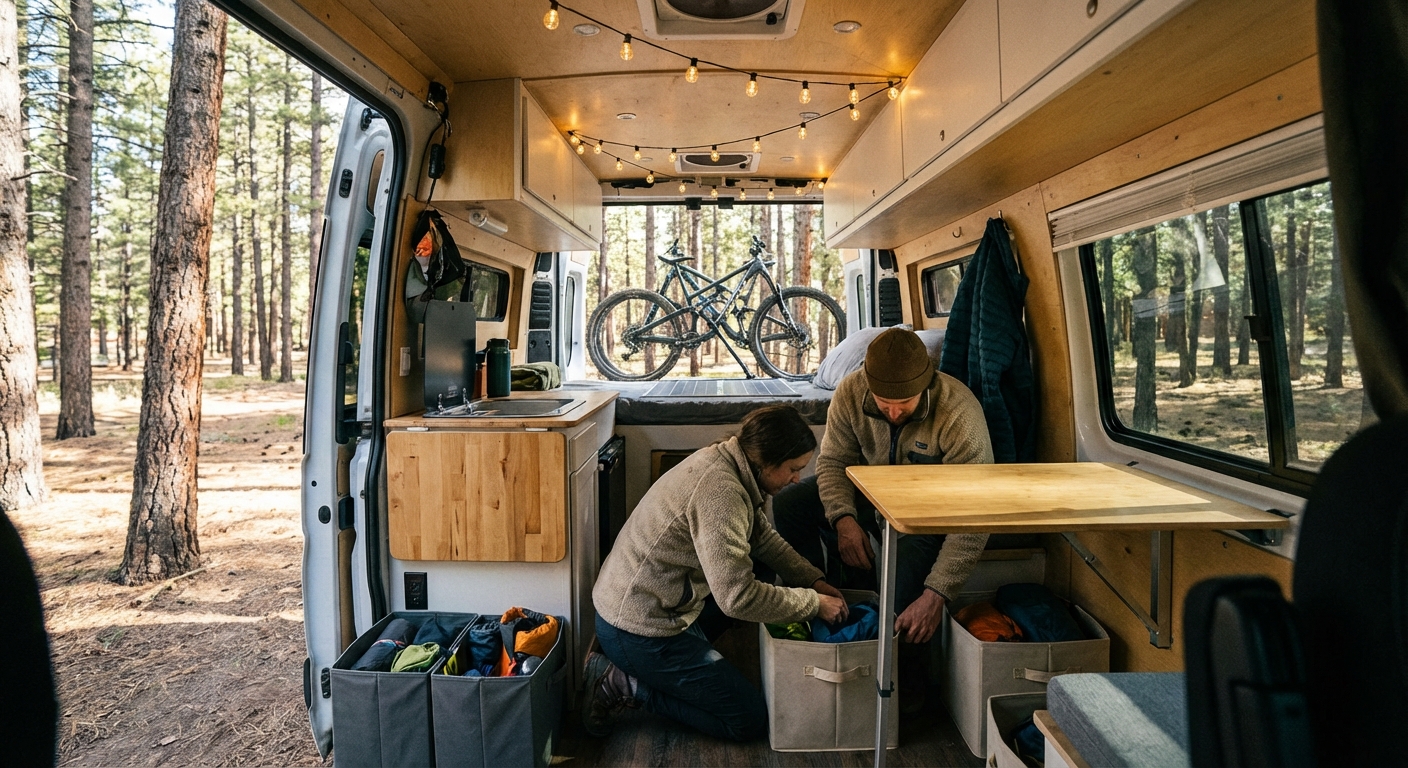
When I tested various organization systems, packing cubes were the runaway winner. Clothes stay grouped, you don’t explode your entire wardrobe to find a shirt, and they fit neatly into overhead cabinets.
Hanging shoe organizers (cut in half) also make great door or wall storage for toiletries, tools, and random gear.
Mounting & securing gear
Two unglamorous accessories I use constantly:
- Heavy duty bungee cords
- Ratchet straps for bikes, water jugs, and heavier items
After having a toolbox launch itself across the van during a sudden stop, I got very serious about tie‑down points.
6. Outdoor Living Accessories
One of my favorite moments on the road was setting up camp in Utah: awning out, camp chairs deployed, portable table set, coffee brewing. For a second it felt less like “van life” and more like a tiny movable cabin.
Shade, chairs & tables
- A simple side awning or even a tarp system means you’re not trapped inside on hot days.
- Compact camp chairs (Helinox-style or similar) and a folding table extend your living space dramatically.
I tested cheap $10 chairs and broke two within a month. Spending a little extra for something sturdy is worth it if you’re out often.
Outdoor shower setups
Privacy plus cleanliness is a huge morale booster. I use:
- 12V pump and collapsible bucket with a shower head
- Pop-up shower tent
Is it luxurious? Not exactly. But compared to awkwardly washing in a gas station bathroom, it feels like a spa day.
7. Navigation, Connectivity & Tech
Van life is still real life—you’ll need maps, work connections, and some entertainment.
Navigation & apps
My daily stack:
- Google Maps for general routing
- Gaia GPS or AllTrails for off-road and hiking
- iOverlander and Park4Night for finding spots, dump stations, water
I cross‑check apps because user-submitted info can be outdated or overly optimistic.
Connectivity: mobile routers & boosters
When I started working remotely from the van, connectivity became mission critical. I now use:
- An unlocked 4G/5G router or hotspot
- Antenna or signal booster (where legal and compatible)
- Multiple SIMs on different carriers
It’s not perfect—there are still dead zones—but redundancy keeps my work calls from imploding.
8. Budget vs Premium: What’s Worth the Money?
Not every accessory has to be top-shelf. Here’s how I prioritize after thousands of miles:
Spend more on:- Electrical (battery, wiring, fuse protection)
- Fridge
- Mattress & fan
- Safety gear
- Cookware and stoves
- Chairs and tables
- Water tanks and pumps
- Storage bins and cubes
- Decorations, fairy lights, small organizers
I’ve been burned by ultra‑cheap power gear and sketchy no-name inverters; I wouldn’t gamble there again. But a $12 storage cube that rips isn’t a big deal.
Honest Reality Check
There’s no “perfect” camper van accessories list because vans, climates, and travel styles are wildly different.
Some people happily live with a basic cooler and a camp stove; others need full-time remote work setups with Starlink, 400W solar, and a $1200 fridge. Both are valid.
What I’ve learned, after living with this stuff day‑to‑day, is that the best accessories are the ones that reduce friction:
- Fewer ice runs
- Less condensation and bad sleep
- Cooking that doesn’t feel like a chore
- Safer electrical and heating
If an accessory consistently saves you time, energy, or arguments, it’s probably worth the space and money. If it’s just adding complexity or looks good on Instagram but rarely gets used, it’s dead weight.
Start simple, add slowly, and let your actual trips—not YouTube or Instagram—tell you what you really need.
Sources
- National Renewable Energy Laboratory – Consumer Guide to Solar Electricity - Technical overview of small-scale solar, useful for sizing van solar setups.
- U.S. Department of Energy – Energy Saver: Portable Generators and Emergency Power - Safety and usage guidance relevant to off-grid and backup power in vans.
- Centers for Disease Control and Prevention – Carbon Monoxide Poisoning Prevention - Official safety info for using propane, heaters, and stoves in enclosed spaces.
- REI Co-op – How to Choose a Camping Stove - Practical breakdown of stove types and fuel options for van kitchens.
- University of Illinois Extension – Water Storage and Emergency Disinfection - Evidence-based guidance on safe water storage and treatment, applicable to van water systems.