Can Your Dog Actually Get Bored? What I Found Running a “Home Enrichment Lab”
Then I set up a cheap pet camera.
Watching the footage back felt like a punch in the gut: hours of pacing, long stretches of staring at the door, and this sad little sigh he did before flopping on the floor…again.
That’s when I went down the rabbit hole of can dogs actually get bored? And more importantly: what does boredom even look like in pets that can’t say, “Hey, I’m mentally dying here”?
I turned my apartment into a mini “enrichment lab” for a month—testing toys, routines, scent games, and even dog TV. Here’s what actually changed my dog’s behavior, what absolutely flopped, and how you can steal the stuff that worked (without spending a ton).
What “Bored” Looks Like in a Dog (It’s Not What I Expected)
I always assumed boredom = destruction. Chewed shoes, shredded pillows, chaos. If the apartment was intact, I figured my dog was content.
Behaviorists disagree with that oversimplified picture.
The American Kennel Club and several veterinary behaviorists describe “under-stimulation” as a mix of:
- Repetitive behaviors (pacing, licking, spinning)
- Sleep that looks more like “shutting down” than true rest
- Attention-seeking out of nowhere, then nothing to do again
- Random explosions of energy (zoomies) after long dull periods
When I started watching more closely, I spotted some of these in my own dog:
- The pacing loop. He’d walk the exact same path: bed → window → door → water bowl → bed. Zero real purpose.
- The “you again?” greeting. Hyperscrolling-style excitement when I came back… followed by dead silence ten minutes later.
- Weird late-night chaos. Around 10 p.m. he’d suddenly grab toys, toss them in the air alone, then just stop and sigh.
This matched what researchers call “frustrated behavior” in confined or understimulated animals. Even zoos fight against this with environmental enrichment so animals don’t develop stereotypies—those repetitive, functionless behaviors you sometimes see in captive wildlife.
So yes, from everything I’ve seen and read: your dog can absolutely get bored. But it doesn’t always look dramatic. Sometimes it just looks like… nothing.
My One-Month “Enrichment Lab” Experiment at Home
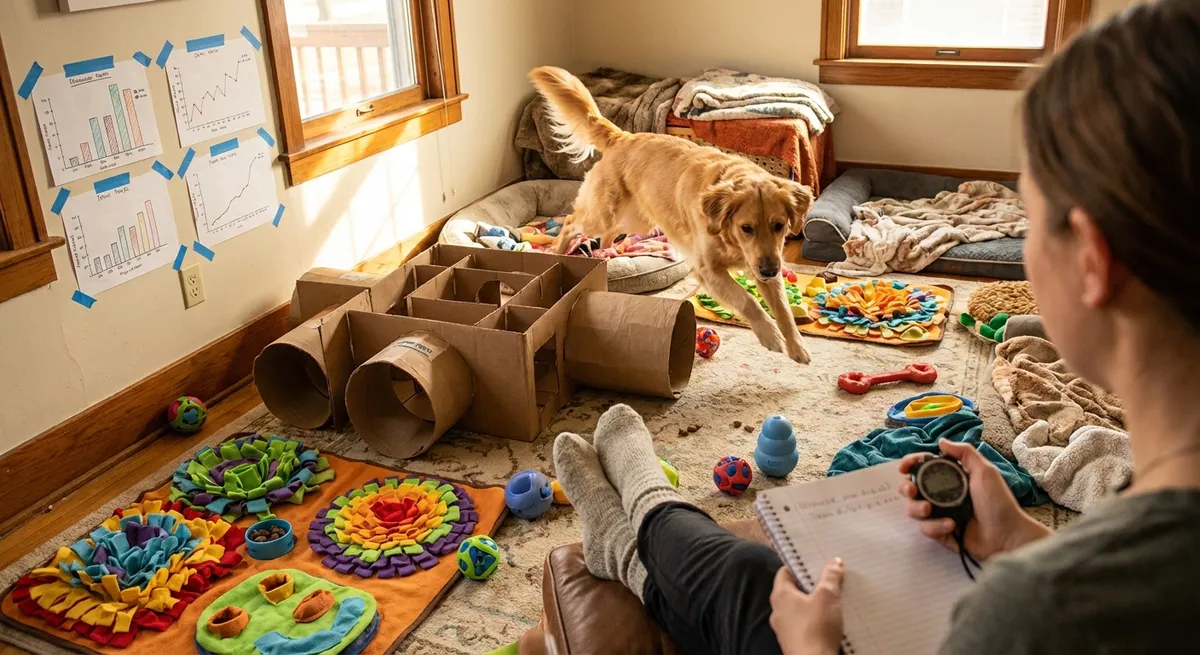
I decided to treat my dog’s brain like a muscle that needed workouts, not just his legs. Instead of throwing 10 things at him randomly, I created a super low-tech “experiment”:
- Week 1: Food puzzle toys + meal changes
- Week 2: Scent games
- Week 3: Training bursts + “jobs”
- Week 4: Structured rest + screens (yes, dog TV)
I kept the rest of his life the same: same walks, same food, same schedule. I wanted to see what changed when I only touched the mental side.
Week 1 – Turning Meals into Missions
I started with the easiest upgrade: making him work for his food.
What I tried:- A basic silicone lick mat smeared with wet food, frozen overnight
- A classic Kong stuffed with his regular kibble plus a bit of yogurt
- A slow-feeder bowl with ridges so he couldn’t inhale dinner in 10 seconds
- Mealtime went from ~30 seconds to 8–15 minutes.
- After meals, instead of pacing, he’d flop down with that “I did something” tiredness I usually see after a long walk.
- He stopped begging as much between meals. I suspect the actual effort and licking (which triggers calming behaviors) helped.
- A super complicated puzzle toy I found online.
It looked genius. He looked at it, pawed it twice, then walked away like, “You solve it.”
I had to downgrade the difficulty. Behaviorists recommend starting so easy it’s almost impossible for them to fail—that part I totally skipped at first.
Key takeaway: You don’t need fancy toys. My dog had almost the same reaction to me scattering kibble in different rooms and letting him “hunt” for it.
Week 2 – Scent Games: The Secret Weapon Dogs Are Basically Built For
Every source I read kept saying some version of: “A dog’s nose is its superpower.”
Fun fact that blew my mind: Dogs have around 220 million scent receptors (humans have about 5 million), and a huge chunk of their brain is wired for smell. Not using their nose is like giving a gifted musician a broken piano.
So I leaned into nose work.
Game 1: The “Find It” StarterI showed him a treat, let him sniff it, then placed it obviously under a plastic cup while he watched. I said “Find it!” and let him knock the cup over. After a few reps, I started hiding it in slightly trickier spots (behind a table leg, under a towel, in another room).
Within two days, he knew the phrase “Find it” and his whole body language changed when I said it—ears up, tail wagging, eyes sharp.
Game 2: Scent Walk UpgradeInstead of rushing our walks, I tried “decompression walks” where I let him sniff almost anything (within reason). I slowed down. No more “come on, let’s go” every five seconds.
Result:
He came home more tired from a 20-minute truly sniffy walk than from a 40-minute rushed power walk. And the post-walk pacing dropped noticeably.
Downside:
Decompression walks are less “fitness influencer” and more “old person strolling their memories.” You’ll feel like you’re doing nothing. Your dog’s brain, however, is going wild—in a good way.
Week 3 – Giving My Dog an Actual “Job”
I kept reading this line from trainers: “Most dogs were bred to do something specific. When they don’t have a job, they invent one.”
My dog’s invented job used to be:
- Alert me to every sound in the hallway
- Supervise the window
- Shred Amazon boxes
So I tested giving him tiny “jobs” instead.
1. Micro Training SessionsI split training into tiny 3–5 minute bursts, 3–4 times a day:
- Morning: simple cues (sit, down, stay) with quick rewards
- Afternoon: one trick or new skill (spin, touch, wait)
- Evening: calm behavior (go to mat, settle, look at me when there’s a sound)
This did three things:
- Sharpened his focus
- Gave him a sense that I was consistently communicating with him
- Gave me leverage in real-life situations (“settle” actually started to mean something)
I rotated one “special” toy that only came out when he did something: a tug toy or a squeaky plush.
Example:
After a quick recall practice in the living room—“Come!” → reward → 30 seconds of tug. Then toy away.
That made play feel earned, not random, which weirdly seemed to make him more engaged.
What didn’t work:
- One long, 30-minute training block.
He mentally checked out halfway through, I got frustrated, and we both ended up annoyed. Short, fun, and frequent absolutely beat long and “serious.”
Week 4 – Rest, Screens, and the Stuff I Was Skeptical About
I used to think rest just “happened.” If the dog is tired, he sleeps. Easy.
But after three weeks of mental enrichment, I noticed something subtle: he was more likely to settle if I gave him a clear signal that the action was over. So I experimented with structured calm.
1. The “Calm Zone”I moved his bed to a quieter corner—not by the door, not next to the window. I added a chew (bully stick, stuffed Kong, or frozen carrot) only when I wanted him to decompress.
Result:
- He started going to that corner on his own when he wanted downtime.
- I heard way fewer hallway-bark alerts because he was physically farther from the door.
I used to laugh at “Dog TV.” Then I tried it on a day with construction noise outside.
What worked:
- Neutral nature sounds (rain, birds, light ambient music) at low volume
- A few curated YouTube channels made for dog relaxation—basically moving nature scenes
What definitely didn’t:
- Videos with high-pitched animals or squeaky toy noises.
He went from relaxed to full-on detective mode.
Did it cure boredom? No.
Did it slightly mask unpredictable sounds and make the apartment feel calmer? Yes.
What Actually Changed (And What Didn’t)
After a month of treating my dog’s brain like it mattered as much as his body, things looked different—on camera and in real life.
Visible changes:- Way less pacing when I wasn’t home
- Fewer “random” barking fits
- He settled more quickly after walks and meals
- He started bringing me toys in a more purposeful “let’s do something together” way, not frantic chaos
- He still had zoomies, just fewer and shorter
- He still had days where he seemed restless if I worked too long without interacting
- He still hates the vacuum and probably always will
I also realized there’s a myth that a tired dog = a happy dog.
You can exhaust a dog physically and still have a mentally starved animal. The sweet spot, at least from what I’ve seen, is a balance of:
- Physical exercise (walks, play)
- Mental work (sniffing, problem-solving, training)
- Predictable rest (safe spots, clear “we’re done” signals)
And yes, some dogs are absolutely more “content potato” than others. Breed, age, health, and personality all matter. My senior dog needed way less action than my friend’s young herding mix, who would probably start a revolution without a job.
How to Tell If Your Pet Is Bored—and What’s Actually Worth Trying
If you’re wondering whether your own dog is bored, here’s the honest version based on behavior experts and my own mini experiment:
You might be dealing with boredom or under-stimulation if:
- Your dog has random explosive energy but otherwise sleeps all day
- They obsess over tiny things (shadows, sounds, one spot on the wall)
- They invent “bad” hobbies: counter surfing, tissue hunting, barking at nothing
- They seem clingy when you’re around, then flat when left alone
But: those signs can also point to anxiety, pain, or medical issues. If the behavior feels extreme, sudden, or off, a vet check comes first. Boredom is a diagnosis you gently back into after you’ve ruled out the serious stuff.
If your dog is healthy and you want to upgrade their life without losing your own, here’s what I’d repeat from my experiment:
- Turn one meal a day into a puzzle or sniff hunt.
- Add one 10–15 minute truly sniffy walk where speed doesn’t matter.
- Do two or three 3-minute training bursts with easy cues and lots of rewards.
- Create a calm corner with a chew they only get there.
- Watch them for a week like a scientist. What reduces pacing? What lights them up?
You don’t have to be perfect or turn your home into a doggie Montessori school. In my experience, even small, consistent mental challenges changed my dog from “low-key sad roommate” to “actual companion with a job and a life.”
And honestly? It made my days better too. There’s something very grounding about watching another creature solve tiny problems and feel proud of themselves.
That, plus fewer chewed delivery boxes, is a win I’ll take.
Sources
- American Kennel Club – Enrichment for Dogs – Overview of mental exercise, enrichment ideas, and how they affect behavior.
- RSPCA – Environmental Enrichment for Dogs – Practical guidance on reducing boredom and improving welfare through enrichment.
- VCA Animal Hospitals – Behavioral Enrichment for Dogs – Veterinary behavior perspective on boredom, under-stimulation, and activity planning.
- Humane Society of the United States – What to Do If Your Dog Is Bored – Signs of boredom and simple activities to provide mental stimulation.
- ScienceDirect – Olfactory Brain Structures in Dogs – Research-based insight into dogs’ olfactory system and why scent work is so powerful.