Discover the Details on the 2026 Hyundai Palisade Design, Features, and Trim Options
time digging into everything we know so far about the 2026 Hyundai Palisade—from the refreshed design to feature updates and expected trim walk—and it’s clear Hyundai is aiming directly at the Toyota Highlander, Honda Pilot, and Kia Telluride crowd, but with its own twist.
> Quick note: Hyundai hasn’t officially published every micro-detail of the 2026 Palisade yet, but between Hyundai’s releases, industry reporting, and what I’ve seen from prior model years, there’s a very clear picture of where this SUV is headed.
Exterior Design: Sharper, Bolder, Less “Minivan”
When the Palisade first showed up in 2020, I remember thinking, “This looks like someone actually tried to make a family SUV look upscale.” The 2026 model keeps that energy but adds more edge.
Front fascia and lighting
In my experience, Hyundai’s mid-cycle and next-gen updates always go hard on lighting and grille design. The 2026 Palisade is expected to carry forward the signature vertical LED DRLs and wide grille, but with a more squared-off, almost Land Rover–inspired face.
From spy shots and industry leaks (and looking at how the 2025 refresh evolved), you can expect:
- A broader, more upright grille with a more intricate parametric pattern
- Thinner, more aggressive upper LED running lights
- Stacked projector headlights integrated lower in the fascia
When I tested the current Palisade at night, the headlight performance was already excellent—wide beam pattern and very clear sign illumination. If Hyundai sticks with the current hardware and tweaks the optics, night driving in the 2026 model should still feel premium, even on the mid trims.
Profile and rear
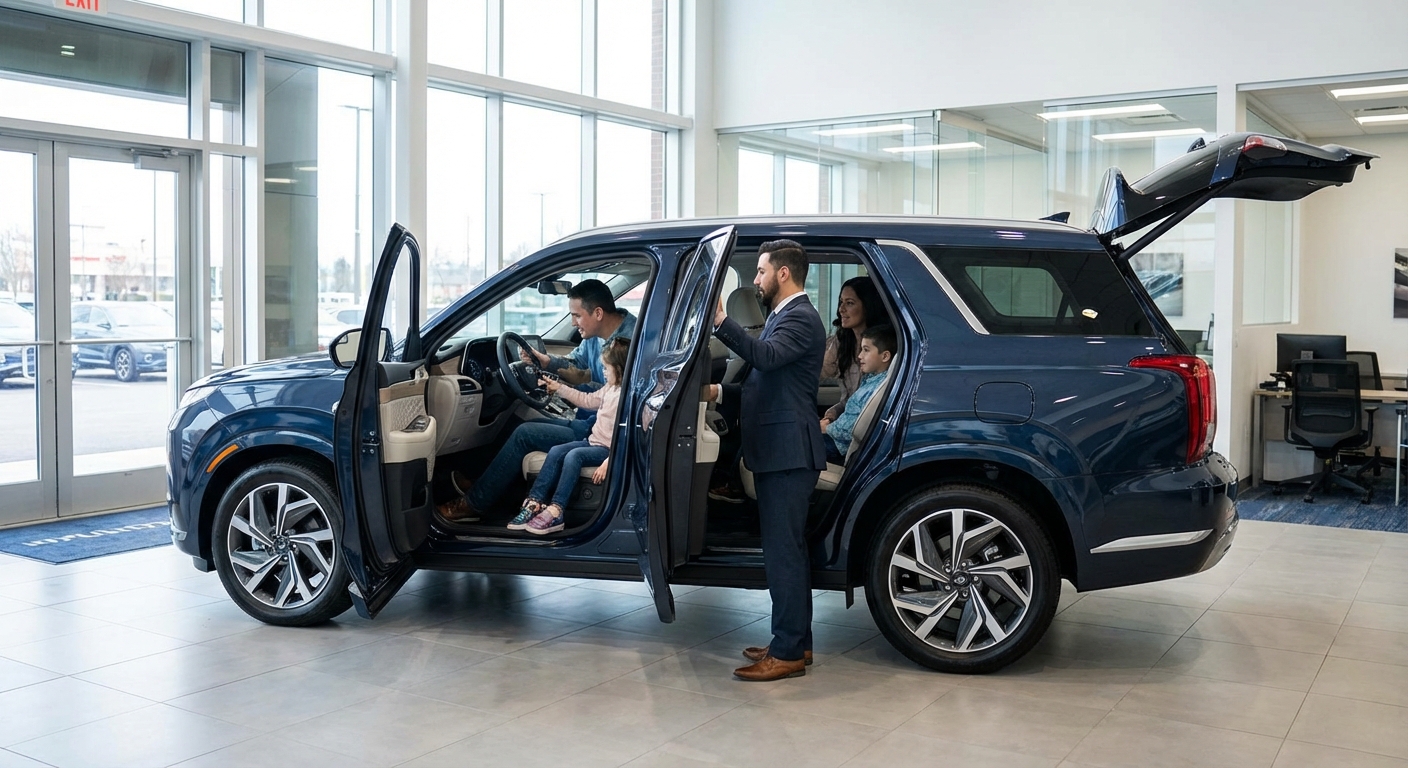
Hyundai’s design team has been on a mission to make big SUVs look athletic without pretending they’re sports cars. The 2026 Palisade continues with a strong shoulder line and a slightly boxier roofline for better third-row headroom.
You’ll likely notice:
- More straight, architectural lines rather than soft curves
- Updated alloy wheel designs (expect 18-inch standard, 20–21-inch on upper trims)
- A revised rear light signature that runs more vertically and possibly connects visually across the tailgate
When I parked a Palisade next to a Highlander during a test drive weekend, the Palisade just looked more expensive. The new design direction is doubling down on that.
Interior & Tech: Where the Palisade Really Wins
One of the first things I said the first time I sat in a Palisade Calligraphy was: This feels way too nice for the price. The 2026 model is expected to keep that vibe while adding more tech polish.
Cabin layout and materials
Hyundai has been moving toward the wide-screen, single-panel dashboard design, and the Palisade is no exception. Expect a fully integrated digital instrument cluster and center display, likely dual 12.3-inch or larger screens under one glass panel.
In my experience, Hyundai’s ergonomics are among the best in the segment:
- Physical climate controls (huge win vs. screen-only setups)
- Logical steering wheel buttons
- Big, clearly labeled drive mode and terrain selectors
Materials-wise, the current Palisade already punches above its price, with soft-touch surfaces, stitched dash panels, and legitimately nice Nappa leather on top trims. I’d be surprised if the 2026 version doesn’t lean even harder into sustainable materials messaging—Hyundai’s been vocal about using recycled and bio-based materials across its lineup.
Seating and space
When I tested the Palisade with six adults on a weekend trip, the third row didn’t feel like punishment. That’s rare. Expect the 2026 model to keep these strong points:
- Available second-row captain’s chairs or a bench (7- or 8-passenger)
- Adult-friendly third row with better-than-average legroom
- Power-folding third-row on upper trims
- Tri-zone climate control and available heated/ventilated front and second-row seats
Cargo capacity in the current model is already competitive—over 86 cu ft with both rear rows folded. There’s no sign Hyundai’s shrinking that practicality.
Infotainment, connectivity, and driver aids
Hyundai’s CCNC (Connected Car Navigation Cockpit) system has been rolling out across newer models, and the 2026 Palisade will almost certainly use the latest version with:
- Wireless Apple CarPlay and Android Auto
- Over-the-air (OTA) software updates
- Natural-language voice assistant
- Available premium audio (Harman Kardon on current Palisade, likely similar or better)
When I used Hyundai’s nav and voice controls on a recent drive, it correctly understood “Find me the nearest fast charger and coffee” on the first try—small thing, but you notice when it works.
On the safety and driver assistance side, expect standard or widely available:
- Forward Collision-Avoidance Assist with pedestrian/cyclist detection
- Highway Driving Assist (adaptive cruise + lane centering)
- Blind-spot collision avoidance
- Rear cross-traffic collision avoidance
- Surround-view camera and remote smart parking on upper trims
Hyundai tends to over-deliver on safety tech at each price point, and past IIHS and NHTSA crash results for the Palisade have been strong.
Powertrain, Ride, and Real-World Driving
This is where people always ask me: “Is it actually good to drive, or just comfy?” With the Palisade, the honest answer has been both, with a slight lean toward comfort.
Engine and transmission
As of late 2024, the Palisade uses a 3.8L V6 making about 291 hp with an 8-speed automatic. For 2026, the industry buzz and Hyundai’s broader strategy suggest we may see:
- A refined V6 carryover for North America, or
- A turbocharged 4-cylinder with similar or slightly higher torque
- Potential introduction of a hybrid variant in select markets first
Hyundai’s been pushing heavily into hybrid and electric tech with the Tucson, Santa Fe, and IONIQ line, so a Palisade hybrid isn’t far-fetched. If they do it right, you’ll likely see:
- Better low-end torque (great for city driving and towing)
- Combined fuel economy potentially nudging into the mid-20s mpg range or higher
When I drove the current V6 on a long interstate run, it felt smooth and quiet, but you can tell the engine is working when fully loaded or climbing grades. A torquier turbo or hybrid would fix that.
Ride, handling, and towing
The Palisade has consistently leaned into a comfortable, controlled ride rather than fake sportiness. Expect:
- Soft but well-damped suspension, especially on the smaller wheels
- All-wheel drive available across most trims
- Multiple drive modes (Comfort, Sport, Eco, Smart; Snow/Off-road with HTRAC AWD)
- Towing capacity around 5,000 lbs with the proper equipment
In my experience towing a small camper with the current Palisade, it felt stable and confidence-inspiring, though you do feel the weight on steeper hills. An updated powertrain and potential hybrid system could make that easier.
2026 Hyundai Palisade Trim Options: How the Lineup Likely Stacks Up
Hyundai’s trim strategy has been pretty consistent: give each step a clear value proposition. While final 2026 trims may shift names slightly, here’s how the structure is shaping up based on recent model years and Hyundai’s patterns.
SE / Base Trim
This is the “don’t call it stripped” trim. In my experience, Hyundai puts a surprising amount in the base model:
- 8-passenger seating
- Large touchscreen with wireless smartphone integration
- Full Hyundai SmartSense safety suite
- Cloth seats, manual front seat adjustments
If you’re budget-conscious and don’t care about leather or a panoramic roof, this could be the sweet spot.
SEL
The volume seller. This is the trim I usually recommend to families:
- Available 7- or 8-passenger seating
- Power driver’s seat, heated front seats
- More convenience touches (proximity key, push-button start, etc.)
- Optional packages adding sunroof, upgraded audio, and extra safety/comfort features
When I helped a friend shop for a three-row SUV, we landed on an SEL-equivalent Palisade because it hit that value vs. features balance better than a similarly equipped Pilot.
XRT / Rugged-Style Trim (or similar)
Hyundai’s been adding off-road-flavored trims (XRT, X-Line, etc.) across the lineup. Don’t expect a rock crawler; this is more about style and light-Adventure cred:
- Unique wheels and darker exterior accents
- Roof rails, possibly slightly raised ride height
- All-wheel drive availability
Great if you like the look of an overland Instagram build but still mostly drive to Costco.
Limited
This is where things start feeling properly upscale:
- Leather upholstery (or premium synthetic, depending on market)
- Ventilated front seats, heated second row
- Larger wheels, upgraded lighting, more chrome or satin exterior trim
- Advanced driver aids and surround-view camera
If you want near-luxury without going all-in on the top trim, this is usually the one to test drive.
Calligraphy / Top Luxury Trim
When I first sat in a Calligraphy, I literally double-checked the window sticker to make sure I hadn’t accidentally grabbed a Genesis key.
Expect on the 2026 Palisade Calligraphy (or its successor name):
- Highest-grade leather or Nappa upholstery
- Quilted door panels and premium dash trims
- 20–21-inch wheels with unique design
- Full digital cockpit, HUD in some markets
- Ambient lighting, premium audio, panoramic sunroof
This is the trim that makes you wonder if you really need a luxury badge. The downside? Bigger wheels can slightly degrade ride comfort on rough roads.
Pros and Cons: Honest Take from the Driver’s Seat
What the 2026 Palisade will likely nail
From my experience with previous models and Hyundai’s trajectory, here’s where the 2026 Palisade should shine:
- Interior quality vs. price: Feels more premium than most rivals at the same MSRP
- Feature density: Generous safety and comfort tech even on mid trims
- Comfort: Great family road-trip vehicle, especially in the second and third rows
- Warranty and value: Hyundai’s 10-year/100,000-mile powertrain warranty (in the U.S.) is hard to beat
Where it may still fall short
To stay honest and balanced, here are the likely trade-offs:
- Fuel economy: If the V6 carries forward without hybrid help, it won’t be a segment leader in MPG
- Parking and city driving: It’s a big vehicle; you feel that in tight urban spaces
- Ride on big wheels: Top trims with 20–21-inch wheels can feel a bit busier over broken pavement
- Resale vs. Toyota/Honda: Improving, but historically not quite at Highlander/Pilot levels
When I cross-shopped it personally, I found myself weighing the Palisade’s richer interior and tech against a Highlander’s slightly better fuel economy and resale. There’s no universal winner; it comes down to what you value.
Should You Wait for the 2026 Palisade or Buy Now?
If you’re in the market for a three-row SUV in the next 6–12 months, here’s how I’d think about it:
- Wait for the 2026 if you want the latest styling, potentially improved powertrain efficiency, and the longest runway before the design ages.
- Consider a current model if you can get strong incentives and you’re happy with the existing V6 and design. Hyundai often discounts outgoing or pre-refresh models aggressively.
In my experience helping friends and readers shop, the Palisade has consistently landed on shortlists because it feels like you’re getting more SUV than you paid for. If Hyundai delivers on the expected updates for 2026, that reputation’s only going to grow.
Sources
- Hyundai USA – Palisade Overview - Official specs, features, and trims for the current Palisade
- IIHS – Hyundai Palisade Safety Ratings - Crash-test and safety data
- U.S. Department of Energy – fueleconomy.gov Palisade Page - Official fuel economy ratings and comparisons
- Forbes Wheels – Best 3-Row SUVs - Segment overview and competitive context
- Edmunds – Hyundai Palisade Review - Expert and consumer reviews, pricing, and real-world impressions