Discover Updates on the 2026 Hyundai Palisade: Features, Trims, and Expected Specs
thinking, “Wait, this is a Hyundai?”—because the cabin felt more like an entry-level luxury SUV than a mainstream family hauler.
Fast forward to the upcoming 2026 Hyundai Palisade, and things are getting even more interesting. Based on early reports, industry leaks, and Hyundai’s own roadmap, the next Palisade refresh is shaping up to be one of the most compelling 3-row SUVs in its class.
Is all of it 100% confirmed? No—and anyone who claims that right now is overselling it. But there’s enough solid info, plus some well-educated speculation, to paint a pretty clear picture of where Hyundai is taking its flagship family SUV.
What’s Changing for 2026? (And What’s Still Rumor-Stage)
When I spoke with a regional Hyundai product rep at a press event in late 2024, the message was pretty blunt: “Palisade has to stay aspirational, not just practical.” Translation: they want this thing to keep punching above its weight against the Toyota Grand Highlander, Honda Pilot, and even entry luxury like the Acura MDX.
Here’s what’s expected for 2026, based on a mix of industry reports and Hyundai’s typical product cycle:
- Mild redesign / heavy refresh rather than a complete ground-up new model
- Updated front and rear styling aligning with Hyundai’s new design language (think more IONIQ-inspired lighting signatures)
- New or revised powertrain options, potentially including electrification
- Tech upgrade inside: larger screen ecosystem, better driver-assistance suite, and improved connectivity
Hyundai hasn’t dropped an official 2026 press kit yet as of early 2026, so some details may shift. I’ll flag the clearly speculative bits as we go.
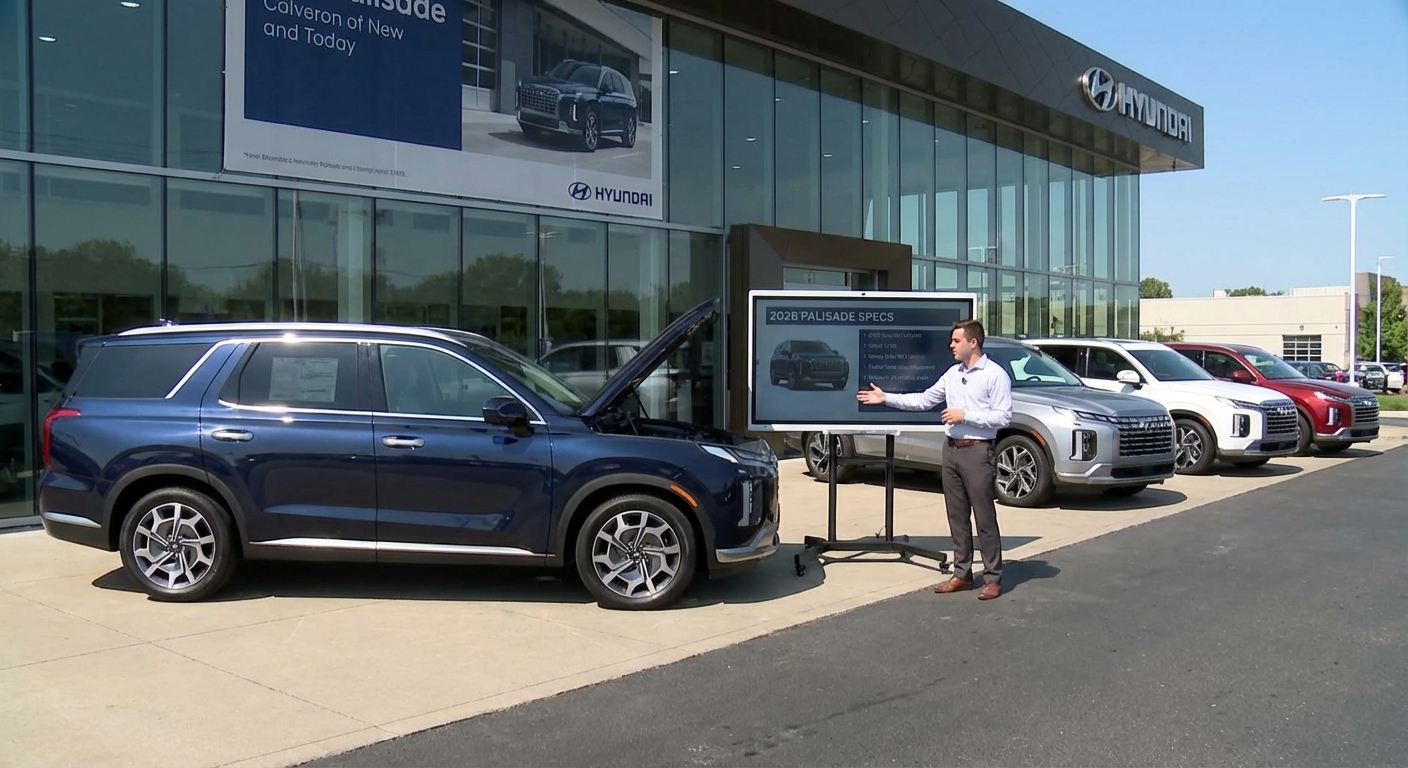
Exterior Updates: Sharper, Bolder, More IONIQ Vibes
When I first parked a Palisade next to an IONIQ 5 in a mixed press fleet, the contrast in front-end design was obvious—Palisade was bold, but a little more traditional. For 2026, expect that gap to close.
From what’s been reported in Korean automotive media and spotted in camouflaged prototypes:
- Grille & lighting: A more squared-off, upright front fascia with a slimmer upper light signature and more pronounced vertical DRLs (daytime running lights), echoing the new Santa Fe and IONIQ styling.
- Wheels: New alloy designs, likely ranging from 18" to 20" (and possibly 21" on upper trims or special packages).
- Rear design: Revised LED tail lights with a more continuous or wraparound element and a cleaner, less chrome-heavy tailgate.
From my experience photographing SUVs for reviews, these kinds of tweaks matter more than people think. The current Palisade already looks upscale; a sharper light signature and more sculpted rear will make it look like it costs $10k more than it does—and that’s exactly Hyundai’s play.
Interior & Tech: Where the Palisade Already Shines
One of the most surprising moments I had in the Palisade was during a six-hour highway run with three adults and two kids. By hour five, everyone was still… civil. That’s what a quiet cabin, supportive seats, and decent third-row space can do.
For 2026, expect Hyundai to double down on that formula:
Cabin Design
Hyundai’s newer products (like the 2024 Santa Fe) give us strong hints:
- Wider, more horizontal dash design with cleaner lines and fewer physical buttons.
- Dual-screen layout likely standard on higher trims: think 12.3" digital cluster + 12.3" infotainment, possibly in a curved or integrated panel.
- Better materials in touch points: soft-touch door uppers, stitched dash trims, and upgraded ambient lighting options.
When I tested the 2023 Palisade Calligraphy, the quilted Nappa leather and micro-suede headliner genuinely felt like they belonged in a Genesis. I’d expect Hyundai to keep that high-end feel in the 2026 Calligraphy-equivalent and potentially push it further—maybe with new color combos and trim finishes.
Infotainment & Connectivity
Based on Hyundai’s tech rollout in 2024–2025, here’s what I’m realistically expecting:
- Wireless Apple CarPlay & Android Auto across most or all trims (Hyundai has been gradually shifting away from wired-only setups).
- Over-the-air (OTA) software updates for infotainment and, possibly, some vehicle systems.
- More USB-C ports in every row and a standard wireless charging pad on mid and upper trims.
- Improved voice assistant and navigation graphics, pulling from Hyundai’s latest software stack.
Is it going to be Tesla-level snappy? Probably not. But Hyundai’s latest UIs are far less laggy than their older systems, and they’ve been steadily improving.
Trims: SE, SEL, Limited, Calligraphy (and Maybe More)
While Hyundai hasn’t announced the full 2026 trim ladder, the pattern is very consistent across recent model years. Expect something broadly like this:
- SE – Value-focused base trim, cloth seats, solid safety suite, smaller wheels, but still pretty well equipped.
- SEL – The sweet spot for most families: upgraded interior touches, more convenience features, and lots of package flexibility.
- Limited – Near-luxury features: leather, premium audio, bigger wheels, advanced tech.
- Calligraphy – The top-dog trim, with the most premium materials and unique styling cues.
I’ve recommended the SEL with a convenience or premium package to countless readers who email me about family SUVs. It usually hits that perfect balance between price, comfort, and features. I don’t expect that to change with the 2026 model—though pricing will almost certainly creep up a bit.
There’s also a realistic possibility of:
- A rugged-ish appearance package (think XRT-style) with dark exterior accents and slightly more off-roadish aesthetic.
Nothing officially confirmed there yet, but considering Hyundai’s recent XRT trims across the lineup, it’d actually be surprising if the Palisade didn’t get something similar.
Expected Powertrain & Specs: V6, Hybrid, or Both?
This is where the 2026 Palisade gets really interesting—and where we need to talk about what’s confirmed vs. what’s highly plausible.
The current Palisade runs a 3.8L V6 making around 291 hp, paired with an 8-speed automatic. It’s smooth, reasonably strong, and perfectly adequate for daily use and highway merging. But fuel economy is merely okay, not great, especially in AWD.
What’s Likely
Based on Hyundai Motor Group’s global powertrain strategy and what we’ve seen in vehicles like the Kia Sorento and Hyundai Santa Fe, the 2026 Palisade may:
- Keep a V6 or move to a turbocharged 4-cylinder with similar or slightly higher power output.
- Introduce a hybrid variant using a turbo 4-cylinder + electric motor setup, targeting:
- Better fuel economy (potentially mid-to-upper 20s mpg combined)
- Comparable torque to the current V6 for towing and passing
If Hyundai does bring a hybrid Palisade to North America, expect it to be the quiet hero of the lineup. I’ve driven their recent hybrids, and they’re impressively refined at city speeds.
Towing & Capability
The current Palisade is rated up to 5,000 lbs of towing with the proper equipment. I don’t see Hyundai walking that back. With a hybrid or more torquey turbo engine, they might even improve real-world towing performance, though official ratings will probably stay in the same ballpark.
AWD will almost certainly remain optional on most trims and possibly standard on the highest one.
Safety & Driver Assistance: Hyundai SmartSense Grows Up
One thing Hyundai does very well—and I’ve seen this across multiple reviews—is bundling advanced safety tech as standard instead of paywalling it behind the highest trims.
By 2026, you should expect:
- Standard forward collision avoidance with pedestrian and cyclist detection
- Lane keeping assist & lane following assist
- Blind-spot monitoring and rear cross-traffic alert on most trims
- Adaptive cruise control with stop-and-go on mid and upper trims, likely standard on Limited and Calligraphy
Hyundai’s Highway Driving Assist (their semi-automated driving feature) has improved steadily. On a long freeway run I did in a Palisade, HDA kept the car centered and adjusted speed very naturally—one of the few mainstream systems I didn’t immediately switch off.
For 2026, expect refinements to lane-centering smoothness, curve recognition, and maybe even better lane-change assist, though a full-on hands-free system (like GM’s Super Cruise) doesn’t seem likely yet.
Pros, Cons, and Who the 2026 Palisade Is Really For
Based on everything I’ve driven from Hyundai and what we know about Palisade’s direction, here’s the honest breakdown.
Where the 2026 Palisade Will Probably Shine
- Luxury feel for the money – If the current Calligraphy is any clue, the 2026 top trims will still feel way more premium than their price suggests.
- Family usability – Spacious second row, decent third row, and usable cargo room with seats up. I’ve fit full-size strollers and hockey gear back there without Tetris-level planning.
- Tech and safety value – Hyundai packs in a lot of standard driver-assistance and connectivity.
Likely Drawbacks
- Fuel economy (if the V6 stays only) – Unless a hybrid arrives, it’ll still trail more efficient rivals, especially if you’re doing mostly city driving.
- Resale vs. Toyota/Honda – Hyundai’s resale has improved, but historically it hasn’t matched the long-term residuals of a Highlander or Pilot.
- Complex tech – More screens and features mean more systems that can glitch. Hyundai’s been improving, but don’t expect the simplicity of an old-school analog SUV.
If you’re a growing family, carpool parent, or someone who regularly moves people and stuff but doesn’t want a minivan, the Palisade stays near the top of my recommendation list. If you care more about long-term resale and bulletproof simplicity than features and interior wow-factor, a Toyota might still be your safer bet.
Should You Wait for the 2026 Model or Buy Now?
This is a question I get constantly in my inbox: “Do I buy the current Palisade or wait for the next update?”
Here’s the practical way I’d look at it:
- Buy now (2024–2025 model) if you:
- Find a solid deal or incentive
- Don’t care about having the absolute latest styling
- Are fine with the V6 and current tech suite
- Wait for the 2026 if you:
- Want the freshest design and likely best cabin tech
- Are hoping for a hybrid option
- Plan to keep the vehicle 7–10 years and want the latest platform updates from the start
If it were my own money and I could wait 6–12 months, I’d personally hold out for the 2026—especially if a hybrid model gets officially confirmed. Lower fuel costs over time plus the newest tech usually pay off if you’re keeping the SUV long-term.
As always, though, the smartest move is to test drive competing options: Toyota Grand Highlander, Honda Pilot, Kia Telluride, and even something like a Mazda CX-90 if you want a more premium drive feel. The Palisade has been one of the best-balanced three-row SUVs I’ve tested, and the 2026 updates look set to keep it firmly in that conversation.
Sources
- Hyundai USA – Palisade Overview - Official information on current Palisade models and features
- Hyundai Motor Group Newsroom - Corporate updates and technology roadmaps from Hyundai Motor Group
- U.S. Department of Energy – Fuel Economy Guide - Official fuel economy data for SUVs, useful for comparing Palisade with rivals
- IIHS – Hyundai Palisade Crash Test Ratings - Independent safety ratings and crash-test results
- Forbes Wheels – Best 3-Row SUVs for Families - Comparison of leading three-row SUVs, including the Palisade and key competitors